

In contrast to COP30’s disappointing outcomes on finance, adaptation and fossil fuel transition, governments in Belém agreed to an ambitious Just Transition package. It combines the strongest language on rights and inclusion yet seen in the UN climate process with a new global mechanism to support countries reshaping their economies in a cleaner and fairer way.
Delegates described the win as a rare convergence of political will, technical facilitation and years of groundwork by civil society.
For Indian women workers, a just transition means surviving climate impacts with dignity
“This decision brings the highest level of commitment we’ve ever seen on rights, inclusion and cooperation in climate planning,” said Anabella Rosemberg, Just Transition lead at Climate Action Network International.
“In a COP where many other rooms were struggling, this shows what is possible when the people who have been carrying Just Transition for years finally get heard.”
Civil society kept the issue alive
The work programme on Just Transition, launched in 2022, remained low-profile across several COP cycles. During that time, unions, youth networks, feminist groups, Indigenous advocates and NGOs continued refining their proposals and pushing negotiators even when political attention was limited.
As momentum built toward COP30 this year, these groups began referring to their proposal as the Belém Action Mechanism – the “BAM” – signalling the level of institutional ambition they believed the process required. “There would be no Just Transition mechanism without civil society,” Rosemberg said.

She noted how different groups kept the issue alive over the past three years – drafting text, feeding ideas into consultations, and staging actions – from June’s ‘picketnic’ in Bonn to demonstrations in Belém.
“The strongest rights and inclusion language ever agreed at a COP comes directly from that sustained work,” she added.
Governments shifted faster than expected
A key moment arrived on day two of COP30, when the G77+China group of developing countries signalled its support for establishing a Just Transition mechanism. Negotiators from several regions described this as the turning point that made an ambitious outcome possible.
This was followed by the EU at the end of the first week and then by the UK. Behind the scenes, civil society groups in Canada, Australia and Switzerland pushed their governments to align with the emerging consensus.
COP30: Spain’s unions say just transition means renewing communities beyond jobs
Facilitators and ministers closed the gaps
The technical co-facilitators of talks on the Just Transition Work Programme, Joseph Teo (of Singapore) and Federica Fricano (Italy), were credited with producing a clear, workable draft text that helped bridge divides. Delegates said its readability – unusual for UNFCCC text – helped maintain trust.
Last year at COP29 in Baku, the Just Transition track of the negotiations ended without an outcome, partly because no ministers were mandated to land one.
Belém took a different approach: Mexico’s Alicia Bárcena and Poland’s Krzysztof Bolesta were appointed as ministerial leads and played a central role in balancing strong rights language with the institutional detail needed to implement it.
UNFCCC secretariat staff supported the process with rapid revision work through the second week.
Brazil’s presidency and the significance of place
As the COP host nation, Brazil made Just Transition one of its three priorities, ensuring the track remained visible amid wider disputes. The presidency directed parties toward “institutional arrangements” – the diplomatic route that made a mechanism possible.
Belém’s context also mattered. The region is a long-standing focal point for debates around livelihoods, extractivism of natural resources and environmental protection, grounding the negotiations in a real-world context.
“Water is worth more than lithium,” Indigenous Argentine community tells COP30
“Brazil was the right place for this breakthrough,” Rosemberg said. “Here the tension between social protection and environmental protection is lived, not abstract. A mechanism agreed in the land of trade unionist and environmentalist Chico Mendes – that means something.”
What the Just Transition decision changes
The final text approved at COP30 sets out principles for rights-based, inclusive transitions and decides to develop a global mechanism to support countries in implementing those principles – elevating it to a structural component of how climate action will be delivered in the Paris Agreement era. The mechanism is due to be operationalised at COP31 next November.
The COP30 agreement also reinforces the expectation that social and economic dimensions must be central to national climate plans, not appended to them.
The work starts now
The mechanism’s impact will depend on the operational details agreed by governments in the months ahead. Key questions include the design of the mechanism’s committee, what form secretariat support will take, and whether civil society and trade unions will have a formal role in its work.
Parties also need to decide whether the mechanism should help convene a wider network of practitioners. Its first workplan, the identification of support needs, and clarification of how it will interact with existing UNFCCC bodies will shape how effective it becomes – decisions that are expected to be taken at COP31.
A just transition for renewables: Why COP30 must put people before power
“What comes next is making sure this mechanism speaks to reality,” Rosemberg said.
“It has to work for workers facing job loss, for communities left out of climate decisions, and for governments trying to shift economies away from extractivism. If those voices shape it, this can be an eye-opener rather than a repetition of old conversations.”
Social justice at the forefront
COP30 will likely be remembered for its unresolved debates and for outcomes that fell short in areas many countries consider essential. Against that backdrop, the Just Transition decision stands out as a rare instance of coordination between civil society, governments and the presidency.
It marks the first time the UN climate process has created an institutional structure dedicated to ensuring that social and economic justice is embedded in the shift away from fossil fuels and other high-carbon sectors that must change.
The Just Transition outcome may not resolve the broader challenges faced by the UN climate process, but it establishes a foundation that many negotiators and observers say could shape climate policy for the better in the years to come.
The post How Belém built a new Just Transition mechanism appeared first on Climate Home News.
https://www.climatechangenews.com/2025/11/27/how-belem-built-a-new-just-transition-mechanism/

Climate Change
‘COP-out’: COP31 fails to deliver the ambition needed to phase out fossil fuels and address climate breakdown
Antalya, Türkiye, Sunday 22 November 2026 — The COP31 climate summit in Antalya has ended in disappointment and anger, as the final COP31 outcome failed to deliver on critical issues like overshooting the 1.5°C limit, fossil fuel phase out and climate finance. Greenpeace Australia Pacific says that Australia did not deliver the deal that the world needed in a time of escalating climate breakdown.
In Antalya, Dr Susie Byers, Head of Advocacy at Greenpeace Australia Pacific, said: “We need to call this COP outcome what it is: a COP-out that has failed to deliver what the world urgently needs given the scale of the crisis we’re facing. It’s a colossal lost opportunity, and one that the world won’t easily forget.
“Coming out of Belém there was momentum to phase out fossil fuels, but COP31 wasn’t able to harness that energy and drive the world forward. The failure to adopt the Cover Decision means there’s now no acknowledgement of, let alone response to, 1.5°C overshoot — the survival line for Pacific nations. Electrification, defence of science, protection for the oceans, and advances on climate finance were all casualties of cynical attempts to derail climate action with dangerous distractions like CCUS.
“Australia knew how hard this task would be and put their hand up anyway. In the end, they didn’t get it done. This outcome validates exactly why so many countries are looking towards parallel tracks like the International Court of Justice Advisory Opinion and national transition roadmaps, where we’ve seen microdiplomacy and Pacific leadership again lead the way. This spirit of multilateralism and collaboration is how we will move beyond rhetoric to concrete actions, and end the fossil fuel chokehold.”
Also in Antalya, Shiva Gounden, Head of Pacific at Greenpeace Australia Pacific, said: “They called this an ‘implementation’ COP, but implementation means nothing when the foundation is broken. The frontline communities leading this fight came to Antalya demanding the urgent, definitive action required to confront the sickening realities of 1.5°C overshoot. Instead, developed countries turned their backs on their historical responsibilities, held climate finance hostage, and treated the debt they owe as a cheap bargaining chip.
“At the exact same time, Parties and negotiating blocs deliberately blocked the bold action the world needed on mitigation, peddled toxic distractions like CCUS, and intentionally scrubbed the words ‘fossil fuels’ from the final text. A strong Presidency that understood the urgency of the situation would not have let this happen; Australia failed to deliver what it promised the Pacific.
“Billions of people across the world are fiercely defending their lives, their homes, their cultures, and their livelihoods, and we came here with their voices demanding real action. By choking off the money and refusing to name the root cause of this collapse, polluting nations made a calculated choice to protect their own interests over our shared future. The Pacific will increasingly look towards parallel paths like the ICJ climate advisory opinion, and the Santa Marta process, to continue finding solutions because that is what our people need.”
ENDS
COP31 images and video available here in Greenpeace Media Library
Media contact: Kate O’Callaghan in Antalya (GMT+3) on +61 406 231 892 (Whatsapp/Signal)
Climate Change
COP31 Bulletin Day 13: New draft retains electrification goal but delays adaptation finance and science decisions
After an evening of tense discussions, a new version of the cover text was finally released at around 2am on Sunday morning. But, with many delegates flying home, it is unclear if – and for how long – there will be the two-thirds of governments present needed to legally adopt a decision.
The latest draft, which is – as of 9.30 – scheduled to be put to a plenary session for approval at 10am – retains a goal to boost electrification and links it more strongly with clean energy and storage. It does not, however, include language on transitioning away from fossil fuels as many countries had called for.
It ditches a specific numerical target for carbon capture, use and storage (CCUS), a controversial technology that is favoured by fossil fuel producers, which is now only an aim “to achieve gigatonne scale globally by 2035 as a collective global aspiration”. The previous version had two alternative targets, a weaker one of 0.5Gt “working towards” 1.3-2.5Gt and a stronger one of 2.5Gt.
The draft cover decision has strong language on responding to an almost certain overshoot of the 1.5C warming limit, recognising that it will increase loss and damage and result “in increasingly adverse, and in some cases irreversible, impacts and risks to human and natural systems”. As President of Negotiations Chris Bowen has repeatedly drawn attention to, this is the first COP held since the UN acknowledged that overshoot is inevitable.
In pursuing efforts to limit any overshoot, the decision recognises the need for “deep, rapid and sustained reductions in greenhouse gas emissions in line with 1.5 °C pathways” – which is a push towards greater ambition.
The text also resolves to close adaptation gaps and boost action and support to help countries and communities to better cope with adverse climate impacts. But it does not put a figure to a goal agreed at COP30 last year to triple adaptation finance by 2035.
The goal did not specify a baseline year and African nations, least-developed countries and small island states had pushed for it to be a later and higher baseline and therefore a larger target number of $120 bn a year. Instead, the text launches a “roadmap” on adaptation finance to be considered at COP32.
Loss and damage finance has been cut from the roadmap’s scope, as have references to about half the money pledged to the loss and damage fund having yet to be sent to the fund’s bank account and the gap between the $2.8 billion of loss and damage funding requested by developing countries in the fund’s start-up stage and the $0.342 billion allocated to fund these projects. “Erasing the shortfall doesn’t make it disappear for families who have lost everything”, said Harjeet Singh, global convenor of Fill the Fund.
The new text drops its invitation to the Intergovernmental Panel on Climate Change (IPCC) to publish all of its next three reports in time for the 2028 global stocktake of climate progress. Instead, it just invites them to “continue to provide policy-relevant information as input to the UNFCCC processes, including outputs from the seventh assessment cycle to the next global stocktake”. It no longer specifies that all their reports, including the third on reducing emissions, are published. The IPCC will have an online meeting in December to discuss this issue but COP31 guidance will be influential in its decision.
As Climate Home News entered the venue around 7.30am, tired-looking negotiators from Saudi Arabia and from the Alliance of Small Island Developing States were seen entering the area which houses the Presidency’s offices, as others dozed on sofas. A source close to the German delegation said that negotiations had been intense and were not necessarily resolved.
If the Presidency does not think it can get agreement on a cover text, then it can withdraw it or it can issue it a Presidency declaration, which does not have much weight. Some of its provisions could be added into other agenda items and adopted seperately. Governments could also decide to reconvene COP31 at a later date – known as a bis – as happened at COP6.
The post COP31 Bulletin Day 13: New draft retains electrification goal but delays adaptation finance and science decisions appeared first on Climate Home News.
COP31 Bulletin Day 13: Germany rejects text moments before plenary meeting
On Friday night, COP31 approved a series of less controversial agenda items and then COP President Murat Kurum told governments to hang around the venue until midnight in case his team wanted to consult them on the cover text, which is still Thursday’s version.
If you don’t hear from us, Kurum said, go home and get some rest and don’t bother coming in before 9am. Governments appear to have taken his advice. Around 10am, the conference centre was ghostly and there was still no sign of a new draft cover text.
COP31 Bulletin Day 11: Countries decry cover text for omitting fossil fuels
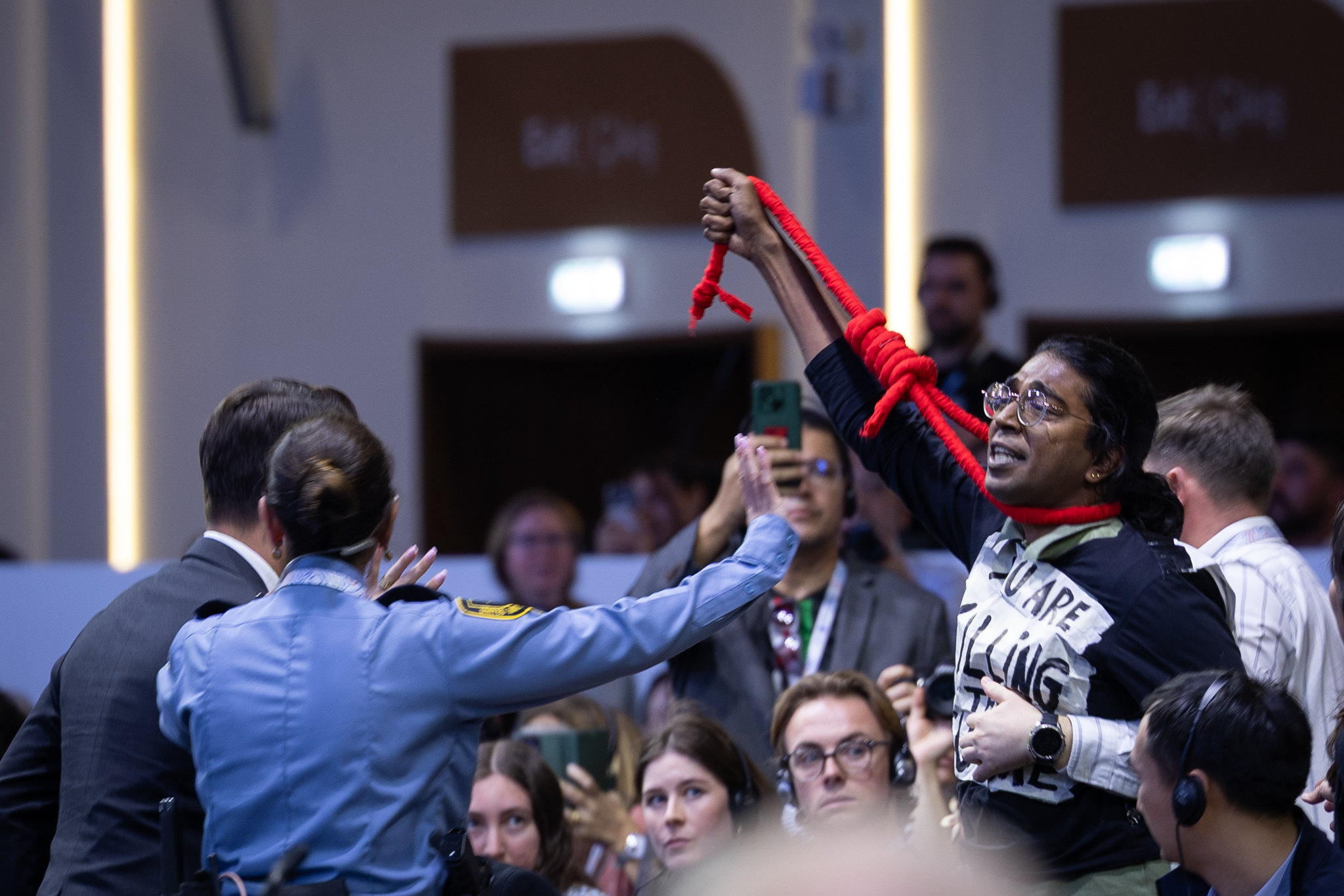
Friday night’s plenary did offer a few moments of drama. An activist was ushered out of the room by security after holding a rope around his neck and shouting “you keep doing nothing, nothing at all” and “you are killing the future, just kill me now” to a smattering of applause.
Panama’s environment minister Juan Carlos Navarro urged Kurum to ensure full respect of the rules of procedure when gavelling decisions through this weekend. Given he has led threats to object to the cover text if it is not ambitious enough, this sounded like a warning to Kurum not to ignore objections, as previous COP presidents have been accused of doing.
Another significant development on Friday night was a joint statement from Australia and China which, among other things, expressed China’s backing for the 35×35 electrification goal. More on that here.
The post COP31 Bulletin Day 12: ‘Don’t ignore us,’ Panama warns as COP31 runs into overtime appeared first on Climate Home News.
COP31 Bulletin Day 12: ‘Don’t ignore us,’ Panama warns as COP31 runs into overtime



-
Climate Change1 year ago
Guest post: Why China is still building new coal – and when it might stop
-
Greenhouse Gases1 year ago
Guest post: Why China is still building new coal – and when it might stop
-

 Renewable Energy1 year ago
Sending Progressive Philanthropist George Soros to Prison?
-
Greenhouse Gases1 year ago
嘉宾来稿:探究火山喷发如何影响气候预测
-

 Climate Change2 years ago
Analysis: China’s CO2 falls 1% in Q2 2024 in first quarterly drop since Covid-19
-

 Climate Change1 year ago
嘉宾来稿:探究火山喷发如何影响气候预测
-
 Renewable Energy5 months ago
Send a Bible to a Starving Child
-

