
Apple stock (AAPL) has been on an upward trend, fueled by a mix of strategic investments, strong earnings, and a push toward domestic manufacturing. Investors are taking notice as the tech giant positions itself to reduce tariff risks, strengthen its supply chain, and meet rising demand for its products—all while staying true to its sustainability goals.
The Rise of AAPL Stock: Why and How
Several factors are driving the recent rally in Apple (AAPL) shares. The company’s $100 billion expansion of its U.S. manufacturing program, record-breaking quarterly results, partnerships with domestic suppliers, and commitment to recycled materials have combined to create strong investor confidence.
On top of that, bullish technical signals and potential AI collaborations are adding to the market enthusiasm.
“As of August 14, 2025, Apple Inc. (AAPL) is trading at $233.33 USD on the NASDAQ exchange, reflecting a 1.6% increase (+$3.68) from the previous close.”

Let’s dive deeper into this:
$100 Billion Boost to American Manufacturing
Apple recently pledged an additional $100 billion to expand its U.S. manufacturing footprint, raising its total four-year American Manufacturing Program commitment to $600 billion. This plan includes opening new plants, offering supplier grants, and forming partnerships for key components like glass and chips.
The move is seen as a direct response to trade tensions with Washington, particularly past threats from President Donald Trump to impose a 25% tariff if iPhones weren’t made in the U.S. By increasing domestic production, Apple is improving its standing with policymakers and reducing the risk of costly import tariffs.
Key Partnerships Strengthen U.S. Supply Chain
As per media reports, the manufacturing expansion covers a broad network of U.S.-based suppliers and partners:
- Corning (GLW): Expanding smartphone glass production in Kentucky.
- Coherent (COHR): Producing VCSEL lasers for Face ID in Texas.
- TSMC, GlobalFoundries (GFS), and Texas Instruments (TXN): Collaborating on semiconductor production across Arizona, New York, Utah, and Texas.
- GlobalFoundries: Manufacturing wireless charging tech in New York.
Apple says this reshoring effort will enable an “end-to-end” chipmaking process in the U.S., from wafers to finished semiconductors. Over 19 billion chips for Apple products will be made domestically this year.
Rare Earth Partnership with MP Materials
Apple is also investing $500 million in MP Materials (NYSE: MP) to secure a long-term supply of rare earth magnets made entirely from recycled materials. These will be processed and manufactured in the U.S., supporting both supply chain resilience and Apple’s environmental commitments.
Apple’s Strong Earnings Fuel Investor Optimism
Apple’s latest earnings report added fuel to the rally. The company posted record June-quarter revenue of $94 billion—up 10% year over year. Product sales hit $66.6 billion, led by strong demand for the new iPhone 16 lineup and Mac computers.
Services revenue rose 13% to $27.4 billion, showing the company’s ability to diversify beyond hardware and generate steady, high-margin income.
- MORE DETAILS: Apple (AAPL Stock) Rings Up $94B Q3 Win Fueled by iPhones, AI Push, and Climate Smarts
Sustainability at the Core of Apple Products
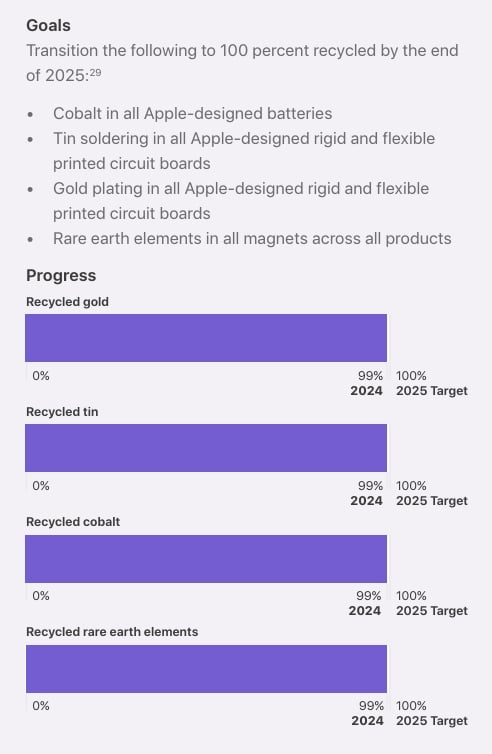
Apple’s stock story also has a purpose. As per its latest sustainability report, in 2024, 24% of all product materials came from recycled or renewable sources, including:
- 99% recycled rare earth elements in magnets
- 99% recycled cobalt in batteries
- 100% recycled aluminum in many cases
Apple avoided 41 million metric tons of greenhouse gas emissions in 2024—equal to taking 9 million cars off the road. The company aims for a 75% emissions reduction from 2015 levels.
AI Partnerships Could Add Another Growth Driver
Reports suggest Apple is exploring partnerships with OpenAI and Anthropic to enhance Siri. If successful, these deals could strengthen Apple’s position in the fast-growing AI market.
Can U.S. Manufacturing Plans Keep the Rally Going?
Apple’s reshoring strategy could sustain momentum over the medium term. By resonating with Trump’s “America First” policies and reducing reliance on overseas suppliers, the company is lowering regulatory risks and earning political goodwill.
Nonetheless, challenges remain, but the long-term benefits could outweigh them by securing a more resilient supply chain.
From this analysis, it’s evident that Apple’s recent gains reflect a powerful combination of U.S. manufacturing investments, record earnings, sustainability leadership, and potential AI growth. By strategically aligning with domestic policy and building a stronger supply chain, the company is reducing uncertainty, which is one of the biggest drivers of investor confidence.
The post Apple: $94 Billion Record Earnings and the Breakthrough Climate Solutions Fueling Growth appeared first on Carbon Credits.
Carbon Footprint
Insetting vs Offsetting: Which Actually Counts Toward Your Scope 3 Targets
The accounting differences that decide whether your nature investment shows up in inventory, in BVCM, or nowhere at all.
The question reaches a procurement team about three weeks before the next sustainability committee meeting. Someone has read about insetting. Someone else has just signed off on an offset purchase. The CSO wants to know if the two are interchangeable. The answer is no, and the GHG Protocol Land Sector and Removals Standard is the reason why.
This article walks through what each term means at audit-grade specificity, what the standards actually say about how each gets counted, and how to decide which tool fits which target. The insetting vs offsetting question is one of the most-searched in corporate climate strategy, and one of the most poorly answered. By the end of this piece, you should be able to brief a committee on the difference without notes.
The two definitions, in plain English
Offsetting means buying carbon credits generated outside your value chain and retiring them against your residual emissions. The reduction happens somewhere else, financed by you, and the credit is the receipt.
Insetting means investing in emission reductions or removals inside your own value chain, typically with suppliers, where the reduction is directly linked to the products and services you buy. The reduction happens inside the boundary of your Scope 3 inventory, and the accounting treatment is fundamentally different.
The shorthand from the University of Oxford’s Nature-based Insetting Initiative is useful: insetting is what you do with the supply chain you have; offsetting is what you do with the supply chain you do not have.
What the GHG Protocol Land Sector Standard actually says
The GHG Protocol Land Sector and Removals Standard, finalised in 2024 after a multi-year pilot, sets the rules for how land-based emission reductions and removals enter corporate inventories. The Standard distinguishes between inventory accounting (Scope 1, 2, and 3) and project or intervention accounting (a separate methodology for crediting).
For insetting, the practical implication is that supplier-level interventions, when properly measured and attributed, can reduce your Scope 3 category 1 (purchased goods and services) emissions in your inventory. The reduction is not a credit retired against the inventory; it is a lower inventory number, period.
For offsetting, the credit is retired separately. It can be reported as a contribution toward a net-zero claim under the SBTi Beyond Value Chain Mitigation framework or as part of a VCMI Carbon Integrity claim, but it does not lower the inventory number.
A practical consequence: if your Science Based Target requires a 50% absolute reduction in Scope 3 emissions by 2030, insetting moves you toward the target. Offsetting does not. This single point of difference reshapes the procurement decision.
When insetting counts toward Scope 3 (and when it does not)
Insetting counts toward Scope 3 only when several conditions are met:
- The intervention must occur with an entity in your value chain.
- The emissions reduction or removal must be measured against a defensible baseline.
- The reduction must be attributed to your share of that supplier’s output, not double-counted with other buyers.
- It must follow the inventory accounting rules in the GHG Protocol Land Sector Standard, not the project accounting rules used to generate credits.
The most common failure mode is double counting. If your supplier sells the same reduction as a credit on the voluntary market and also reports it to you as a Scope 3 reduction, the math breaks. The Standard requires you to address this risk, typically by purchasing and retiring the supplier-issued credit as part of your inventory or by contractual provisions that prevent the supplier from selling the reduction twice.
When insetting does not count toward Scope 3: when the intervention sits with a supplier you do not buy from, when the baseline is not defensible, when the attribution is unclear, or when the documentation does not survive audit. Those cases default to Beyond Value Chain Mitigation, which is still useful but operates on a different ledger.
The procurement and supplier engagement question
Insetting is harder than offsetting. That is the unfashionable truth most buyers eventually confront. Offsetting is a transaction; insetting is a relationship.
To run an insetting program, you need supplier mapping precise enough to know which farms or facilities sit at which Scope 3 boundary. You need an engagement model that gets suppliers to participate, which usually requires multi-year commitments and shared economics. You need an MRV architecture that measures the right things and produces audit-ready documentation. And you need a contractual structure that prevents double counting and protects both sides.
The trade-off you receive in return is significant. Reductions count against your inventory rather than your residual. Supplier relationships deepen, which protects sourcing continuity. Yield and quality improvements often follow regenerative interventions, which reduces your input cost over time. And the regulatory file, under CSRD, CSDDD, EUDR, and the SBTi FLAG Guidance, is materially stronger.
Choosing the right tool for the right target
A practical decision rule. If your target is a science-based Scope 3 reduction and you operate in a FLAG sector or source FLAG commodities, insetting is the structurally correct tool. If your target is a net-zero claim that includes neutralising hard-to-abate residual emissions outside your value chain, BVCM via high-integrity offsets is the structurally correct tool. Most companies with material Scope 3 exposure need both, in different proportions, sequenced over time.
The sequencing matters. Insetting takes longer to stand up but produces a permanent reduction in the inventory. Offsetting can be transacted faster but does not change the inventory and now sits under tighter claim restrictions. Treat them as complementary tools with different jobs, not as substitutes. The Accountability Framework Initiative and the IUCN Global Standard for Nature-based Solutions both provide useful guardrails for the insetting side, with biodiversity, human rights, and benefit-sharing requirements that go beyond carbon math.
If you are mapping a Scope 3 reduction roadmap and need to scope which interventions count toward your inventory versus which sit in Beyond Value Chain Mitigation, the carbon and sustainability experts at Carbon Credit Capital can help you structure a nature-based supply chain investment program that fits your FLAG exposure, your target architecture, and your audit horizon. Schedule a consultation.
Carbon Footprint
Net zero needs nature: a carbon credit guide
Net zero is often described as a balancing act: cut what you can, account for the rest, and reach zero on the ledger. That framing is useful, but it leaves something out. It treats every tonne of carbon as interchangeable and every route to zero as equally sound, while the science tells a more specific story.
![]()
Carbon Footprint
Deforestation in Malawi: causes and solutions
Malawi has lost a striking share of its forests over the past three decades. Woodlands that once covered well over a third of the country now cover less than a quarter, and the pressure on what remains is increasing. Behind those figures sit two practical questions: what is driving the loss, and what reverses it?
![]()
-
Climate Change1 year ago
Guest post: Why China is still building new coal – and when it might stop
-
Greenhouse Gases1 year ago
Guest post: Why China is still building new coal – and when it might stop
-
Greenhouse Gases2 years ago嘉宾来稿:满足中国增长的用电需求 光伏加储能“比新建煤电更实惠”
-

Climate Change2 years ago嘉宾来稿:满足中国增长的用电需求 光伏加储能“比新建煤电更实惠”
-
Climate Change2 years ago
Bill Discounting Climate Change in Florida’s Energy Policy Awaits DeSantis’ Approval
-
Renewable Energy10 months agoSending Progressive Philanthropist George Soros to Prison?
-
Greenhouse Gases1 year ago
嘉宾来稿:探究火山喷发如何影响气候预测
-
Carbon Footprint2 years agoUS SEC’s Climate Disclosure Rules Spur Renewed Interest in Carbon Credits

