

The rapid global rollout of artificial intelligence (AI) data centers is set to add new pressure to the already strained copper market. A recent BloombergNEF (BNEF) report warns that:
- Copper supply gap could swell to 6 million tonnes by 2035 if demand keeps rising at this pace.
- Copper demand from AI-powered facilities will average about 400,000 tonnes a year over the next decade, peaking at 572,000 tonnes in 2028.
- By 2035, the cumulative copper locked into data centers could surpass 4.3 million tonnes.
Furthermore, this rise comes as other copper-hungry industries, like power transmission and wind energy, are also using more of the metal. BNEF expects their copper demand to almost double by 2035. Together, they are putting heavy pressure on a market already held back by years of low investment in new mines.
Why AI Data Centers Are So Copper-Intensive?
Copper may account for up to 6% of a data center’s capital costs, but its role is essential. The metal’s unmatched electrical conductivity ensures efficient power transmission, while its high thermal conductivity supports heat exchangers vital for cooling AI-intensive servers. That’s why cables, busbars, power distribution strips, connectors, transformers, and cooling systems all rely heavily on copper.
Its ductility and malleability also allow it to be shaped into compact connectors and other components critical to space-optimized server rooms. From high-capacity cabling to switchgear and transformers, copper is woven into every layer of a data center’s infrastructure.
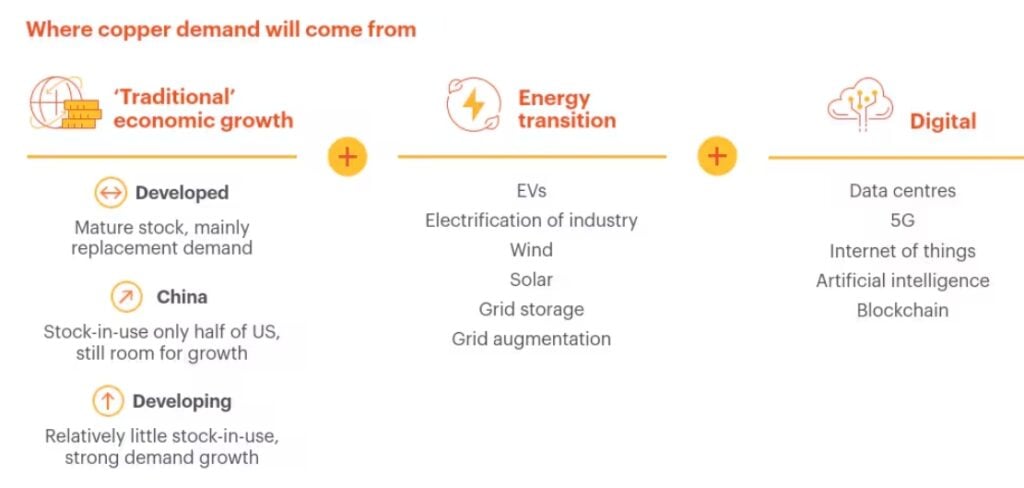
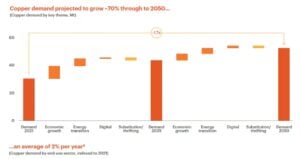
Mining giant BHP predicts:
- Copper demand will rise 72% by 2050 — driven largely by AI infrastructure and the clean energy transition.
- By 2050, it could hit 3 million tonnes per year. That would lift the sector’s share of total global copper consumption from about 1% today to as much as 7% by mid-century.
Case studies illustrate the scale: Microsoft’s $500 million Chicago data center, completed in 2009, used about 2,177 tonnes of copper — roughly 27 tonnes per megawatt of power capacity. With AI-ready racks increasing power needs, the copper footprint per site is growing.
Growth Projections Paint a Steep Climb
Similarly, a Macquarie analysis estimates that by 2030, data centers could consume between 330,000 and 420,000 tonnes of copper annually, with a midpoint of 375,000 tonnes. This projection factors in recent mega-project announcements from Microsoft, Meta, and the $500 billion Stargate Project to build OpenAI infrastructure in the U.S.
It also accounts for a forecast jump in required data center power capacity from 77 gigawatts in 2023 to 334 GW in 2030.
- Goldman Sachs says AI will drive a 165% increase in data center power demand by 2030.
- This means this massive leap will require extensive copper use for both on-site systems and the wider electrical grid.
The Grid Connection Factor
Moving on comes the grid connection factor. As Colin Hamilton of BMO Capital Markets notes, the copper demand story isn’t just about what’s inside the data center. He says, “Data centers themselves are becoming incrementally less copper-intensive, but getting the electricity to them, that is copper-intensive.”
That means transmission lines, substations, and grid upgrades, all of which use large volumes of copper. In the era of AI, hyperscale campuses will need multiple redundant grid connections to ensure an uninterrupted power supply, further boosting copper demand.
Additionally, the scale of investment is staggering. North American data center infrastructure spending is expected to rise from $33 billion in 2020 to $70 billion by 2030 and $185 billion by 2040. Each new AI-ready site locks in thousands of tonnes of copper for decades.
What’s Driving the Copper Market Now?
On August 1, the U.S. imposed a 50% tariff on copper imports to boost domestic production. This policy could benefit major U.S.-based miners like Freeport-McMoRan and Rio Tinto, but some industry players warn it could cause short-term disruptions. The news hit just as Goldman Sachs lowered its 2025 copper price forecast on weaker Chinese demand.
However, following the BNEF report on future shortages, copper stocks like Freeport-McMoRan and the Global X Copper Miners ETF fell as investors weighed the combined effect of tariffs and market forecasts.
Analysts still expect a long-term crunch, projecting a 6 million-tonne shortfall by 2035 as AI data centers and clean energy projects drive demand higher.
Copper Price Volatility and Shocks
Copper prices plunged more than 20% after the tariff announcement, partly due to speculative trading, arbitrage, and stockpiling. In short, the “tariff trade” quickly unraveled in the U.S. market.
BNEF believes this is temporary, forecasting a price peak of $13,500 per tonne in 2028 as demand outpaces supply. By 2035, global output could reach just 29 million tonnes, well below the 35 million tonnes needed.
J.P. Morgan takes a cautious view, predicting prices could dip toward $9,100 per tonne in Q3 before recovering slightly to around $9,350 in Q4.

AI Turns Copper into a Bottleneck
AI-ready data centers are changing the copper demand story. Unlike electric vehicles, which add demand gradually, these facilities need massive amounts of copper all at once — from utility-scale wiring and high-voltage tie-ins to dense cabling inside the building.
With mine development taking more than a decade, the AI-driven copper crunch could arrive sooner than expected. For miners, utilities, and tech giants, this collision of digital expansion and material scarcity is set to be one of the biggest industrial challenges of the next 20 years.
The post Data Centers’ Copper Hunger: How AI is Driving a Looming Supply Crunch? appeared first on Carbon Credits.

EU carbon credit claims changed on 27 September 2026, the day the Directive (EU) 2024/825 began to apply across the European Union. The change is narrow. It changes how a company can talk about the credits it buys. A product can no longer be called neutral on the strength of compensation alone; however, every specific, evidenced statement about what a company measured, reduced, and funded stays fully available.

The post Promoting Improved Cooking Practices in Nigeria appeared first on Terrapass.



-
Climate Change1 year ago
Guest post: Why China is still building new coal – and when it might stop
-

 Greenhouse Gases2 years ago
嘉宾来稿:满足中国增长的用电需求 光伏加储能“比新建煤电更实惠”
-
Greenhouse Gases1 year ago
Guest post: Why China is still building new coal – and when it might stop
-

 Climate Change2 years ago
嘉宾来稿:满足中国增长的用电需求 光伏加储能“比新建煤电更实惠”
-

 Renewable Energy12 months ago
Sending Progressive Philanthropist George Soros to Prison?
-
Climate Change2 years ago
Bill Discounting Climate Change in Florida’s Energy Policy Awaits DeSantis’ Approval
-
Greenhouse Gases1 year ago
嘉宾来稿:探究火山喷发如何影响气候预测
-

 Climate Change2 years ago
Analysis: China’s CO2 falls 1% in Q2 2024 in first quarterly drop since Covid-19