

Welcome to Carbon Brief’s DeBriefed.
An essential guide to the week’s key developments relating to climate change.
This week
Earth eyes 2C
TEMPERATURE WARMING: Global temperatures could hit nearly 2C above pre-industrial levels for the first time in the next five years, according to new data from the UN World Meteorological Organization (WMO) covered by the Financial Times. The outlet noted that this would not represent a breach of the Paris Agreement target of keeping warming below 2C, as this threshold is typically measured over at least two decades. However, it added that 2C of warming would result in a “fall in crop yields” and more than a third of the world’s population being exposed to extreme heat.
WILDFIRE EMERGENCY: Wildfires in Canada have forced thousands of people to flee their homes, CBC News reported. The government of Manitoba declared a state of emergency after evacuating 17,000 people and neighbouring province Saskatchewan followed suit a day later, CBC News said. Manitoba premier Wab Kinew said the prevalence of fire in “every region” was a “sign of a changing climate that we are going to have to adapt to”, according to Le Monde. BBC News noted that “scientists have linked worsening wildfire seasons to climate change”.
MONSOON IN MAY: Monsoon rains hit the coast of India’s southernmost state of Kerala eight days early, marking the earliest arrival of the rainy season in 16 years, Reuters reported. Just two days later, the rains reached Mumbai – the city’s earliest monsoon in 75 years, according to Business Standard. India Today said human-caused climate change and “natural climatic systems” played a role.
ALPINE DISASTER: A landslide of ice, mud and rocks triggered by the collapse of a glacier has buried a large part of the Swiss village of Blatten, Swissinfo reported. Climate scientist Christian Huggel told Reuters that climate change had “likely played a part in the deluge”, given that the loss of permafrost can “negatively affect the stability of mountain rock”. The Swiss army has been deployed to find a missing person, Reuters said.
Around the world
- INDONESIA UN-QUITS COAL: Indonesia set out plans to build new coal plants in its power supply plan for 2025-2034, “backtrack[ing]” on its previous pledge to gradually phase out coal assets, the Straits Times said.
- NIXED: Inside Climate News covered analysis which found that $14bn of clean energy investment has been cancelled so far this year in the US. The non-profit group behind the figures – Environmental Entrepreneurs – said this was an “ominous sign” as the Senate gears up to vote on a bill that would, if passed in its current form, gut Biden-era clean energy tax credits.
- ‘CLIMATE SETBACK’: Bloomberg reported that Australia has given preliminary approval to extend the life of its biggest and oldest liquefied natural gas (LNG) plant from 2030 to 2070.
- THE NEW SCEPTICS: COP30 president-designate André Corrêa do Lago told the Guardian that attempts to discredit climate policies are the “new kind of opposition to climate action”. He said: “It’s not a scientific denial, it’s an economic denial.”
- FARAGE’S ‘FANTASY’: Meanwhile, the UK’s hard-right Reform party led by Nigel Farage has been accused of espousing “fantasy economics” after falsely claiming £225bn could be saved by scrapping net-zero projects, according to the Evening Standard.
- GREEN TOURIST LEVY: Hawaii has introduced a tax on hotel rooms and holiday rentals which will raise money for environmental protection and defences against natural disasters, the Guardian reported.
18 football pitches
The equivalent amount of primary tropical forest that was lost every minute in 2024, according to data from the World Resources Institute.
Latest climate research
- Researchers in Nature Climate Change looked at how floods drove migration between counties in the US from 2006-19, finding young, educated people were more likely to leave following a disaster, while older, unemployed people were more likely to move into an affected area.
- Sea ice strength and “pressure” along two major Arctic shipping routes will decline “substantially” over the next two decades under strong warming, according to findings in Geophysical Research Letters.
- A study in Nature revealed that changes to concentrations of air pollutants have contributed in recent decades to an increase in the global “methane sink”, the amount of methane that is removed from the atmosphere and thus unable to drive up temperatures.
(For more, see Carbon Brief’s in-depth daily summaries of the top climate news stories on Tuesday, Wednesday, Thursday and Friday.)
Captured
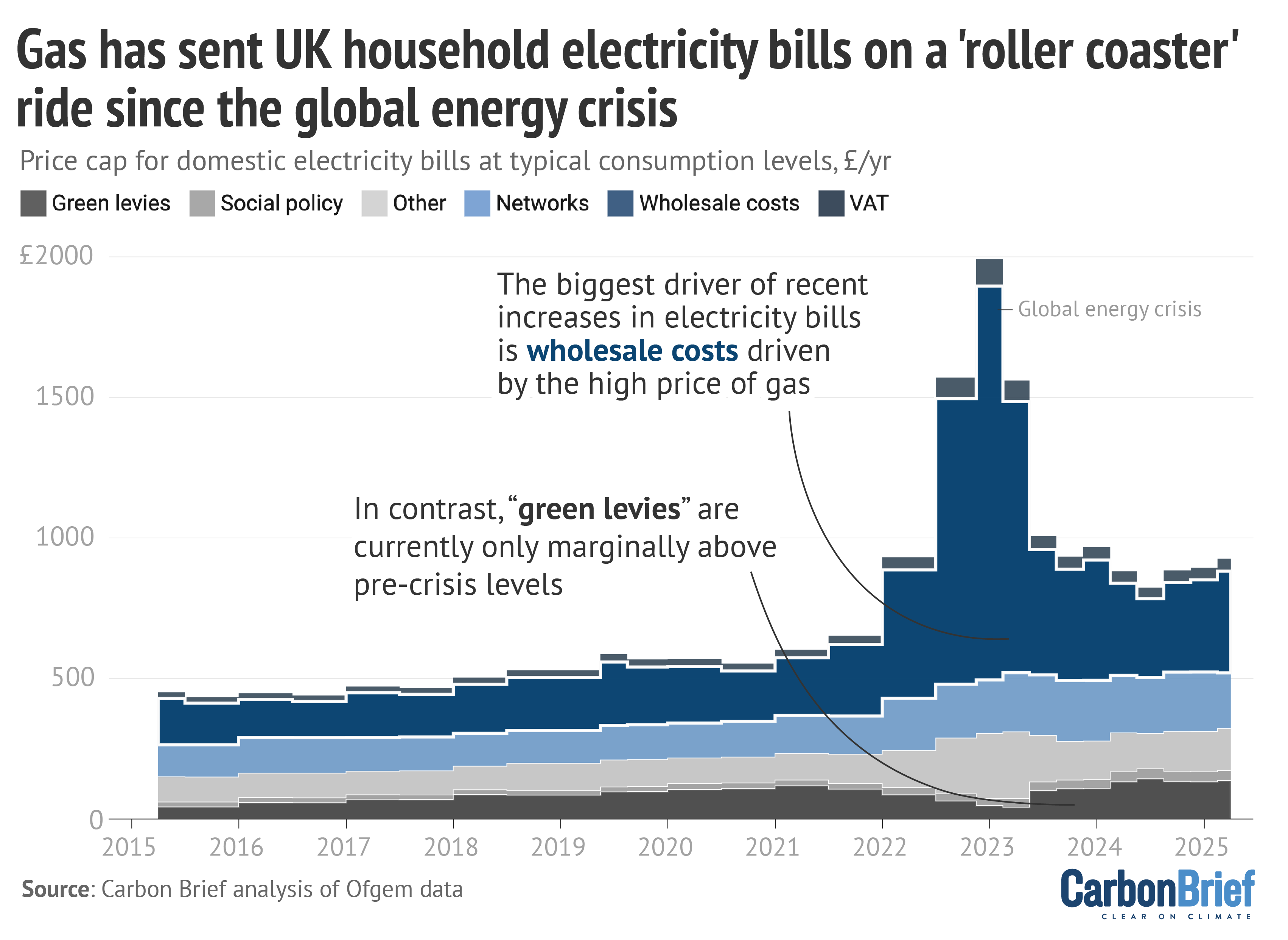
A new analysis by Carbon Brief of data from UK energy regulator Ofgem showed how the biggest driver of recent increases in electricity bills in the UK has been wholesale electricity prices – which in the UK are set almost exclusively by wholesale gas prices. In contrast, “green levies” – costs added to bills in order to pay for government climate policies – actually fell during the height of the gas price spike, as the dark grey area of the chart shows. This runs counter to opposition politicians’ claims that the UK’s high electricity prices are caused by its target for net-zero emissions by 2050 and green levies.
Spotlight
Livestreaming for climate science
This week, Carbon Brief speaks to US climate scientists taking part in a 100-hour livestream aimed at raising awareness of their work and the risks they face.
Marathon livestreams are typically the preserve of video gamers, sex workers and chess stars – not climate scientists. But unusual times call for unusual measures.
Hundreds of climate scientists and meteorologists from across the US are this week participating in a 100-hour livestream, which aims to raise awareness of their work as the government gears up for a major programme of cuts to federal science agencies.
The broadcast runs day and night until Sunday afternoon on YouTube, with each speaker advised to dedicate their 30-45 minute session to presenting their research in layperson’s terms – with a mention of how it is or could be impacted by federal cuts to science.
The online event comes after the Trump administration set out plans to halve NASA’s science budget and shrink the National Oceanic and Atmospheric Administration (NOAA’s) funding by more than a quarter.
The livestream will be rolling while NASA’s climate and space monitoring lab, the Goddard Institute for Space Studies, is moving out of its New York building on 31 May, after the federal government abruptly terminated the space agency’s lease.
(The White House has also cancelled funding to the body that produces the country’s National Climate Assessment, blocked US scientists from attending Intergovernmental Panel for Climate Change meetings and laid off hundreds of workers at the agency responsible for hurricane preparations.)
Speaking to Carbon Brief in a personal capacity, climate scientist and keynote speaker Dr Kate Marvel described the livestream event as a “fire hose of public engagement”. She added:
“It is scientists making the case to the people we work for. We work for the American people because we receive taxpayer dollars. It is really important for us to share our results, to explain to people why what we do is important and to help them see themselves in what we do.”
‘Climate science affects us all’
At 1:30am California time – 4:30am New York time – on Thursday morning, more than 750 people were tuned in to the livestream, and the comment section was lively.
Some viewers shared words of encouragement – “not from the continent of America but still here to support!!! climate science affects us all!!!!” and “beautiful visualisations!”
Others focused on the science: “Look up the relationship between the Salton Sea and earthquakes – fascinating findings”, “does this mean misaligned storms have two different impacts on each level?” and “albedo effect [fire emoji]”.
Livestream organiser Dr Margaret Duffy, who studies cloud dynamics at the Massachusetts Institute of Technology, said the event’s “long format” is designed to underscore the “widespread” nature of the cuts. She told Carbon Brief:
“[It will] make clear that it’s not one or two programmes that are being cut, [nor] one or two researchers that are losing their funding. Researcher after researcher after researcher will explain what they do, and then make the connection to the cuts and what is happening to them.”
The audience is being pointed to materials to help them contact their political representatives about cuts to climate and weather research – but this is not an obligation, Duffy said, explaining that “at a very basic level, we just want to share with the public what it is that we do”.
Climate scientist Marvel commended the livestream organisers for “stepping up” amid much-justified “flailing” and “panic”, adding:
“We are not in normal times. There is a lot of fear and there’s a lot of reasons to be afraid. I think trouble may be coming for us – but we just need to make sure that we get in good trouble. [In other words] you shake things up, you maybe attract negative attention. Maybe it’s scary and maybe there are consequences. But ultimately, you are always going to be happy to have done the right thing.”
Watch, read, listen
WATER CRISIS: Atmos Earth looked at how changing rainfall patterns are impacting the lives of Palestinians already denied access to water.
FRAGILE TEXTS: In a photo essay, Al Jazeera looked at how encroaching desert sands are threatening centuries-old manuscripts stored in Oualata, Mauritania.
LURCHING RIGHT: For Drilled, Amy Westervelt unpacked the structural issues in the US media hurting climate coverage.
Coming up
- 1 June: Round two of Poland’s presidential election
- 2-4 June: 8th Copernicus Climate Change Service general assembly, Valencia, Spain
- 4-7 June:Right here, right now global climate summit, Oxford, UK
Pick of the jobs
- Carbon Brief, summer internship | Salary: London living wage (£13.85 an hour). Location: London (hybrid)
- British Antarctic Survey, space weather scientist | Salary: £41,344-£45,479. Location: Cambridge, UK
- UN Development Programme,energy finance specialist | Salary: Unknown. Location: Abidjan, Cote d’Ivoire
DeBriefed is edited by Daisy Dunne. Please send any tips or feedback to debriefed@carbonbrief.org.
This is an online version of Carbon Brief’s weekly DeBriefed email newsletter. Subscribe for free here.


The post DeBriefed 30 May 2025: Earth eyes 2C; Why net-zero is not behind UK bill hikes; US academics stage climate science ‘fire hose’ appeared first on Carbon Brief.

When oil and gas shipments stopped flowing through the Strait of Hormuz at the start of the Iran war, Southeast Asian nations were left reeling as the supply crunch laid bare their acute reliance on fossil fuel imports.
As prices soared, governments in the region scrambled to introduce emergency energy-saving measures – from a four-day working week to curbs on air conditioning. Thailand revived decommissioned coal plants while the Philippines, which imports nearly all of its oil, declared a “national energy emergency”.
But the crisis has also prompted renewed resolve to find a long-term solution to their vulnerability at a time when electricity demand is booming to power the region’s growing industry, cooling needs and the mushrooming of energy-hungry data centres.
At the heart of Southeast Asian nations’ response is a longstanding infrastructure project to connect the region’s power grids by 2045 and enable cross-border trading of clean electricity through a network of underground and subsea interconnectors.
-
Southeast Asia’s fragile grids threaten billions in clean energy investment
Renewables developers need reliable electricity infrastructure and stable policies to help the region meet climate goals and surging demand for power -
UN backs push to upgrade grids slowing clean power uptake in Africa and SE Asia
The Global Grids Accelerator will help turn national and regional plans to expand electricity infrastructure into viable projects on the ground -
China keeps Indonesia’s battery dream afloat but future less certain
Chinese capital and technology turned Indonesia into the world’s top nickel supplier, but its dependence on China and the rise of nickel-free batteries could upset its battery ecosystem plans
The plans will allow nations with high renewable energy generation potential to trade surplus power to their neighbours and major demand centres like Singapore, helping to integrate more renewables into the power mix and reduce reliance on fossil fuel imports.
“[It] will give us more energy security,” the Philippines’ energy secretary, Sharon Garin, told a press conference after a meeting of the Association of Southeast Asian Nations’ (ASEAN) energy ministers last week, when they discussed accelerating the delivery of the regional grid as part of measures to respond to the energy crisis.
“The Philippines is rich in solar power, Malaysia is rich in hydropower and Indonesia has geothermal: different countries have different resources. [The ASEAN Power Grid] will optimise the utilisation of renewables to the benefits of each member state,” said Garin.
But turning this decade-old political vision into a reality has been slow, held up by painstaking work to harmonise a patchwork of regulatory and legal frameworks and mobilise the private capital needed to build cross-border infrastructure.
More than $300 billion is needed to expand and modernise the region’s fragile grids to support the projected energy demand increase by 2050. This includes $27 billion required to deliver the cross-border interconnections by 2040, according to the International Energy Agency (IEA).
Every year of delay could cost the region billions of dollars in additional fuel costs and lock in new gas infrastructure for decades to come, according to analysis by global energy think-tank Ember.
The building block for energy security
With electrification high on the agenda of the COP31 climate talks in Türkiye next month, there is growing attention on the need to modernise and expand grid infrastructure to cope with growing electricity use and more renewables in the power mix.
Clean electrification and energy efficiency could deliver about a third of cumulative carbon emission reductions between 2026 and 2050, according to the International Renewable Energy Agency’s World Energy Outlook. But delivering that would require doubling annual global grid investment to $1 trillion between now and 2035.
Last month, the UN launched an initiative to accelerate investment into expanding and modernising grids in Southeast Asia and Africa.
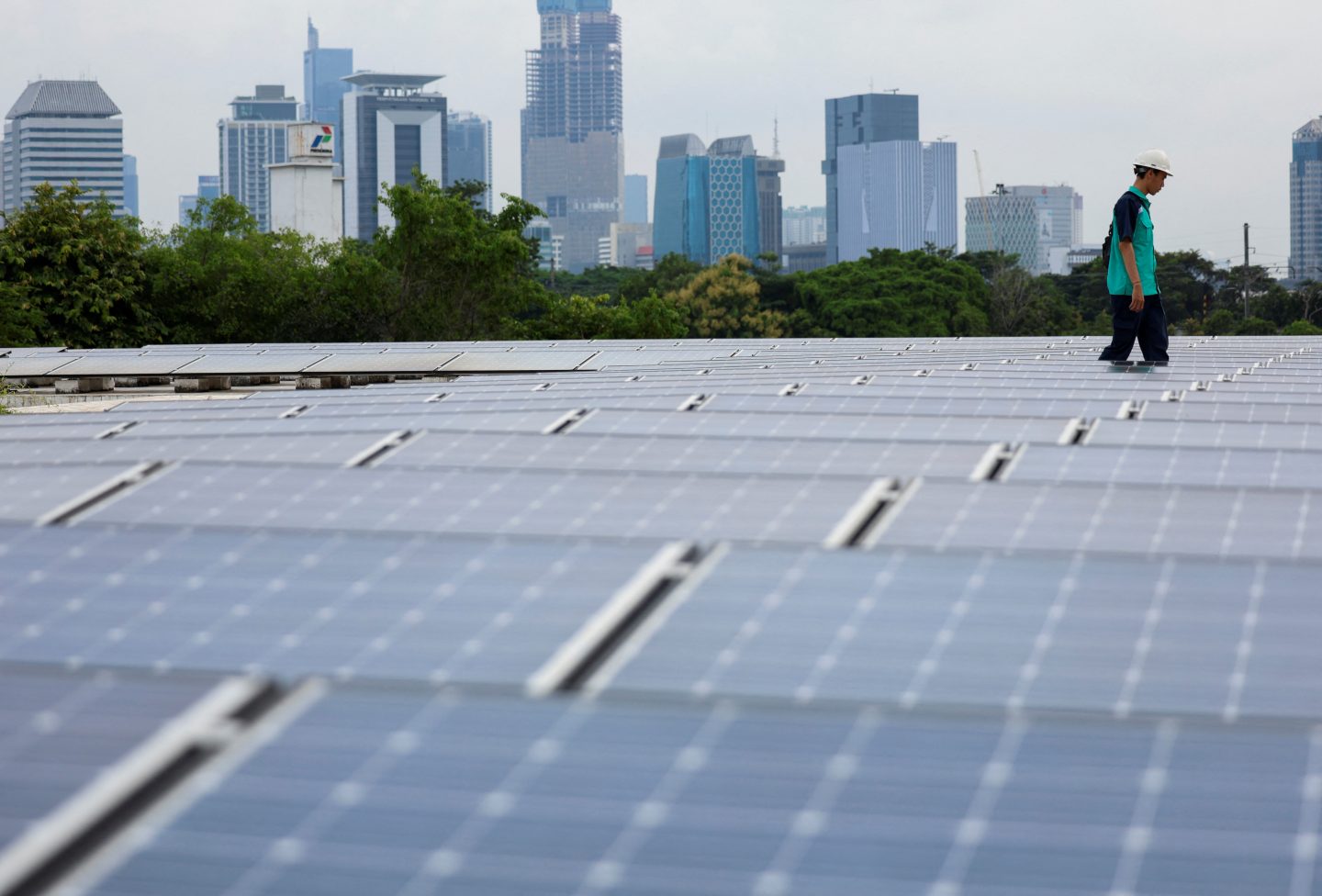
First conceptualised in 1997, the ASEAN Power Grid has gained fresh impetus in recent years as countries turn to renewables to cut their emissions and move away from volatile fossil fuel markets.
Energy supply disruption caused by wars in Ukraine and the Middle East has strengthened the case for regional grid connections. Before this year’s conflict began, the Middle East accounted for 60% of Southeast Asia’s crude oil imports. Competition for fewer, more expensive oil and gas shipments has left Southeast Asia facing a $160 billion energy import bill this year. Based on current policies, this could rise to $400 billion by mid-century.
In the Philippines last week, energy ministers agreed on an enhanced planning framework to deliver the ASEAN Power Grid and made progress on regulatory guidelines.
Garin said ministers were considering accelerating the project’s delivery. “The first study was to connect [by] 2045 – that’s too far,” she said.
A strong business case
The economic benefits of the plan have “captured the political imagination” of leaders in the region, Robert Cooke, grids advocacy lead at the Global Renewables Alliance, told Climate Home News. “The business case is stronger than ever,” he said.
“If countries were to go about building their own separate grids, of course that would be an expensive endeavour. But the discussion around the ASEAN Power Grid includes what costs could we share in building out this grid,” added Tiza Mafira, director of the Indonesia office for the Climate Policy Initiative.
Stronger grids would help the region meet collective targets to increase the share of renewable energy in total primary energy supply from 14% to 30% and in installed power capacity from 34% to 45% by 2030.
Connecting and pooling dispersed renewable resources would also help smooth local power shortages caused by daily and seasonal variations, reducing the need for backup gas plants and battery storage.
The IEA found the ASEAN Power Grid could help unlock some of the 20 terawatts of untapped solar and wind potential across Southeast Asia – an amount around 55 times the region’s current total power capacity.
From lines on a map to shovels in the ground
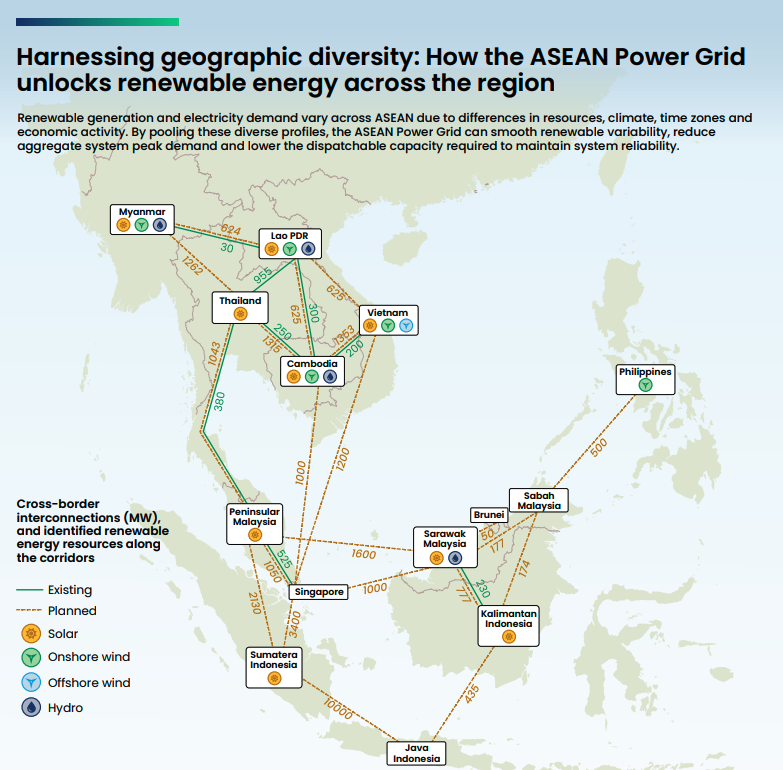
Rather than building a single unified network, the ASEAN Power Grid is developing cross-border links between neighbouring countries and smaller groups of nations.
As of 2025, nine of 18 priority interconnection projects are operational – accounting for around 10 GW of capacity with an additional 13.7 GW planned by 2040.
Source: Ember
A power line channelling up to 200 MW of clean electricity generated from hydropower in Laos to Singapore via Thailand and Malaysia has emerged as a key building block for grid-to-grid trading.
Progress on technical discussions will also help provide the clarity the private sector needs to invest in bankable projects, said Cooke.
In 2025, the Asian Development Bank and the World Bank announced a dedicated funding initiative to support the project.
“The enabling pieces are emerging,” said Monalisa Dimalanta, former chair of the Philippine Energy Regulatory Commission and the National Renewable Energy Board. “But the timelines remain unclear and a 2045 vision cannot answer today’s emergency,” she said.
“A power grid… that exists only on paper will not keep the lights on.”
Singapore: the delivery test
The implications of failing to deliver the ASEAN Power Grid are most acute in Singapore.
Constrained by space, with few renewable energy resources and dependent on gas for more than 90% of its electricity mix, Singapore has emerged as a leading proponent of a regional power grid as it seeks to achieve net-zero emissions by 2050.
To meet its power needs, the city-state aims to import 6 GW of low-carbon electricity by 2035, around one-third of its energy demand – a target which it is set to miss, however.
The plans heavily rely on building interconnectors to import solar power from Indonesia across the South China Sea. Around 40% of the ASEAN Power Grid’s planned interconnections are directed towards Singapore.
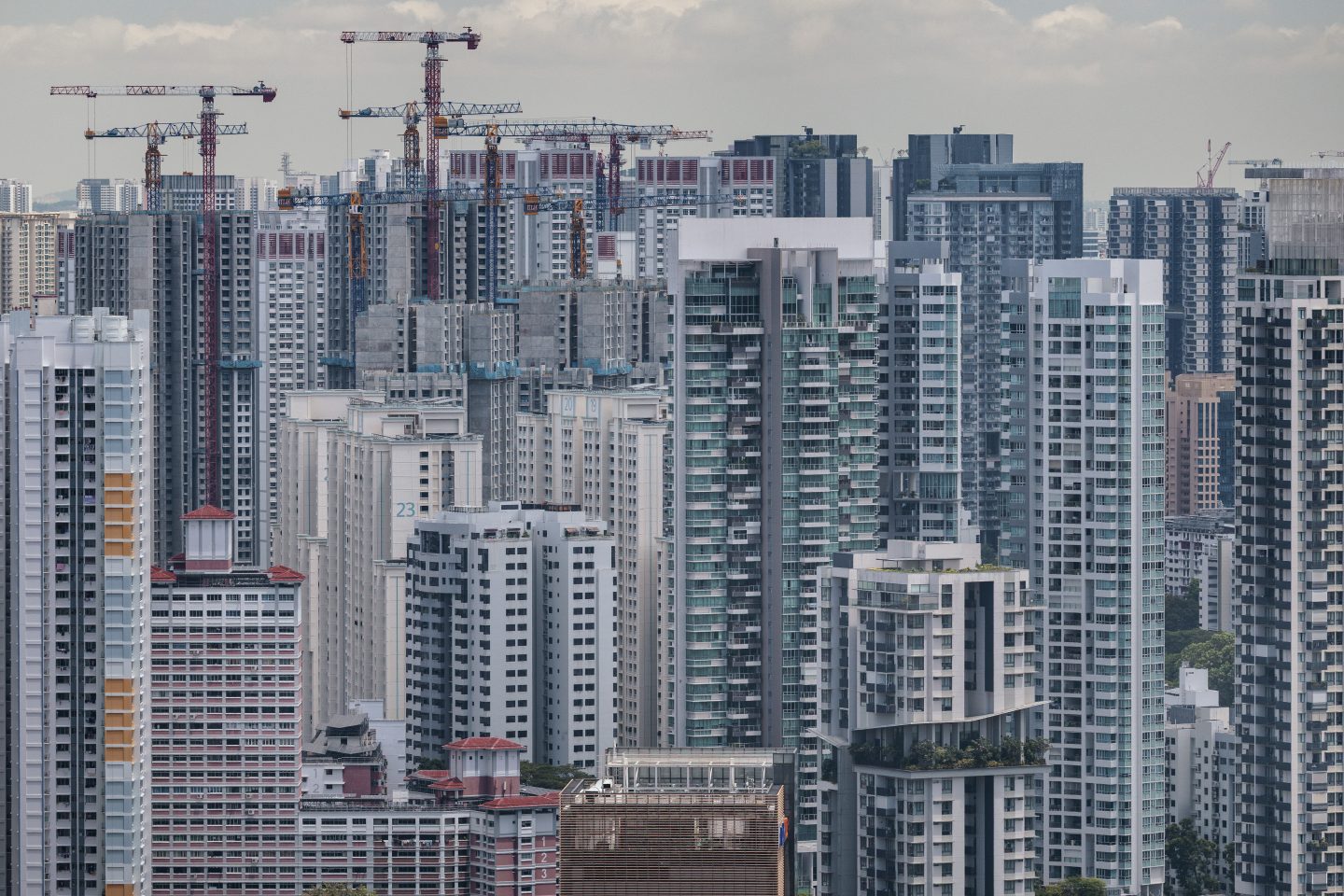
Ember’s analysis found that delivering the planned interconnectors by 2035 could enable renewables to meet nearly half of Singapore’s electricity demand. Delays could drop this to only a fraction of the country’s needs, and risk locking in new gas capacity until t