

In an executive order, Gov. Phil Scott paused enforcement of EV supply mandates. The stated reasons defy the administration’s prior messaging about zero-emission vehicle goals.
Vermont, in a surprising shift, will not enforce electric car and truck supply mandates through the end of calendar year 2026.
Vermont’s Governor Delays Electric Car Mandates, Part of State’s Climate Plan

Sinking land and rising seas could expose more than seven million people living in Africa’s coastal “megacities” to flooding by the middle of the century, according to new research.
The analysis, published in Science Advances, combines satellite data with projections of sea level rise to assess the risk of flooding in 20 of Africa’s most populous coastal cities.
The study finds that, under a moderate warming scenario, an “extreme sea level event” – when sea levels are unusually high due to short-term changes in weather and ocean conditions – could expose a million buildings and $180bn of assets to flooding.
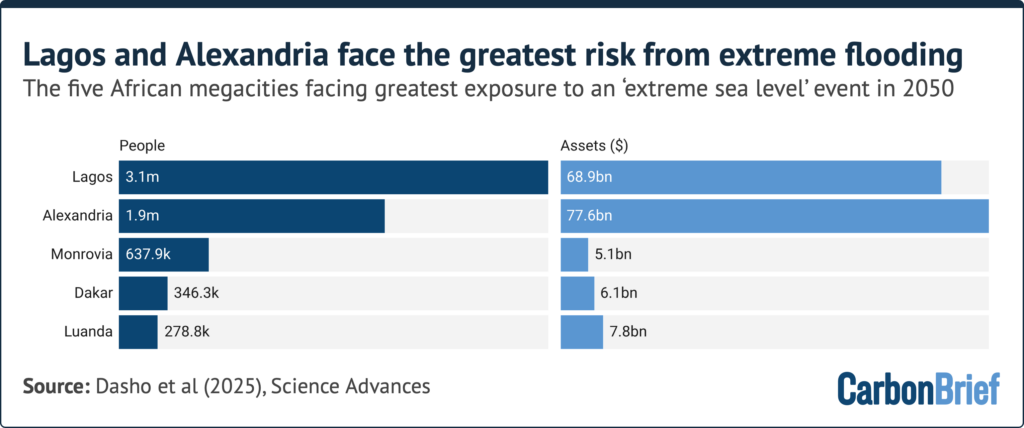
Lagos, the capital of Nigeria, and Alexandria in Egypt are the most vulnerable cities in the analysis.
In these two cities alone, five million people and $150bn in assets could be exposed to flooding and the cities by mid-century.
Human activity, such as pumping groundwater or drilling for fossil fuels, can cause the ground to sink, in a process called “subsidence”.
Seismic or volcanic activity can also drive changes in the height of the land, causing it to either rise or fall. This “vertical land movement” can either alleviate or exacerbate the effects of sea level rise.
The researchers combined more than 4,000 satellite images of Africa’s coastline to determine how quickly different regions are rising or sinking.

They identified Lagos and Alexandria as “subsidence hotspots”, finding that the two cities are sinking at rates of 5.2mm and 6.3mm per year, respectively.
This is “comparable to rates reported for south-east Asian megacities such as Jakarta, Manila and Ho Chi Minh City”, which have recorded “some of the highest subsidence rates yet observed”, according to the study.
The authors combined these estimates with sea level rise projections from the Intergovernmental Panel on Climate Change’s sixth assessment report under three different emissions scenarios, to assess the regional sea level rise across the African coastline.
They used 2020 population data, building footprints and GDP per capita to estimate how much of each city would be exposed to these flooding events over the 21st century, if the city itself stays the same.
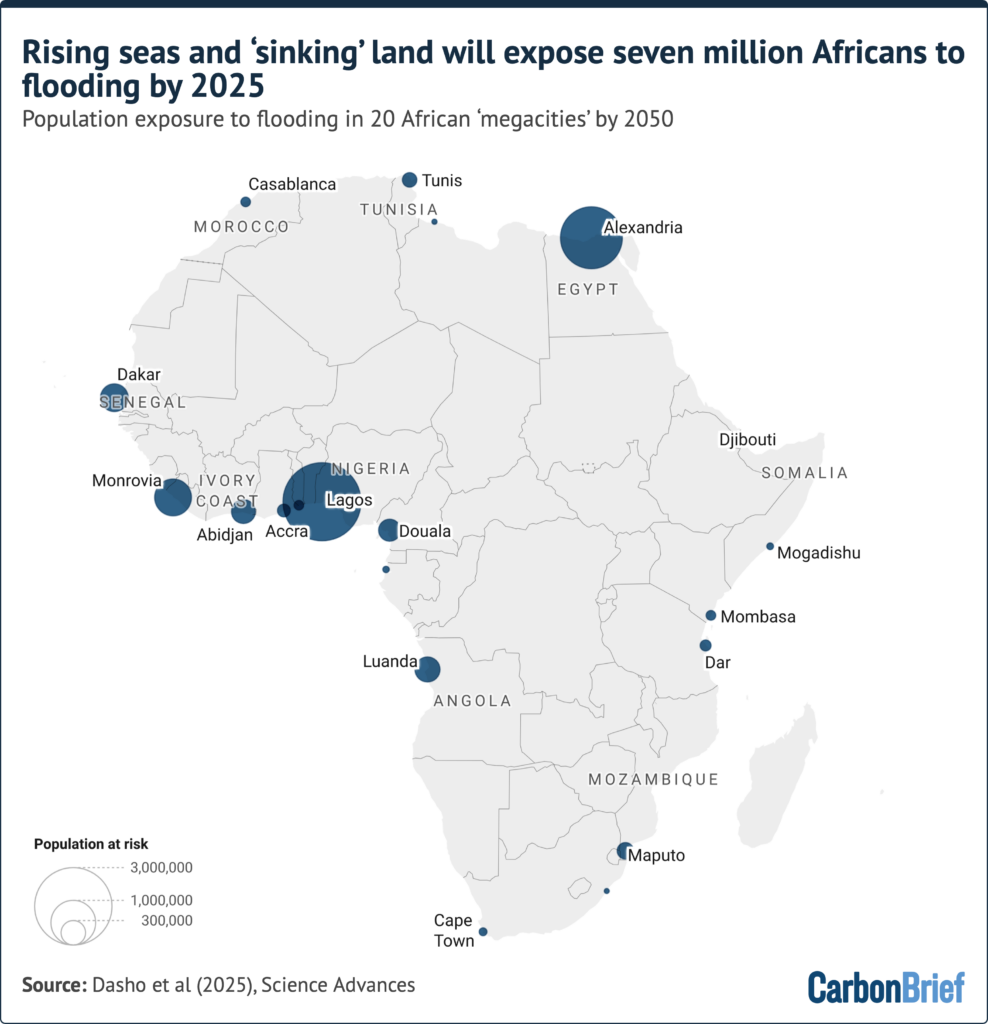
While Lagos and Alexandria are the most vulnerable cities, the research finds that Djibouti City in Djibouti, Mogadishu in Somalia and Tripoli in Libya will face “minimal economic exposure due to their smaller populations and infrastructure bases”.
Lead author Oluwaseyi Dasho, a PhD student at Virginia Tech, tells Carbon Brief that the analysis holds population and city data constant at 2020 levels, so that the authors can isolate the effects of sea level rise and vertical land movement on changing flood exposure.
He notes that if people move away from “threatened areas” over the coming decades, then estimates could be too high. However, if “continued urban growth” causes city populations to increase, the estimates could be too low.
Africa is the world’s fastest-urbanising region, with cities growing at an average rate of 3.5% every year. By 2050, Africa’s urban population is expected to double from 7m to 1.4bn.
He also notes that “the flood model assumes no coastal defenses, so the estimates are a worst-case physical picture”.
Subsidence in African coastal cities has not been consistently monitored in the past, largely due to a lack of local data, the study explains.
The authors say their method of using satellites to assess subsidence and uplift could be used in other “data-scarce coastal regions across the global south”.
Dasho, O., et al (2026), Sinking cities: Latent flood risk in Africa’s coastal megacities, Science Advances, doi:10.1126/sciadv.aeh6538
Related
Q&A: What can – and cannot – be said about global warming’s role in the 2026 Himalayan floods

Revealed: Floods have forced at least 67 closures at NHS hospitals since 2021
Mapped: How climate change affects extreme weather around the world

Analysis: Constituency of Reform’s climate-sceptic Richard Tice gets £55m flood funding
The post ‘Sinking’ African megacities will expose seven million people to flooding by 2050 appeared first on Carbon Brief.
‘Sinking’ African megacities will expose seven million people to flooding by 2050
SYDNEY, Friday 27 November 2026 — In response to the Federal Government today announcing public consultation on a proposed bilateral agreement for approval of native forest logging with the Tasmanian Government, the following statement can be attributed to Adele Chasson, Nature Policy Lead at Greenpeace Australia Pacific:
“The Tasmanian Government has a proven track-record of reckless disregard for the state’s precious native forests, and for decades have given the logging industry the green light to tear through critical habitat of threatened species like swift parrots and Tasmanian devils, threaten water sources, damage cultural heritage and deplete carbon stores.
“The Federal Government has the extraordinary opportunity to implement our new national nature laws to finally protect the incredible Tasmanian wilderness, but that would be undermined by allowing native logging to continue unchecked. The Tasmanian government cannot be trusted to do it themselves.
“The Federal Government must address deep-rooted problems with the Tasmanian system governing forestry, particularly its governance failures and mismanagement of species habitat, and step up protection for forests as it looks to bring forestry under the new nature laws.
“Native forest logging is a national shame and it must end across Australia. Governments need to get on with the urgent job of protecting Australia’s extraordinary forests and wildlife for good.”
-ENDS-
Tas govt ‘cannot be trusted’ in new proposed native forest logging sign-off
Climate Change
“Absurd” environmental green light for Australia’s most polluting AI data centre proposal shows urgent need for moratorium
SYDNEY, Friday 27 November 202