


The lithium market is experiencing a major price decline due to rising supply and weaker demand. In February 2025, the lithium carbonate CIF North Asia price fell below $10,000 per metric ton, dropping 4.5% to $9,550/t. This is the lowest level since February 2021. Analysts expect further cuts in production throughout 2025 to balance the market.
The price drop is mainly due to strong production in Chile and a post-holiday demand slowdown in China. Also, new lithium projects in Mali and Argentina boost global supply. This adds to the downward pressure on prices.
Why Are Lithium Prices Falling?
Several key factors contribute to the ongoing decline in lithium prices, ranging from oversupply to shifting market dynamics and policy changes.
Oversupply Floods the Market
Lithium production has been growing rapidly. In January 2025, Chile’s lithium exports increased by 22.8% month over month, flooding the market with additional supply.
Mali’s new lithium mines, Bougouni and Goulamina, will boost lithium output to 40,528 metric tons of lithium carbonate equivalent (LCE) in 2025. This accounts for 2.7% of the global supply.
Additionally, Argentina’s Ganfeng Lithium Group has started production at the Mariana brine project, adding another 17,420 metric tons of LCE annually. Argentina is now the top producer in the Lithium Triangle. This area includes Bolivia and Chile, which hold some of the richest lithium reserves in the world.
Benchmark Mineral Intelligence shows that the global weighted average price for lithium is dropping, as seen in the chart. This change reflects the increase in supply.

China’s Demand Woes
China, the world’s biggest buyer of lithium, saw a sharp decline in demand in early 2025. The Lunar New Year holidays slowed down industrial work. Many battery makers also postponed their purchases. This contributed to a 1.6% price drop for lithium carbonate in China, bringing it down to 76,100 yuan per metric ton by mid-February.
Additionally, the shift to lithium iron phosphate (LFP) batteries—which require less lithium than traditional nickel-based batteries—is reducing lithium demand. Companies such as Tianqi Lithium and IGO Ltd. have already halted expansion at their lithium hydroxide refineries due to weaker market conditions.
Benchmark Mineral Intelligence said lithium prices soared to $81,375 per tonne in China by December 2022. This spike pushed consumers to look for alternatives, such as LFP batteries.
Policy Uncertainty in the U.S.
The future of North America’s lithium supply chain is unclear, adding to the market pressure. The US Inflation Reduction Act (IRA) of 2022 gave tax credits for lithium from Canada and other allied countries.
Now, it is being reconsidered. The Trump administration also suggested a 10% tariff on energy exports from Canada, like lithium. If enacted, these tariffs could make lithium imports more expensive, limiting investment in the sector.
Currently, only 44.7% of US lithium demand is met by domestic production, rising to 76.4% when including Canadian supply. Any policy changes could significantly impact lithium prices and availability in North America.
Cheaper Lithium Sparks a New EV Price War
The decline in lithium prices has had a notable impact on battery manufacturing costs. The falling prices are closely linked to trends in the plug-in electric vehicle (PEV) and battery electric vehicle (BEV) markets.
Slower-than-expected EV adoption in key regions, driven by reduced government incentives and economic uncertainty, has weakened lithium demand. Automakers are adjusting production forecasts, leading to fluctuations in battery material purchases.

Benchmark Mineral Intelligence reports that cell prices have dropped 73% since 2014. This decline comes from higher production volumes, new technology, and lower raw material costs. These factors let battery makers cut prices.
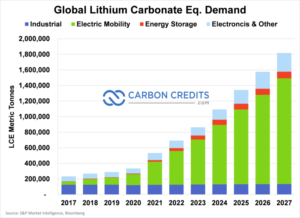
However, lower costs have made EVs cheaper. This could increase demand over time as forecasted below. Yet, the current oversupply of lithium makes it hard for producers to stay profitable.
How the Industry Is Reacting to the Lithium Slump
The prolonged decline in lithium prices has led to significant industry reactions. The industry is responding to the ongoing slump with various strategies aimed at stabilizing the market. Big producers like Albemarle and SQM plan to cut back production. This move aims to stop further price drops.
Some mining companies are delaying new projects, while others are cutting costs to remain profitable in the face of lower revenues. Smaller lithium miners are having a tough time. Those without strong financial support are struggling the most. Some have had to stop operations or look for mergers to survive.
In December 2024, Rio Tinto acquired Arcadium Lithium for €6.2 billion, consolidating its position in the global lithium market. This acquisition occurred amid an excess supply and significantly lower prices since their peak in 2022.
Despite these challenges, major mining companies expect lithium demand to rise in the next decade. This growth will be fueled by the shift toward electric transportation and renewable energy storage.
However, the oversupply is causing problems for smaller companies. Some have cut back or stopped their operations. Cutting subsidies in key countries has slowed EV sales growth. This means that only a production cut may raise lithium prices in the medium term.
Looking Ahead – When Will Lithium Prices Recover?
Despite the current challenges, there is optimism about the future of the lithium market. Industry analysts foresee a future increase in lithium demand, potentially leading to a market shift by the early 2030s, driven by infrastructure projects and the growth of green technology. Notable investments include Exxon Mobil and Tesla, seeking to capitalize on future lithium needs.
Goldman Sachs Research estimates the overall increase in data center power consumption from AI to be 200 terawatt-hours per year between 2023 and 2030. As AI use and high-performance computing grow, the need for lithium-ion batteries will rise. These batteries are key for backup power in big computing facilities.
Notably, S&P Global Commodity Insights predicts that the oversupply will make it hard for lithium prices to go up until the next decade.

The lithium market is facing oversupply and falling prices. This is due to higher global production, reduced demand from key markets like China, and uncertainties in major economies.
While these factors present challenges in the short term, the anticipated growth in electric vehicle adoption and renewable energy storage solutions offers a positive outlook for lithium demand in the long run. Industry stakeholders must navigate these complexities carefully, balancing current market realities with future opportunities.
The post Lithium Prices Crash Below $10K, Hitting a 4-Year Low: Will the Market Rebound? appeared first on Carbon Credits.

EU carbon credit claims changed on 27 September 2026, the day the Directive (EU) 2024/825 began to apply across the European Union. The change is narrow. It changes how a company can talk about the credits it buys. A product can no longer be called neutral on the strength of compensation alone; however, every specific, evidenced statement about what a company measured, reduced, and funded stays fully available.

The post Promoting Improved Cooking Practices in Nigeria appeared first on Terrapass.



-
Climate Change1 year ago
Guest post: Why China is still building new coal – and when it might stop
-

 Greenhouse Gases2 years ago
嘉宾来稿:满足中国增长的用电需求 光伏加储能“比新建煤电更实惠”
-
Greenhouse Gases1 year ago
Guest post: Why China is still building new coal – and when it might stop
-

 Climate Change2 years ago
嘉宾来稿:满足中国增长的用电需求 光伏加储能“比新建煤电更实惠”
-

 Renewable Energy12 months ago
Sending Progressive Philanthropist George Soros to Prison?
-
Climate Change2 years ago
Bill Discounting Climate Change in Florida’s Energy Policy Awaits DeSantis’ Approval
-
Greenhouse Gases1 year ago
嘉宾来稿:探究火山喷发如何影响气候预测
-

 Climate Change2 years ago
Analysis: China’s CO2 falls 1% in Q2 2024 in first quarterly drop since Covid-19