


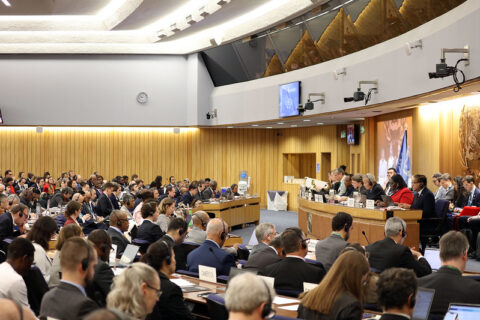
- What happened at COP31?
- What has the reaction to the presidency been?
- How has the role of oil-rich nations been portrayed?
- How has the role of developed nations been portrayed?
- How has the role of developing nations been portrayed?
- How has the role of China been portrayed?
- What does this mean for the consensus process and reform?
- Could COP31 send a ‘positive signal’?

Australia’s oceans are heating at an alarming rate. In 2024, sea surface temperatures reached record highs, marking the hottest year on record for our surrounding waters.1 This isn’t just an abstract statistic—it’s a crisis unfolding beneath the waves, threatening marine life, coral reefs, and the livelihoods of those who depend on healthy oceans.

Why Are Our Oceans Heating Up?
The primary driver is human-induced climate change. The burning of fossil fuels—coal, oil, and gas—has led to a significant increase in greenhouse gas emissions, trapping heat in the atmosphere. The vast majority of this excess heat is absorbed by the ocean, causing surface temperatures to rise at an unprecedented rate.2
Rising sea surface temperatures contribute to phenomena such as marine heatwaves and coral bleaching. These disruptions are becoming more frequent and severe, pushing marine ecosystems past their limits.
Climate change is also disrupting ocean currents, which play a crucial role in regulating global temperatures. This could have serious implications for Australia and the Pacific, for example the Atlantic Meridional Overturning Circulation (AMOC), a key system regulating global temperatures, is slowing down due to climate change. If it worsened and collapsed, this could produce a La Niña-like pattern over eastern Australia—bringing more intense rainfall and flooding.3
Closer to home, the East Australian Current now extends further south, creating an area of more rapid warming in the Tasman Sea, where the warming rate is now twice the global average.4
What Happens When the Ocean Gets Too Hot?
1. Coral Bleaching and Reef Degradation
Australia’s Great Barrier Reef has experienced widespread coral bleaching events in recent years. Coral bleaching occurs when corals, stressed by elevated sea temperatures, expel the symbiotic algae that provide them with energy and vibrant colours. Without these algae, corals can die, leading to the degradation of reef ecosystems that support a vast array of marine life.5
2. Marine Heatwaves and Mass Die-Offs
Marine heatwaves—periods of abnormally high sea temperatures—have become more frequent and intense. A recent marine heatwave off the coast of Western Australia caused the deaths of approximately 30,000 fish, an event scientists have linked directly to climate change. The extreme temperatures depleted oxygen levels and disrupted marine food chains, leaving fish and other marine life struggling to survive. Research indicates that such events are now up to 100 times more likely due to climate change.6
3. Disruption of Marine Ecosystems
Warmer oceans can alter the distribution and abundance of marine species. Many fish and other marine organisms are shifting their ranges toward cooler waters, disrupting existing ecosystems and affecting fisheries. Others that can’t migrate or adapt to changing temperatures are likely to die. These changes can have cascading effects throughout the food web, impacting species from the smallest plankton to the largest predators.4
4. Sea Level Rise and Coastal Impacts
As ocean temperatures rise, seawater expands, and melting polar ice contribute to sea level rise. Rising sea levels increase the risk of coastal flooding, erosion, and habitat loss, threatening coastal communities and ecosystems.7 Pacific Island nations are already experiencing the severe effects of climate change: rising sea levels, extreme storms, tidal inundation, food and water insecurity, and displacement are becoming all too common. These impacts threaten not just physical survival, but the very culture and identity of Pacific communities.
The Solution: Protecting Our Oceans
To address these challenges, Greenpeace advocates for:
- Global Oceans Treaty: Protecting at least 30% of the world’s oceans by 2030 through a network of international marine sanctuaries can help safeguard biodiversity and allow ecosystems to recover.
- Reducing Greenhouse Gas Emissions: Transitioning away from fossil fuels toward renewable energy sources is crucial to mitigate climate change and its impacts on the oceans.
- Preventing Overfishing and Pollution: Implementing sustainable fishing practices and reducing pollution, including plastic waste, are essential steps to maintain healthy marine environments.
Australia is home to unique and diverse marine ecosystems, and we have a responsibility to protect them. The Global Ocean Treaty, agreed upon in 2023, provides a framework for creating ocean sanctuaries in international waters. We urge the Australian government to ratify this treaty and take bold action to protect our oceans.
We need urgent action from Environment Minister Tanya Plibersek and Foreign Minister Penny Wong to ratify the Global Ocean Treaty and protect critical marine habitats, including the South Tasman Sea and Lord Howe Rise.
Sign the petition now to demand ocean protection before it’s too late.
The ocean is our greatest ally in the fight against climate change. Often called the lungs of the Earth, the ocean produces around 50% of the planet’s oxygen, regulates global temperatures, and absorbs vast amounts of carbon dioxide. But with rising temperatures, acidification, and pollution, its ability to sustain life—both beneath the waves and above—is under serious threat. The time to act is now.
- https://theconversation.com/its-official-australias-ocean-surface-was-the-hottest-on-record-in-2024-249277
- https://climate.nasa.gov/vital-signs/ocean-warming/
- https://theconversation.com/a-huge-atlantic-ocean-current-is-slowing-down-if-it-collapses-la-nina-could-become-the-norm-for-australia-184254
- https://www.csiro.au/en/research/environmental-impacts/climate-change/state-of-the-climate/oceans
- https://www.gbrmpa.gov.au/the-reef/reef-health/climate-change
- https://www.theguardian.com/environment/2025/feb/05/deaths-of-30000-fish-off-wa-coast-made-more-likely-by-climate-change-research-finds
Australia’s Oceans Just Hit Their Hottest Year on Record—Here’s Why That Matters
Dan Ioschpe is the Climate High-Level Champion for COP30.
A year ago at COP30 in Belém, we said this would be the decade of implementation for climate action. Simply put, implementation is the fastest way to promote sustainable socio-economic development. But implementation is not about words. It is about action, on the ground, at speed and scale.
COP31 in Antalya demonstrated why the implementation of the Paris Agreement must extend well beyond the two weeks of a climate conference. Despite political divisions, businesses, investors, governments, cities and communities came with results and remained committed to scaling climate action, showing that the real economy does not wait.
That is why continuity matters. In Belém, the Global Climate Action Agenda was given a new structure, with six thematic axes, and Plans to Accelerate Solutions (PAS). Because that structure carries work from one COP to the next, progress can compound. And progress is now something we can measure.
This year’s Yearbook of Global Climate Action shows that 87% of PAS reported progress, while 38% of the 40 with quantitative targets are on track or ahead of their goals. It highlights where the gaps remain.
Grids stretching halfway around the world
The strongest signal from Antalya came from electrification. The Electrification Delivery Package brings together more than 200 actions from over 180 organisations, involving over 150 countries plus the European Union – together over two-thirds of global GDP – and more than 260 businesses with over $4 trillion in annual revenue.
The results are already visible on the ground. Members of the Utilities for Net Zero Alliance built more than 21,000 kilometres of grid in 2025, up from 14,000 km the year before – enough to stretch halfway around the world. From grids, storage and renewable power to energy access, the foundations of a modern, interconnected system are coming together at speed and scale.
-
Australia and South Korea’s clean energy deal could boost low-carbon trade
The deal aims to connect Australia’s renewable resources with Korean industries’ clean energy demand, potentially transforming a relationship built on coal and gas -
After COP31, our chance to save climate diplomacy lies in global shipping
If COP31’s high ambition countries can show the same resolve at London shipping talks, a climate breakthrough is possible next week
The Global Climate Action Agenda is helping connect these investments and shift from individual solutions to economy-wide transformation. Electrification is simply the fastest way to foster sustainable socioeconomic development – efficiently, affordably, and securely.
On transport, 13 zero-emission freight corridors are now in development across six continents, covering more than 29,000 km of roads. That is already ahead of the Global Green Road Corridors Initiative’s goal of ten corridors by 2026.
Sustainable aviation fuel starts to take off
Progress is also visible on sustainable aviation fuel (SAF), a solution approaching a positive tipping point. One in three new sustainable industry investment decisions this year was for SAF, a sign of how quickly the market is developing, including through an Action Agenda plan to decarbonise aviation.
Projects that have reached final investment decision represent around 7 million tonnes of SAF a year, or 3% of today’s jet fuel use. But the wider pipeline stands at 31 million tonnes – around 11% of the existing market. Once sustainable solutions capture 5-10% of an established market, growth can become self-reinforcing as costs fall, supply chains mature and investors gain confidence. Across heavy industry more broadly, 36 deep decarbonisation projects reached final investment decision this year – a record.

On nature, the Tropical Forest Forever Facility has reached $8.3 billion in commitments towards its $10-billion initial target, and the Global Fund for Coral Reefs announced $30 million in new reef financing across 22 developing countries.
With the launch of the Rio Synergies Group for Action, implementation will be at the centre of the three Rio Conventions on climate, biodiversity and land, and 17 governments are now backing the Intergovernmental Land Tenure Commitment to strengthen the rights of Indigenous Peoples and local communities.
On food and agriculture, solutions range from methane-reducing practices reaching more than 5,000 smallholders to food recovery initiatives now reaching 40.5 million people, cutting food waste and emissions at the same time. Some 66 million hectares are now under regenerative landscape projects.
Accelerator to support two solutions per year
Antalya also laid the groundwork for progress. Mandated by the Mutirão Decision in Belém, the Global Implementation Accelerator established its governance and operational framework at COP31. Each year, two solutions – one on mitigation and one on adaptation – will be selected for coordinated support, informed by independent expert assessment and mobilising the capabilities of a dedicated partner network.
The Accelerator builds on the Action Agenda, bringing governments, businesses, finance and technical expertise together to accelerate solutions with the potential to reach positive tipping points.
None of this happened by accident. It was possible because a structure is in place that allows progress to compound – connecting political guidelines with investments, infrastructure and sustainable socio-economic development.
This is the Global Climate Action Agenda at work: a multi-year engine for the implementation of the Paris Agreement, guided by a shared vision towards 2030. And I am optimistic about what comes next.
In Belém, we collectively revamped its structure and strengthened its foundations. In Antalya, we demonstrated the value of continuity. The opportunity now is to deepen its reach across regions, strengthening implementation on the ground with speed and scale.
From Antalya to Addis Ababa and beyond, the work continues 365 days a year, 24 hours a day.
The post Despite political divisions, COP31 showed the real economy does not wait appeared first on Climate Home News.
https://www.climatechangenews.com/2026/11/26/despite-political-divisions-cop31-showed-the-real-economy-does-not-wait/
COP31 came to a dramatic close last weekend when a coalition of nations rejected the proposed “Antalya pact”, citing its failure to mention fossil fuels.
The tense final moments and lack of a much-anticipated “pact” have sparked extensive media coverage around the world.
Many commentators have rushed to label the COP31 outcome a “failure”, questioning what it means for the future of the UN climate process and a “divided world”.
There has been much finger-pointing, with some outlets attributing COP31’s “collapse” to “oil-rich nations”, while others blame Europe’s “reluctance” to provide more climate finance.
While it is not accurate to say there was “no agreement” at COP31, the media response demonstrates the complexity of the divergent views on display at the Antalya conference.
In this article, Carbon Brief draws together media reactions from around the world to show the diversity of responses to the COP31 outcome.
- What happened at COP31?
- What has the reaction to the presidency been?
- How has the role of oil-rich nations been portrayed?
- How has the role of developed nations been portrayed?
- How has the role of developing nations been portrayed?
- How has the role of China been portrayed?
- What does this mean for the consensus process and reform?
- Could COP31 send a ‘positive signal’?
What happened at COP31?
COP31 ended without agreement on a proposed “Antalya pact”, which had been pushed by the Turkey-Australia presidency.
The final text was rejected by at least 32 countries, including the EU, the UK and some climate-vulnerable countries, in chaotic scenes as the talks overran by two days.
An Irish Times editorial said the outcome was an “unprecedented ending of a COP without any agreement or roadmap forward”.
This view, while commonly expressed in the media, is incorrect.
As veteran “COP-watchers” explained for an article on CB Connect, the summit reached agreement on many decisions, even though the presidency’s “cover decision” failed.
Referring to the rejection of the cover decision, Melbourne University climate researchers Prof Jacqueline Peel and