



- Formal negotiations
- Finance
- Global review
- Global report
- Digital sequence information
- Harmful subsidies
- Marine biodiversity
- Planning, monitoring, reporting and review
- Article 8(j) implementation
- Biodiversity and climate change
- Links with other bodies
- Around the COP
- Armenian presidency
- Protests
- Lobbying and influence
- Carbon and biodiversity markets

A decline in the area burned globally by wildfires over the 20th century due to land-use change has almost entirely been offset by the increase caused by global warming, a new study says.
The paper, published in Nature Climate Change, is the first attribution study to assess the impacts of climate change and land-use change on “global burned area”.
It finds that changes in population distribution and land use over the 20th century – including forest fragmentation and the conversion of land for urban development and agriculture – have suppressed wildfires, driving down global burned area by 19%.
However, this decline has been hindered by human-caused warming, which has expanded the area burned by 16% through increasingly hot and dry conditions across much of the world.
As a result, the global burned area has declined just 5% over the past 100 years.
Despite the worldwide decline overall, the study finds that climate change has driven increases in burned area of 29% in south-eastern South America, 22% in northern Australia, 18% in west Siberia and 15% in western North America.
This study is the “key missing piece to the puzzle of tracking anthropogenic emissions”, according to Dr Matthew Jones – an independent researcher who was not involved in the study.
Jones, who works with on the annual Global Carbon Budget (GCP), tells Carbon Brief that this study is a “major step forward in modelling the extent of additional, human-related fires”. He notes that until now, projects like the GCB have “been forced to assume that all fire emissions are natural, therefore underestimating the effect of people on the global carbon cycle”.
Burned area paradox
Australia’s “black summer” bushfires of 2020-21 are one of the continent’s most intense and damaging fire seasons on record. The fires burned around almost 25m hectares of land, killed more than 30 people and released more CO2 than the combined annual emissions of over 100 countries.

Researchers from the World Weather Attribution (WWA) service published a “rapid attribution” study on Australia’s wildfires. They find the likelihood of Australia experiencing weather conditions like those in the lead-up to its 2020-21 fires has increased by at least 30% since 1900 as a result of climate change.
Similarly, WWA found that climate change more than doubled the likelihood of extreme fire weather conditions that led to unprecedented fires in eastern Canada in 2023. And the hot, dry and windy conditions that drove the devastating Pantanal wildfires in 2024 were 40% more intense due to climate change.
Attribution studies make it clear that climate change is making individual wildfires more intense and frequent. However, data shows that, overall, the area burned globally by fires is decreasing.
Dr Matthew Jones is an independent researcher who works with the Natural Environment Research Council and Global Carbon Project. He is the lead author of a study published last week, which finds that forest fire carbon emissions increased by 60% globally over 2001-23.
He tells Carbon Brief there climate change is does not provide the whole picture when it comes to global burned area, noting that human activity can impact wildfires in many ways:
“Wildfires are a natural phenomenon, but they are made increasingly likely by human-induced climate change and they are also influenced by people, who manage much of Earth’s land area and also alter rates of fire ignition.
“Fire scientists have long grappled with the troublesome task of separating out the additional fires that people are causing, over and above the fires that would have happened naturally.”
Attributing burned area
Seppe Lampe is a doctoral student at Vrije University Brussels department of water and climate and co-lead author on the study. He tells Carbon Brief that “this is the first study that actually attributes and quantifies how much climate change has affected burned area all over the world”.
The authors use seven “fire-vegetation models” from the Inter-Sectoral Impact Model Intercomparison Project to carry out the attribution study, which compares wildfires in today’s climate with wildfires in a counterfactual world without human-caused climate change.
To assess the impact of climate change on global burned area, the authors run models of the present-day climate (2003-19), both with and without the impacts of climate change. They then compare the results to isolate the impacts of climate change on global burned area.
To study the impact of “direct human forcing” – defined as land-use change, land management and population density – they compare simulations of the world in the early-industrial period (1901-17) and a present day world (2003-19) without the impact of climate change. In these simulations, the authors do not include any long-term changes in climate, so the only differences are in land use and population change.
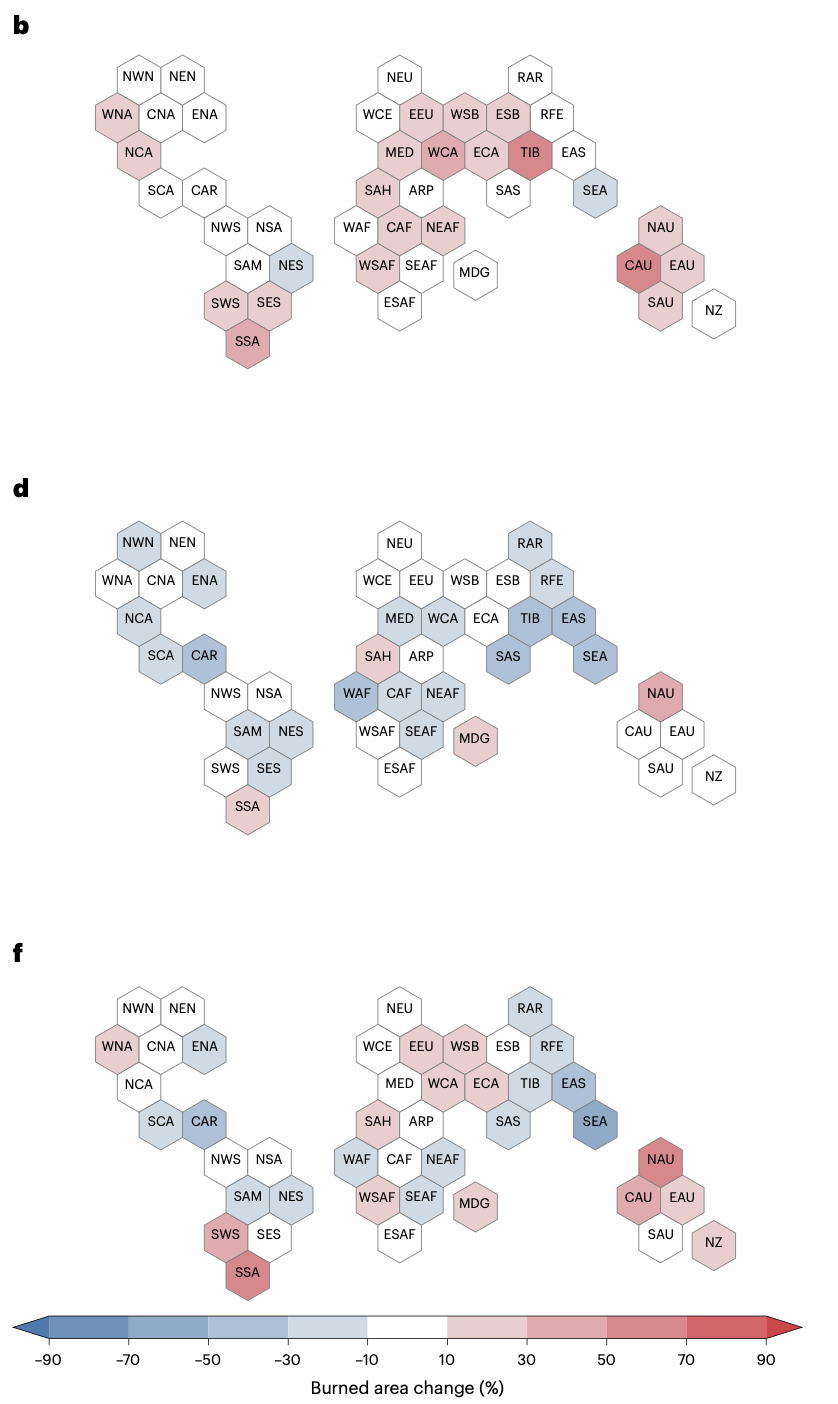
The maps below show the percentage change in burned area due to climate change (top), direct human forcing (middle) and both (bottom). Red indicates an increase in percentage burned area and blue indicates a decrease. White indicates that there has been little change in the percentage of burned area. The map divides the world into hexagonal regions, as used by the Intergovernmental Panel on Climate Change (IPCC).
Climate and land-use change
The study finds that climate change has driven an increase in burned area in most IPCC regions, with only eight of the 42 regions showing a decrease in burned area due to the changing climate.
Lampe explains that the climate-driven decrease in burned area in regions such as south-east Asia could be due to factors such as changing rainfall patterns.
Many regions have seen more than a 10% increase in burned area due to climate change alone, including all IPCC regions in Australia and several regions in South America, Siberia and North America, the study adds.
The authors find that on average, climate change has driven a 16% increase in burned area globally and increased the probability of experiencing months with above-average global burned area by 22%.
The area of land that would be burned in the two most-active fire months of the year in a world without climate change is now expected for four months every year, the authors add.
The authors also find that the impact of climate change on burned area is accelerating over time, increasing most rapidly after the 1970s. Central Australia has seen the greatest increase.
Conversely, the authors find that changes in direct human forcing factors since the early industrial period have driven a 19.1% decrease in burned area.
This is due to landscape fragmentation, a reduction in fuel for fires – often seen when landscapes are converted from natural areas into urban areas or cropland – and deliberate fire management and suppression techniques, according to the study.
The decrease in burned area is mainly seen in savannah, grasslands and croplands – particularly in equatorial Asia and tropical North Africa – Lampe tells Carbon Brief. He adds:
“The global signal of burned area is actually 70% determined by what’s going on in the African savannahs. And there we see more and more savannahs being turned into cropland, which causes a decline in burned area.”
Overall, the study finds a 5% reduction in global burned area since the early 20th century.
‘Major step forward’
The study shows that without the “mitigating influences” of land-use change, global burned area would probably be even higher today.
This work is a “major step forward in modelling the extent of additional, human-related fires”, Jones tells Carbon Brief. He adds:
“Up until now, projects like the Global Carbon Budget have struggled to estimate how people influence the climate through wildfire emissions. We have been forced to assume that all fire emissions are natural, therefore underestimating the effect of people on the global carbon cycle.”
He explains that this study is the “key missing piece to the puzzle of tracking anthropogenic emissions”.
Prof David Bowman is an Australian Research Council laureate fellow and the director of the transdisciplinary Fire Centre at the University of Tasmania. He tells Carbon Brief that the approach used in this study seems “valid”, but adds that wildfire modelling is “extraordinarily difficult”.
He points out a few important assumptions and caveats in the “useful” study – for example, that the authors do not consider the intensity of fires.
Bowman also warns that the decline in global burned area “has been used for political purposes deflecting attention from the escalating wildfire crisis”.
Dr Maria Barbosa – a researcher at the Universidade Federal de São Carlos, who was not involved in the study – tells Carbon Brief that the study “provides valuable insights into how fire regimes are likely to shift”.
Barbosa warns that “we are currently failing to prepare for the upcoming fire seasons”, and says that governments need to invest in early warning systems, improve land-use planning to reduce fire risks and strengthen policies for forest management and restoration.
Lampe tells Carbon Brief that the findings of this study could help to inform regional policymakers and could “have significance for loss and damage”.
The post Climate change almost wipes out decline in global area burned by wildfires appeared first on Carbon Brief.
Climate change almost wipes out decline in global area burned by wildfires
Continue Reading
Countries have completed the first “global review” of their progress towards reversing nature loss by 2030 at the COP17 biodiversity talks in Yerevan, Armenia.
The review “notes with deep concern” that, unless action is “rapidly accelerated”, the goal to reverse nature loss and meet a set of 23 targets by 2030 “will not be achieved”.
It “urges” countries to accelerate action, including by “increased ambition in addressing the gaps”.
Much of the discussions in Yerevan focused on how to raise the necessary funds to help developing countries protect nature.
Some major economies pushed to expand the range of nations that are expected to provide finance, with countries agreeing at the end of the two weeks of talks that non-donors that want to contribute can “signal interest” before COP18.
This came after developed countries failed to meet a target to significantly ramp up nature finance over the last few years.
It also came as a landmark fund agreed at COP16 in Colombia to pay communities for the genetic resources derived from nature stands nearly empty two years on.
The Yerevan talks marked the halfway point of the “Kunming-Montreal Global Biodiversity Framework” (GBF), the “Paris Agreement for nature” first made in 2022 and due to be achieved by 2030.
During the nearly 12-hour-long final plenary, countries voted for Quito, Ecuador, to host the COP18 nature talks, which will be held in 2028.
Countries managed to sign off on all the major negotiation texts, marking a stark contrast to COP16, which ran so far over time that the Colombian presidency lost “quorum”, forcing talks to resume in Rome months later.
Below, Carbon Brief has detailed analysis of all of the key outcomes from COP17.
Formal negotiations
Finance
Finance, predictably, was at the heart of the discord and deadlock at the Yerevan talks.
At COP17, discussions on finance had to achieve several outcomes.
The first part – to take stock of biodiversity finance mobilised so far to meet the nature deal’s goals – fell under the global review.
As the global report noted, developed countries failed to meet their commitments to raise “at least $20bn a year by 2025” for nature. Delegates pointed to falling aid levels and a sharp 27% decline in environmental funding for the 2026-30 period.
The second part was to agree on how to mobilise resources for the next four years, to meet the GBF’s goals and targets.
Calls to “broaden the contributor base” of who pays to protect nature – and whether that should include emerging economies – became the most fraught element of the talks.
Eventually, countries agreed on what Switzerland described as a “super, mega-delicate” text. It hinged on major “political compromises”, with “no major winner or loser”, according to Kenya.
Per the decision, countries that want to be included on a list of developed country donors can “signal interest” through bilateral, confidential consultations before COP18 and every alternate COP after.
Finally, countries also agreed on criteria to shape and resource a new, permanent financial mechanism to protect nature after 2030.
However, this did not immediately take the form of a new fund under the COP that biodiverse countries have demanded since 2022, deferring the mechanism’s institutional structure to COP18.
Resource mobilisation discussions at the GBF’s halfway mark were supposed to agree on how to close the “biodiversity finance gap” and to “increase resources from all sources” to “at least” $200bn per year by 2030, as set out in target 19 of the GBF.
The talks were largely dominated by a push, led by the JUSCANZ bloc of developed countries, to “broaden the contributor base”. This could see emerging economies, such as Qatar, China, Saudi Arabia and India, being added to the list of countries that pay to protect nature.
Article 20 of the UN Convention on Biological Diversity (CBD) states that developed countries “shall provide new and additional financial resources” to developing countries to meet the costs of implementing measures to protect nature.
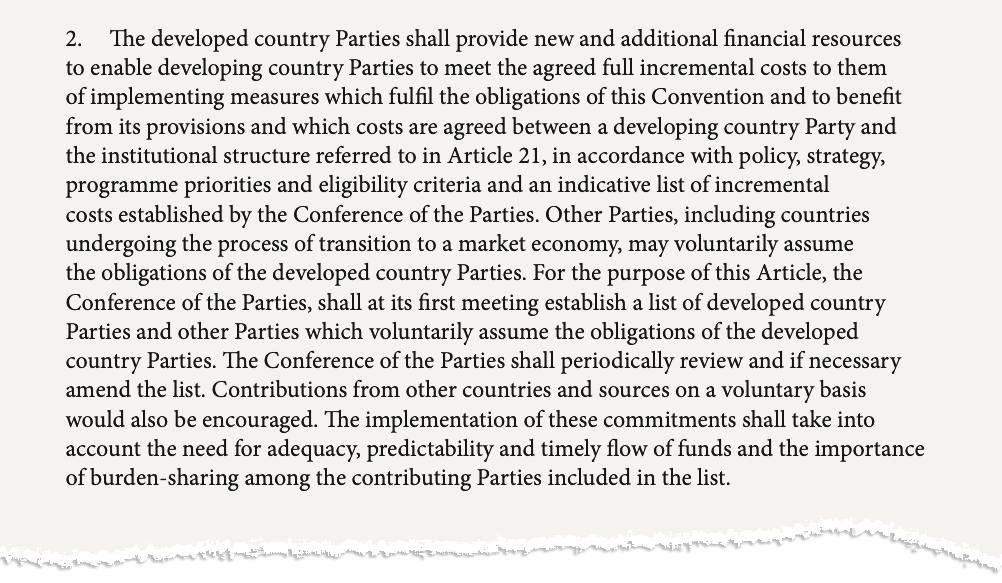
The text states that other countries – including emerging economies – may “voluntarily assume” these obligations to pay. However, it adds that this list of developed countries “shall” be reviewed periodically and amended “if necessary”.
The list was last amended in 2006.
(See this “jargon buster” which explains the specific meaning and legal weight of various terms and verbs used in UN formal documents.)
Discussions around this fraught subject had reached a dead end at intersessional talks this year, but resurfaced in Yerevan.
The first “non-paper” had four different options for expanding the contributor base. These ranged from using the World Bank’s country income groups “as a proxy” to identify high-income countries, to commissioning a study on the impacts of being included on the list.
By 21 October, the number of options swelled to eight, including two from Saudi Arabia and one from Peru.
Some countries “expressed concern” that certain options were based on a CBD secretariat study on “what constitutes a developed country”, Earth Negotiations Bulletin reported.
By the end of the first week, it was clear that the finance deadlock would have to go into informal ministerial consultations for any consensus to emerge.
At a press conference on 28 October, Christopher O’Sullivan, Ireland’s nature minister and representing the EU delegation, told Carbon Brief:
“Our position isn