


ASEAN’s (Association of Southeast Asian Nations) emerging carbon markets present a unique opportunity for addressing climate change while fostering economic development. Comprising 10 dynamic economies, the region’s natural resources and strategic position offer great potential to lead in global decarbonization efforts.
Abatable’s new report, The Opportunity for Carbon Markets in ASEAN, launched in Jakarta, explores ASEAN’s carbon market landscape, its challenges, and the roadmap for harnessing its vast potential.
The report highlights how ASEAN’s carbon markets could generate $3 trillion in cumulative revenue by 2050. This would come from reducing or removing emissions equivalent to 1.1 gigatonnes of CO2 annually, presenting a significant opportunity for the region.
The trillion-market potential includes the following values for each of the three types of carbon projects:
- $27 billion from REDD+ (Reducing Emissions from Deforestation and Forest Degradation),
- $96 billion from blue carbon, and
- $144 billion from biochar markets.
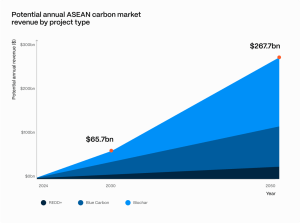
This growth could create 13.7 million green jobs in the ASEAN, highlighting a transformative economic and environmental opportunity.
Decarbonizing ASEAN: Turning Emissions into Economic Gold
Carbon markets operate by assigning a monetary value to carbon emissions, incentivizing industries to reduce their greenhouse gas outputs. These markets fall into two categories:
- Compliance Markets: Mandated by governments, these include mechanisms like carbon taxes and emissions trading systems (ETS).
- Voluntary Carbon Markets (VCMs): Businesses voluntarily offset emissions by purchasing carbon credits from certified projects.
In ASEAN, carbon markets hold dual promise—environmental benefits through emissions reductions and economic gains through market-driven investments.
The ASEAN’s Climate Context
The region, with its combined GDP of $3.4 trillion, is a growing economic powerhouse. However, its reliance on fossil fuels and deforestation has made it a significant emitter, contributing around 6% of global emissions in 2023.
The key contributors to this carbon pollution include these major areas:
- Energy Sector: Accounts for 50% of emissions due to coal dependence.
- Land Use and Forestry: Responsible for 30%, linked to deforestation and agricultural expansion.
- Agriculture: Produces 450 million tonnes of CO2 equivalent annually.
Despite these challenges, ASEAN’s tropical forests, mangroves, and agricultural landscapes offer untapped potential for carbon sequestration and sustainable practices.
The region has already made strides in carbon credit generation, producing 233 million tonnes of credits from 2009 to 2024. This represents about 7% of global issuances. Indonesia and Cambodia have been leading suppliers, primarily through forestry projects like REDD+.
Here’s how the member states in the region approach various carbon markets as stated in Abatable’s report:
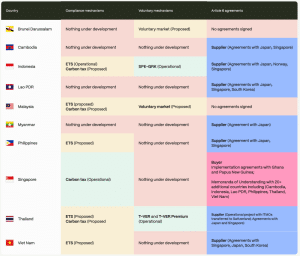
Several ASEAN countries, such as Thailand and Vietnam, are also advancing renewable energy and efficiency projects. However, the lack of regional coordination and regulatory clarity hampers market growth.
How Can ASEAN Unlock Its Carbon Opportunities
ASEAN’s carbon market could generate up to $3 trillion in cumulative revenue by 2050 as shown below.
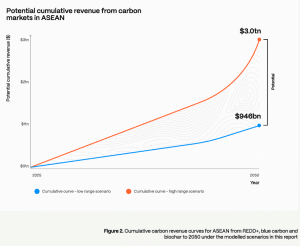
The region can achieve this potential with three key strategies. First is through nature-based solutions like afforestation, reforestation, and mangrove restoration to capture carbon while preserving biodiversity.
The second is with energy transitions through early coal plant retirements. And third is through renewable investments, along with innovative projects like biochar and blue carbon. They offer sustainable approaches for agriculture and marine ecosystems.
These initiatives could also deliver socio-economic benefits, including millions of green jobs by 2050.
However, ASEAN must overcome significant challenges to fully unlock this potential. Regulatory uncertainty, characterized by inconsistent policies and unclear frameworks, deters investments. Market fragmentation limits cross-border carbon trading opportunities due to weak regional collaboration.
Additionally, integrity issues such as concerns over greenwashing and the quality of carbon credits undermine market credibility, highlighting the need for robust systems and transparent practices.
A Roadmap for Unleashing ASEAN’s Carbon Market Potential
The following policy recommendations can help ASEAN overcome these challenges and establish itself as a global carbon market leader:
- Establish Clear Regulations
Transparent, standardized frameworks are essential for attracting investments and scaling carbon markets. Governments should define project approval processes, fee structures, and benefit-sharing rules.
- Build Institutional Capacity
Dedicated carbon market offices, regional training programs, and collaboration platforms can equip ASEAN countries with the expertise needed to manage carbon projects effectively.
- Align with International Standards
ASEAN must harmonize its methodologies with global best practices to enhance the credibility of its carbon credits. Developing localized standards while ensuring international recognition can expand market access.
- Develop Domestic Compliance Markets
Implementing carbon taxes and ETS can drive domestic demand for carbon credits, incentivizing industries to adopt greener practices.
- Promote Regional Cooperation
ASEAN can leverage Article 6 of the Paris Agreement to foster intra-regional carbon trading. A unified framework can facilitate partnerships and attract global buyers.
- Enhance Public Awareness
Regional campaigns and recognition programs can encourage corporate participation in voluntary markets and boost demand for high-quality carbon credits.
By implementing these strategies, ASEAN can position itself as a hub for carbon market innovation. The region’s abundant natural resources, coupled with a commitment to sustainable development, make it uniquely qualified to lead global decarbonization efforts.
- READ MORE: Is the Voluntary Carbon Market Dead?
The post Unlocking ASEAN’s $3 Trillion Carbon Market Potential appeared first on Carbon Credits.

EU carbon credit claims changed on 27 September 2026, the day the Directive (EU) 2024/825 began to apply across the European Union. The change is narrow. It changes how a company can talk about the credits it buys. A product can no longer be called neutral on the strength of compensation alone; however, every specific, evidenced statement about what a company measured, reduced, and funded stays fully available.

The post Promoting Improved Cooking Practices in Nigeria appeared first on Terrapass.


Ming Yang Eyes 33 MW Turbine, Greenvolt Delays FID
‘A strong start’: WA’s transition to renewable energy powerhouse aided by Premier’s announcement
WA EPA warned Woodside of ‘serious, significant and irreversible’ harms to Scott Reef from gas plans, new documents reveal
-
Climate Change1 year ago
Guest post: Why China is still building new coal – and when it might stop
-

 Greenhouse Gases2 years ago
嘉宾来稿:满足中国增长的用电需求 光伏加储能“比新建煤电更实惠”
-
Greenhouse Gases1 year ago
Guest post: Why China is still building new coal – and when it might stop
-

 Climate Change2 years ago
嘉宾来稿:满足中国增长的用电需求 光伏加储能“比新建煤电更实惠”
-

 Renewable Energy1 year ago
Sending Progressive Philanthropist George Soros to Prison?
-
Climate Change2 years ago
Bill Discounting Climate Change in Florida’s Energy Policy Awaits DeSantis’ Approval
-
Greenhouse Gases1 year ago
嘉宾来稿:探究火山喷发如何影响气候预测
-

 Climate Change2 years ago
Analysis: China’s CO2 falls 1% in Q2 2024 in first quarterly drop since Covid-19