

- Formal negotiations
- Finance
- Global review
- Global report
- Digital sequence information
- Harmful subsidies
- Marine biodiversity
- Planning, monitoring, reporting and review
- Article 8(j) implementation
- Biodiversity and climate change
- Links with other bodies
- Around the COP
- Armenian presidency
- Protests
- Lobbying and influence
- Carbon and biodiversity markets

With Donald Trump winning a come-back victory as president of the United States and Republicans in a position to win both chambers of Congress, analysts and commentators around the world are offering their views on what this means for the world’s battle to tackle climate change.
At home, Trump – a climate-change sceptic – has promised to encourage the production of fossil fuels and rein in Biden’s green economy spending.
Internationally, he has said he would withdraw the US from the Paris climate agreement, as he did briefly during his first term in office. He is reportedly also considering trying to quit the 1992 United Nations Framework Convention on Climate Change (UNFCCC), the treaty that establishes the basic architecture for countries to work together to address climate change. He may also cut the US’s climate finance contributions to developing countries.
Climate Home is compiling reactions from climate experts in the US and beyond on the implications of a Trump victory for global climate policy and climate action in the United States:
Todd Stern, former US climate envoy
Speaking before the election, Todd Stern – who was former President Barack Obama’s chief climate negotiator, including on the Paris Agreement – said that if Trump blocks efforts to cut his country’s CO2 emissions, it “will be very disappointing – to put it mildly”. But, he added, “the machine is moving – the wheels that are spinning in all elements of clean technology are not going to stop”.
He said Trump would try to pull back Biden’s green spending through legislative mechanisms like the Inflation Reduction Act. But “in many cases, they won’t be able to do that”, Stern added, because a lot of the spending has been in states with Republican Congressmen and Governors who are “not going to want those things to be undermined because of jobs and employment”.

US climate envoy Todd Stern consults with his Chinese counterpart Xie Zhenhua in 2011 (Pic: IISD Reporting Services/2011)
Gina McCarthy, former US presidential climate adviser and Environmental Protection Agency administrator
Echoing Stern, McCarthy said “the shift to clean energy is unstoppable and our country is not turning back”. She added that the EPA and all public servants “stand ready to do their jobs, follow the science, and protect the rule of law”. “We all must stand ready to hold this administration accountable to do its job of protecting our people and our environment,” she added.
“Bloomberg’s America Is All In [a coalition of local leaders supporting climate action] will work with cities, states and the private sector to do everything in its power to stop this administration from unwinding the progress we’ve made on climate,” she said.
Jennifer Morgan, German government climate envoy
The US-born diplomat said that the German government would “work with the next US administration wherever possible to strengthen the international rules-based order and deal with shared security challenges, including the climate crisis.”
“For Germany and the EU the transition to climate neutrality is a cornerstone of our future competitiveness. We therefore will work with all partners towards a level playing field in the race for green industries,” she added.

Jennifer Morgan speaks at the World Economic Forum in 2020 (World Economic Forum/Boris Baldinger)
Christiana Figueres, former head of the UNFCCC
The Costa Rican diplomat, who oversaw the Paris Agreement in 2015, said the US election result was a “major blow to global climate action, but it cannot and will not halt the changes underway to decarbonise the economy and meet the goals of the Paris Agreement”.
She added: “Standing with oil and gas is the same as falling behind in a fast-moving world. Clean energy technologies will continue to out-compete fossil fuels, not just because they are healthier, faster, cleaner and more abundant, but because they undercut fossil fuels where they are at their weakest: their unsolvable volatility and inefficiency.”
Legal experts say Trump could quit Paris pact – but leaving UNFCCC much harder
Izabella Teixeira, former Brazilian environment minister
Teixeira, Brazil’s environment minister from 2010 to 2016, said “there is no room for climate denialism in the context of the climate emergency”. “American society is co-responsible for global warming and, despite Trump’s victory, will undoubtedly be co-responsible for the solutions to the climate crisis,” she added.

Izabella Teixeira served as Brazil’s environment minister under ousted president Dilma Rousseff (Pic: Senado Federal/Flickr)
Laurence Tubiana, CEO of the European Climate Foundation and architect of the Paris Agreement
The French diplomat said: “The US election result is a setback for global climate action, but the Paris Agreement has proven resilient and is stronger than any single country’s policies.”
She added: “The context today is very different to [when Donald Trump was first elected in] 2016. There is powerful economic momentum behind the global transition, which the US has led and gained from, but now risks forfeiting.”
Bill Hare, climate scientist and CEO of Climate Analytics
Hare, who has contributed to the flagship scientific reports of the Intergovernmental Panel on Climate Change (IPCC), warned that “the election of a climate denier to the US Presidency is extremely dangerous for the world”.
He added: “We are already seeing extreme damages, loss of life around the globe due to human-induced warming 1.3C. President Trump will not be above the laws of physics and nor will the country that he leads. If Trump follows through with his threat to withdraw from the Paris Agreement, the biggest loser will be the United States.”
Yao Zhe, global policy advisor at Greenpeace East Asia
Zhe said: “China finds itself at a pivotal moment. Expectations are high that China will join key nations in reassuring the world that climate action will continue.” She added that, to reassure the world, China should submit a new UN climate plan “that outlines clear actions to transition away from fossil fuels”.
“Climate played a crucial role in stabilising US-China relations during the Biden time. The Trump administration may undo some of the climate diplomacy gains of recent years, but US-China climate cooperation will continue at the subnational level and among non-state actors,” she concluded.
Mary Robinson, former prime minister of Ireland
Robinson said: “I sincerely hope that the recent hurricanes in the United States have caused President Trump to rethink his belief that climate change will create ‘more oceanfront properties’. It will only bring more death and devastation.”
She called for a redoubling of efforts by those working to tackle global warming, adding: “The outcome of the US elections should not be used as an excuse by world leaders to avoid taking action against climate change.”

Mary Robinson is a climate justice campaigner, UN special envoy and former president of Ireland (Pic: twitter/ODI)
Collin Rees, Oil Change International’s US program manager
Rees called for Biden to “secure his climate legacy” by ending fossil fuel expansion, making permanent a pause on LNG gas exports, shutting down the Dakota Access oil pipeline and fulfilling the US’s commitment to stop financing international fossil fuel projects.
“What Biden does now will determine whether he’ll be remembered as the leader who did his utmost to limit the Trump administration’s damage and keep the world from hurtling towards climate chaos,” he said.
Fatih Birol, executive director of the International Energy Agency
The Turkish energy analyst congratulated Trump in a social media post on X and said that, as during his first term, the International Energy Agency “looks forward to working closely with your new administration to support US energy policy goals and to advance global efforts towards affordable, secure & sustainable energy.”

IEA head Fatih Birol speaks at the Battersea power station shopping centre (Picture: Powering Past Coal Alliance)
(Reporting by Climate Home news team; editing by Megan Rowling)
The post US election: Climate experts react to Donald Trump’s victory appeared first on Climate Home News.
US election: Climate experts react to Donald Trump’s victory
Continue Reading
Countries have completed the first “global review” of their progress towards reversing nature loss by 2030 at the COP17 biodiversity talks in Yerevan, Armenia.
The review “notes with deep concern” that, unless action is “rapidly accelerated”, the goal to reverse nature loss and meet a set of 23 targets by 2030 “will not be achieved”.
It “urges” countries to accelerate action, including by “increased ambition in addressing the gaps”.
Much of the discussions in Yerevan focused on how to raise the necessary funds to help developing countries protect nature.
Some major economies pushed to expand the range of nations that are expected to provide finance, with countries agreeing at the end of the two weeks of talks that non-donors that want to contribute can “signal interest” before COP18.
This came after developed countries failed to meet a target to significantly ramp up nature finance over the last few years.
It also came as a landmark fund agreed at COP16 in Colombia to pay communities for the genetic resources derived from nature stands nearly empty two years on.
The Yerevan talks marked the halfway point of the “Kunming-Montreal Global Biodiversity Framework” (GBF), the “Paris Agreement for nature” first made in 2022 and due to be achieved by 2030.
During the nearly 12-hour-long final plenary, countries voted for Quito, Ecuador, to host the COP18 nature talks, which will be held in 2028.
Countries managed to sign off on all the major negotiation texts, marking a stark contrast to COP16, which ran so far over time that the Colombian presidency lost “quorum”, forcing talks to resume in Rome months later.
Below, Carbon Brief has detailed analysis of all of the key outcomes from COP17.
Formal negotiations
Finance
Finance, predictably, was at the heart of the discord and deadlock at the Yerevan talks.
At COP17, discussions on finance had to achieve several outcomes.
The first part – to take stock of biodiversity finance mobilised so far to meet the nature deal’s goals – fell under the global review.
As the global report noted, developed countries failed to meet their commitments to raise “at least $20bn a year by 2025” for nature. Delegates pointed to falling aid levels and a sharp 27% decline in environmental funding for the 2026-30 period.
The second part was to agree on how to mobilise resources for the next four years, to meet the GBF’s goals and targets.
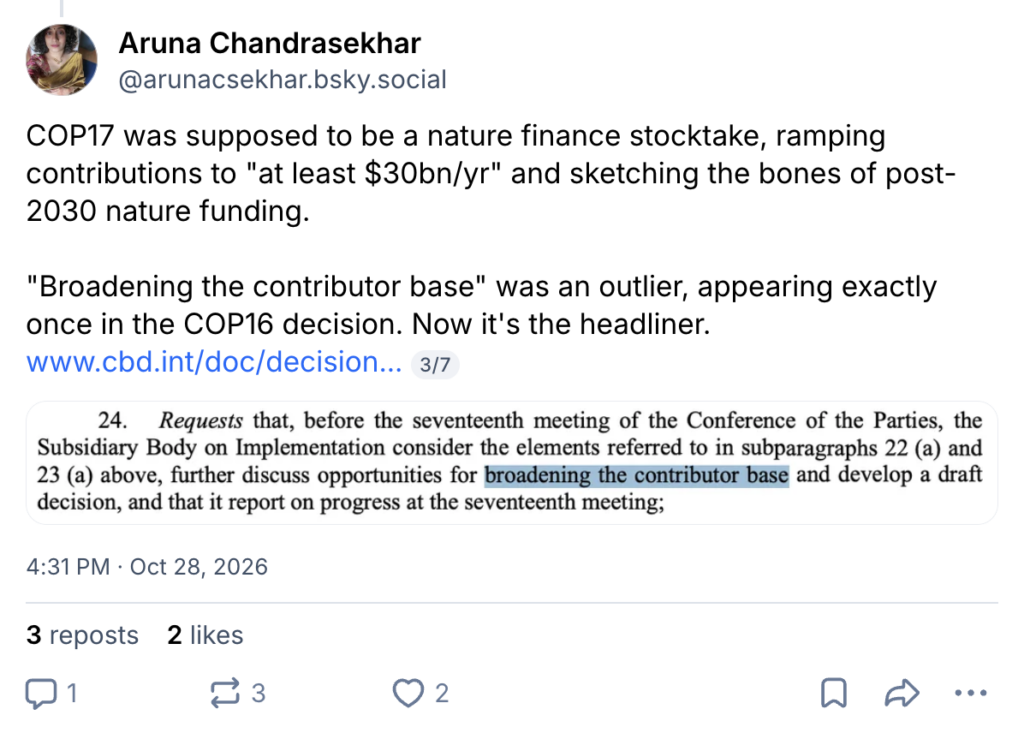
Calls to “broaden the contributor base” of who pays to protect nature – and whether that should include emerging economies – became the most fraught element of the talks.
Eventually, countries agreed on what Switzerland described as a “super, mega-delicate” text. It hinged on major “political compromises”, with “no major winner or loser”, according to Kenya.
Per the decision, countries that want to be included on a list of developed country donors can “signal interest” through bilateral, confidential consultations before COP18 and every alternate COP after.
Finally, countries also agreed on criteria to shape and resource a new, permanent financial mechanism to protect nature after 2030.
However, this did not immediately take the form of a new fund under the COP that biodiverse countries have demanded since 2022, deferring the mechanism’s institutional structure to COP18.
Resource mobilisation discussions at the GBF’s halfway mark were supposed to agree on how to close the “biodiversity finance gap” and to “increase resources from all sources” to “at least” $200bn per year by 2030, as set out in target 19 of the GBF.
The talks were largely dominated by a push, led by the JUSCANZ bloc of developed countries, to “broaden the contributor base”. This could see emerging economies, such as Qatar, China, Saudi Arabia and India, being added to the list of countries that pay to protect nature.
Article 20 of the UN Convention on Biological Diversity (CBD) states that developed countries “shall provide new and additional financial resources” to developing countries to meet the costs of implementing measures to protect nature.
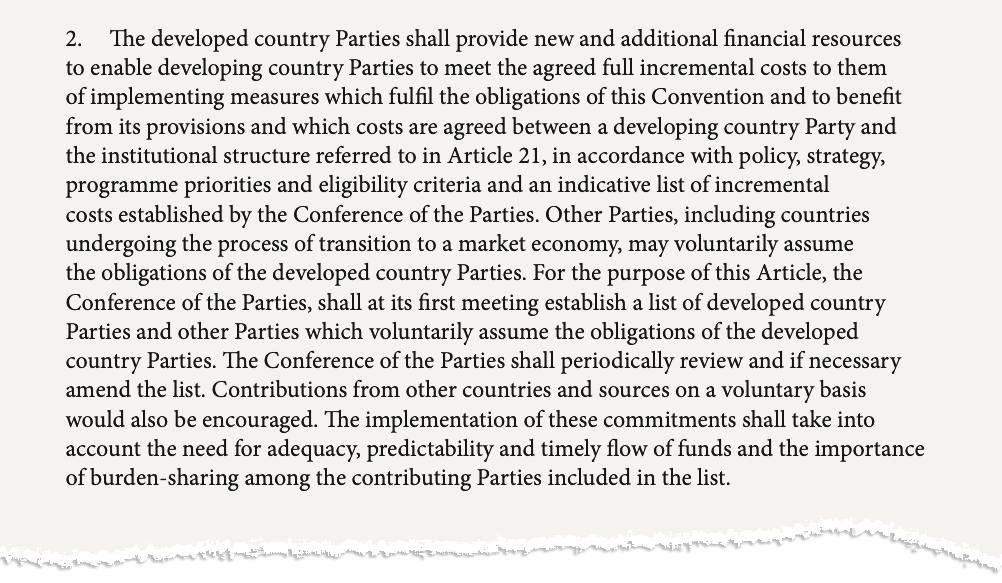
The text states that other countries – including emerging economies – may “voluntarily assume” these obligations to pay. However, it adds that this list of developed countries “shall” be reviewed periodically and amended “if necessary”.
The list was last amended in 2006.
(See this “jargon buster” which explains the specific meaning and legal weight of various terms and verbs used in UN formal documents.)
Discussions around this fraught subject had reached a dead end at intersessional talks this year, but resurfaced in Yerevan.
The first “non-paper” had four different options for expanding the contributor base. These ranged from using the World Bank’s country income groups “as a proxy” to identify high-income countries, to commissioning a study on the impacts of being included on the list.
By 21 October, the number of options swelled to eight, including two from Saudi Arabia and one from Peru.
Some countries “expressed concern” that certain options were based on a CBD secretariat study on “what constitutes a developed country”, Earth Negotiations Bulletin reported.
By the end of the first week, it was clear that the finance deadlock would have to go into informal ministerial consultations for any consensus to emerge.
At a press conference on 28 October, Christopher O’Sullivan, Ireland’s nature minister and representing the EU delegation, told Carbon Brief:
“Our position isn’t that we want to pull back in terms of contributing…but it’s been 20 years since that list was added to, times have changed and there are new realities. We just simply want those new realities reflected. I don’t fully understand why there’s so much opposition to that.”
The EU chose not to comment on which countries it would like to see on that list.
Lim Li Ching from the Third World Network, meanwhile, called the push for others to “assume the obligations” of developed countries “sheer hypocrisy”, adding that any country could make a voluntary contribution. She told Carbon Brief:
“At a forum like the CBD, this linking of income status with finance does not take into account where historical and current responsibilities lie. If you want to generate more funding for biodiversity, let’s look at sovereign debt burdens and rules, which are inequitable for developing countries. But if you can fund wars, and provide resources for your defence industry, then you know where the priorities are.”
On 29 October – at a plenary meant to adopt final texts for the most contentious subjects – Norway’s Gaute Hanssen announced that resource-mobilisation discussions would go into a smaller “friends of the chair” meeting.
Facilitated by Carolina Caceres from Canada and Imèn Meliane from Tunisia, the meeting would discuss the most contentious elements of a draft decision that had swelled to 112 brackets, denoting areas of disagreement on specific details in the text.
While the meeting was open to all, countries that were called to be present included Brazil, Canada, Chile, China, the EU, Fiji, Norway, Russia, Switzerland, Saudi Arabia, South Africa and the UK.
At the same time, a “non-paper” text by finance and environment ministers laid out countries’ red lines and compromises.
At the end of COP17, countries welcomed a final compromise text, with Kenya thanking the “strong women” co-chairs who strove to strike a “delicate” balance.
China, Saudi Arabia, Switzerland and Fiji cautioned against any further interventions, with Brazil warning: “If we open this text, we will never close it again.”
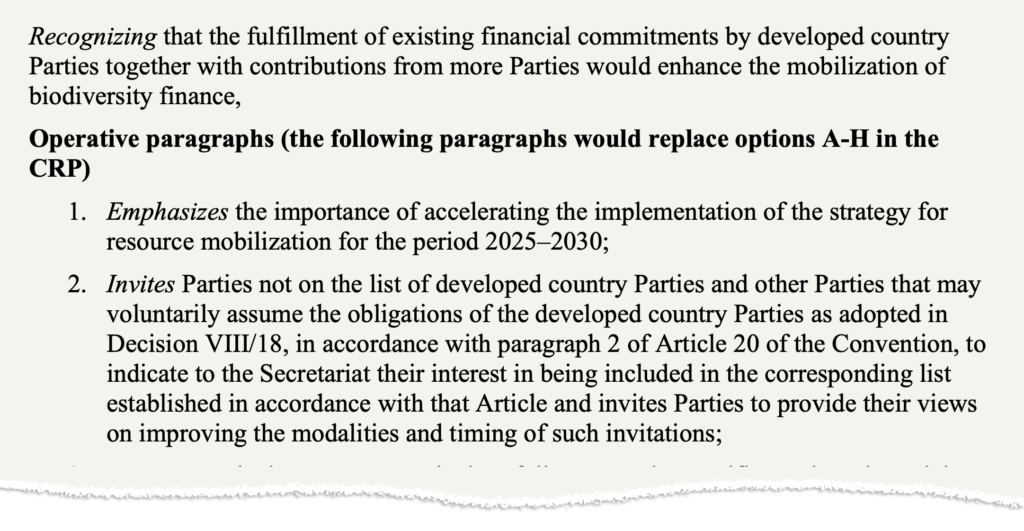
While the final decision “recognises” that “contributions from more parties would improve the mobilisation” of biodiversity finance, it steered away from issuing criteria to expand the list of donor countries.
The text makes it clear that no additions to the list would be made without inviting and confidentially consulting with interested countries, to secure their explicit consent.
Instead, the CBD secretariat “invites” countries keen to be on the list and “assume the obligations” of developed countries to “signal interest” before COP18 and at every alternate COP thereafter.
At the same time, developing countries can contribute to meeting the GBF and biodiversity convention’s goals on a “voluntary basis”, with contributions not implying inclusion on the list.
A negotiator for China told Carbon Brief at the closing plenary:
“We welcome this balanced document. It was a very long discussion that has gone [on] since [2022 nature talks in] Nairobi. But actually this time, there were a lot of sensitive issues, [there were] a lot of critical things we didn’t open in the contact groups; it mainly went to the high-level discussion.”
The decision also establishes a financial mechanism for nature funding after 2030 under the governance of the COP, a key ask from developing countries.
However, it defers decisions on what form this mechanism would take – whether this would be a new fund or based on existing arrangements – until COP18.
Oscar Soria at the