

- Formal negotiations
- Finance
- Global review
- Global report
- Digital sequence information
- Harmful subsidies
- Marine biodiversity
- Planning, monitoring, reporting and review
- Article 8(j) implementation
- Biodiversity and climate change
- Links with other bodies
- Around the COP
- Armenian presidency
- Protests
- Lobbying and influence
- Carbon and biodiversity markets

Rattle, clang, bash.
Branches, leaves, and rain slam into my bedroom window.
I knew what was coming when the sky started to transition into a green-yellow color. Even though I could predict it, it didn’t make sitting through it any easier.
As a 5-year-old, I only thought about what the weather was like. While I didn’t ponder the bigger picture of changing climate patterns, I noticed the increasing number of tornadoes. My least favorite days were those characterized by the blaring siren and sitting in the hallway in my basement while over the radio “Hennepin County, Minnesota” was repeated in a robotic voice telling us to take shelter.
What kind of kid wasn’t scared of tornadoes?

Although the immediate fear was rational, my anxiety around severe weather began to consume my life. I was afraid to go outside to see my friends at the park or to go to sports practices because I didn’t want to see any signs of a severe storm. In order to try and minimize this fear, my parents began to rationalize this phenomenon to me. They hoped this would ease my anxiety.
“Well, Lucia, the weather is changing frequently now.”
“What do you mean?” Nothing quite like the idea of constant change to calm down a kid who ran on routine. “Does this mean I have to get used to tornadoes? Do I have to accept them?”
They reassured me that I didn’t have to think about it too much, and that even now tornadoes won’t be happening that frequently. After some exposure therapy that included watching tornado documentaries and reading books about them, my fears began to subside.
I assumed that my anxiety around tornadoes existed in a vacuum, something that wouldn’t come back later in my life. But just a few years later, it manifested itself in another fear of mine.
At eight-years-old, with so much room in my brain that was once filled with fears about tornadoes, I was looking for a new fixation. This soon became snowboarding. Most of my nights were spent deep in piles of snow, and I found tranquility in the sport that I soon realized would be a lifelong passion of mine.
I continued to shred, carve, and turn through the next few years of my life. I didn’t think about tornadoes as much, but I was starting to think about snow. My seasons were being cut shorter each year, and when we did have snow, it was no longer the fluff I learned on. I began to fall into slush, and weather patterns yet again became my main concern.

This time though, I could understand the climate crisis beyond the big ideas. I was able to digest research, science, and really began to understand the implications of what was happening in our atmosphere.
I would be wrong to continue to tell my climate story without acknowledging how much of a privilege it was for severe weather to be the first negative impact I felt from climate change. That being said, it served as the catalyst to get me involved in the fight against global warming and allowed me to open my mind to other people’s stories about their tragedies due to climate change.
Now that I was older, every chance I got I took to talk about the climate crisis. Every middle school project, every conversation. I understood that it was no longer just about tornadoes or snow, but something much more dire. Something that was ruining lives.
When we fell into the pandemic lockdown, I no longer was able to take little opportunities throughout my day to talk about the fight against climate change. Without those little outlets, I had to look for something concrete to do. When I was 13 I sought out nonprofit work and began devoting my time to spreading information about the environment. My interest in the state and corporation’s roles in perpetuating the climate crisis started to grow, and legislation became my outlet.
Once I began my climate activism work, it became abundantly clear to me that severe weather was the tip of the iceberg. People were losing their jobs, their homes, their families, and their entire lives to the climate crisis. This posed the question in my mind: why am I feeling less effects of climate change than those in my state, even those minutes away from me?
This was the moment that environmentalism and social justice could no longer be mutually exclusive to me.
Coming from a white, middle-class family, with parents who both went to college and with extended family that was historically given resources to prosper, I hadn’t experienced the brunt of the climate crisis.
I committed myself to spreading legislation, education, and advocacy plans into place in order to fight against the climate crisis. I realized my fear never was really about the tornadoes themselves, but our inability to control them. I want to work towards a world where I can raise children and ease their anxieties, instead of living in a life of fear surrounding the environment.
Lucia is a Climate Generation Window Into COP delegate for COP29. To learn more, we encourage you to meet the full delegation, support our delegates, and subscribe to the Window Into COP digest.

Hi! I am Lucia Everist, a recent high school graduate from the Twin Cities Metro area. I am extremely passionate about fighting for policy change to combat the climate crisis, and tend to focus on bills related to fossil fuel divestment and climate justice. My work with Climate Generation began last year as a Youth Environmental Activist (YEA!) leader, and I cannot wait to continue my work with the organization at COP this coming fall. I hope to use this experience to share my voice as a youth activist and to spread the message to others about the importance of younger generations being involved in the policy process.
The post A Need for Control in a Climate Out of Control appeared first on Climate Generation.
Continue Reading
Prepared by a coalition of nine Western Australian union, industry, conservation, and community organisations—including UnionsWA, the Conservation Council WA, and the Smart Energy Council—the WA Clean Energy, Jobs & Industry Plan provides a practical roadmap to transform Western Australia into a clean energy powerhouse while creating thousands of secure local jobs.
Western Australia stands at a pivotal crossroads: lead the global clean energy economy or watch investment, future industries, and secure jobs go elsewhere. The WA Clean Energy, Jobs & Industry Plan outlines a transformative blueprint to harness the state’s world-class solar and wind resources. Discover how legislated renewable targets, green iron manufacturing, and a dedicated regional training strategy can generate tens of thousands of local jobs, lower household bills, and build a resilient, net-zero future for all Western Australians.

WA needs a clear and forward-thinking plan if it is going to become a competitive renewable energy powerhouse and maintain its economic strength through the energy transition.
“Western Australians know a faster renewable energy transition will lower their household expenses and prevent harmful climate pollution. But the community also needs clear direction to ensure this transition will create jobs, lower costs and not cause undue environmental harm.
“Here, sectors representing a broad range of interests have laid the groundwork for those outcomes, clearly outlining what is needed to create a future for WA that is good for the environment, for the climate, for workers and for the economy.
Summary
The WA Clean Energy, Jobs & Industry Plan sets out a strategic roadmap to position Western Australia as a global clean energy superpower while creating thousands of secure local jobs.
The report establishes three overarching goals:
- Creating local employment.
- Maintaining industrial competitiveness.
- Lowering household energy costs
To realize this vision, the framework details actionable measures to follow on from the recent WA Government announcement of a 75% Renewable Energy Target by 2031 for the South West Interconnected System. This includes developing a statewide Renewable Energy Target, coordinating statewide workforce and training pipelines, strategically planning regional infrastructure to safeguard high-value biodiversity and cultural heritage, and ensuring equitable benefit-sharing through household electrification incentives and First Nations equity partnerships. Ultimately, the plan highlights that establishing clear policy and regulatory certainty will unlock lower energy bills, boost power reliability, and secure the state’s global competitiveness in emerging green commodity export markets.

Key Findings
- Statewide Renewable Energy Target and Emissions Reduction Targets: The report calls for a statewide RET and 1.5°C aligned emission reduction targets to remove policy risk, lower capital costs, and attract clean energy investment.
- Transformative Job Creation: Accelerating the transition offers massive employment prospects, including up to 8,800 solar and battery jobs by 2050, as well as 24,000 ongoing and 11,000 construction jobs in a commercial green iron industry.
- Industrial Electrification & Competitiveness: Requiring large gas users to adopt binding electrification timetables and providing concessional financing will protect existing energy-intensive manufacturers from rising energy costs and impending domestic gas shortfalls.
- Green Commodity Export Leadership: Western Australia can build new export markets in green iron, green ammonia, and offshore oil/gas decommissioning by constructing shared common-user infrastructure and setting dedicated Green Commodity Export Targets.
- Coordinated Workforce & Training Pipeline: To address critical skill shortages the plan recommends establishing a WA Clean Energy Jobs Plan 2050, three regional training hubs, and dedicated pathways for female and under-represented apprentices.
- Environmental Safeguards & Community Benefits: Fast-tracked development must be paired with State Planning Policies that avoid high-biodiversity and cultural heritage lands, mandate new data centres to run on additional renewable power, and deliver household electrification rebates and First Nations equity partnerships.
What you can do
WA has an opportunity to lead on sustainable, clean energy and associated industries. You can help by:
- Sending an email to Environment Minister Murray Watt and Prime Minister Anthony Albanese, calling on them to reject Browse.
- Sharing this story to help more Australians understand what’s at stake.
- Encouraging your friends and family to take action.
Countries have completed the first “global review” of their progress towards reversing nature loss by 2030 at the COP17 biodiversity talks in Yerevan, Armenia.
The review “notes with deep concern” that, unless action is “rapidly accelerated”, the goal to reverse nature loss and meet a set of 23 targets by 2030 “will not be achieved”.
It “urges” countries to accelerate action, including by “increased ambition in addressing the gaps”.
Much of the discussions in Yerevan focused on how to raise the necessary funds to help developing countries protect nature.
Some major economies pushed to expand the range of nations that are expected to provide finance, with countries agreeing at the end of the two weeks of talks that non-donors that want to contribute can “signal interest” before COP18.
This came after developed countries failed to meet a target to significantly ramp up nature finance over the last few years.
It also came as a landmark fund agreed at COP16 in Colombia to pay communities for the genetic resources derived from nature stands nearly empty two years on.
The Yerevan talks marked the halfway point of the “Kunming-Montreal Global Biodiversity Framework” (GBF), the “Paris Agreement for nature” first made in 2022 and due to be achieved by 2030.
During the nearly 12-hour-long final plenary, countries voted for Quito, Ecuador, to host the COP18 nature talks, which will be held in 2028.
Countries managed to sign off on all the major negotiation texts, marking a stark contrast to COP16, which ran so far over time that the Colombian presidency lost “quorum”, forcing talks to resume in Rome months later.
Below, Carbon Brief has detailed analysis of all of the key outcomes from COP17.
Formal negotiations
Finance
Finance, predictably, was at the heart of the discord and deadlock at the Yerevan talks.
At COP17, discussions on finance had to achieve several outcomes.
The first part – to take stock of biodiversity finance mobilised so far to meet the nature deal’s goals – fell under the global review.
As the global report noted, developed countries failed to meet their commitments to raise “at least $20bn a year by 2025” for nature. Delegates pointed to falling aid levels and a sharp 27% decline in environmental funding for the 2026-30 period.
The second part was to agree on how to mobilise resources for the next four years, to meet the GBF’s goals and targets.
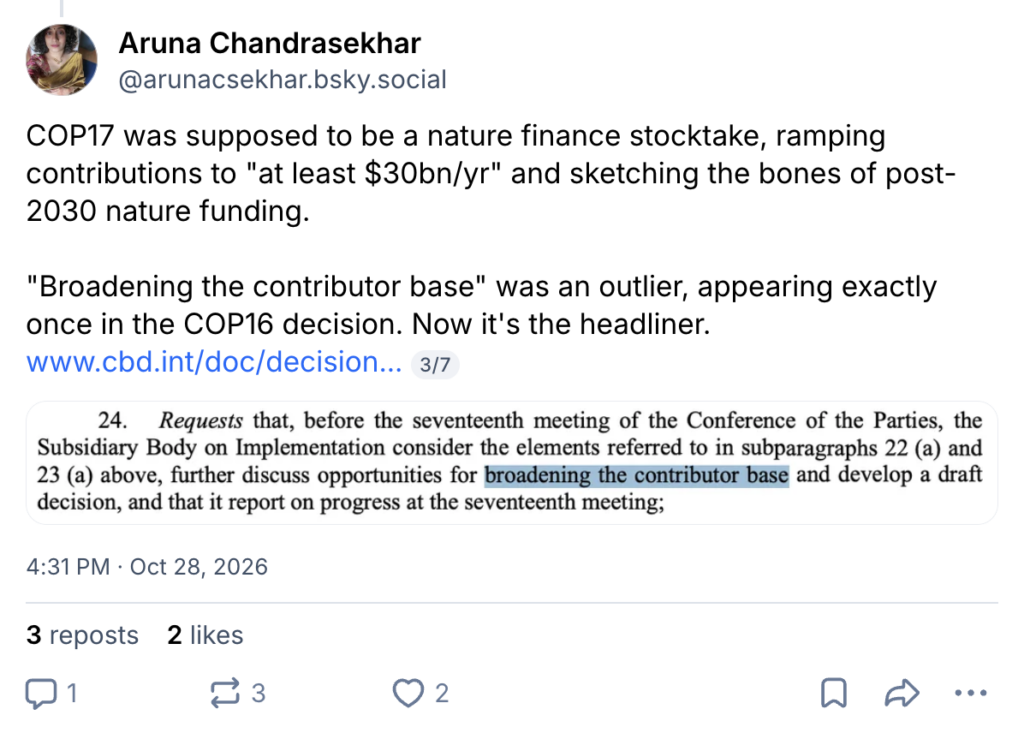
Calls to “broaden the contributor base” of who pays to protect nature – and whether that should include emerging economies – became the most fraught element of the talks.
Eventually, countries agreed on what Switzerland described as a “super, mega-delicate” text. It hinged on major “political compromises”, with “no major winner or loser”, according to Kenya.
Per the decision, countries that want to be included on a list of developed country donors can “signal interest” through bilateral, confidential consultations before COP18 and every alternate COP after.
Finally, countries also agreed on criteria to shape and resource a new, permanent financial mechanism to protect nature after 2030.
However, this did not immediately take the form of a new fund under the COP that biodiverse countries have demanded since 2022, deferring the mechanism’s institutional structure to COP18.
Resource mobilisation discussions at the GBF’s halfway mark were supposed to agree on how to close the “biodiversity finance gap” and to “increase resources from all sources” to “at least” $200bn per year by 2030, as set out in target 19 of the GBF.
The talks were largely dominated by a push, led by the JUSCANZ bloc of developed countries, to “broaden the contributor base”. This could see emerging economies, such as Qatar, China, Saudi Arabia and India, being added to the list of countries that pay to protect nature.
Article 20 of the UN Convention on Biological Diversity (CBD) states that developed countries “shall provide new and additional financial resources” to developing countries to meet the costs of implementing measures to protect nature.