

- Formal negotiations
- Finance
- Global review
- Global report
- Digital sequence information
- Harmful subsidies
- Marine biodiversity
- Planning, monitoring, reporting and review
- Article 8(j) implementation
- Biodiversity and climate change
- Links with other bodies
- Around the COP
- Armenian presidency
- Protests
- Lobbying and influence
- Carbon and biodiversity markets

I share the frustration already expressed in Jen Grey Eagle’s blog and Melody Arteaga’s interview with Ethan Vue about this morning’s youth engagement session hosted by NOAA.
As an educator born and raised on a family farm in Iowa and as a first generation college student, I am acutely aware of how access to particular types of power requires access to particular types of language. By this, I mean that participating in communities with decision making abilities — e.g. roundtable discussions at COP29 — requires the ability to bullshit. Or, as Jen put it, the reliance on the “rhetorical woke”, which in turn “takes up so much space,” as Ethan said. This morning was a case in point.
The majority of “conversations” I have heard at COP have been dominated by what I’m beginning to think of as “politik-speak”: extended monologues loaded with policy jargon, references only group insiders would know, acronyms without explanation, repetition, prefaces, summaries, statement after statement, an absence of questions, an air self-importance, an obvious affluence, self-assurance, abstractions, an unwillingness to say I don’t know. These are not conversations as I understand the term. For me, “conversation” suggests a back-and-forth: a curiosity, desire to learn and hear from others, a want to understand the perspectives of those different from yourself. Or, more frankly: a willingness to share.
When I listen to “conversations” like the one I heard this morning, I think about the farmers I knew growing up back home.
They are rough-speaking people — folks that academics and politicians might call “crass” or “vulgar” or “uneducated” or “simple.” They do not speak in abstractions. They speak about the concrete reality of their lives: the weather, the markets, troubleshooting the broken innards of iron machines, corporate greed, their aches and pains and ailments. There is no ego in their talk. There is only the comradery of shared work and experience. In this sharing, I believe, is empathy. But if the folks from back home were to be sitting where I was in that windowless meeting room this morning, the cultural power of politik-speak would’ve forced them into silence without even acknowledging their presence, and that is a shame.
I once had a mentor tell me that — while an overgeneralization — working-class folks tend to only say as much as what needs to be said in order to convey the idea at hand. I believe the same is true for young people working for climate justice in communities. The young folks with whom I have had the privilege of working — and from whom I have had the great fortune to learn — communicate about the climate crisis in similar ways. They know the stakes of our time. They feel the urgency in their bones. They know there’s neither need nor time to self-promote or grandstand. “As young as we are,” Georgina Masega, a ten year old activist, said during her youth panel yesterday, “we still understand the Paris Agreement.” Young folks on the ground understand, yet they refuse to reproduce the platitudes and empty promises of politik-speak. Instead, they demand—directly, angrily, fully articulating the already ongoing impacts of the climate emergency on their homes and communities—”the right to be heard.” I relish this frankness. And yet, in Baku, so far, with few exceptions, this has come only from the margins.
Before I left for COP, I asked my students (undergraduates at the University of Minnesota) to tell me what questions they want me to think about while I am here. I wrote their responses down. My students would like climate leaders — the affluent old and young — to answer the following pointed questions:
- What are political leaders actually doing to give young people a chance to work toward a greener world?
- What are governments actually doing at local and national levels? Why are individuals and communities left with so much of the burden?
- What’s preventing larger action? How can we educate to engage?
- How are teachers working inside and outside of formal education to support climate action?
- How can we advocate for education as a worthwhile profession worthy of collective respect?
- How are educators involving families in and out of the classroom?
- What coalitions have been helpful in a local or global context?
- How are global educators talking about the crisis in today’s sociopolitical climate? How do educators spark curiosity and engagement, rather than fear?
These are excellent, necessary questions. I will continue to ask them though I am not confident I will find answers. Still, as frustrated and deflated as I felt this morning, I am buoyed by two things.
First: I have the great fortune to share my COP29 experience with a group of incredibly kind, intelligent, funny, and motivated community organizers who understand the importance of working together, with communities, for a just transition. Their work involves advocating for concrete policies to advance racial equity, Indigenous sovereignty, the redistribution of wealth, accessible and stigma-free healthcare, language revitalization, culturally sustaining education, and more. I am grateful to them.


Second: even as my fellow delegates — my friends, now — are diligent in their labor, they are also acutely aware of the importance of renewing the heart. Despite this morning’s frustration and fatigue, by evening we found ourselves commiserating over dinner. In that stone restaurant nestled in Baku’s Old Town, surrounded by paintings of oil rigs and pomegranates, I was reminded of all that I admire about my community back home. Straight talk, ample laughter, and a want to take care of one another. Again, I am grateful to those young folks.
In the remaining days of COP, I am not confident I will get the answers to the questions my students pose. But I can and will respond to them with an intention: to ensure that they — the young folks committed to communities and justice — have the space to speak and lead. I second Ethan’s call to recognize the youth already engaged in climate justice and “give them the platform to not only help their communities but other communities.” I second Jen’s call “to remind ourselves that we are never the most important in the room and that collective and authentic voices being equally heard is not only vital but lifesaving.” I am grateful for these insights. These lessons, I believe, will be the method for keeping the real work going and hope alive.
Nick is a Climate Generation Window Into COP delegate for COP29. To learn more, we encourage you to meet the full delegation, support our delegates, and subscribe to the Window Into COP digest.

Nick Kleese is an Iowa farm kid turned literacy educator. Nick serves as the Associate Director of Community Engagement at the Center for Climate Literacy at the University of Minnesota, Managing Editor for Climate Literacy in Education, and Editor at Climate Lit. He is also Co-Founder of KidLitLab! He has taught middle school and high school English, undergraduate children’s literature courses, and outdoor immersion experiences for kindergarteners. His current research explores the role young people’s literature and media could play in advancing an interspecies democracy.
The post Real Talk appeared first on Climate Generation.
Continue Reading
Prepared by a coalition of nine Western Australian union, industry, conservation, and community organisations—including UnionsWA, the Conservation Council WA, and the Smart Energy Council—the WA Clean Energy, Jobs & Industry Plan provides a practical roadmap to transform Western Australia into a clean energy powerhouse while creating thousands of secure local jobs.
Western Australia stands at a pivotal crossroads: lead the global clean energy economy or watch investment, future industries, and secure jobs go elsewhere. The WA Clean Energy, Jobs & Industry Plan outlines a transformative blueprint to harness the state’s world-class solar and wind resources. Discover how legislated renewable targets, green iron manufacturing, and a dedicated regional training strategy can generate tens of thousands of local jobs, lower household bills, and build a resilient, net-zero future for all Western Australians.

WA needs a clear and forward-thinking plan if it is going to become a competitive renewable energy powerhouse and maintain its economic strength through the energy transition.
“Western Australians know a faster renewable energy transition will lower their household expenses and prevent harmful climate pollution. But the community also needs clear direction to ensure this transition will create jobs, lower costs and not cause undue environmental harm.
“Here, sectors representing a broad range of interests have laid the groundwork for those outcomes, clearly outlining what is needed to create a future for WA that is good for the environment, for the climate, for workers and for the economy.
Summary
The WA Clean Energy, Jobs & Industry Plan sets out a strategic roadmap to position Western Australia as a global clean energy superpower while creating thousands of secure local jobs.
The report establishes three overarching goals:
- Creating local employment.
- Maintaining industrial competitiveness.
- Lowering household energy costs
To realize this vision, the framework details actionable measures to follow on from the recent WA Government announcement of a 75% Renewable Energy Target by 2031 for the South West Interconnected System. This includes developing a statewide Renewable Energy Target, coordinating statewide workforce and training pipelines, strategically planning regional infrastructure to safeguard high-value biodiversity and cultural heritage, and ensuring equitable benefit-sharing through household electrification incentives and First Nations equity partnerships. Ultimately, the plan highlights that establishing clear policy and regulatory certainty will unlock lower energy bills, boost power reliability, and secure the state’s global competitiveness in emerging green commodity export markets.

Key Findings
- Statewide Renewable Energy Target and Emissions Reduction Targets: The report calls for a statewide RET and 1.5°C aligned emission reduction targets to remove policy risk, lower capital costs, and attract clean energy investment.
- Transformative Job Creation: Accelerating the transition offers massive employment prospects, including up to 8,800 solar and battery jobs by 2050, as well as 24,000 ongoing and 11,000 construction jobs in a commercial green iron industry.
- Industrial Electrification & Competitiveness: Requiring large gas users to adopt binding electrification timetables and providing concessional financing will protect existing energy-intensive manufacturers from rising energy costs and impending domestic gas shortfalls.
- Green Commodity Export Leadership: Western Australia can build new export markets in green iron, green ammonia, and offshore oil/gas decommissioning by constructing shared common-user infrastructure and setting dedicated Green Commodity Export Targets.
- Coordinated Workforce & Training Pipeline: To address critical skill shortages the plan recommends establishing a WA Clean Energy Jobs Plan 2050, three regional training hubs, and dedicated pathways for female and under-represented apprentices.
- Environmental Safeguards & Community Benefits: Fast-tracked development must be paired with State Planning Policies that avoid high-biodiversity and cultural heritage lands, mandate new data centres to run on additional renewable power, and deliver household electrification rebates and First Nations equity partnerships.
What you can do
WA has an opportunity to lead on sustainable, clean energy and associated industries. You can help by:
- Sending an email to Environment Minister Murray Watt and Prime Minister Anthony Albanese, calling on them to reject Browse.
- Sharing this story to help more Australians understand what’s at stake.
- Encouraging your friends and family to take action.
Countries have completed the first “global review” of their progress towards reversing nature loss by 2030 at the COP17 biodiversity talks in Yerevan, Armenia.
The review “notes with deep concern” that, unless action is “rapidly accelerated”, the goal to reverse nature loss and meet a set of 23 targets by 2030 “will not be achieved”.
It “urges” countries to accelerate action, including by “increased ambition in addressing the gaps”.
Much of the discussions in Yerevan focused on how to raise the necessary funds to help developing countries protect nature.
Some major economies pushed to expand the range of nations that are expected to provide finance, with countries agreeing at the end of the two weeks of talks that non-donors that want to contribute can “signal interest” before COP18.
This came after developed countries failed to meet a target to significantly ramp up nature finance over the last few years.
It also came as a landmark fund agreed at COP16 in Colombia to pay communities for the genetic resources derived from nature stands nearly empty two years on.
The Yerevan talks marked the halfway point of the “Kunming-Montreal Global Biodiversity Framework” (GBF), the “Paris Agreement for nature” first made in 2022 and due to be achieved by 2030.
During the nearly 12-hour-long final plenary, countries voted for Quito, Ecuador, to host the COP18 nature talks, which will be held in 2028.
Countries managed to sign off on all the major negotiation texts, marking a stark contrast to COP16, which ran so far over time that the Colombian presidency lost “quorum”, forcing talks to resume in Rome months later.
Below, Carbon Brief has detailed analysis of all of the key outcomes from COP17.
Formal negotiations
Finance
Finance, predictably, was at the heart of the discord and deadlock at the Yerevan talks.
At COP17, discussions on finance had to achieve several outcomes.
The first part – to take stock of biodiversity finance mobilised so far to meet the nature deal’s goals – fell under the global review.
As the global report noted, developed countries failed to meet their commitments to raise “at least $20bn a year by 2025” for nature. Delegates pointed to falling aid levels and a sharp 27% decline in environmental funding for the 2026-30 period.
The second part was to agree on how to mobilise resources for the next four years, to meet the GBF’s goals and targets.
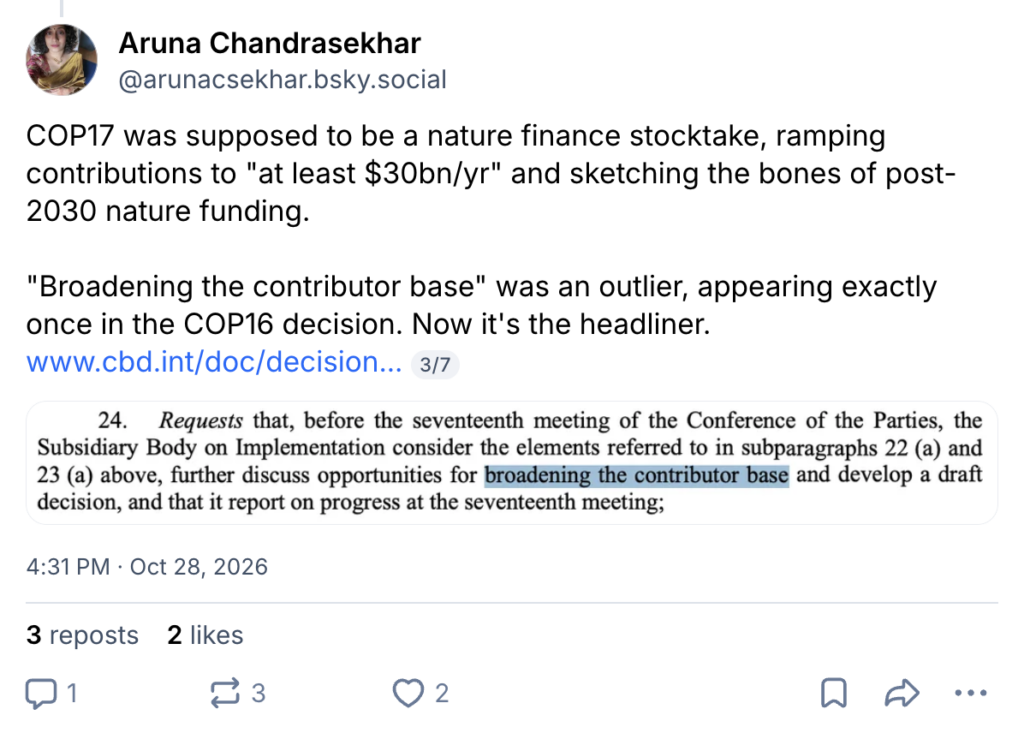
Calls to “broaden the contributor base” of who pays to protect nature – and whether that should include emerging economies – became the most fraught element of the talks.
Eventually, countries agreed on what Switzerland described as a “super, mega-delicate” text. It hinged on major “political compromises”, with “no major winner or loser”, according to Kenya.
Per the decision, countries that want to be included on a list of developed country donors can “signal interest” through bilateral, confidential consultations before COP18 and every alternate COP after.
Finally, countries also agreed on criteria to shape and resource a new, permanent financial mechanism to protect nature after 2030.
However, this did not immediately take the form of a new fund under the COP that biodiverse countries have demanded since 2022, deferring the mechanism’s institutional structure to COP18.
Resource mobilisation discussions at the GBF’s halfway mark were supposed to agree on how to close the “biodiversity finance gap” and to “increase resources from all sources” to “at least” $200bn per year by 2030, as set out in target 19 of the GBF.
The talks were largely dominated by a push, led by the JUSCANZ bloc of developed countries, to “broaden the contributor base”. This could see emerging economies, such as Qatar, China, Saudi Arabia and India, being added to the list of countries that pay to protect nature.
Article 20 of the UN Convention on Biological Diversity (CBD) states that developed countries “shall provide new and additional financial resources” to developing countries to meet the costs of implementing measures to protect nature.