

Person County, North Carolina is beautiful. The drive up from Durham rolls through fields of corn and tobacco, past horse pastures and cattle farms. The county, nestled up next to the Virginia line, is rural, with a sparse 40,000 people living and farming within its 404 square miles.
Person County is also home to two of Duke Energy’s six North Carolina coal plants, including Roxboro, the largest coal plant in North Carolina and one of the largest power plants in the United States. Carolina Power and Light built the Roxboro Steam Electricity Plant in 1966, and coal has been brought in by the trainload and burned to generate electricity ever since. Duke Energy Progress, formerly Carolina Power and Light, has proposed replacing two of the four coal units with a fossil gas combined cycle plant as soon as 2029.

Duke Energy Progress’ Roxboro Steam Electricity Plant in Person County, NC (photo by S. Robbins)
In 1950, almost two decades before the Roxboro coal plant began operation, the neighboring community of Semora built Woodland Elementary School. Today, the school is home to over 200 children in kindergarten through fifth grade. The school is also dangerously close to the coal plant – and more specifically to the emissions stacks that send mercury, arsenic, and other pollutants into the air. How close? The coal plant is 7,756 feet from the school. Below is a photo taken from the school’s entrance driveway on Semora Road. These pollutants cause asthma, heart problems, cancer, neurological disorders, and premature death.

Duke Energy Progress’ Roxboro coal plant see from Woodland Elementary School (Photo by S. Robbins)
And while the coal plant is close to the elementary school, the proposed fossil gas plants will be even closer (a mere 3,776 feet from the school). Fossil gas plants emit NOx, SOx, carbon monoxide, and particulate matter, resulting in similar health impacts. Person County – a rural county without concentrations of heavy industry – has a higher asthma rate than neighboring counties, including the more urbanized Orange and Durham Counties.
Duke plans to build the new gas plant and have it up and running before they shutter two of the four coal units. They can do this because they have a lot of land – almost 7,000 acres. They also have a lot of transmission lines and transmission capability in this location, which is a tremendous asset. Some of these large transmission lines have an existing right-of-way into the PJM wholesale market a mere five miles away across the Virginia border.
Could there be a better alternative?
Instead of replacing one form of pollution with another form of pollution, this 7,000 acre site provides a perfect opportunity to transition the Roxboro site into a significant solar and battery storage facility, backstopped by access to the PJM market.
One type of battery technology that might be great for this site is Form Energy’s iron-air 100 hour battery. This technology is no longer speculative – the company has just completed construction of their factory in West Virginia. Xcel Energy is replacing its 2,238 MW Sherco coal plant in Minnesota (similar in size to Duke’s Roxboro plant) with solar and a Form iron-air battery, scheduled to come online in 2025.
Building solar and energy storage on this site instead of more fossil generators would 1) eliminate the additional costs of fossil gas pipeline expansion needed to supply the plant, 2) eliminate the ongoing fossil gas fuel costs that are passed directly to ratepayers, also 3) allow Duke to take advantage of the tax credits and Energy Infrastructure Reinvestment (EIR) program funds available for clean energy projects built on former coal sites, reducing costs to ratepayers while also cutting emissions out completely in the local community rather than merely reducing them. Adding solar and energy storage to this large site would also maintain the tax value of the site.
What about the cost?
Xcel estimates the cost of its solar and iron-air battery storage project at about $1 billion, which sounds expensive. But the first of two of the replacement fossil gas plants at Roxboro is estimated to cost about $2 billion (and this does not include pipeline costs and ongoing fossil gas fuel costs that ratepayers will also shoulder). Solar paired with energy storage has no volatile fossil gas costs to pass along to customers.
Person County deserves better
Person County has hosted Duke Energy’s dirty coal plants for decades. In exchange, the community has received the beautiful Hyco Lake (see photo below), significant employment at the coal plants, and important tax revenue. The employment offered by the coal plants will not be maintained by the proposed gas plants, which are largely automated, so Duke must plan for an equitable transition for employees of the coal plant.

Duke Energy Progress’ Roxboro coal plant on Hyco Lake (Photo by S. Robbins)
But Hyco Lake is here to stay, and its beauty will grow as the coal plant shrinks. The tax revenue can be maintained as well, all while eliminating – not reducing – eliminating the local pollutants that have been impacting the families and the school children who have been living and learning in the shadow of coal smoke stacks for 57 years.
The North Carolina Utilities Commission will decide soon whether to allow Duke to build the gas plant. SACE is working with the Southern Environmental Law Center to oppose the gas plant and to ask for a better alternative for the Person County community and for all of Duke’s customers. We will keep you updated in future columns as a hearing date becomes available.
The post Person County deserves a better deal from Duke appeared first on SACE | Southern Alliance for Clean Energy.

 For most of our lives, many of us boomers have believed that the biggest threat to the United States was our president, starting with Tricky Dick Nixon, the inventor of the “trickle-down economics,” liar Ronald Reagan, and GW (the moron) Bush.
But yes, none of us was prepared for the cold, calculating criminal who is Donald Trump.
There Were Prior Threats to the Nation Stemming from the White House
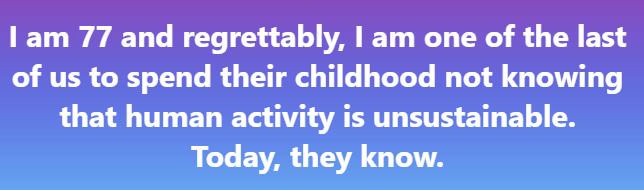 The fact that human activity is unsustainable has been revealed to us gradually over the last century. Rachel Carson’s “Silent Spring” was published 63 years ago.
That said, the ideas of climate change, ocean acidification, and loss of biodiversity have been essentially unchallenged by scientists for just the last couple of decades.
The only thing standing in the way of rapid environmental progress is greed, and in the end, that may prove to be an unbeatable foe. Decarbonizing our grid and transportation sector will eventually destroy the fossil fuel industry, a group so powerful that it has a stranglehold, both on our lawmakers and on our corporate-owned media, that works so hard to misinform our citizenry.
 It’s still possible that our most senior military leaders will insert themselves in time to prevent some truly catastrophic event here in the United States/abroad.
I keep thinking I’ll read about an exchange like this:
Trump: We’re invading Greenland.
Some four-star general: The f*** we are.
This may sound like a pipe dream, but these are people of real honor and integrity who take their oaths to our constitution quite seriously.
Will the U.S. Top Military Intervene Before Trump Inflicts Irreparable Damage



-

 Greenhouse Gases2 years ago
嘉宾来稿:满足中国增长的用电需求 光伏加储能“比新建煤电更实惠”
-
Climate Change1 year ago
Guest post: Why China is still building new coal – and when it might stop
-
Greenhouse Gases1 year ago
Guest post: Why China is still building new coal – and when it might stop
-

 Climate Change2 years ago
嘉宾来稿:满足中国增长的用电需求 光伏加储能“比新建煤电更实惠”
-

 Renewable Energy11 months ago
Sending Progressive Philanthropist George Soros to Prison?
-
Climate Change2 years ago
Bill Discounting Climate Change in Florida’s Energy Policy Awaits DeSantis’ Approval
-
Greenhouse Gases1 year ago
嘉宾来稿:探究火山喷发如何影响气候预测
-

 Climate Change2 years ago
Analysis: China’s CO2 falls 1% in Q2 2024 in first quarterly drop since Covid-19