

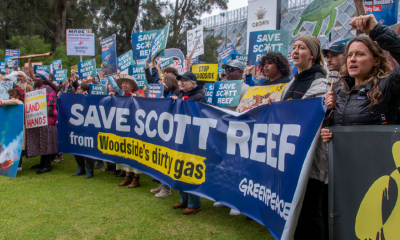
SYDNEY – Thursday 16 May 2024 – Greenpeace Australia Pacific has today welcomed news that the Federal Government must now drop its sneaky means to fast-track approvals for new gas projects, but warned the Government must still rule out further climate-wrecking gas projects, like Woodside’s Burrup Hub.
“After a series of horrifying commitments to new gas from the Government this week, we’re glad to see that some sense has prevailed,” Greenpeace Australia Pacific Head of Climate and Energy Joe Rafalowicz said today.
“Along with our allies in the climate movement, Greenpeace had been extremely concerned to see Resources Minister Madeleine King use sneaky means to fast-track approvals for new gas projects while trying to sidestep environmental protections under the EPBC Act, which she buried in a Bill largely about worker safety.
“Sadly, the fight against toxic, polluting gas isn’t over – in fact, it’s only just begun.
“Madeleine King and the gas lobby don’t just want to ignore the laws that protect our environment – they want a blank cheque to drill for dirty, climate-wrecking gas.
“Just this week we saw Australian and Pacific communities betrayed by the release of the so-called ‘Future Gas Strategy’ – a document that might as well have been written by the fossil fuel lobby, handcuffing our country to decades more climate-wrecking gas amid a climate crisis.
“The gas industry has been pushing the Labor government to weaken Australia’s environmental protections because it has a suite of new projects in the pipeline that pose a major threat to our oceans and climate.
“To secure a safe climate future for Australian and Pacific communities, laying the groundwork for more new gas during a climate crisis is the last thing we need.
“The biggest and most dangerous gas project on the books is Woodside’s Burrup Hub, which would require drilling up to 50 wells around Scott Reef, Australia’s largest oceanic reef system and a vital habitat for pygmy blue whales and green turtles.
“Minister Plibersek is expected to decide whether to give Woodside the green light to drill at Scott Reef this year.
“These are the moments that count – where Labor writes its legacy on environmental protection and climate action into the history books.
“Now more than ever, we need Labor to step up and say no to Woodside’s climate-wrecking, nature-destroying Burrup Hub.”
For more information or to arrange an interview please contact Lisa Wills on 0456 206 021.



Energy bills in the UK have continued to soar in 2026, with intense debate raging about how to bring them down.
In October 2026, the cap on household energy bills reached its highest level in three years, rising by £60 amid high gas prices driven by the Iran war.
The cap is forecast to jump by as much as another quarter in January 2027, pushing annual energy bills towards £2,200.
Energy bills have not been that high since 2022 when, in the fallout of the Russian invasion of Ukraine, the UK government spent more than £60bn on supporting consumers through the crisis.
While expensive gas is behind the lion’s share of the rise in bills since 2020, policy costs and investment in the gas and electricity grids are also putting some pressure on prices.
This has sparked conflicting calls to continue the clean-energy transition to get off the “fossil-fuel rollercoaster”, to move more slowly – or to abandon climate goals in favour of more gas.
Below, Carbon Brief looks at the real drivers of high energy bills in the UK, what has been done to address them to date and what options are available to cut them going forward.
These include taking more policy costs off electricity bills, boosting flexibility or shifting to more efficient technologies with lower running costs, such as heat pumps and electric vehicles (EVs).
What is driving high energy bills?
In October 2026, UK household energy bills reached their highest levels since 2022, with the price cap for typical homes hitting £1,723 per year, up 47% in real terms since October 2020.
Industrial energy users also face high costs, particularly for their electricity.
For households, another sharp increase is now all but guaranteed under the price cap for January 2027, which is forecast to rise by around 25% from current levels.
Wholesale costs for electricity and gas make up 44% of the current cap of £1,723 per year, according to Carbon Brief analysis of figures from thinktank Nesta, shown in the figure below.
The wholesale cost of both electricity and gas is tied to gas prices, due to the marginal pricing system used in power markets in the UK and most other countries.
Network charges make up a further 24% of bills and operating costs are another 17%, whereas policy costs only account for 7% of the total.
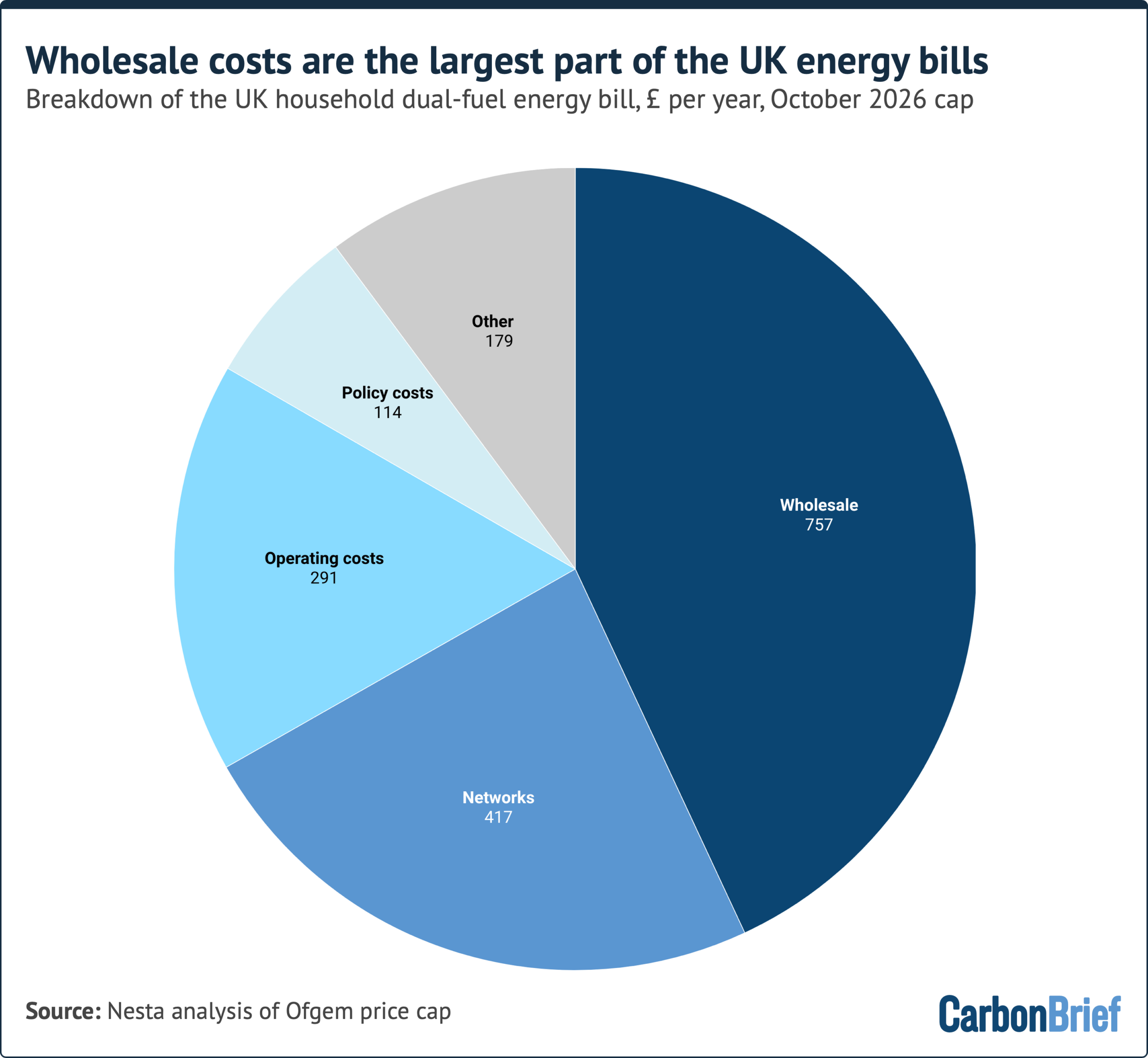
There has been increasing interest in the so-called “non-commodity costs” – those not related to wholesale energy – that now make up a significant portion of bills, as shown in the figure above.
Yet while these costs have been increasing – particularly those related to investing in energy networks – they are not the reason why energy bills have soared once again in recent months.
Indeed, Nesta analysis recently published by Carbon Brief shows that, contrary to widespread UK media and political narratives, a surge in wholesale costs driven by expensive gas is responsible for more than 80% of the rise in dual-fuel household energy bills since 2020, as shown below.
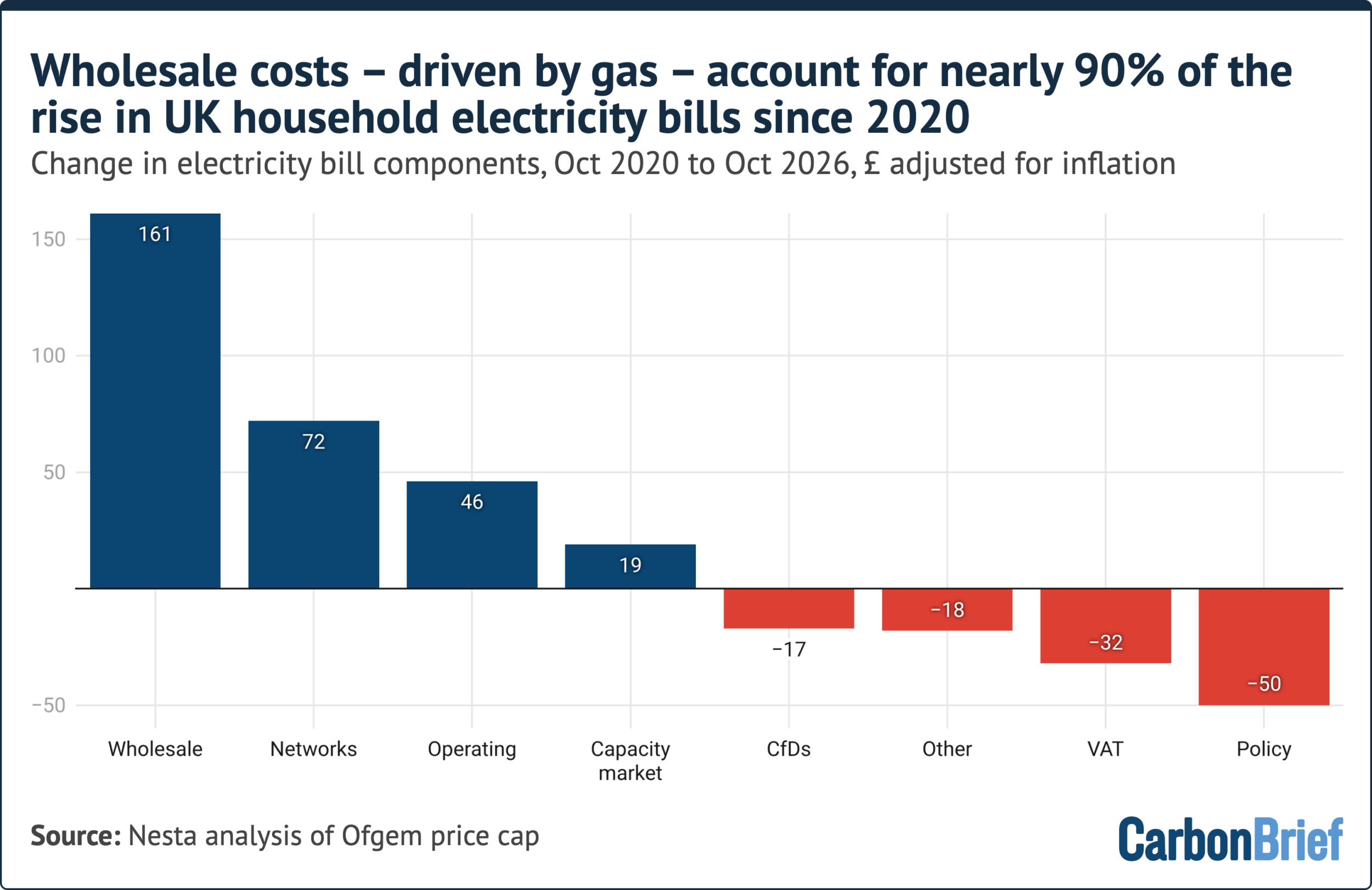
The second-largest driver of the rise in costs since 2020 is due to the cost of operating, maintaining and expanding gas and electricity networks, as shown in the figure above.
At the end of 2025, energy regulator Ofgem approved £29bn of upfront investment into the national gas and electricity grids, as well as the gas distribution network that connects to homes and businesses. This is part of a wider package of up to around £90bn of investment out to 2031.
As a result of these investment plans, network charges are expected to increase by around 50% between 2025 and 2030, from £222 a year to £330 for a typical dual-fuel household.
(This figure covers gas and electricity transmission and gas distribution, but not electricity distribution. A further package of increased investment in the electricity distribution network, for the period from 2028-2033, is due to be approved by Ofgem by the end of 2027.)
The increase in network costs is often attributed to the need to connect increasing levels of geographically dispersed renewable energy sources, particularly wind power.
However, a significant proportion of these increases relate to the need to update ageing infrastructure after decades of under-investment.
This package of investment represents a “once-in-a-generation renewal of our energy infrastructure”, Ofgem head Tim Jarvis told a recent conference attended by Carbon Brief.
Ofgem says some three-fifths of the £108 per household per year rise in network charges to 2030 is due to “business-as-usual” costs such as ongoing maintenance of the gas and electricity networks. It says only £30 is due to investing in expanding the electricity transmission grid.
Similarly, according to the Energy Networks Association, up to 80% of the investment in electricity grids is required to maintain existing assets, with the remainder going towards expansion.
Another point of contention is “constraint costs”, where windfarms are switched off if the network lacks the capacity to transmit their power – and gas plants are switched on to meet demand.
These costs sit within network balancing charges and – despite rising steeply in recent years, partly due to high gas prices – these still make up just £35, or 4% of typical annual electricity bills.
Today, rising constraint costs are partly a reflection of the decision in the 2010s to postpone network investments under a policy known as “connect and manage”. Ofgem says the investments it has now approved in the electricity grid would help limit constraints in the future.
Trade association RenewableUK’s head of policy Steven Agnew points to a recent review by the National Audit Office and says investment in the grid is “critical to avoid large rises in consumers’ bills as more of the country’s electricity is generated from clean sources”. He adds:
“The current crunch is the result of inaction by successive previous governments to tackle this issue. Consumers are losing out on some of the benefits because low-cost wind has to be turned down and expensive gas turned up elsewhere.”
Projections from the National Energy System Operator (Neso) illustrate how constraint costs depend on the relative pace of expansion in new generating capacity and the electricity network.
It says balancing costs could rise from £2bn to £8bn by 2030, if the grid faces delays. However, its central projection is £3-4bn, with a range of options available to limit this increase.
Finally, following years of elevated energy bills, the cost of “bad debt” has increased. This is where unpaid bills are recovered by energy companies through a charge on all households.
These charges add around £60 to typical bills, according to Carbon Brief analysis of Ofgem