

The chair of this month’s penultimate round of talks to agree a global treaty on tackling plastic pollution is concerned that certain countries “seem to have forgotten” that all nations originally backed an ambitious pact.
Canadian Environment Minister Steven Guilbeault, who will host the talks in Ottawa starting on April 23, said in an interview with Climate Home that all governments had “agreed collectively that we wanted an ambitious treaty to fight plastic pollution and to eliminate it by 2040”.
But, he added, “unfortunately some countries seem to have forgotten that’s what we agreed upon [at the United Nations Environment Assembly] almost two years ago. I’m going to make it my mission in life in the coming weeks to remind everyone that this is our collective agreement.”
He did not specify which countries appear to be backtracking, but noted that some “are in more of a hurry than others” to get a deal – “which is why you have a high-ambition coalition”.
That coalition is pushing for a strong accord to end plastic pollution and includes all large developed countries except the United States, plus some developing nations.

The members of the self-described “high-ambition coalition” are coloured in light blue.
Guilbeault was speaking during the latest UN Environment Assembly (UNEA) in Nairobi last month, where some governments tried to water down anti-plastics language.
David Azoulay, from the Center for International Environmental Law, told Climate Home “a number of countries” had tried at this year’s UNEA to “get around or away” from the mandate to set up a plastics treaty.
They did not propose a rival resolution, he said, “probably because they saw there was very little appetite for it”. But that did not stop them from attempting to use the assembly to influence the plastics treaty negotiations, he added. The talks are organised by the United Nations Environment Programme.
In submissions to the UNEA, the US tried to delete the words “legally binding” in reference to the plastics treaty, Iran wanted to remove “ambitious”, and Saudi Arabia attempted to cut a reference to accelerating the treaty talks.
Russia’s ambassador to Kenya, Dmitry Maksimychev, told the UNEA that Russia is an “active participant” in the talks and “we do not support shifting emphasis to restrictive measures of a productive or commercial nature”.
Plastics support fossil fuel demand
Over the last two years, government negotiators have gathered for three rounds of talks on setting up the treaty to tackle plastic pollution.
The fourth round will be held in Ottawa this month, and the fifth and supposedly final session will be in the South Korean city of Busan in November. The agreement should then be adopted officially at a diplomatic conference in 2025.

BP expects the share of oil demand from non-combusted (grey) sectors like plastic to rise in the next few decades. (Photo: BP/Screenshot)
Plastics are made from oil and gas, and their production causes 3% of greenhouse gas emissions. The fossil fuel industry predicts that as demand for oil and gas for energy falls, they can make up for it by selling their products to plastic manufacturers.
New estimates from the US-based Lawrence Berkeley National Laboratory show plastic production emits as much carbon pollution each year (2.24 gigatonnes of carbon dioxide equivalent in 2019) as 600 coal-fired power plants.
A study published by the lab on Thursday, supported by Bloomberg Philanthropies’ Beyond Petrochemicals campaign, warned that carbon pollution from plastic production could triple by 2050.
And even if global power grids shift over to clean energy, the plastic industry’s share of the global carbon budget could rise from just over 5 percent now to more than 20 percent by mid-century, based on conservative projections for industry growth, it added.
Plastic litter also makes flooding – already exacerbated by climate change – worse.
In Zambia, Lwenga Mulela, whose company converts plastic waste into useful products like paving and plant pots, told Climate Home plastic bottles pile up in drainage channels in the nearby capital Lusaka and stop rain escaping down the drain, causing flooding on the streets.

Lwenga Mulela shows plastic wrappers which she turns into products like paving on March 12 24. (Photo: Joe Lo)
During a brief rainstorm in Lusaka’s Central Business District in March, Climate Home saw cars slowing to a crawl to pass through puddles and pedestrians jumping over water to stay dry.
Money talks
The UN treaty negotiations have so far been divided on whether to focus on the production of plastic, potentially through targets to reduce it, as the “high-ambition coalition” and climate campaigners want.
The alternative is to limit its scope to expanding recycling of plastic, as the industry itself and the US, Saudi Arabia and others are calling for.
Asked if plastic production should be in the treaty, Canada’s Guilbeault said: “We have to look at every element of plastic pollution.” But asked about the biggest remaining divides, he pointed to finance.
Many countries, particularly small islands, “receive an incredible amount of plastic pollution that they’re not responsible for, and there should be an international mechanism to help them deal with the problem,” he said.

Activists clean up a beach in Fiji in 2016 (Photo: Kurt Peterson/Greenpeace)
“Right now with the economic situation internationally – high interest rates, high inflation – it’s a difficult conversation but it’s a necessary conversation nonetheless,” he added.
This was highlighted by Madagascar’s representative at the UNEA who said his country backed a plastics treaty and was “insisting on the need to prepare global countries of the south and support them in this regard”.
In Zambia, entrepreneur Mulela also called for finance for developing countries to develop waste disposal and recycling systems. She said the companies that produce the plastic should provide that funding, as should richer nations.
“I think they have an obligation,” she said. “It’s a global village, so what is affecting one part of the world is also affecting every other part of the world.”
Approval by consensus or vote?
If governments do not unanimously agree on a text in November, a treaty could be endorsed through a two-thirds majority vote – but, for many negotiators, that would be a last resort.
Jyoti Mathur-Filipp, head of the secretariat responsible for the talks, told Climate Home “there is no wish on any member state’s part to actually have a vote on substance… so for us, we hope that we will adopt this treaty with consensus, without a vote.”
But, for campaigners like Greenpeace’s Graham Forbes, the apparent unwillingness to vote could end up weakening or delaying the treaty as he argued that a process based on consensus has enabled low-ambition countries to “undermine substantive progress”.
“Voting would enable member states that are serious about addressing the issue to negotiate a treaty that actually gets at the core of the issue: reducing plastic production and use,” he said.
Guilbeault took the middle-ground, noting that not every country has to agree to something for it to be adopted by consensus.
He wants the new treaty “to have as much buy-in as possible from as many countries as possible but, at the same time, I don’t think the world should be held hostage to the interest of a few countries – that’s not consensus either.”
The talks in Ottawa are tasked with narrowing down the draft text for the treaty. Guilbeault said he hopes to see 75-80% of it agreed this month, but added that the thorniest issues will be left to Busan in November.
(Reporting by Joe Lo; editing by Megan Rowling)
The post Canadian minister vows to fight attempts to weaken plastic pollution treaty appeared first on Climate Home News.
Canadian minister vows to fight attempts to weaken plastic pollution treaty

Climate Change
‘COP-out’: COP31 fails to deliver the ambition needed to phase out fossil fuels and address climate breakdown
Antalya, Türkiye, Sunday 22 November 2026 — The COP31 climate summit in Antalya has ended in disappointment and anger, as the final COP31 outcome failed to deliver on critical issues like overshooting the 1.5°C limit, fossil fuel phase out and climate finance. Greenpeace Australia Pacific says that Australia did not deliver the deal that the world needed in a time of escalating climate breakdown.
In Antalya, Dr Susie Byers, Head of Advocacy at Greenpeace Australia Pacific, said: “We need to call this COP outcome what it is: a COP-out that has failed to deliver what the world urgently needs given the scale of the crisis we’re facing. It’s a colossal lost opportunity, and one that the world won’t easily forget.
“Coming out of Belém there was momentum to phase out fossil fuels, but COP31 wasn’t able to harness that energy and drive the world forward. The failure to adopt the Cover Decision means there’s now no acknowledgement of, let alone response to, 1.5°C overshoot — the survival line for Pacific nations. Electrification, defence of science, protection for the oceans, and advances on climate finance were all casualties of cynical attempts to derail climate action with dangerous distractions like CCUS.
“Australia knew how hard this task would be and put their hand up anyway. In the end, they didn’t get it done. This outcome validates exactly why so many countries are looking towards parallel tracks like the International Court of Justice Advisory Opinion and national transition roadmaps, where we’ve seen microdiplomacy and Pacific leadership again lead the way. This spirit of multilateralism and collaboration is how we will move beyond rhetoric to concrete actions, and end the fossil fuel chokehold.”
Also in Antalya, Shiva Gounden, Head of Pacific at Greenpeace Australia Pacific, said: “They called this an ‘implementation’ COP, but implementation means nothing when the foundation is broken. The frontline communities leading this fight came to Antalya demanding the urgent, definitive action required to confront the sickening realities of 1.5°C overshoot. Instead, developed countries turned their backs on their historical responsibilities, held climate finance hostage, and treated the debt they owe as a cheap bargaining chip.
“At the exact same time, Parties and negotiating blocs deliberately blocked the bold action the world needed on mitigation, peddled toxic distractions like CCUS, and intentionally scrubbed the words ‘fossil fuels’ from the final text. A strong Presidency that understood the urgency of the situation would not have let this happen; Australia failed to deliver what it promised the Pacific.
“Billions of people across the world are fiercely defending their lives, their homes, their cultures, and their livelihoods, and we came here with their voices demanding real action. By choking off the money and refusing to name the root cause of this collapse, polluting nations made a calculated choice to protect their own interests over our shared future. The Pacific will increasingly look towards parallel paths like the ICJ climate advisory opinion, and the Santa Marta process, to continue finding solutions because that is what our people need.”
ENDS
COP31 images and video available here in Greenpeace Media Library
Media contact: Kate O’Callaghan in Antalya (GMT+3) on +61 406 231 892 (Whatsapp/Signal)
Climate Change
COP31 Bulletin Day 13: New draft retains electrification goal but delays adaptation finance and science decisions
After an evening of tense discussions, a new version of the cover text was finally released at around 2am on Sunday morning. But, with many delegates flying home, it is unclear if – and for how long – there will be the two-thirds of governments present needed to legally adopt a decision.
The latest draft, which is – as of 9.30 – scheduled to be put to a plenary session for approval at 10am – retains a goal to boost electrification and links it more strongly with clean energy and storage. It does not, however, include language on transitioning away from fossil fuels as many countries had called for.
It ditches a specific numerical target for carbon capture, use and storage (CCUS), a controversial technology that is favoured by fossil fuel producers, which is now only an aim “to achieve gigatonne scale globally by 2035 as a collective global aspiration”. The previous version had two alternative targets, a weaker one of 0.5Gt “working towards” 1.3-2.5Gt and a stronger one of 2.5Gt.
The draft cover decision has strong language on responding to an almost certain overshoot of the 1.5C warming limit, recognising that it will increase loss and damage and result “in increasingly adverse, and in some cases irreversible, impacts and risks to human and natural systems”. As President of Negotiations Chris Bowen has repeatedly drawn attention to, this is the first COP held since the UN acknowledged that overshoot is inevitable.
In pursuing efforts to limit any overshoot, the decision recognises the need for “deep, rapid and sustained reductions in greenhouse gas emissions in line with 1.5 °C pathways” – which is a push towards greater ambition.
The text also resolves to close adaptation gaps and boost action and support to help countries and communities to better cope with adverse climate impacts. But it does not put a figure to a goal agreed at COP30 last year to triple adaptation finance by 2035.
The goal did not specify a baseline year and African nations, least-developed countries and small island states had pushed for it to be a later and higher baseline and therefore a larger target number of $120 bn a year. Instead, the text launches a “roadmap” on adaptation finance to be considered at COP32.
Loss and damage finance has been cut from the roadmap’s scope, as have references to about half the money pledged to the loss and damage fund having yet to be sent to the fund’s bank account and the gap between the $2.8 billion of loss and damage funding requested by developing countries in the fund’s start-up stage and the $0.342 billion allocated to fund these projects. “Erasing the shortfall doesn’t make it disappear for families who have lost everything”, said Harjeet Singh, global convenor of Fill the Fund.
The new text drops its invitation to the Intergovernmental Panel on Climate Change (IPCC) to publish all of its next three reports in time for the 2028 global stocktake of climate progress. Instead, it just invites them to “continue to provide policy-relevant information as input to the UNFCCC processes, including outputs from the seventh assessment cycle to the next global stocktake”. It no longer specifies that all their reports, including the third on reducing emissions, are published. The IPCC will have an online meeting in December to discuss this issue but COP31 guidance will be influential in its decision.
As Climate Home News entered the venue around 7.30am, tired-looking negotiators from Saudi Arabia and from the Alliance of Small Island Developing States were seen entering the area which houses the Presidency’s offices, as others dozed on sofas. A source close to the German delegation said that negotiations had been intense and were not necessarily resolved.
If the Presidency does not think it can get agreement on a cover text, then it can withdraw it or it can issue it a Presidency declaration, which does not have much weight. Some of its provisions could be added into other agenda items and adopted seperately. Governments could also decide to reconvene COP31 at a later date – known as a bis – as happened at COP6.
The post COP31 Bulletin Day 13: New draft retains electrification goal but delays adaptation finance and science decisions appeared first on Climate Home News.
COP31 Bulletin Day 13: Germany rejects text moments before plenary meeting
On Friday night, COP31 approved a series of less controversial agenda items and then COP President Murat Kurum told governments to hang around the venue until midnight in case his team wanted to consult them on the cover text, which is still Thursday’s version.
If you don’t hear from us, Kurum said, go home and get some rest and don’t bother coming in before 9am. Governments appear to have taken his advice. Around 10am, the conference centre was ghostly and there was still no sign of a new draft cover text.
COP31 Bulletin Day 11: Countries decry cover text for omitting fossil fuels
Friday night’s plenary did offer a few moments of drama. An activist was ushered out of the room by security after holding a rope around his neck and shouting “you keep doing nothing, nothing at all” and “you are killing the future, just kill me now” to a smattering of applause.
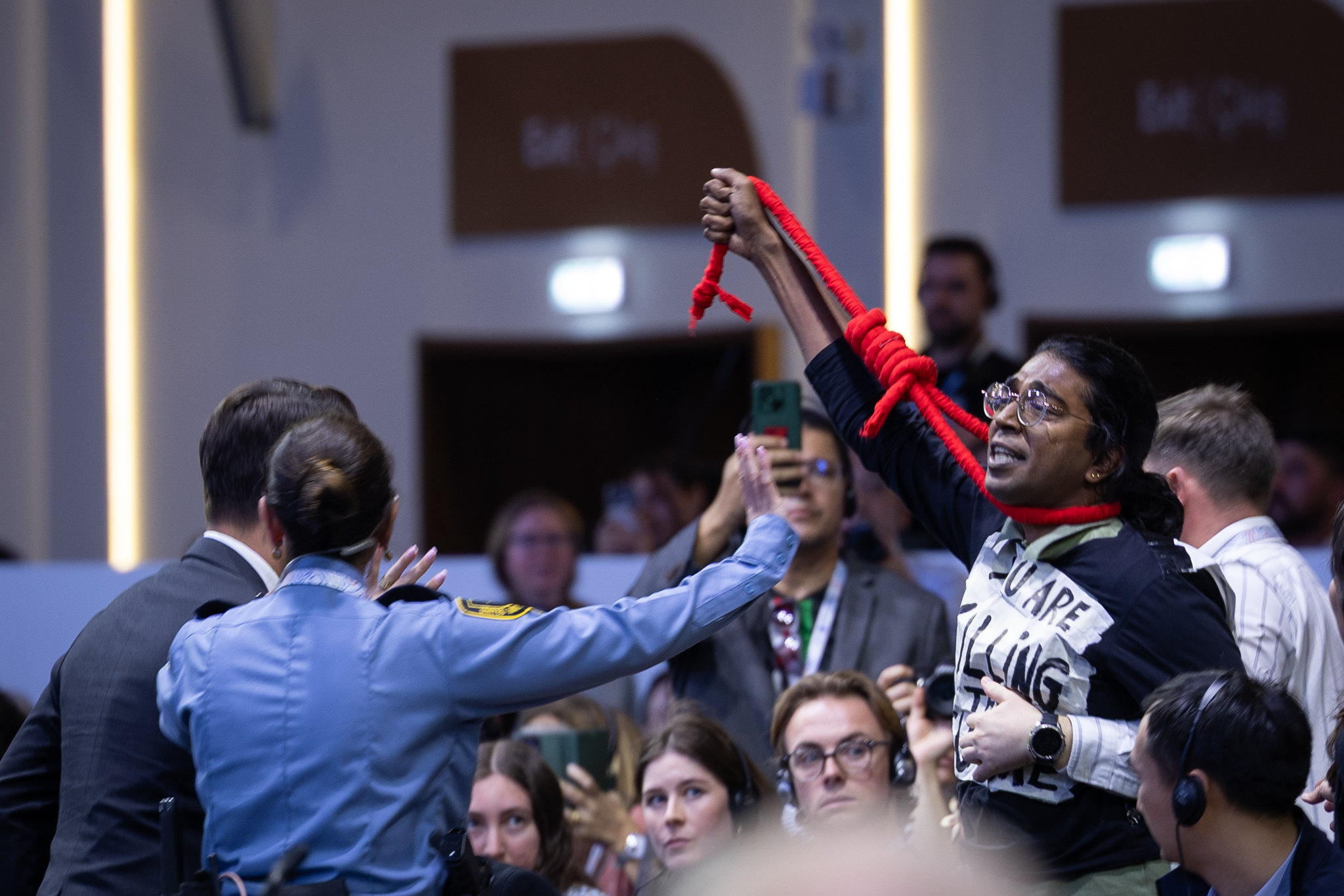
Panama’s environment minister Juan Carlos Navarro urged Kurum to ensure full respect of the rules of procedure when gavelling decisions through this weekend. Given he has led threats to object to the cover text if it is not ambitious enough, this sounded like a warning to Kurum not to ignore objections, as previous COP presidents have been accused of doing.
Another significant development on Friday night was a joint statement from Australia and China which, among other things, expressed China’s backing for the 35×35 electrification goal. More on that here.
The post COP31 Bulletin Day 12: ‘Don’t ignore us,’ Panama warns as COP31 runs into overtime appeared first on Climate Home News.
COP31 Bulletin Day 12: ‘Don’t ignore us,’ Panama warns as COP31 runs into overtime

‘COP-out’: COP31 fails to deliver the ambition needed to phase out fossil fuels and address climate breakdown
COP31 Bulletin Day 13: New draft retains electrification goal but delays adaptation finance and science decisions

How “Marie Antoinnete” Can We Get?

-
Climate Change1 year ago
Guest post: Why China is still building new coal – and when it might stop
-
Greenhouse Gases1 year ago
Guest post: Why China is still building new coal – and when it might stop
-

 Renewable Energy1 year ago
Sending Progressive Philanthropist George Soros to Prison?
-
Greenhouse Gases1 year ago
嘉宾来稿:探究火山喷发如何影响气候预测
-

 Climate Change2 years ago
Analysis: China’s CO2 falls 1% in Q2 2024 in first quarterly drop since Covid-19
-

 Climate Change1 year ago