

Build the cash-flow case before the carbon-revenue line.
Your finance team receives a proposal for restoring land in a sourcing region. The spreadsheet has a planting budget, an attractive carbon estimate and a line called “resilience value.” Nobody can explain which invoice that last line would reduce.
The economics of nature-based investments need the same scrutiny as any other spending decision. Start with the business exposure, compare practical alternatives and identify who receives each benefit. Then test whether the project earns its place in your budget under weaker assumptions. CCC’s CFO’s Guide to Nature Based Solutions sets out the broader strategic case. Here, you will build the model behind the funding request.
The four cost categories you can model now
Give every cost an owner, payment date and basis of estimate. Your model needs four categories:
- Design and establishment. Include site assessment, rights checks, baseline work and implementation. Separate land measures from other improvements, such as better drying equipment, so you can compare what each component achieves.
- Supplier participation and maintenance. Cost training, farmer payments, upkeep and replacement of failed plantings. Record who bears each expense and how long support continues. A buyer’s contribution may cover only part of the total project budget.
- Measurement and assurance. Include data collection, monitoring and verification where required. Credit certification, if pursued, needs its own budget. WRI’s financial-sector guidebook identifies high transaction costs as a barrier for smaller nature-based projects.1
- Financing and risk management. Include financing fees, insurance premiums and expected remediation spending. Show working-capital requirements separately from operating costs. A contingency funding allowance also needs a clear purpose and drawdown rule.
Build the model around incremental cash flows: what changes because you fund this proposal? Compare it with continuing current practices and with credible alternatives. For a coffee buyer, those might include storage improvements or a different sourcing arrangement. Do not assign every future procurement saving to the landscape project.
Specify the currency and whether costs rise with inflation. Keep tax assumptions consistent with the discount rate. Add an estimate range where a supplier quote or site assessment is still missing.
The two return categories to test separately
Start with changes in recurring operating cash flow. Better input quality might reduce processing losses; more efficient water use might lower bills. Record the baseline, expected change and evidence linking the intervention to it. A supplier’s higher yield becomes a buyer benefit only through a defined mechanism, such as more contracted volume or a change in purchase cost.
Then assess reductions in expected disruption losses. Identify a specific event, its financial consequence and the assumed change in probability or severity. If a sourcing interruption has an assumed 20% annual probability and would cost $1 million, its expected annual loss is $200,000. An intervention assumed to lower that probability to 15% creates a hypothetical $50,000 annual benefit. Those assumptions need evidence before becoming a funding forecast.
Keep the two categories distinct. If lower rejection rates already reduce emergency purchasing in your operating forecast, adding the same saving under resilience would count it twice. WRI distinguishes risk mitigation and resilience from financial growth opportunities; neither category guarantees a return to a particular buyer.1
Maintain a separate record of environmental outcomes that you cannot credibly monetize. UNEP’s 2023 finance-for-nature assessment describes the global funding challenge, rather than establishing a return for your project.2 A biodiversity objective can matter to your decision without becoming an invented cash receipt.
Carbon income needs another schedule. Test eligibility, ownership, issuance timing and selling costs before adding revenue. The World Bank dashboard covers different carbon-pricing instruments; a tax rate or allowance price does not establish what your project’s credits could sell for.3 Start the base case with zero carbon receipts and show any supported carbon scenario separately.
Multi-year P&L treatment options
Separate the investment appraisal from the accounting treatment. A4S’s capital-investment guidance provides a framework for bringing sustainability considerations into investment decisions.4 Your cash-flow model should show the proposal’s funding needs and economic assumptions before the controller maps it into the accounts.
The contract matters. Are you buying ongoing services, paying suppliers in advance, acquiring an interest in an entity, or obtaining an asset your company controls? Ask your controller to document the applicable recognition policy for the arrangement. The word “investment” on a proposal does not settle whether expenditure can be capitalized.
Prepare a bridge from project cash payments to forecast profit and loss. Show when services are received, when any recognized asset would be consumed, and what obligations could remain after the purchasing contract ends. Confirm the treatment with your accounting team before circulating the board pack.
For background on disclosure and credit-quality questions, see CCC’s 2025 Year in Review. Cost the actual reporting work in your proposal rather than assigning a generic compliance premium.
Do not count depreciation as another cash payment in a model that already includes the asset purchase. Equally, do not treat a benefit included in an investment appraisal as revenue recognized in the accounts. The economics of nature-based investments can support a spending decision while the environmental outcome still requires separate verification.
Where insurance and reserves fit
List the losses you expect a policy to cover, then check the actual exclusions, limits and deductible. Keep uncovered exposure visible. Ask how a claim would be evidenced and how long payment could take. Model a delayed recovery where the business would need cash before an insurer pays.
Distinguish insurance from a carbon-program buffer and from your own contingency funding. If the proposal relies on a buffer to address a carbon reversal, establish what it protects and which commercial losses remain with you. Require the relevant program rules and contract terms; do not assume that lost supply volumes would be compensated.
A budget contingency is also different from an accounting provision. Have the controller review whether any accounting recognition is required. In the cash forecast, show the expected remediation spending and a separate liquidity stress, rather than charging the full allowance and the same expected loss twice.
Before signing, allocate responsibility for maintenance and restoration if the intervention fails. Review those obligations alongside exit terms and the length of your purchasing relationship. A five-year financial forecast may sit inside a much longer stewardship commitment.
A worked example at three commodity exposures
The following illustration uses invented assumptions, not CCC project results or market benchmarks. Coffee, cocoa and cotton label three annual procurement-spend exposures; they do not rank the commodities’ investment potential.
Assume $150,000 paid at signing and $40,000 of annual costs in years one through five. From year two, assume gross benefits equal 1.2% of annual sourcing spend: 0.4% from routine savings and a separate 0.8% from lower expected disruption losses. This simplified example excludes insurance premiums and contingency spending. Assume no carbon receipts, taxes, inflation, financing cash flows or terminal value. Discount year-end cash flows at 8%.
| Illustrative exposure | Annual sourcing spend | Base-case NPV | Downside NPV |
|---|---|---|---|
| Coffee | $5 million | −$126,000 | −$217,000 |
| Cocoa | $10 million | +$58,000 | −$124,000 |
| Cotton | $20 million | +$426,000 | +$61,000 |
NPV, or net present value, discounts future net cash flows and subtracts the initial payment. The downside cuts both benefit assumptions by 30% and delays their start to year three. Annual costs continue throughout the same five-year window. Values are rounded to the nearest $1,000.
The middle case changes from positive to negative. A reasonable response would be to narrow the pilot or gather better evidence before approving expansion. Holding costs constant across exposures is a sensitivity exercise; a real project would need a separate design and budget at each scale.
The economics of nature-based investments become useful when you can explain what changes the decision. Carbon Credit Capital’s Dual-Value Model examines supply-chain economics alongside potential sustainability outcomes. Bring your finance and sustainability teams together to compare a proposed engagement with your existing carbon spend. Schedule a consultation.
Sources
- World Resources Institute, Financial Sector Guidebook on Nature-Based Solutions Investment: Aligning Investment With Impacts and Showcasing Examples, June 2025, pp. 6–7 and 13.

- United Nations Environment Programme, State of Finance for Nature 2023, 2023. Historical finance-flow context; not a project return benchmark.
- World Bank, Carbon Pricing Dashboard, instrument categories for emissions trading systems, carbon taxes and crediting, accessed 25 November 2026.
- Accounting for Sustainability, Essential Guide to Capex, pp. 18–21. Original guide content; the 2019 PDF updated cover and colours only. Accessed 25 November 2026.

Carbon credit providers vs marketplaces is the first comparison many buyers try to make. In this comparison, a carbon credit provider is the project developer: the company that originates credits from its own projects and sells them directly. A carbon credit marketplace is a platform that lists credits from many projects at published prices.

Carbon Footprint
Democrats who call climate change an emergency should not defend a permitting system too slow to build the clean energy that would address it.”
Democrats, Take The Deal. New York Times editorial, Nov. 12.
Insetting program design starts with your supplier map. The carbon claim comes much later.
Consider a coffee procurement team that funds a farm intervention before checking its sourcing data. The supplier aggregates coffee lots from several regions. The buyer lacks farm-level traceability. Another purchaser expects to report the same outcome. A more attractive project brochure solves none of these problems.
If the distinction between a value-chain intervention and a purchased credit is still open, read CCC’s Insetting vs Offsetting guide before you set the brief.
Insetting program design begins with the purchasing relationship and works outward. You need to decide 1) where an intervention belongs, 2) what business problem it addresses, 3) who pays for it, 4) how results will be measured, and 5) what the evidence will let you say about them. This five-step playbook turns that sequence into a procurement plan.
Step 1: Insetting program design starts with supplier mapping
Start with the commodities that matter most to your Scope 3 inventory and sourcing continuity. Ask finance for spend by supplier, sustainability for the emissions baseline, and category managers for origin and volume records. Then identify which suppliers can trace material to a jurisdiction, sourcing region, producer group, or individual land-management unit.
The level of traceability affects what you can account for. Under the GHG Protocol Land Sector and Removals Standard, the spatial boundary for purchased land-based products depends on the traceability associated with each volume. Farm-specific factors or removals require physical traceability through an acceptable chain-of-custody model. A contract with a tier-one trader, by itself, does not establish a link to the farms behind its deliveries.[1]
Build a first-pass table with five columns: commodity and annual volume; supplier and origin; current traceability level; land-use and production risks; and the business owner who can change the purchasing terms. Mark missing data plainly. A blank cell is cheaper to fix before a program starts than after a claim is drafted.
If your company sets an SBTi Forest, Land and Agriculture target (FLAG), keep its land-related target boundary separate from energy and industry emissions. The current FLAG guidance also requires relevant companies to assess primary deforestation-linked commodities in their value chains.[2]
Step 2: Choose a commodity and jurisdiction for a pilot
Select one supply corridor where the sourcing connection can be established and procurement has a reason to stay. A useful pilot has repeat purchases, suppliers willing to share records, an intervention matched to a diagnosed problem, and a defined plan to measure the result. Carbon potential alone is a poor selection rule if the supplier cannot deliver the crop your business needs.
Compare candidate regions on land-use risk, supplier concentration, local rights and tenure, the availability of baseline data, and exposure to drought, erosion, or forest conversion. Check the relevant legal requirements separately. A nature project does not satisfy a due-diligence obligation merely because it has a carbon method attached.
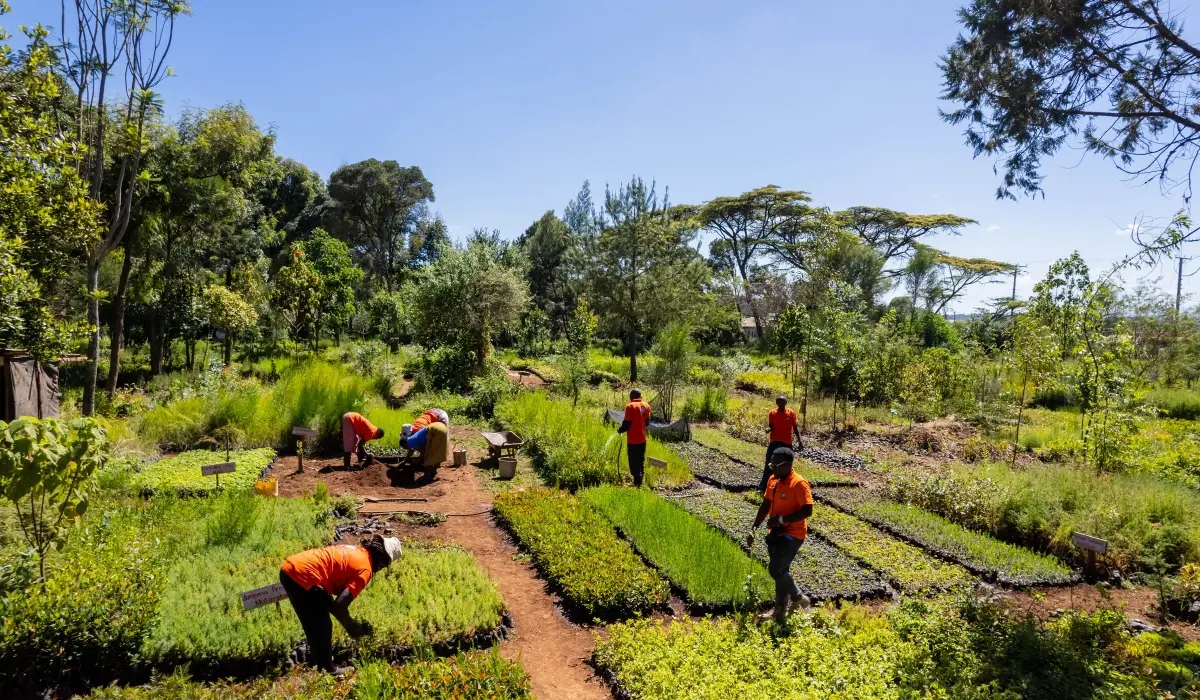
Consider a coffee buyer sourcing from two districts. In the first, producer-group records identify the farms, while recent dry seasons have increased rejected green coffee lots. In the second, deliveries pass through several intermediaries and farm origins are unknown. Pilot shade management in the first district, with local agronomic advice and quality checks built into the plan. The buyer can trace purchases there and test the intervention against a defined sourcing problem.
Use a short decision memo to record why the selected corridor beats the alternatives, what remains uncertain, and what would stop the pilot. That memo is the first control against a project drifting toward whatever happens to photograph well.
Step 3: Design the supplier engagement and commercial model
The intervention needs an owner on each side of the contract. Decide who supplies planting material or training, who maintains the practice, who bears the cost if a harvest disappoints, and how long the buyer expects to purchase from participating suppliers. Where smallholders participate, budget cash flow and technical support for practices that offer a later return.
Put these terms in a supplier agreement or pilot addendum. It should cover eligible farms and volumes, consent to data collection, access for monitoring, any land or carbon rights that matter, benefit sharing, and what happens if the purchasing relationship ends. Ask local counsel and producer representatives to review the arrangement. The Accountability Framework is a useful reference for supply-chain work involving forests, ecosystems, and human rights.[3]
Avoid assigning an automatic carbon benefit to the buyer. The contract should say which party has the right to report each outcome, how overlapping claims will be checked, and how any issued credits will be handled. A reduction reported in a buyer’s inventory cannot simply be sold for someone else’s offset claim without an accounting review. SBTi FLAG guidance excludes purchased credits used as offsets from near-term FLAG target achievement.[2]
Set commercial measures beside environmental ones: delivered volume, rejection rate, supplier retention, and procurement cost. They tell you whether the program works as a supply-chain investment, even if carbon accounting takes longer to resolve.
Step 4: Build monitoring, reporting, and verification before rollout
Agree on the baseline and data flow before paying for a full rollout. Identify the land units or sourcing regions in scope, the practices that change, the records suppliers already keep, and the additional measurements the program requires. Decide which data can come from field visits, transaction records, or remote sensing, and who checks each source.
For carbon, separate three questions. Did the practice happen? Did emissions or removals change under an applicable method? Can the buyer attribute a defensible share to its purchased goods without double counting? The GHG Protocol’s 2026 guidance includes dedicated chapters on spatial boundaries, data and methods, evaluating actions, credited outcomes, and assurance.[1] These are distinct jobs. A photograph of a planted tree answers only part of the first.
CCC’s MRV and Additionality article explains the separate evidence questions a project reviewer will ask.
Create an evidence file for every reporting period: dated supplier and farm records, purchase volumes, methods and emission factors, uncertainty, quality checks, and changes from the baseline. Specify who can challenge the data and how corrections are recorded. If a project also seeks credit certification, keep project accounting and corporate inventory accounting separate. The GHG Protocol says its land standard focuses on entity-level inventories and does not set the rules for credit certification.[4]
Start with the minimum viable measurement design that can survive review. Add complexity when the pilot tells you which data actually changes a decision.
Step 5: Decide what can be reported and claimed
Insetting program design needs reporting rules before the marketing copy. Procurement, sustainability, finance, and legal should agree on four distinct outputs: operational performance; observed land or nature outcomes; inventory effects, if the accounting criteria are met; and any separately issued credits. One dashboard can display them, but they should not share a single unqualified headline.
SBTi FLAG guidance allows certain land-based removals within a company’s operations or supply chain to contribute to FLAG pathways, subject to criteria including permanence, traceability, data quality, and allocation. It does not allow purchased offsets to meet near-term FLAG targets.[2] Eligibility therefore depends on evidence and the applicable target rules, not on calling an activity “insetting.”
Draft a claims register. For each proposed sentence, record the period, boundary, data owner, calculation method, reviewer, and whether the result is measured, estimated, or still a goal. If the evidence supports only “we funded a pilot with 200 farms,” say that. Do not turn a funding fact into a verified emissions reduction.
What good looks like by year three
Treat year three as a review point, not a promised payback date. A mature pilot should have mapped participating supply volumes, a stable supplier agreement, a repeatable data collection process, and a comparison of commercial and environmental results against the baseline. It should also have a documented answer for outcomes that cannot be included in the buyer’s inventory.
Scale only where the pilot improves a sourcing decision and the evidence can follow the product. If neither condition holds, redesign the intervention or change the corridor. A disciplined program can conclude that a site is unsuitable. That is useful procurement intelligence.
Discuss your insetting program with CCC
Carbon Credit Capital designs nature-based supply chain investments around sourcing needs and measurable sustainability outcomes. Schedule a consultation with our carbon and sustainability experts to map your tier-one supplier network, FLAG exposure, and first pilot decision.
Sources
[1] GHG Protocol, Land Sector and Removals Standard, version 1.1, and companion Guidance, June 2026: https://ghgprotocol.org/land-sector-and-removals-standard ; https://ghgprotocol.org/land-sector-and-removals-guidance
[2] Science Based Targets initiative, Forest, Land and Agriculture Science-Based Target-Setting Guidance, version 1.2, March 2026, especially pp. 16–17, 37, and 41: https://sciencebasedtargets.org/resources/files/SBTiFLAGGuidance.pdf
[3] Accountability Framework initiative, Accountability Framework and guidance for companies: https://accountability-framework.org/
[4] GHG Protocol, Frequently Asked Questions: Land Sector and Removals Standard, questions 10 and 18: https://ghgprotocol.org/blog/frequently-asked-questions-land-sector-and-removals-lsr-standard



-
Climate Change1 year ago
Guest post: Why China is still building new coal – and when it might stop
-
Greenhouse Gases1 year ago
Guest post: Why China is still building new coal – and when it might stop
-

 Renewable Energy1 year ago
Sending Progressive Philanthropist George Soros to Prison?
-
Greenhouse Gases1 year ago
嘉宾来稿:探究火山喷发如何影响气候预测
-

 Climate Change2 years ago
Analysis: China’s CO2 falls 1% in Q2 2024 in first quarterly drop since Covid-19
-

 Climate Change1 year ago
嘉宾来稿:探究火山喷发如何影响气候预测
-

 Renewable Energy5 months ago
Send a Bible to a Starving Child
-

 Green Living2 years ago
Our Picks for the Top 2024 Black Friday and Cyber Week Sales From Sustainable Brands