

Alex Maitland, Nafkote Dabi and Pubudini Wickramaratne work on climate and inequality for Oxfam International.
Few places on Earth have escaped the deadly effects of climate breakdown in 2026. In the early half of the year, devastating floods swept through Ghana, Nigeria, Côte d’Ivoire and other West African countries while August flash floods in Nepal, caused by a glacier collapse, affected over 80,000 people.
India endured a prolonged extreme heatwave in May, followed by the weakest monsoon in 20 years. Excess deaths from the European heatwaves are likely to have topped 50,000. And 2026 is on track to be one of the hottest years on record.
The effects of these disasters have not been caused nor felt equally. Disasters discriminate: the less you have, the more you stand to lose.
While everyday people died in heatwaves, the super-rich built snow rooms in their mansions. As families fled from wildfires, the rich were evacuated by helicopter to five-star hotels. As flash floods wiped out entire villages, luxury properties stood protected by high-end private flood defence systems.
What’s even more galling is that the same people that have done the most to drive climate chaos can pay to insulate themselves from its effects and are now finding new ways to profit from disaster.
Oxfam’s latest report “Disaster Divide” sets out exactly how climate breakdown is deepening inequality and enriching a tiny few.
Unequal emissions
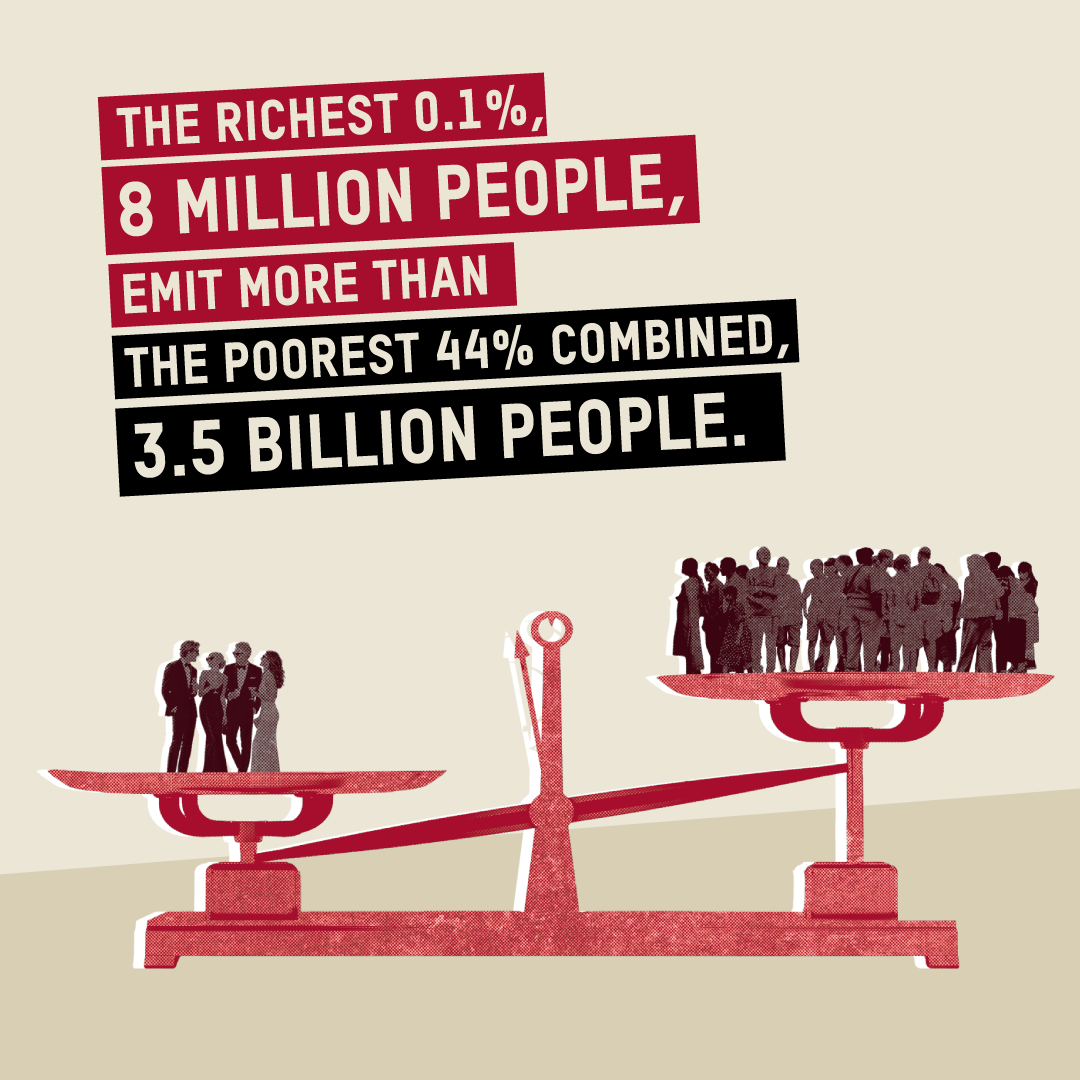
Billionaires and the super-rich are destroying the planet at a wildly disproportionate rate. The richest 0.1% (roughly 8 million people) emit more carbon than the poorest 3.5 billion people, almost half of humanity.
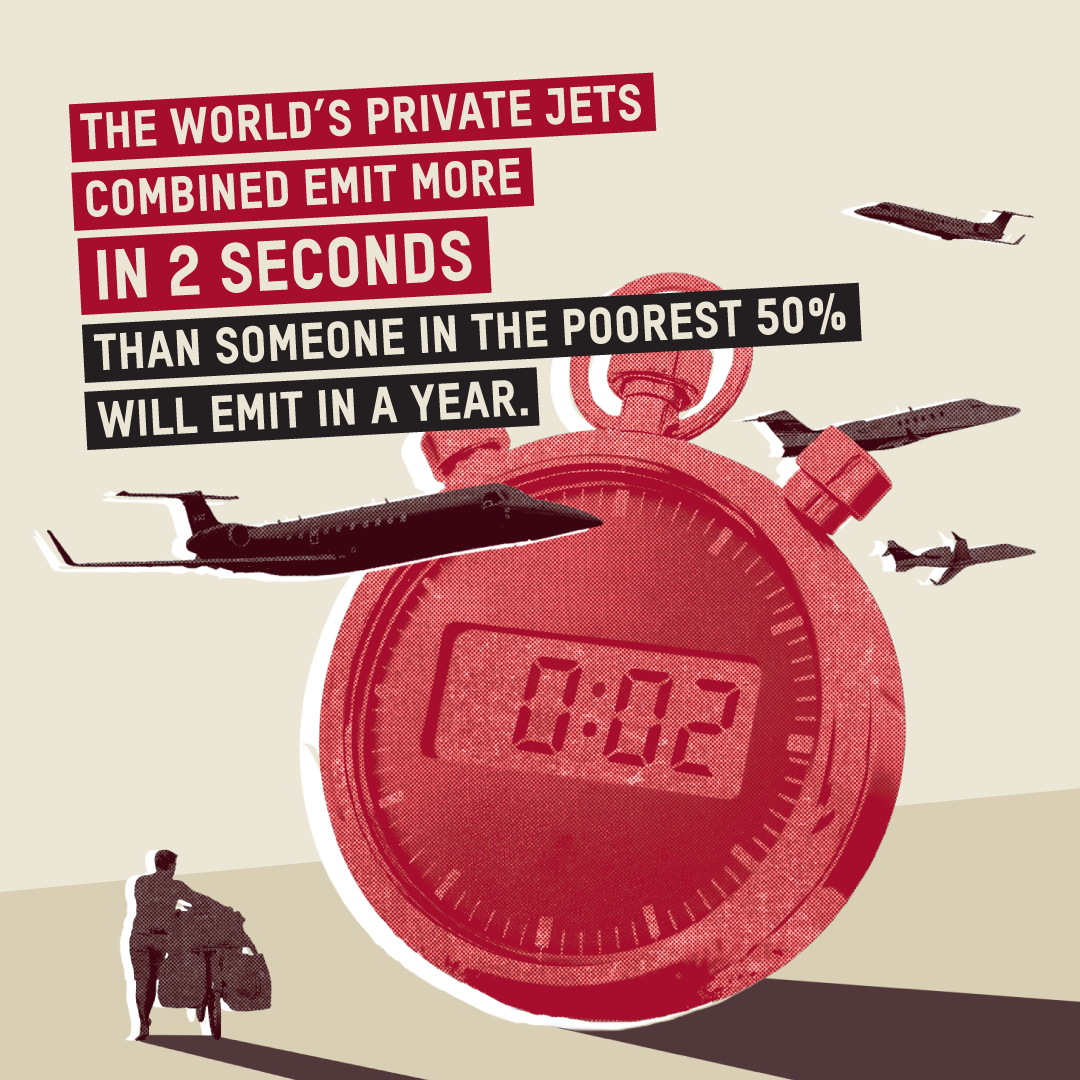
There is perhaps no starker symbol of wasteful emissions than travel by private jet. Every two seconds, the world’s private jets pump out more carbon than someone in the poorest 50% of the world will emit in an entire year.
But the climate impacts of the super-rich go far beyond their luxury lifestyles. How they invest their fortunes helps determine which high-carbon infrastructure gets built.
About 70% of billionaire investments are in “high climate-impact sectors” such as oil, gas or chemicals. The economic damage linked to individual billionaires’ investments can run into billions of dollars. Mexican oligarch Carlos Slim’s investments, for example, caused $3.7 billion of environmental damage in 2024, and French fashion titan Bernard Arnault, owner of Louis Vuitton, was responsible for $1.7 billion in damage, our calculations show.
Emissions of the rich drive climate disasters
For the first time, Oxfam combines the Stockholm Environment Institute (SEI)’s carbon inequality data with climate attribution models to link the emissions of the super-rich to extreme weather events.
The richest 1% are responsible for 20% of global warming since 1990, 100 times more per person, than someone in the poorest half of humanity.
The data also shows how the rich increase the likelihood of extreme heat occurring: a person from the richest 0.1% has contributed 125 times more than the average person to extreme heat events.
Inequality is what turns extreme weather events into disaster. In more unequal countries, disasters cause higher death tolls, inflict greater damage and affect more people.
Inequality also determines who can survive, endure and recover. A study of floods in Mumbai, India, found that lower-income households had to spend 15 times more than rich households to repair and replace damaged assets.
Billionaires escape climate consequences
Climate impacts are also deeply unequal along gender lines. A review of 130 studies found that women and girls were more affected than men and boys by climate-related health impacts in 68% of cases. Climate disasters exacerbate pre-existing gender inequality: gender-based violence increases during and after extreme weather events, with two-thirds of studies identifying increases in intimate partner or domestic violence following floods, storms or droughts.
“Coordinated backlash”: Activists say COP30 gender spat reflects wider threat
For millions of people, the consequences of climate chaos go further still: being forced to leave their homes and communities. UN Migration projects that, if the international community fails to act, as many as 1 billion people (around 10% of the world’s population) will have been displaced by 2050. The majority of those displaced will be in the Global South, but rich people are quietly joining their ranks.
Billionaires are buying islands and building fortified compounds and underground bunkers — tech billionaires are increasingly at the forefront of this trend. This is a form of climate apartheid: the super-rich use their wealth and power to escape the consequences of the crises they largely helped create.
Destroying the food system
Climate change is lowering food production and pushing food prices higher. Low-income households are more exposed to high food prices because it makes up the greatest share of their overall spending. People in low- or lower-middle-income countries spend almost three times as much of their income on food as people in high-income countries.
Some of the richest people in the world and their corporations are directly benefiting, exploiting rising food prices and uneven food production to reap large profits.
In 2024, extreme weather damaged West African cocoa harvests, resulting in prices jumping around 230% year-on-year but accruing no gains to cocoa farmers. The same year, heavy rains in Indonesia and droughts in Brazil and Vietnam contributed to a surge in coffee prices, with a 39% increase on the previous year’s average. Coffee-trading corporations, the intermediary traders of the supply chains, made huge profits as a result.

Profiting from disaster
Corporations have long made massive amounts of money from wrecking the planet. Now, the wreckage itself is becoming a lucrative market. The global disaster recovery market is forecast to grow from $70 billion to $92 billion a year by 2029, driven in part by increasingly frequent climate-related extreme weather events.
Often, the very same people profiting from fuelling climate breakdown are also cashing in on disaster clean-ups. To investigate this trend, Oxfam created a sample of 217 corporations which profit from business activities that either drive climate disasters, build resilience before they hit, or work on repairing the damage. We coined it the “Destroy and Rebuild” Index.
The corporations in the “Destroy and Rebuild” Index made $1.8 billion on average in 2025, paying out more than $1 billion on average to their shareholders. Ten asset managers have investments in over 90% of these corporations, with BlackRock and Vanguard invested in 92% of the corporations in the index: the pair’s total investments in these companies exceed$1 trillion.
Coalition set sights on taxing luxury air travel to fund climate action
The lengths the super-rich go to exploit disasters doesn’t stop at cynical profiteering. Recovery efforts have also been used to push through the privatisation of public services and deregulation, reshaping communities in ways that benefit private interests rather than the people affected.
After Hurricane Irma devastated Barbuda in 2017, reconstruction made way for luxury residences and a golf course on land that included natural coastlines and wetlands. This restricted access to the sea for many fisherfolk and local people. In Puerto Rico, Hurricane Maria’s aftermath was used to advance the privatisation of the island’s electrical grid. Since then, the grid has suffered widespread failures, including a blackout in April 2022 that left the entire country without power.

Make rich polluters pay
Climate breakdown is the result of political choices and an economic system that protects the wealth and power of polluters while leaving others to pay the price. This is neither just nor sustainable. It must change.
Governments meeting at COP31 must commit to curb the excessive emissions of the super-rich through taxes on wealth, income and carbon-intensive luxury consumption, like private jets and mega-yachts. These measures will help generate the public climate finance urgently needed for Global South countries to adapt, recover and rebuild without being pushed deeper into debt.
Governments must also draw a hard line against disaster capitalism, refusing to let corporations turn human suffering into shareholder value.
The post The great disaster divide: How the super-rich are profiting from global climate suffering appeared first on Climate Home News.
The great disaster divide: How the super-rich are profiting from global climate suffering

On 3 November, the Brazilian presidency of the COP30 climate talks released its long-awaited “roadmap” on ending deforestation.
Ahead of the Belém summit, Brazilian president Luiz Inácio Lula da Silva made a call for a “roadmap” to halt and reverse deforestation.
Although this voluntary roadmap was outside the COP’s official agenda, it snowballed into a rallying point at the “Amazon” COP.
By the end of the summit, 93 countries had signed on to the deforestation roadmap, committing to develop voluntary pathways to reverse forest loss and degradation by 2030.
The Brazilian presidency called on countries to describe what a pathway away from deforestation could look like, what challenges and support they needed.
This call was answered by 18 countries and four negotiating blocs that offered their inputs on the roadmap, along with scores of NGOs, research centres and other groups.
Now that the roadmap has been published, Carbon Brief explains where it came from, what it entails, why some did not sign on – and what’s next.
What is a deforestation ‘roadmap’?
The “deforestation roadmap” was one of the signature announcements of the Brazilian presidency of the COP30 climate summit in Belém – albeit one that fell outside the official, negotiated outcomes.
Brazilian president Lula first proposed the deforestation and forest degradation roadmap, alongside one on the fossil fuel transition, at the leaders’ summit in Belém a few days before COP30 began.
By the end of COP30, nearly 100 countries had expressed their support for such a roadmap. This includes the EU, with its 27 member states, as well as the 56-member Coalition for Rainforest Nations.
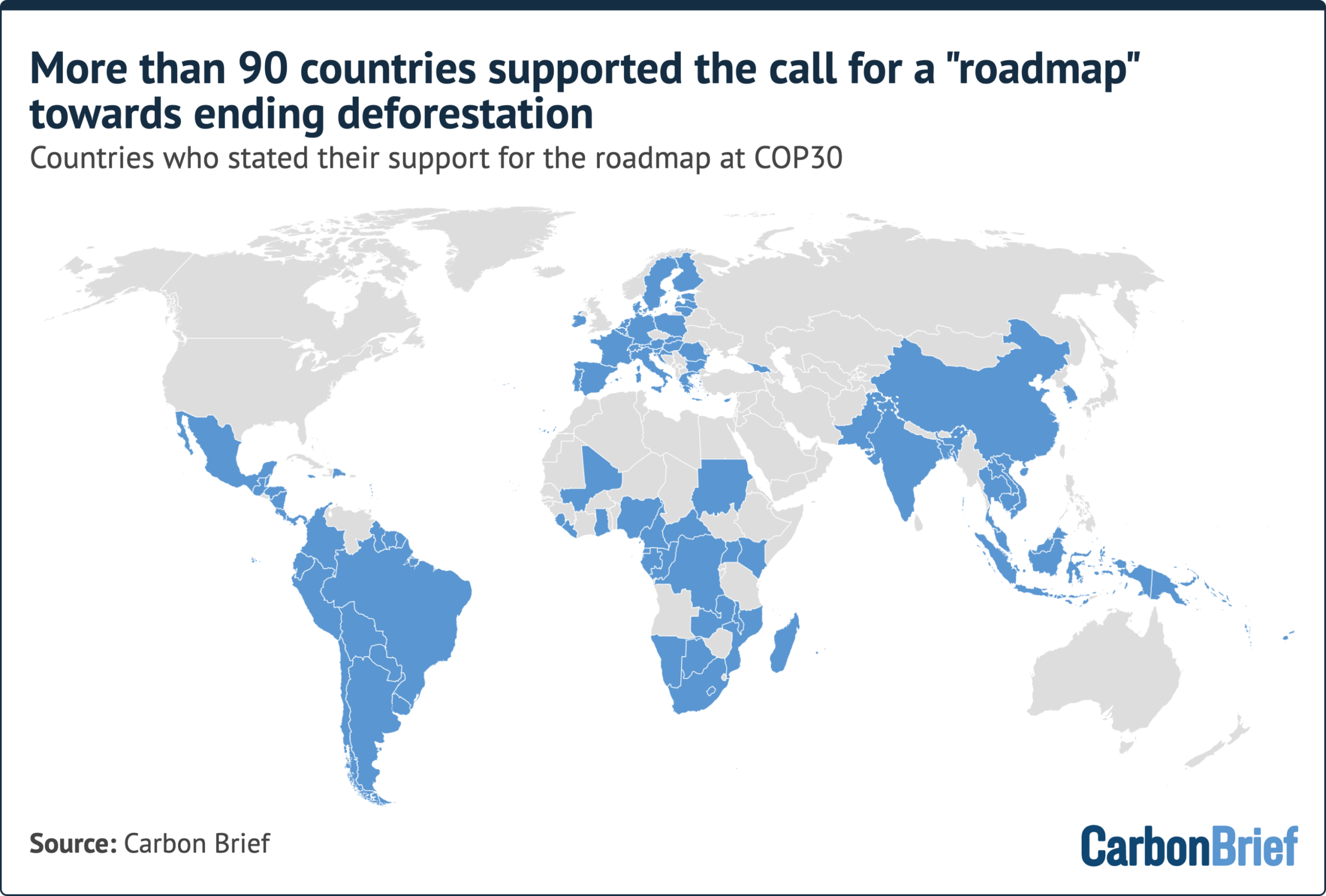
However, this was still short of the 196 parties needed for consensus at a COP, meaning that, ultimately, the roadmap was not a formal outcome.
Instead, COP30 president André Corrêa do Lago announced during the closing plenary session that the presidency would work towards creating both deforestation and fossil-fuel phaseout roadmaps outside of the COP process.
The deforestation roadmap is the latest in a series of international pledges to put an end to forest loss.
In 2014, 39 countries pledged to end natural forest loss by 2030 at UN Climate Week, as part of the New York Declaration on Forests.
Seven years later, at COP26, more than 140 countries signed the Glasgow Leaders’ Declaration on Forests and Land Use. The declaration stated that countries “commit to working collectively to halt and reverse forest loss and land degradation by 2030” – although conflict subsequently arose over what, exactly, countries had agreed to.
The objective of halting and reversing deforestation by 2030 was ultimately agreed in a negotiated text for the first time two years later, at COP28 in Dubai, where it was part of the global stocktake.
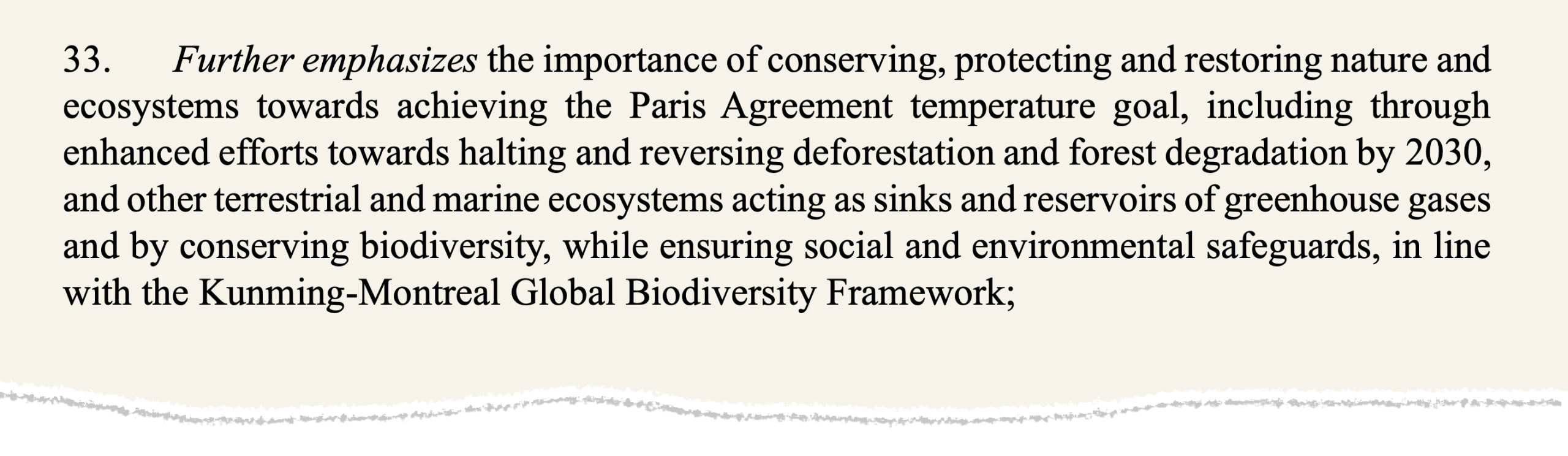
Unlike these previous pledges, the roadmap does not make any new commitments. It also does not “seek to reopen agreed decisions”.
Instead, the roadmap’s stated objective is to “translate forest-related outcomes into coordinated, country-led action while respecting different national circumstances, priorities and implementation challenges”.
Following the conclusion of COP30, the presidency – along with the Climate Policy Initiative thinktank – began soliciting inputs from countries, civil society organisations, Indigenous peoples, academic researchers, the private sector and other groups.
(The Climate Policy Initiative was chosen to serve as the secretariat and technical partner to the roadmap process.)
The secretariat notes that it received more than 200 contributions following this invitation. However, just 18 of these came from countries, and four from blocs – the EU, the Coalition for Rainforest Nations, the Alliance of Small Island States (AOSIS) and the Least Developed Countries (LDC) blocs – themselves.
What does the roadmap say about reducing deforestation?
The roadmap was released less than a week before the COP31 climate summit is due to begin, at an event hosted by the UN Development Programme in Brasilia.
During the launch event, Do Lago highlighted recent figures showing that Brazil’s deforestation rate had fallen to its lowest level on record – dropping by more than 70% since 2022.
“Even the optimists wouldn’t believe that we were able to decrease deforestation” by as much as the country has managed in recent years, he said.
Corrêa Do Lago said that he hoped the roadmap would be a “living document” and that it could provide countries with a “practical pathway for climate action”.
The roadmap divides forest action into three complementary parts: national action, international action and financial mechanisms.
For each of the three, the document highlights current actions or instruments and the enabling conditions required to promote action. Then, it offers “COP30 presidency proposals on the way forward” on each pillar.
Under “national efforts”, the roadmap addresses the challenge of halting and reversing deforestation across five “forest dimensions”:
- Maintaining existing forests.
- Using forests sustainably while generating value for communities.
- Combatting forest degradation.
- Combatting deforestation.
- Restoration, reforestation and afforestation.
The roadmap identifies 18 policies or “implementation approaches” that countries can use to address forest loss and degradation, although it notes that the list is not intended to serve as an “exhaustive or prescriptive classification”.
This includes a wide range of approaches, including establishing or maintaining protected areas, recognising the territorial rights of Indigenous peoples, managing the spread of pests and plant diseases and restricting permits for activities associated with forest conversion.
For each of these policies, the roadmap explains the approach and gives an overview of the evidence of its effectiveness. It also gives examples of how countries are implementing that policy.
Then, the roadmap discusses the enabling conditions that need to be ensured for action to occur at the national level, such as supporting land governance and promoting environmental education.
Finally, for national action, the roadmap proposes a five-step process for countries to follow. It provides “guiding questions” that countries may consider in their work to support each step.
On “international architecture for forest action”, the roadmap discusses how various international environmental and human-rights instruments address the problem of deforestation in different ways. It says:
“Climate change, biodiversity, land degradation, Indigenous peoples and local communities’ rights, ecosystem conservation and species protection are addressed through distinct international regimes, but their objectives and implementation intersect in important ways in relation to forests.”
The roadmap highlights some of the global forest-monitoring initiatives that can support national efforts, while noting that countries’ capacity for accessing and using such information “remains uneven”. It calls for improving technical cooperation between countries and increasing capacity-building.
Finally, the roadmap discusses two cross-border issues: crime and trade. On the latter, it notes that trade measures that reward compliance are generally more effective than those that impose “additional economic and administrative burdens on exporters”.

Membership
Support award-winning climate journalism
The roadmap’s final proposals for international action include strengthening national capacity for investigating environmental crime and prioritising trade policies that reward sustainable, deforestation-free production.
The roadmap notes that countries need an estimated $300bn per year by 2030 to halt and reverse deforestation, yet current finance reaches less than one-third of that figure.
Of this, nearly 90% comes from domestic public finance, as forest countries already dedicate “substantial effort” to protecting their domestic policies and budgets, the roadmap notes.
The roadmap offers 10 proposals for action on forest finance, including aligning domestic finance flows to support forest action, enacting effective benefits-sharing measures and strengthening the position of forests in carbon markets.