

Anne Jellema is executive director of 350.org; Mads Christensen is executive director of Greenpeace International; and Amitabh Behar is executive director of Oxfam International.
On Monday, global petitions with a collective total of more than 2 million signatures were presented to the United Nations, calling on governments to introduce binding mechanisms to make fossil-fuel companies and the super-rich contribute to the costs of the damage they have created.
The petition signatures were received by Selwin Hart, the UN Assistant Secretary-General for Climate Action, in New York during the UN General Assembly, sending a clear message to governments: there is no more room for excuses.
If governments are serious about resilience, energy security and protecting people from an increasingly unstable world, they must make the companies profiting from the fossil-fuel economy pay their fair share. Because the crisis we are facing is no longer some distant threat. It is unfolding in real time, and it is exposing the extraordinary costs of an economy still built around fossil fuels.
-
Climate change and energy transition rise up national security agenda
Leaders highlighted the national security risks posed by global warming and fossil fuel dependency at New York Climate Week -
COP31 presidency announces AI pledge as UN climate chief says Big Tech ‘on thin ice’
Turkish minister Murat Kurum said AI companies should be transparent about their energy use and power their data centres with clean energy
For more than six months, the Strait of Hormuz, the channel through which a fifth of the world’s oil once flowed without a second thought, has been closed, contested or effectively unusable. Tankers sit at anchor. Insurance premiums have gone through the roof. Petrol pumps from Los Angeles to Lagos have felt the tremor. It has taken a war to remind the world just how much of our daily lives still rests on a single, fragile artery of fossil fuels.
At the other end of the same emergency, a glacier came down on the Nepal–China border in the last week of August. A wall of ice, rock and water tore through the Bhote Koshi and Langtang valleys. It has been described as one of the deadliest disasters in the region’s modern history, unfolding in a landscape where the world’s glaciers are retreating and destabilising at a pace scientists have been warning about for years.
And this came only weeks after hundreds of thousands of people were displaced — not by ice, but by fire. Europe has experienced its worst wildfire season in more than a decade. Homes have been lost across Spain, Portugal, France, Greece and the UK. Firefighters and civilians have been killed battling the blazes, while damage and reconstruction costs continue to reach extraordinary levels.
These are not separate crises. They are different expressions of a world becoming more volatile, while the fossil-fuel economy continues to generate enormous profits for those at the top and pushes the costs onto everyone else.
Communities absorbing cost
Because the crisis we are facing is no longer some distant threat. It is unfolding in real time, and it is exposing the extraordinary costs of an economy still built around fossil fuels. One thread runs through all of these events: a global economy still organised around the profits of a fossil fuel industry that has known, for decades, exactly what it was doing to the planet.
At a moment when governments are gathering in New York for the UN General Assembly to talk about security, resilience and economic competitiveness, it is worth spelling out what “security” – or the lack of it, driven by our economy’s dependence on oil – actually means this year for ordinary people around the world: 35,000 excess deaths in Europe due to heat; the highest food prices in three and a half years; $700 billion in economic losses, threatening countless jobs and livelihoods, from a war and a closed oil chokepoint whose consequences are nowhere near over.
Meanwhile the companies that extracted, refined, shipped and sold the fuel behind all of this continue to report extraordinary profits. Households are paying more for energy. Governments are spending billions on disaster response, on reconstruction, on emergency deployments of firefighters and aid. Communities are absorbing the cost of a system they didn’t design and don’t control. We pay. They profit.
This is not a coincidence, and it is not inevitable. It is a political choice, repeated year after year, to let the companies most responsible for the climate crisis hoard the wealth they generate while the rest of us carry the risk.
Taxes and fines needed
That is why, together with communities and campaigners in dozens of countries have spent the last three years building the case for a simple, overdue idea: polluters should pay for the damage they have caused. Not through voluntary pledges or distant net-zero promises, but through binding mechanisms, climate damages taxes, surtaxes on fossil fuel profits, and fines ring-fenced for recovery and adaptation that put real money where the harm actually is. This is how we take the profit out of destruction and protect the generations to come.
The response has told us we are not alone in thinking this. Our petitions calling on governments to make polluters pay have now gathered a collective total of over 2 million signatures from people across every region of the world.
The case for making polluters pay has moved into the mainstream
That is not a fringe demand. It is what happens when people watch a choke-point war spike their fuel bill, watch a glacier take a thousand lives, watch their own summer holidays rearranged by fire. They draw the obvious conclusion: the people who caused this should be paying for it – not profiting from it.
We hear the objection already forming: that this is not the moment, with wars underway and economies fragmenting, to burden industry further. We would say the opposite is true. If governments can mobilise trillions for war, for bailouts and for new fossil fuel infrastructure, they can mobilise the political will to tax the companies that caused this crisis.
Money for clean energy and resilience
That money can go straight to the people paying for it, through cheaper, cleaner, more secure energy, and through funding for communities on the frontline of floods, fires and glacial collapse. There isn’t an excuse left. There is only a choice about where power and money go next. Every dollar we don’t spend now on adaptation, resilience and cutting emissions, we burn many times over later: on disasters we could have prevented and economies we scramble to fix too late.
This year’s UNGA should be the moment that choice gets made in public. Governments arriving in New York will talk about resilience, about energy security, about protecting their citizens from an unstable world. Let them explain on the record why a fossil fuel industry that has spent decades profiting from that instability should not be the one paying to fix it so wrecking the planet no longer pays off.
The fires, floods and storms won’t just go away. The system that keeps producing these disasters, and keeps paying the same companies for the privilege, will not change itself unless political leaders step up. It is on all of us to make sure they hear, as loudly as possible, that the time for excuses has run out.
The post After Hormuz, Nepal and wildfires, people demand action to make polluters pay appeared first on Climate Home News.
After Hormuz, Nepal and wildfires, people want action to make polluters pay

Climate Change
‘COP-out’: COP31 fails to deliver the ambition needed to phase out fossil fuels and address climate breakdown
Antalya, Türkiye, Sunday 22 November 2026 — The COP31 climate summit in Antalya has ended in disappointment and anger, as the final COP31 outcome failed to deliver on critical issues like overshooting the 1.5°C limit, fossil fuel phase out and climate finance. Greenpeace Australia Pacific says that Australia did not deliver the deal that the world needed in a time of escalating climate breakdown.
In Antalya, Dr Susie Byers, Head of Advocacy at Greenpeace Australia Pacific, said: “We need to call this COP outcome what it is: a COP-out that has failed to deliver what the world urgently needs given the scale of the crisis we’re facing. It’s a colossal lost opportunity, and one that the world won’t easily forget.
“Coming out of Belém there was momentum to phase out fossil fuels, but COP31 wasn’t able to harness that energy and drive the world forward. The failure to adopt the Cover Decision means there’s now no acknowledgement of, let alone response to, 1.5°C overshoot — the survival line for Pacific nations. Electrification, defence of science, protection for the oceans, and advances on climate finance were all casualties of cynical attempts to derail climate action with dangerous distractions like CCUS.
“Australia knew how hard this task would be and put their hand up anyway. In the end, they didn’t get it done. This outcome validates exactly why so many countries are looking towards parallel tracks like the International Court of Justice Advisory Opinion and national transition roadmaps, where we’ve seen microdiplomacy and Pacific leadership again lead the way. This spirit of multilateralism and collaboration is how we will move beyond rhetoric to concrete actions, and end the fossil fuel chokehold.”
Also in Antalya, Shiva Gounden, Head of Pacific at Greenpeace Australia Pacific, said: “They called this an ‘implementation’ COP, but implementation means nothing when the foundation is broken. The frontline communities leading this fight came to Antalya demanding the urgent, definitive action required to confront the sickening realities of 1.5°C overshoot. Instead, developed countries turned their backs on their historical responsibilities, held climate finance hostage, and treated the debt they owe as a cheap bargaining chip.
“At the exact same time, Parties and negotiating blocs deliberately blocked the bold action the world needed on mitigation, peddled toxic distractions like CCUS, and intentionally scrubbed the words ‘fossil fuels’ from the final text. A strong Presidency that understood the urgency of the situation would not have let this happen; Australia failed to deliver what it promised the Pacific.
“Billions of people across the world are fiercely defending their lives, their homes, their cultures, and their livelihoods, and we came here with their voices demanding real action. By choking off the money and refusing to name the root cause of this collapse, polluting nations made a calculated choice to protect their own interests over our shared future. The Pacific will increasingly look towards parallel paths like the ICJ climate advisory opinion, and the Santa Marta process, to continue finding solutions because that is what our people need.”
ENDS
COP31 images and video available here in Greenpeace Media Library
Media contact: Kate O’Callaghan in Antalya (GMT+3) on +61 406 231 892 (Whatsapp/Signal)
Climate Change
COP31 Bulletin Day 13: New draft retains electrification goal but delays adaptation finance and science decisions
After an evening of tense discussions, a new version of the cover text was finally released at around 2am on Sunday morning. But, with many delegates flying home, it is unclear if – and for how long – there will be the two-thirds of governments present needed to legally adopt a decision.
The latest draft, which is – as of 9.30 – scheduled to be put to a plenary session for approval at 10am – retains a goal to boost electrification and links it more strongly with clean energy and storage. It does not, however, include language on transitioning away from fossil fuels as many countries had called for.
It ditches a specific numerical target for carbon capture, use and storage (CCUS), a controversial technology that is favoured by fossil fuel producers, which is now only an aim “to achieve gigatonne scale globally by 2035 as a collective global aspiration”. The previous version had two alternative targets, a weaker one of 0.5Gt “working towards” 1.3-2.5Gt and a stronger one of 2.5Gt.
The draft cover decision has strong language on responding to an almost certain overshoot of the 1.5C warming limit, recognising that it will increase loss and damage and result “in increasingly adverse, and in some cases irreversible, impacts and risks to human and natural systems”. As President of Negotiations Chris Bowen has repeatedly drawn attention to, this is the first COP held since the UN acknowledged that overshoot is inevitable.
In pursuing efforts to limit any overshoot, the decision recognises the need for “deep, rapid and sustained reductions in greenhouse gas emissions in line with 1.5 °C pathways” – which is a push towards greater ambition.
The text also resolves to close adaptation gaps and boost action and support to help countries and communities to better cope with adverse climate impacts. But it does not put a figure to a goal agreed at COP30 last year to triple adaptation finance by 2035.
The goal did not specify a baseline year and African nations, least-developed countries and small island states had pushed for it to be a later and higher baseline and therefore a larger target number of $120 bn a year. Instead, the text launches a “roadmap” on adaptation finance to be considered at COP32.
Loss and damage finance has been cut from the roadmap’s scope, as have references to about half the money pledged to the loss and damage fund having yet to be sent to the fund’s bank account and the gap between the $2.8 billion of loss and damage funding requested by developing countries in the fund’s start-up stage and the $0.342 billion allocated to fund these projects. “Erasing the shortfall doesn’t make it disappear for families who have lost everything”, said Harjeet Singh, global convenor of Fill the Fund.
The new text drops its invitation to the Intergovernmental Panel on Climate Change (IPCC) to publish all of its next three reports in time for the 2028 global stocktake of climate progress. Instead, it just invites them to “continue to provide policy-relevant information as input to the UNFCCC processes, including outputs from the seventh assessment cycle to the next global stocktake”. It no longer specifies that all their reports, including the third on reducing emissions, are published. The IPCC will have an online meeting in December to discuss this issue but COP31 guidance will be influential in its decision.
As Climate Home News entered the venue around 7.30am, tired-looking negotiators from Saudi Arabia and from the Alliance of Small Island Developing States were seen entering the area which houses the Presidency’s offices, as others dozed on sofas. A source close to the German delegation said that negotiations had been intense and were not necessarily resolved.
If the Presidency does not think it can get agreement on a cover text, then it can withdraw it or it can issue it a Presidency declaration, which does not have much weight. Some of its provisions could be added into other agenda items and adopted seperately. Governments could also decide to reconvene COP31 at a later date – known as a bis – as happened at COP6.
The post COP31 Bulletin Day 13: New draft retains electrification goal but delays adaptation finance and science decisions appeared first on Climate Home News.
COP31 Bulletin Day 13: Germany rejects text moments before plenary meeting
On Friday night, COP31 approved a series of less controversial agenda items and then COP President Murat Kurum told governments to hang around the venue until midnight in case his team wanted to consult them on the cover text, which is still Thursday’s version.
If you don’t hear from us, Kurum said, go home and get some rest and don’t bother coming in before 9am. Governments appear to have taken his advice. Around 10am, the conference centre was ghostly and there was still no sign of a new draft cover text.
COP31 Bulletin Day 11: Countries decry cover text for omitting fossil fuels
Friday night’s plenary did offer a few moments of drama. An activist was ushered out of the room by security after holding a rope around his neck and shouting “you keep doing nothing, nothing at all” and “you are killing the future, just kill me now” to a smattering of applause.
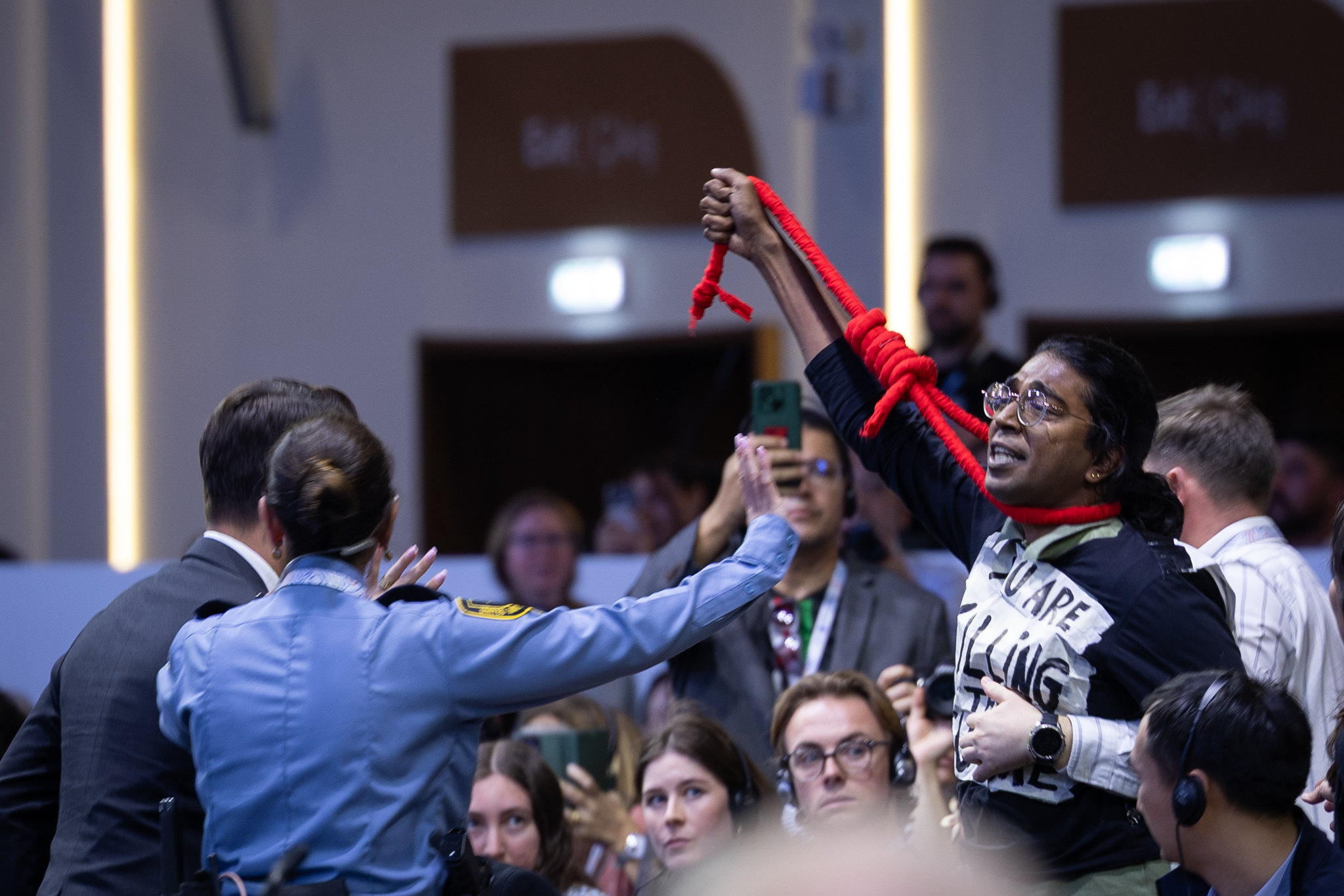
Panama’s environment minister Juan Carlos Navarro urged Kurum to ensure full respect of the rules of procedure when gavelling decisions through this weekend. Given he has led threats to object to the cover text if it is not ambitious enough, this sounded like a warning to Kurum not to ignore objections, as previous COP presidents have been accused of doing.
Another significant development on Friday night was a joint statement from Australia and China which, among other things, expressed China’s backing for the 35×35 electrification goal. More on that here.
The post COP31 Bulletin Day 12: ‘Don’t ignore us,’ Panama warns as COP31 runs into overtime appeared first on Climate Home News.
COP31 Bulletin Day 12: ‘Don’t ignore us,’ Panama warns as COP31 runs into overtime

‘COP-out’: COP31 fails to deliver the ambition needed to phase out fossil fuels and address climate breakdown
COP31 Bulletin Day 13: New draft retains electrification goal but delays adaptation finance and science decisions

How “Marie Antoinnete” Can We Get?

-
Climate Change1 year ago
Guest post: Why China is still building new coal – and when it might stop
-
Greenhouse Gases1 year ago
Guest post: Why China is still building new coal – and when it might stop
-

 Renewable Energy1 year ago
Sending Progressive Philanthropist George Soros to Prison?
-
Greenhouse Gases1 year ago
嘉宾来稿:探究火山喷发如何影响气候预测
-

 Climate Change2 years ago
Analysis: China’s CO2 falls 1% in Q2 2024 in first quarterly drop since Covid-19
-

 Climate Change1 year ago
嘉宾来稿:探究火山喷发如何影响气候预测
-