

Lidy Nacpil is the coordinator of Asian Peoples’ Movement on Debt and Development (APMDD).
Recent reporting on international climate negotiations has highlighted a sharpening divide within civil society and multilateral diplomacy. A troubling, simplistic narrative has taken root: that the UN climate process is witnessing a binary struggle between defenders of science and those attacking it.
This framing is not only inaccurate; it is dangerous. Characterising a substantive methodological and political debate in these terms misdiagnoses the stakes and stirs conflict instead of clarity.
No one disputes that climate action must rest on science. Science tells us what has led us to the climate crisis – the accumulation of historical emissions – and how much carbon budget remains if we are to keep temperature rise below 1.5C. It tells us how much global emissions must drop, and how fast. Science is also essential in assessing each country’s historical contribution to the accumulation of greenhouse gases in the atmosphere.
Responsibility, however, must also be based on capacity. For those who generated the largest share of historical emissions, that capacity includes the enormous wealth and economic power accumulated through the same fossil-fuel-intensive development that generated those emissions.
As science comes under attack at UN talks, climate movement splits over how to respond
While principles that should guide human action aren’t scientific questions – they are matters of values – applying them to real-world problems requires scientific grounding. Equity recognises the scientifically established reality of differentiated responsibilities among countries and within societies. Putting equity into practice demands scientific rigour.
Scrutiny of IPCC models
Today, critics are scrutinising the assumptions and frameworks behind the Intergovernmental Panel on Climate Change’s Integrated Assessment Models (IAMs), used to project future scenarios and map global mitigation pathways. These concerns centre squarely on equity and justice.
The economic, technological and policy assumptions used in IAM scenarios are normative choices rather than scientifically prescribed or neutral facts. These include choices about discount rates, economic growth, energy demand, technology costs, carbon prices, land availability and the regional location of mitigation. Many IAM scenarios reproduce existing global inequalities rather than transform them. Questions about transparency, representativeness and diversity in the scientific process are deeply urgent.
Most IAM scenarios are built primarily around global cost-effectiveness – directing emissions reductions to places where mitigation is modelled as cheapest rather than allocating effort according to historical responsibility, capacity and development needs.
The resulting pathways allow developed countries to retain disproportionately high levels of energy and fossil-fuel consumption while requiring developing countries to undertake substantial mitigation and carbon removal, including land-based measures that threaten food security and local development.
Northern models often assume uniform access to cheap financing. In reality, Global South economies face far higher capital costs, driving up the price tag of rapid infrastructure shifts.
Constraints on development space
Scenario constraints also limit the development space poorer nations need without guaranteeing adequate climate finance. When models treat profoundly unequal starting points as uniform baselines, policy pathways lock in global inequality under the banner of scientific objectivity.
Pointing out these structural flaws isn’t rejecting science. It is essential scientific scrutiny aimed at producing stronger, fairer, and more actionable results.
Science ‘under attack’ from fossil fuel interests at UN climate talks
The fight is not about whether we want to keep temperature rise below 1.5C, but about how we get there. A pathway can be technically compatible with 1.5C or 2C while still being deeply unequal in who gets to consume energy, who must reduce emissions, and whose development is constrained. Temperature compatibility alone does not make a pathway fair.
Critiquing IAM scenarios from an equity perspective is neither an attack on the Intergovernmental Panel on Climate Change (IPCC) nor an attack on science. Rigorously examining IPCC reports – their substance, assumptions, and processes – is an acknowledgement of the IPCC’s importance and entirely consistent with scientific method.
Tensions over AR7 timing
There is a separate but related tension over the cycle and timeline of the IPCC’s Seventh Assessment Report (AR7). Some governments and civil society voices advocate completing its Working Group reports in time to feed directly into the UN’s Second Global Stocktake in 2028.
The motivation makes sense: policymakers need timely science. But several developing-country negotiators and researchers have warned that meeting that deadline could severely disadvantage the Global South.
Funding gap threatens next round of IPCC climate science reports, chair warns
Global North authors and institutions remain disproportionately represented in the research underlying IAM assessments. Developing-country researchers often work with fewer institutional resources, smaller research budgets, and less administrative support. Accelerated publishing and assessment schedules can further limit their ability to generate, submit, and peer-review research in time for inclusion.
The AR7 timeline concerns boil down to inclusivity, representation, and equity. Requiring the IPCC to meet tight political calendars without ensuring meaningful support and participation for developing-country researchers risks reproducing the very inequalities being challenged.
Cooperation requires equity
Political interests are indeed at work in UNFCCC negotiations and must be surfaced. Bad-faith actors seek to evade fossil-fuel phase-outs or shirk climate-finance obligations. Many developed country parties are guilty of both, including those who style themselves as “Friends of Science.”
We must not lump legitimate scientific critiques raised by several Global South researchers and many civil society organisations concerning representation, economic assumptions and fair-share accounting together with obstructionism. Doing so risks misrepresenting and delegitimising critical scientific work and Global South equity and justice perspectives.
The climate movement is strongest when it aligns rigorous science with global equity and justice. Achieving the Paris Agreement’s goals requires robust science that fully integrates the experiences, economic realities and academic contributions of the Global South. Effective climate action also requires international cooperation, and without equity, such cooperation cannot be sustained. We do not have to choose between science and equity. We need both.
The post Framing the climate science debate as a binary battle isn’t just wrong – it’s dangerous appeared first on Climate Home News.
Framing the climate science debate as a binary battle isn’t just wrong – it’s dangerous

China’s carbon dioxide (CO2) emissions fell by 3.1% in the third quarter of 2026, as the Hormuz crisis continued to hit oil demand and coal use also dropped.
This guest post is by:
Lauri Myllyvirta, lead analyst at the Centre for Research on Energy and Clean Air
This was the largest quarterly reduction since the 2022 Covid lockdowns and means that China’s CO2 emissions have now fallen by an estimated 0.5% in the year to date.
The new analysis for Carbon Brief, based on official figures and commercial data, shows that coal use fell by 3% year-on-year in the third quarter of 2026, while oil was down 4%.
The main drivers were a fall in power-sector coal consumption, a continued sharp reduction in transport oil consumption and slowing growth in the coal-to-chemical industry.
The sharp decline in China’s CO2 emissions extends a “flat or falling” trend that began in March 2024 and has now lasted more than two years, as shown in the figure below.
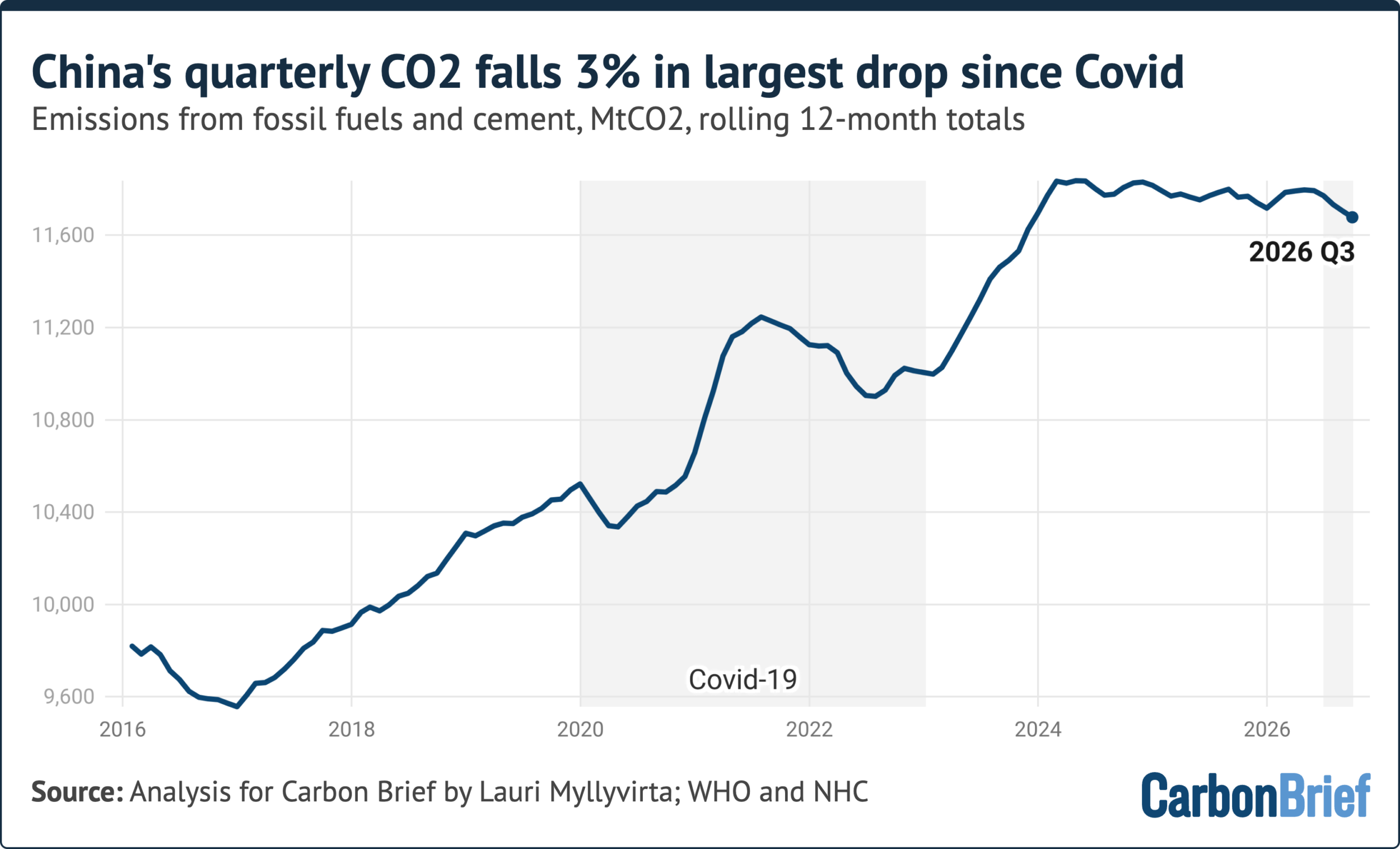
The outlook for China’s CO2 emissions depends on the balance between rising energy demand, clean-energy growth and the government response to a GDP slowdown.
Decline drivers
Key drivers of the fall in CO2 in the third quarter of 2026 included a 3.3% drop in coal-power generation, after demand growth slowed and the amount of “wasted” wind and solar fell.
Power generation from solar, wind and nuclear increased by 110 terawatt hours (TWh) year-on-year, more than twice as much as the growth in total electricity demand. This added clean-power generation equal to Germany’s total power output in the same time period.
The fall in coal-power output and CO2 emissions came despite the fact that China continues to build new coal-power capacity at near-record rates. This means that average running hours for coal plants are falling even faster than total generation, eroding their profits.
Meanwhile, transport oil consumption continued to fall sharply, down 9% year-on-year in the third quarter of 2026. Electric vehicles (EVs) continued to gain market share, hitting a record 67% of passenger car sales and 50% of heavy trucks in September.
The amount of electricity used by EVs grew by 53%, much faster than the number of EVs on the road, showing increased usage of the existing fleet in preference to fuelled vehicles.
Elsewhere, growth in the coal-to-chemical industry continued to slow down in the third quarter of 2026. The sector has been a key source of emissions growth, but high coal prices have weakened profitability and higher output prices hurt downstream demand.
Finally, CO2 emissions from cement and steel production continued to fall in the third quarter, as the contraction in construction volumes accelerated.
Outlook for emissions
Energy consumption growth has been falling after a period of exceptionally high growth during Covid, while clean-power growth has been robust.
This makes it likely that the growth in clean-power generation will exceed total energy demand growth this year, maintaining the structural fall in fossil-fuel use.
Looking ahead, this balance also relies on progress in removing barriers to new solar and wind power being added to the grid, which result in some clean electricity being “wasted”.
The recent slowdown in energy demand growth is partly – but not fully – explained by exceptionally mild weather in the third quarter.
Another key factor is weaker GDP growth. Since reported GDP growth remains within target, however, there is reduced pressure for further stimulus policies.
The focus of the economic stimulus announced to date is “six networks”, which includes the power grid and the transportation network.
These networks are highly relevant for energy and emissions – and they are already covered by policies that emphasise “green” and zero-carbon solutions.

The post Analysis: China’s quarterly CO2 falls 3% in largest drop since Covid appeared first on Carbon Brief.
Analysis: China’s quarterly CO2 falls 3% in largest drop since Covid
Climate Change
Coles, Woolworths grilled as beef buyers receive fail grade on new deforestation scorecard
MELBOURNE, Friday 6 November 2026 — As Coles holds its Annual General Meeting today, Greenpeace Australia Pacific has branded the major supermarkets with a fail grade on their commitment to source deforestation-free beef, with an updated scorecard revealing none of the major beef buyers are following through on forest sustainability commitments.
It comes after Woolworths’s AGM last week where the board copped a grilling by environmentalists and shareholders over its failed sustainability commitments. Both Coles and Woolworths committed to eliminating deforestation in their supply chains by the end of 2025, but a year past the deadline, neither company could guarantee that their beef was not sourced from deforested pastures.
From outside the Coles AGM, Adele Chasson, Nature Policy Lead at Greenpeace Australia Pacific, said:
“This is a report card Coles and Woolworths should be ashamed to take home. While all major beef buyers had promised to take deforestation off the shelves, none of them followed through. Shareholders and the public demanded answers from Woolworths last week and from Coles today, and we will continue to hold their feet to the fire on their promises.
“Beef is the leading cause of deforestation in Australia, and Coles and Woolworths keep putting off action while koalas continue losing their homes. Aussies must be able to get their groceries without having to worry if their dinner is contributing to the bulldozing of forests or driving extinction of iconic Australian animals.
“Without strong, rapid implementation plans, these companies continue with business as usual, flying in the face of Australia’s deforestation crisis. Big beef buyers like Coles and Woolworths must stop the bulldozers now, make good on their sustainability promises and play their part in stopping Australian forest destruction.”
The scorecard assesses how eight of Australia’s largest beef buyers stack up against a conversion and deforestation-free target. It charts whether the major supermarkets, Aldi, McDonalds, Hungry Jacks, Teys, Metcash/IGA and JBS are taking proper action to end Australia’s deforestation crisis. They all failed.
-ENDS-
Media contact: Kimberley Bernard on 0407 581 404 or kbernard@greenpeace.org
Coles, Woolworths grilled as beef buyers receive fail grade on new deforestation scorecard
Özgür Özel is the leader of Turkey’s main opposition “New Party” and a member of parliament from Manisa.
The world is running out of time to deliver on the Paris Agreement. The UN Environment Programme’s latest Emissions Gap Report concludes that the chance of keeping warming below 1.5C without overshooting it is gone. Even if every country delivers its current national pledges, the planet is heading for about 2.6C of warming this century.
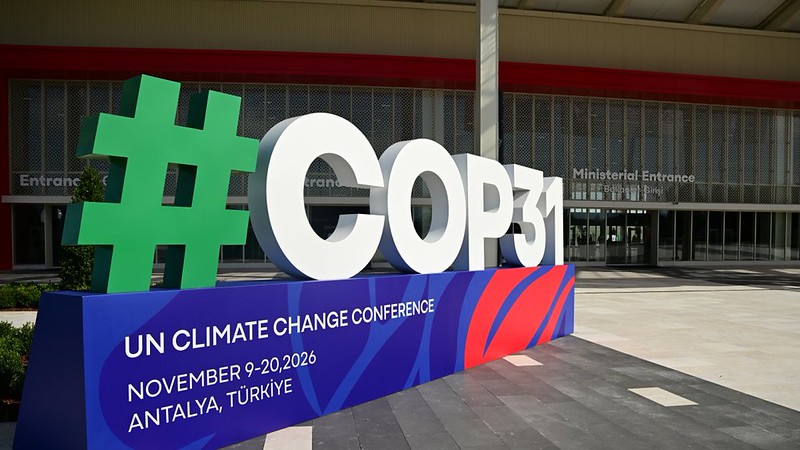
This is the backdrop as governments and their leaders gather in Antalya for COP31, ten years after the Paris Agreement took effect. Turkey lies in the Mediterranean, one of the regions most exposed to climate change, and hosting the summit is a real opportunity.
It is also a responsibility, and that responsibility begins at home. The world does not lack targets. What it has lacked – almost everywhere – is delivery. If Antalya is remembered for anything, it should be for shifting the focus from what countries promise to what they actually do.
For many people in Turkey, the climate crisis is already part of daily life. In 2021, forests in Manavgat, a district of Antalya, burned for more than a week. Last year, wildfires forced more than 50,000 people from their homes around the western coast city of Izmir. This October, Istanbul had its heaviest rainfall in more than 80 years, with the floods killing at least eight people.
COP31 Briefing: What to expect from the Antalya climate summit?
Electrification, the fossil fuel transition, adaptation to rising impacts, climate science and trade are key themes as governments gather for COP31 in TürkiyeBrazil’s fossil fuel roadmap sketches out first global timetable
The COP30 presidency’s voluntary timetable asks countries to plan first, then build up clean energy – only turning to oil and gas supplies from 2031


Measurable outcomes
Two weeks of climate negotiations cannot deliver everything that is needed to resolve the crisis, but COP31 can push for a few things that can be measured. The first is a voluntary fossil-fuel transition roadmap, with national milestones for 2030 and 2035 reported in the same format every year.
The second is a stronger commitment to protecting forests, with progress tracked over time. The third is yearly reporting on progress towards the agreed $1.3 trillion a year in climate finance by 2035, backed by a financial roadmap.
On adaptation, the indicators agreed in Belém should become funded national plans. By COP32, we should be able to see how many countries have an adaptation plan and the financial commitment behind each one.
Regional resilience partnership
The summit also has an unusual shape. Turkey hosts, Australia leads the negotiations, and the Pacific island nations play a central role. Climate diplomacy now sits at the centre of energy security, trade and development, and Turkey, which bridges developed and developing economies, is well placed to help build consensus between them. The lasting value of its presidency will depend on the practical partnerships it leaves behind.
One such partnership could connect two very different regions. On a map, the Mediterranean and the Pacific seem to have little in common, but their problems look similar: eroding coastlines, salt creeping into aquifers, failing harvests, fishing towns with fewer fish.
Turkey and Australia could launch a Mediterranean–Pacific Climate Resilience Partnership, linking coastal cities, scientists, institutions including development banks and island governments. It does not need a new bureaucracy. It can start with a few projects: shared satellite data and early-warning systems, better coastal flood defences, and trials of water-saving farming in the communities most at risk. What matters is visible results on the ground, not a ceremony.
Turkey’s track record
Turkey does have progress to point to. It has committed to net zero by 2053, and its solar and wind capacity has grown fast. The sunshine, the wind and the industrial base are all there. But the long-term direction of the energy mix is still unclear.
Turkey also signed the Glasgow Leaders’ Declaration on Forests and Land Use at COP26, pledging to halt and reverse forest loss by 2030. With four years left, COP31 is a chance to show how that promise will be kept.
COP30 roadmap says faster use of existing tools can halt forest loss by 2030
And while the summit celebrates zero waste, Turkey took in more than half a million tons of European plastic waste last year, much of it bound for Mersin and Adana. On November 21, the day after COP31 closes, an EU ban on plastic-waste exports to non-OECD countries takes effect. Turkey, as an OECD member, is exempt. That should worry us more than it seems to.
None of this will carry much weight unless Turkey’s own record holds up. A leadership at odds with its own environment and its own citizens will struggle to inspire global confidence in its commitment to protecting the planet.
Threat to local climate action
Cities are where adaptation happens. Water, flood protection, waste and urban planning fall largely to municipalities. That is why the imprisonment and removal of more than 50 elected opposition mayors, including the mayor of Istanbul, matter for environment and climate policy, as well as for democracy.
When local leadership is disrupted, investment plans stall and work on flood defences and water supplies loses continuity. As a result, local governments are left paralysed.
Comment: From Australia to Chile, our cities are driving a green investment boom
Inconsistent policymaking when it comes to the environment and climate deepens the problem in Turkey as it does in other countries. A few practical steps would make a real difference.
Set out a gradual, well-planned energy transition. Stop new construction in streambeds and drinking-water basins and put zoning maps online. Inspect every imported plastic shipment and cap total imports. Hold public hearings on environmental impact assessments before permits are issued, not after. And publish an independently audited climate scorecard each year covering emissions, renewables capacity, forest loss and adaptation spending.
This could set an example beyond Turkey. Many emerging economies are trying to cut emissions while protecting jobs and keeping industry competitive. Digital tools and artificial intelligence are already available to help forecast wildfire risk, reduce grid losses and track water use.
With the 1.5C limit now set to be breached, Antalya’s success will be measured by the greenhouse gases avoided, the investments delivered and the forests still standing in the years that follow. It is our responsibility to watch closely and see whether those commitments are delivered, transparently and in line with international standards.