

Global fossil-fuel emissions are set to fall by around 0.5% in 2026 amid the fallout from the Hormuz crisis, according to Carbon Brief analysis.
The US-Iran war has severely disrupted trade through the strait of Hormuz, causing a spike in oil and gas prices that continues to ripple around the global economy.
Each month of disruption – and each new flashpoint, such as in Yemen – is increasing the incentive to switch to alternatives.
Those alternatives include coal, with the latest forecasts pointing to a 1.2% rise in coal demand this year – apparently supporting media claims of a “return to coal” in the wake of the crisis.
Yet Carbon Brief’s analysis shows the rise in emissions associated with this increased coal use, much of which is unrelated to Hormuz, is set to be more than offset by declines for oil and gas.
The estimated overall impact on carbon dioxide (CO2) emissions from fossil fuels in 2026 is shown in the figure below and amounts to a reduction of around 0.5% from 2025 levels.
(Fossil fuels account for two-thirds of global greenhouse gas emissions.)
The emissions estimates for each fossil fuel are based on the latest forecasts from the International Energy Agency (IEA) for coal, oil and gas, in light of the ongoing global energy crisis.
For example, the agency initially estimated that global coal demand would decline this year. In its 2025 coal report, published in mid-December, it said that declining coal demand in China would outweigh the impact of pro-coal policies under US president Donald Trump.
In contrast, the latest update, published in September 2026, said that global coal demand would rise by 1.2% in 2026, instead of the small decline that had been expected.
The report highlighted the boost to coal demand from higher gas prices in the wake of Hormuz. However, there are limits to this, because few countries can switch from gas to coal at large scale.
The IEA’s latest report also noted the role of a strong El Niño, which is pushing up the need for cooling and depressing hydropower output in key markets. Other short-term factors are also affecting coal demand this year, including a rising amount of “wasted” wind and solar in China.
For gas, the IEA did not initially update its previous forecast that global gas demand would rise by 2.0% in 2026, which had been published in January of this year.
Its most recent forecast – published in July – already pointed to a 0.6% drop in demand in 2026. Since then, pressure on gas demand from high prices has only grown stronger.
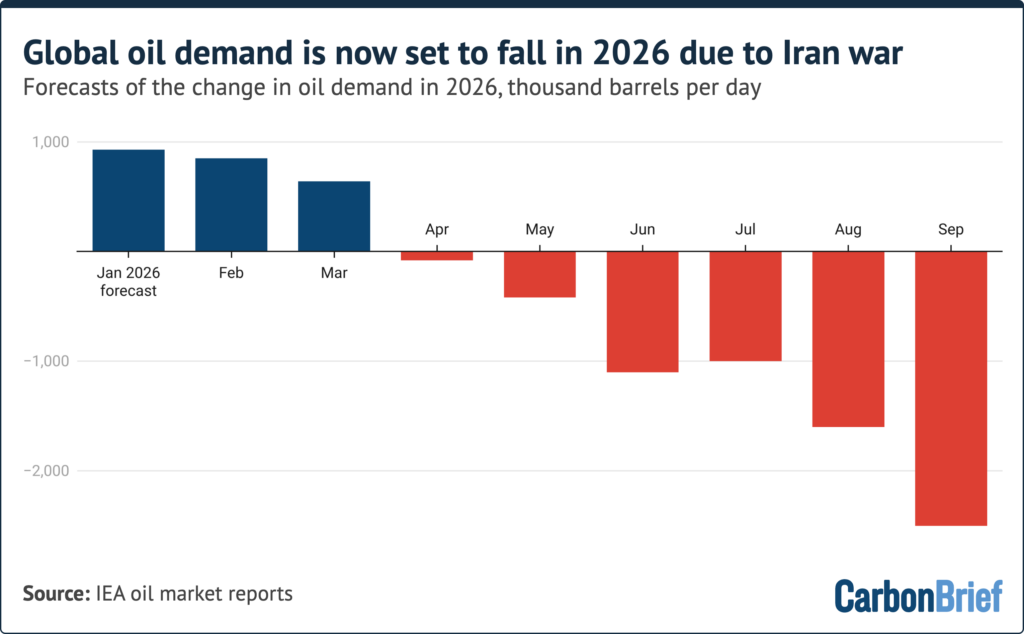
For oil, there has been an even more dramatic shift in forecasts since the start of the year.
In its January 2026 oil market report, the IEA forecast a rise in demand in 2026 of 930,000 barrels per day (bpd). As shown in the figure below, this has been steadily revised downwards over the course of the year, as the Hormuz crisis was first ignited – and then extended.
By September, the IEA was forecasting a 2,500,000bpd drop in oil demand in 2026, equivalent to a reduction of 2.4% from 2025 levels.
(A 15 September research note from Morgan Stanley, not available online, found a “consensus” forecast of a 2,415,000bpd drop in demand in 2026.)
While there are many short-term factors at play in the shifting forecasts for 2026, it is clear that the latest energy crisis will also affect fossil-fuel demand in the next year and beyond.
For example, whereas the IEA initially forecast that oil demand would rebound in 2027 to well above 2025 levels, it is now expecting use of the fuel to be effectively flat for two years.
This puts a question mark over its previous expectation – published in October last year – that global oil demand would not peak until as late as 2030.
“For every month the conflict lasts, the probability of permanent [oil] demand destruction increases,” wrote Sverre Alvik, vice president at consultancy DNV in a late August analysis.
As fuel prices have surged, electric vehicles (EVs) have captured record shares of major car markets, from Australia and China through to Europe, Indonesia and Thailand.
In July, EV sales nearly doubled year-on-year in “new markets”, noted Alvik, pointing to countries outside China, Europe and North America.
The IEA says the 2027 outlooks for coal and gas are interdependent, with coal demand potentially increasing again if gas prices remain elevated – or dropping back if gas prices ease.
At the same time, governments in countries that had planned to rely on imports of liquefied natural gas (LNG) have been signalling shifts towards favouring domestic clean energy instead – or continuing to use coal for longer.
The current crisis, therefore, has the potential to not only lower fossil-fuel use and emissions in the short term, but also on a more lasting basis.
Related

CCC: Heathrow expansion could push flights to ‘80% of UK emissions by 2050’
Analysis: China’s CO2 emissions fall in Q2 2026 due to plummeting oil use
Explainer: The CMIP7 emissions scenarios – and how they explore future climate change

Q&A: What do China’s provincial five-year plans say about climate and energy?
The post Analysis: Global fossil-fuel emissions set to fall in 2026 amid Hormuz crisis appeared first on Carbon Brief.
Analysis: Global fossil-fuel emissions set to fall in 2026 amid Hormuz crisis

Prepared by a coalition of nine Western Australian union, industry, conservation, and community organisations—including UnionsWA, the Conservation Council WA, and the Smart Energy Council—the WA Clean Energy, Jobs & Industry Plan provides a practical roadmap to transform Western Australia into a clean energy powerhouse while creating thousands of secure local jobs.
Western Australia stands at a pivotal crossroads: lead the global clean energy economy or watch investment, future industries, and secure jobs go elsewhere. The WA Clean Energy, Jobs & Industry Plan outlines a transformative blueprint to harness the state’s world-class solar and wind resources. Discover how legislated renewable targets, green iron manufacturing, and a dedicated regional training strategy can generate tens of thousands of local jobs, lower household bills, and build a resilient, net-zero future for all Western Australians.

WA needs a clear and forward-thinking plan if it is going to become a competitive renewable energy powerhouse and maintain its economic strength through the energy transition.
“Western Australians know a faster renewable energy transition will lower their household expenses and prevent harmful climate pollution. But the community also needs clear direction to ensure this transition will create jobs, lower costs and not cause undue environmental harm.
“Here, sectors representing a broad range of interests have laid the groundwork for those outcomes, clearly outlining what is needed to create a future for WA that is good for the environment, for the climate, for workers and for the economy.
Summary
The WA Clean Energy, Jobs & Industry Plan sets out a strategic roadmap to position Western Australia as a global clean energy superpower while creating thousands of secure local jobs.
The report establishes three overarching goals:
- Creating local employment.
- Maintaining industrial competitiveness.
- Lowering household energy costs
To realize this vision, the framework details actionable measures to follow on from the recent WA Government announcement of a 75% Renewable Energy Target by 2031 for the South West Interconnected System. This includes developing a statewide Renewable Energy Target, coordinating statewide workforce and training pipelines, strategically planning regional infrastructure to safeguard high-value biodiversity and cultural heritage, and ensuring equitable benefit-sharing through household electrification incentives and First Nations equity partnerships. Ultimately, the plan highlights that establishing clear policy and regulatory certainty will unlock lower energy bills, boost power reliability, and secure the state’s global competitiveness in emerging green commodity export markets.

Key Findings
- Statewide Renewable Energy Target and Emissions Reduction Targets: The report calls for a statewide RET and 1.5°C aligned emission reduction targets to remove policy risk, lower capital costs, and attract clean energy investment.
- Transformative Job Creation: Accelerating the transition offers massive employment prospects, including up to 8,800 solar and battery jobs by 2050, as well as 24,000 ongoing and 11,000 construction jobs in a commercial green iron industry.
- Industrial Electrification & Competitiveness: Requiring large gas users to adopt binding electrification timetables and providing concessional financing will protect existing energy-intensive manufacturers from rising energy costs and impending domestic gas shortfalls.
- Green Commodity Export Leadership: Western Australia can build new export markets in green iron, green ammonia, and offshore oil/gas decommissioning by constructing shared common-user infrastructure and setting dedicated Green Commodity Export Targets.
- Coordinated Workforce & Training Pipeline: To address critical skill shortages the plan recommends establishing a WA Clean Energy Jobs Plan 2050, three regional training hubs, and dedicated pathways for female and under-represented apprentices.
- Environmental Safeguards & Community Benefits: Fast-tracked development must be paired with State Planning Policies that avoid high-biodiversity and cultural heritage lands, mandate new data centres to run on additional renewable power, and deliver household electrification rebates and First Nations equity partnerships.