


Article Contents

Four Ugandan farmers filed a case with London’s High Court on Tuesday, aiming to stop the East African Crude Oil Pipeline (EACOP) from starting to operate by asking the court to apply Uganda’s laws against the project’s UK-registered company.
The controversial 1,443-kilometre (897-mile) pipeline, majority-owned by French energy company TotalEnergies, aims to carry crude from Ugandan fields for export through neighbouring Tanzania. About 80% has been built so far, according to its developers.
The pipeline’s first oil exports are expected as soon as October, according to its developers, and the campaign group Avaaz, which is backing the farmers’ crowdfunded lawsuit, called it “one final chance to stop one of the worst oil pipelines on the planet”.
The claim, filed by London law firm Leigh Day, argues that EACOP Ltd’s role in developing and operating the pipeline breaches Ugandan laws that protect citizens’ right to a clean and healthy environment.
-
Ugandan farmers use British court to try to stop East Africa oil pipeline
The farmers and their lawyers will argue that a UK-based entity linked to the East African Crude Oil Pipeline has breached Ugandan law and construction should halt -
French court rules Total must revise climate plan to account for all emissions
Oil and gas giant TotalEnergies has been given six months by a court to publish a more robust climate plan -
Uganda cites contentious IEA fossil fuel scenario backed by Trump administration
Critics of the African nation’s oil ambitions say referencing the International Energy Agency’s most pessimistic scenario for climate action is a risky policy
One of the claimants, Racheal Tugume, told a press conference she had been displaced from her land due to the pipeline’s construction, which she said had damaged local rivers, wildlife and ecosystems that communities depend on for their livelihoods just as erratic weather linked to climate change takes an increasing toll.
“I am very happy that there are people in countries like the UK who are listening to us, who are behind us and who have come to support us,” Tugume said, adding that she hoped the case would bring justice to communities affected by the pipeline.
Ugandan law in UK court
While the pipeline is a joint venture led by TotalEnergies, with smaller stakes owned by Ugandan, Tanzanian and Chinese national oil firms, it is operated by EACOP Ltd, a company registered to an office in London’s Canary Wharf financial district.
EACOP Ltd did not respond to a request for comment.
The claim appears to be the first attempt to have Uganda’s climate and environmental protections enforced in a foreign court, partly reflecting concerns over whether cases challenging the multibillion-dollar pipeline would get a fair trial in Uganda.
Ugandans living near new oil pipeline let down by compensation programmes
Concerns about access to a fair hearing are among the issues the court will consider when deciding if it should take on the case, said Matthew Renshaw, partner at Leigh Day.
Renshaw said that precedents including the Nigerian oil pollution case against Shell have shown that claims against British-registered companies for harms overseas can be successfully fought in UK courts.
“We are proud to represent the four brave principled individuals,” Renshaw said.
Constitutional protections
The pipeline project has already been subject to repeated lawsuits in several countries, none of which have succeeded. A climate lawsuit filed in Uganda more than a decade ago by a group of young people has yet to conclude. Another at the East African Court of Justice, brought by campaign groups against Uganda and Tanzania, was rejected on procedural grounds last November.
A separate ongoing lawsuit in TotalEnergies’ home country of France – a refiled version of an earlier failed claim – cannot stop EACOP going ahead, but it does seek damages from TotalEnergies for affected communities.
With the newly launched case, Leigh Day’s legal adviser Marc Willers said the claim draws on specific Ugandan laws in a bid to stop EACOP’s operations.
Uganda may see lower oil revenues than expected as costs rise and demand falls
These include the Ugandan constitution, a 2019 environmental law and the National Climate Change Act 2021, which gives Ugandans the right to bring a case before a court in circumstances where anyone or any entity threatens the country’s ability to mitigate climate change.
Stopping a “carbon bomb”
The pipeline, which will link Uganda’s Lake Albert oil fields to Africa’s east coast in Tanzania, has already displaced thousands of people and cuts through the Lake Victoria basin, one of East Africa’s major freshwater systems and a critical water source for around 40 million people.
According to the BankTrack non-profit, when the pipeline is at peak production, it will carry 216,000 barrels of crude oil per day and release over 33 million tonnes of carbon emissions each year. Over its full lifetime of 25 years, it is estimated to release about 379 million tonnes of greenhouse gas emissions across its value chain including construction, refining and product use.
A May 2026 report from Earth Insight also warns that the pipeline and related infrastructure could affect 158 wetlands in Uganda, 11 rivers, 44 protected areas and seven key biodiversity areas while disrupting about 2,000 square km of protected wildlife habitats.
This is why the primary focus of the UK court case is to stop the operation of the pipeline in its tracks, Leigh Day’s Willers said, calling it a “carbon bomb” that would worsen the world’s climate crisis.
Long wait for first hearing
While the purpose of the case is to stop the pipeline from launching operations, Renshaw said it could take about 12 months before the case gets a first hearing and about 18 months before it goes to trial.
Billions unlocked as Green Climate Fund agrees to spend more and save less
The farmers are, however, seeking an injunction to stop EACOP Ltd from proceeding with operations. In the event that shipments begin, the lawsuit will still seek to stop the pipeline from then on, Renshaw said.
“We will be doing what we can to expedite matters but it is possible that EACOP will have started operating the pipeline before the claim is heard. If that is the case, the claim would intend to halt operations from that point. For example, the pipeline may operate for just one year rather than 30-plus, resulting in far less harm,” he said.
The post Ugandan farmers launch UK court case against East African oil pipeline appeared first on Climate Home News.
Ugandan farmers launch UK court case against East African oil pipeline
Continue Reading
An older teaching about land acknowledgement
As I have come to understand the spirit and intention of land acknowledgement, I often return to fond memories of my grandmother and her words of wisdom. She taught that the health of the places we call home comes first, because the wellbeing of the people depends on it.
In her teaching, land acknowledgement began with the land. Long before it became a paragraph read at the start of a meeting, it was a way of recognizing a homeland: its waters, its species, its seasons, and the spirit that revealed whether the place was well.
Her teaching echoes a practice found across many Indigenous Nations. Haudenosaunee gatherings, for example, have long opened with the Ohén:ton Karihwatéhkwen, the Thanksgiving Address, often translated as “the words that come before all else.” The speaker greets and gives thanks to the people, the earth, the waters, the plants, the animals, the winds, the sun, the moon and the stars. Only after everything that sustains life has been acknowledged does the gathering turn to its own business.
That order changes what an acknowledgement is for. Its purpose was to share the story of a place with neighbours and to draw them into the work of tending it. People entered the story second, as the ones responsible for what had just been named.
Understood this way, an acknowledgement does more than open a meeting. It asks us to reconsider where we stand, and what we owe the ground beneath us.
Nations among nations
In her teaching, people are one nation among many. The salmon are a nation. So are the cedars, the bison, the medicine plants, and the pollinators. Each belongs to a place, carries its own responsibilities, and offers gifts no other nation can give.
This idea of kinship runs through many Indigenous philosophies. The phrase “all my relations,” heard in ceremonies and gatherings across Turtle Island, is a reminder that family extends beyond people to the animals, plants, waters and lands that make life possible. Some Indigenous languages carry the same understanding in their grammar, speaking of many plants, animals and natural forces as living beings rather than objects.
Sovereignty, understood through this relationship, is a kind of standing more than a form of control. Each nation belongs fully to its place and carries its share of that place’s life. No nation thrives alone, and none thrives by taking over the whole.
The land is also the source of instruction. Over generations, people watched how a river valley or a stretch of prairie kept itself well: who arrived when, who fed whom, and how much could be taken before the giving stopped. In my grandmother’s telling, those observations became instructions, and those instructions helped shape law and protocol. They guided when to harvest, where to camp, how to enter a neighbour’s territory, and what was owed in return.
Indigenous legal scholars today often describe this as law that comes from the land itself, learned by watching how living systems sustain one another. A plainer name for it is knowing how to live somewhere.
The host and the guest
One of the clearest teachings in this understanding of the world is the relationship between host and guest. My grandmother invited us to recognize that relationship in the lives of plants and animals.
A host prepares the place before anyone arrives. A beaver family dams a stream, and the pond becomes a home for fish, frogs, birds and plants. A fallen tree becomes a nurse log, feeding the next generation of seedlings as it returns to the soil.
A host offers first. A flowering plant sets out nectar. A berry bush ripens fruit. These provisions come in their own season, not whenever a visitor happens to want them.
A host also makes its presence known. Birdsong, scent and the marks left along a trail tell newcomers that a place is already inhabited. The visitor does not arrive in an empty world.
The guest has responsibilities too. A guest attends to the season and to what the place can offer. A guest does not assume that everything within reach is theirs to take. A guest leaves something that helps sustain the relationship.
A bee takes nectar and carries pollen. Read through this teaching, that exchange offers an image of visiting well: receiving a gift while helping the host continue its life.
Many Indigenous harvesting protocols carry the same ethic into daily practice: ask before taking, take only what is needed, offer thanks, and leave enough for others and for the plant or animal to recover.
None of this suggests that every relationship in nature is peaceful or generous. These are ways of seeing responsibilities that people can learn to carry.
Everyone is both
No being is only a host or only a guest.
A tree makes room for other life while depending on soil, water, sunlight, fungi, and relationships beyond itself. People, too, may welcome others into their homes while remaining dependent on the larger homeland that sustains them.
The distinction between host and guest is therefore about roles, not ranks. Everyone receives. Everyone has something to give.
The question is whether the exchange sustains the place.
A visitor who takes without restraint leaves less for those who come next. A host who neglects the place has less to offer. Both have responsibilities, and neither can fulfil them alone.
This is the heart of reciprocity, a principle found across Indigenous philosophies: relationships stay healthy when gifts move in both directions. The Haudenosaunee teaching of the seventh generation extends that exchange across time, asking that decisions made today leave the place well for those not yet born.
Mutual benefit begins here, with the recognition that different beings carry different gifts and obligations.
What people carry forward
My grandmother’s teaching connects these relationships to the ways people meet their neighbours.
The host prepares a place, offers food and rest, and explains where the visitor has arrived. The guest makes themselves known, explains why they have come, listens to the terms of the visit, and brings something in return. The gift may be material. It may also be labour, knowledge, news, or a commitment to help.
Nations around the Great Lakes carried this ethic into treaty. The Dish with One Spoon, an agreement among the Haudenosaunee, Anishinaabe and allied Nations, describes shared hunting grounds as a single dish. Everyone eats from it with one spoon, takes only what they need, leaves enough for others, and keeps the dish clean. The Two Row Wampum, between the Haudenosaunee and European newcomers, shows two vessels travelling side by side on the same river, each keeping its own ways and neither steering the other.
In this understanding, acknowledgement is more than naming the people associated with a territory. It is learning enough about a homeland to behave responsibly within it.
Whose home is this? What sustains it? What laws and agreements guide our presence? What can we receive, and what must we return?
These questions make acknowledgement a relationship rather than a recital.
They also make it diplomatic. A guest who recognizes the host’s homeland recognizes that they have entered a place with its own relationships and responsibilities. A host who welcomes the guest makes room for an encounter governed by those relationships.
Neither arrives without standing. Neither arrives without obligations.
Beginning with place
I write from the shores of the Bay of Quinte. Here, the teaching asks me to begin with the water, the shoreline, and the life they sustain. Before I describe myself, I must attend to where I am.
That does not make people or history less important. It places them within the homeland that gives them meaning. The people, their laws, their agreements, and their responsibilities all belong to the place.
In a time of longer fire seasons, troubled waters, and uncertainty about what the next season will bring, this teaching asks something difficult and useful of us: pay attention before you speak.
An acknowledgement cannot tell the story of a place if the speaker has stopped noticing it.
The land came first. Beginning there again means learning to name what sustains us, and accepting that what sustains us also asks something of us.
By Rye Karonhiowanen Barberstock
Photo by Andrik Langfield on Unsplash
The post The Land Came First appeared first on Indigenous Climate Hub.
Carbon dioxide (CO2) emissions from fossil fuels and cement are projected to fall by around 0.4% in 2026 to 38.2bn tonnes of CO2 (GtCO2), according to new figures from the Global Carbon Project.
This guest post is by:
- Dr Zeke Hausfather, Carbon Brief’s climate science contributor
- Prof Pierre Friedlingstein, chair of mathematical modelling of climate systems at the University of Exeter and part of the Global Carbon Project team.
Carbon dioxide (CO2) emissions from fossil fuels and cement are projected to fall by around 0.4% in 2026 to 38.2bn tonnes of CO2 (GtCO2), according to new figures from the Global Carbon Project.
The 21st edition of the annual “global carbon budget” report, published today, says that this small decline is largely due to a 1.9% drop in emissions from oil and the energy shock triggered by the Iran conflict and the closure of the strait of Hormuz.
Emissions from coal continue to increase slightly.
The Global Carbon Project’s projections for fossil fuel and cement CO2 emissions in 2026 are preliminary, with a range that spans a fall of -1.5% to a rise of +0.6%.
This means a small increase in emissions can not be ruled out.
Emissions from land-use change, such as deforestation, are projected to rise in 2026.
This is primarily driven by peat fires and forest degradation in south-east Asia and is linked to the development of a strong El Niño event this year.
As a result, total CO2 emissions from fossil fuels and land use are projected to reach a record high of 43.3GtCO2 in 2026 – marginally above 42.8GtCO2 in 2025.
Research published alongside the report by the same team in Nature Climate Change finds that the growth in solar, wind and electric vehicles (EVs) now offsets around two-thirds of the emissions that would otherwise come from rising energy demand.
However, the deployment of these technologies is not yet enough to push global emissions into a sustained decline, according to the study.
The 2026 global carbon budget report also estimates that:
- Fossil emissions are projected to fall in China (-0.9%), the US (-1.3%) and the EU (-1.5%) in 2026, but rise by 4.4% in India.
- Oil emissions are projected to fall in every major region, with the largest drop in China (-4.6%).
- Land-use emissions averaged 4.9GtCO2 per year over 2016-25, around 21% lower than the decade before.
- Total CO2 emissions (fossil and land-use) grew by an average 0.3% per year over the past decade (2016-25), compared with 1.7% per year over the decade before.
- The remaining carbon budget to limit warming to 1.5C is 150GtCO2, or less than four years of current emissions.
- The land sink in 2025 was the highest on record, rebounding after being weakened during the 2023-24 El Niño. The current El Niño is expected to weaken the land sink in 2027.
- The concentration of CO2 in the atmosphere is set to reach 427.7 parts per million (ppm) in 2026, 54% above pre-industrial levels.
(For more on previous editions of the Global Carbon Project’s annual report, see Carbon Brief’s coverage in 2025, 2024, 2023 and 2022.)
Total emissions edge up as land-use emissions rise
Total global CO2 emissions, which combines fossil fuels and land-use change, are projected to reach a record high of 43.3GtCO2 in 2026, up from 42.8GtCO2 in 2025.
The increase in 2026 comes entirely from a projected rise in land-use emissions, which are more challenging to estimate than fossil emissions.
(The global carbon budget groups emissions from fossil fuels and cement production as “fossil emissions”. Carbon Brief follows this convention throughout this piece.)
If land-use emissions had stayed at 2025 levels, total emissions would have fallen slightly in 2026 to around 42.6GtCO2.
Each edition of the global carbon budget updates the historical record as new data and methods become available. The chart below shows total emissions in this year’s budget compared with the five previous editions.
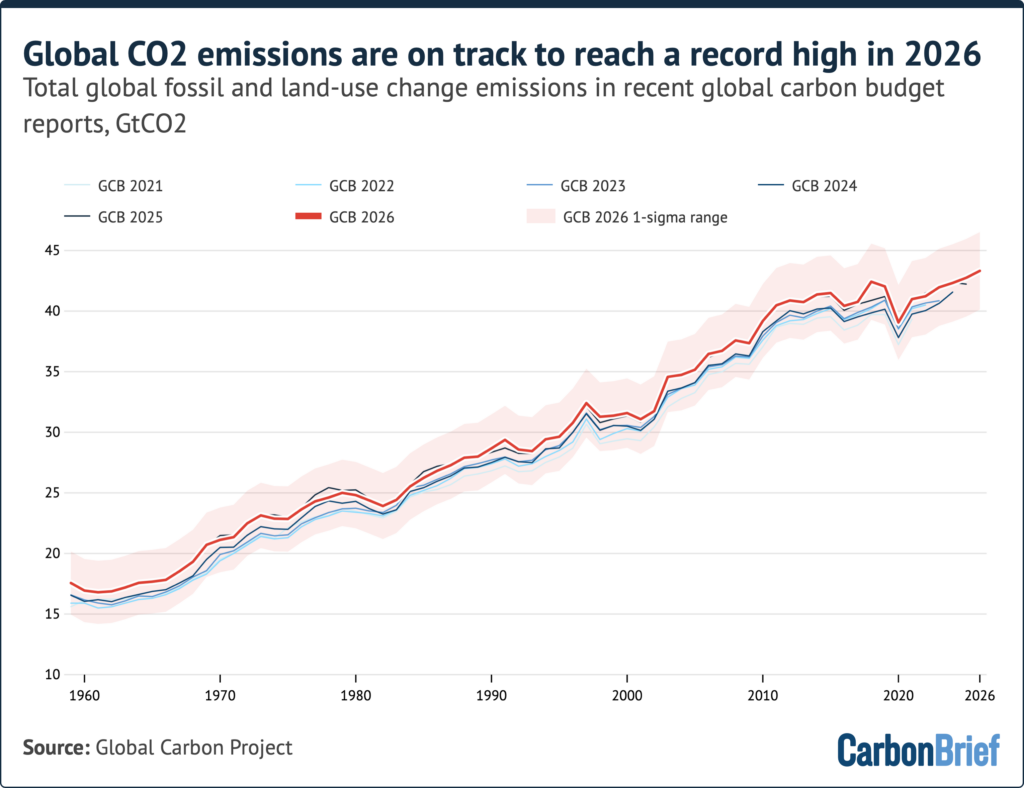
This year’s estimates of historical fossil emissions are around 0.3GtCO2 per year higher than in last year’s budget.
This is largely because the report now estimates a smaller “cement carbonation” sink in the wake of research published this year in Communications Sustainability. In other words, it estimates that cement is able to slowly reabsorb less CO2 over its lifetime than previously thought.
Estimates of land-use emissions have also been revised, including a spike in 2018 – visible in the chart above – linked to updated cropland data for Colombia.
The updated numbers show that total emissions have grown by 0.3% per year over the past decade (2016-25), compared