

The Green Climate Fund (GCF) will have nearly $6 billion more to spend on emissions-reduction and climate adaptation projects in developing countries, after its board agreed to a management proposal to reduce the proportion of money it has to keep in reserve.
At a meeting in Tajikistan this week, the government representatives who make up the fund’s board endorsed the proposal to revise its financial rules so that it no longer has to set aside one dollar for every dollar it spends.
Instead, the buffer amount will be decided based on a new, looser methodology. The GCF’s chief financial officer, Darren Tan, told board members that the old rules had led to too much cash building up in the fund’s reserves and “constrained the resources that we could deploy”.
The fund has a portfolio of 360 projects to which it has allocated $20.5 billion, but it has struggled to collect all the pledges made by donors as the US has failed to deliver billions and other wealthy nations are now making cuts to their funding for climate work in developing countries.
-
World Bank’s climate work can endure without finance target, experts say
Even though the global lender has ditched a headline goal for its financing with climate benefits, it has decided to continue its climate action plan in the face of US pressure -
Can giant batteries unlock Africa’s green industrial future?
Battery energy storage systems (BESS) could drive clean tech manufacturing in Africa but shortfalls in finance and data are still limiting deployment at scale -
Ocean summit stays silent on new wave of offshore oil and gas expansion
At this month’s Our Ocean Conference in Mombasa, campaigners warned that ocean protection requires governments to halt new offshore fossil fuel projects


The new system has been independently validated and is supported by the GCF’s trustee, the World Bank. Tan said the approach is still prudent enough that the fund will remain “financially resilient even under adverse conditions”.
The change “allows the fund to do more with the same resources”, Tan concluded, adding that “this translates directly into greater climate impact”. The shift leaves the fund with $5.65 billion to put into projects instead of around $1 billion under the previous rules.
The reforms follow wider moves to get funders of climate action to do more with their money. In 2023 and 2024, the World Bank lowered its equity-to-loans ratio from 20% to 19% and then 18%, freeing up around $7 billion a year for it to invest.
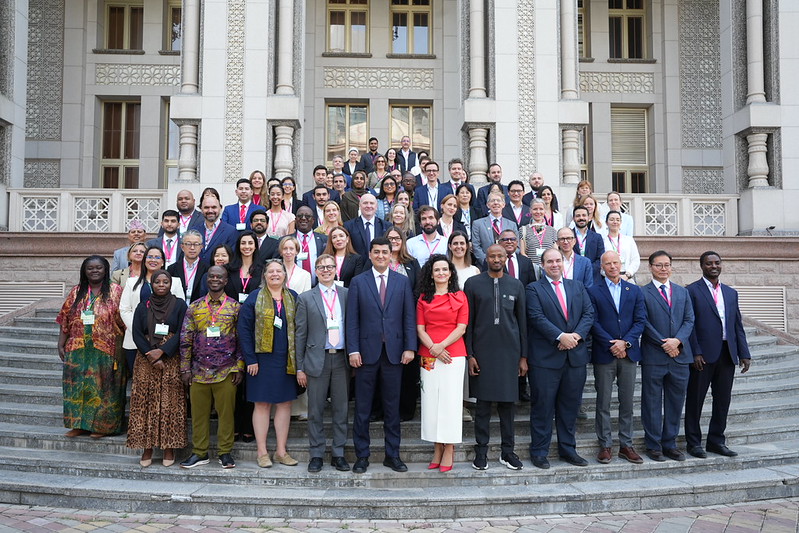
At their meeting in Dushanbe, GCF board members broadly welcomed the proposal, although several complained they had not been given enough time to consider reforms of such importance.
“No brainer”
While developed countries were all supportive, developing nations’ responses were more mixed. Some called for the new system to be implemented immediately but others urged a slower roll-out and raised concerns that the changes would lead the fund to give out more loans and fewer grants.
Canada’s representative said the approach is “considered standard practice across the climate finance architecture”, the UK said it “seems sensible”, France called it a “no-brainer” and New Zealand said it would “grow the funding pie”.
Germany’s Annette Windmeisser said it “responds to the COP29 decision to triple outflows from the mutilateral climate funds”. This goal was agreed after a push from small island and least developed countries but – with funding from wealthy governments faltering – the GCF is looking at controversial options like borrowing from banks to meet it.
Japan’s Kazuho Taguchi hinted at similar motivations for supporting these reforms. “Efficient use of limited public resources” is essential, he said, because “it is unrealistic to expect public finance from developed countries alone to meet the full scale of need”.
Fears grants replace loans
Some developing countries strongly supported the reforms too, including Gambia representing the least developed nations, Costa Rica and Uruguay.
Others urged caution. Georgia’s Nino Tandilashvili said the “outside world… want more projects from us” but also “financial sustainability of this fund”.
Botswana’s Balisi Gopolang echoed this and Ghana’s Antwi Boasiako-Amoah said the fund’s models should be tested against performance and the changes should be implemented slowly and piloted first.
Boasiako-Amoah also said he was concerned that the new methodology would be used to increase the proportion of the fund’s money that is loaned out to developing countries rather than distributed as grants. As the money is intended to be returned, loans are less financially risky to the GCF than grants.
The board’s decision approving the reform incorporated this concern by noting that the “risk appetite or financial instrument mix” of board spending decisions should not be influenced by the new policy.
Liane Schalatek, who monitored the meeting for the Heinrich Böll Foundation, told Climate Home News that the reforms give the GCF “some breathing room” for the next year or two, after the Trump administration reneged on US pledges and the UK halved the contribution it had promised for 2024-2027.
But, Schalatek added, “it does not solve the fundamental question of whether developed countries are willing to stick to their obligations under the Paris Agreement and the [UN climate regime] that still requires them to provide substantial inputs into the GCF for the next replenishment period from 2028-2031.”
The post Billions unlocked as Green Climate Fund agrees to spend more and save less appeared first on Climate Home News.
Billions unlocked as Green Climate Fund agrees to spend more and save less

Three countries have been named by the Paris Agreement’s compliance committee for failing to submit a nationally determined contribution (NDC) and repeatedly snubbing offers of help with their climate plans.
After months of internal debate over whether to identify serial non-responders, the Paris Agreement’s Implementation and Compliance Committee (PAICC) named the three countries which have failed to engage with it over their NDCs on Friday.
It named Democratic Republic of Congo, Senegal and North Korea in a footnote of its annual report, adding that it decided to name them “with a view to facilitating engagement”, adding that representatives of the three nations had been invited to its meeting in early 2027 “with the purpose of identifying any challenges and constraints”.
“The Committee noted the importance of Parties engaging with the Committee in a timely manner, while noting that some delays may be due to the national capabilities and circumstances of the Parties”, the report said.
-
Under US pressure, World Bank says it will back gas “where appropriate”
The US wants the World Bank to expand its gas support while climate campaigners are pushing for it to end – its head spoke this week of limited backing for the fossil fuel -
IPCC scientists vow to press on with climate reports despite political deadlock
After governments again failed to agree a timeline, nearly 120 IPCC authors pledged to complete their assessment on time and with full scientific rigour -
Paris Agreement committee snubbed over missing NDC climate plans
Many governments have still not submitted a nationally determined contribution to the UN, breaching a key requirement of the Paris Agreement

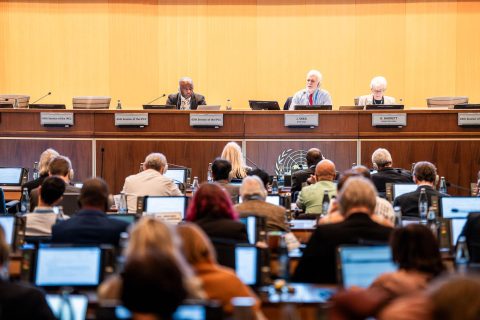

In July, PAICC said 12 countries had ignored its repeated attempts to discuss why they had not published an NDC as required every five years under the 2015 Paris accord.
Members of the committee had been divided over whether to name them, but at a September meeting decided to do so in their annual report to the annual climate COP summit.
By the time the report was published on Friday, only Congo, Senegal and North Korea “had not communicated an NDC or submitted a [Biennial Transparency Report] and had not yet responded to any of the Committee’s notifications, despite several reminders issued by the Committee in this regard”.
Rainforest and renewable energy ambitions
The silence from Congo and Senegal is notable because the former is home to much of the Congo Basin rainforest while the latter has sought billions of dollars in climate finance to support its renewable energy ambitions.
After Brazil, Congo has more rainforest than any country in the world. This forest, and the country’s peatlands, absorb huge amounts of greenhouse gas but are fast being lost to expanding farmland, charcoal production, logging and mining.
Senegal signed a Just Energy Transition Partnership with Canada and wealthy European nations in 2023, to help it meet its renewable energy targets under the-then government of Macky Sall. It was chair of the Least Developed Countries group between January 2022 and December 2023.

Tejas Rao, who is researching the PAICC as part of a doctoral thesis at Cambridge University, said the governments of the three countries should engage with the committee.
“Engagement costs these governments very little and the committee has shown it will listen,” he said.
“Silence leaves the committee with no basis to help, and it leaves the [governments] exposed to the narrative that they are simply disengaged,” he told Climate Home News.
Paris Agreement requirement
The 2015 Paris Agreement requires all parties to publish an NDC every five years outlining their emissions reduction targets, with each plan meant to be more ambitious than the country’s last NDC.
The latest set – the third round of plans, with new targets for 2035 – was due in February 2025. While most countries missed this deadline, all but around 30 – mostly small emitters but including Egypt, Vietnam and Argentina – have now submitted them.
Over the year, the PAICC – which is made up of government climate officials from developed and developing countries – has been communicating with governments that have not submitted NDCs and trying to overcome barriers to them doing so.
Some nations have cited exceptional circumstances as the reason for not submitting an NDC, a process that requires a significant amount of work in tracking emissions and consulting on how to curb them across the economy. For example, a letter from a Sudanese official to the PAICC, seen by Climate Home News, said that the country’s civil war had led to the suspension of its NDC preparation.
-
IPCC scientists vow to press on with climate reports despite political deadlock
After governments again failed to agree a timeline, nearly 120 IPCC authors pledged to complete their assessment on time and with full scientific rigour -
Under US pressure, World Bank says it will back gas “where appropriate”
The US wants the World Bank to expand its gas support while climate campaigners are pushing for it to end – its head spoke this week of limited backing for the fossil fuel -
Who shapes climate science? The equity question facing the IPCC
Early completion of the next global climate science assessment reports risks excluding research from the Global South, which is key to ensuring the findings are fair
The US and Iran are not signed up to the Paris Agreement and so do not have active NDCs, nor does Taiwan, which is not a UN member state.
Rao said that because the PAICC is “facilitative and non-punitive”, naming the countries “is meant to open a door, not close one – the invited consultation is the point”.
“In recent months, governments that explained their constraints, whether capacity, finance or domestic process, have been met with follow-up and support rather than sanction, and the number of silent governments has fallen sharply,” Rao said.
The post Paris Agreement committee names three countries snubbing it over NDCs appeared first on Climate Home News.
Paris Agreement committee names three countries snubbing it over NDCs