


- Formal negotiations
- Finance
- Global review
- Global report
- Digital sequence information
- Harmful subsidies
- Marine biodiversity
- Planning, monitoring, reporting and review
- Article 8(j) implementation
- Biodiversity and climate change
- Links with other bodies
- Around the COP
- Armenian presidency
- Protests
- Lobbying and influence
- Carbon and biodiversity markets

Ocean and coastal creatures are being put at risk by the spills, noise, dredging and shipping associated with new offshore oil and gas infrastructure, says a new report by a group of environmental NGOs.
The report by a group of twelve environmental groups analysed planned new offshore oil and gas blocks covering 430,000 square kilometres – an area the size of Sweden – in 11 countries.
Blocks in countries such as Kenya, Indonesia and Australia overlap with some of the planet’s hotspots for marine biodiversity, home to mangroves, coral reefs, sea turtles, sharks and whales.
Oil and gas expansion is advancing in spite of the legal protections already in place, the report says, with a third of the area being licensed overlapping with marine and coastal protected areas.
-
China’s carbon emissions rise again as more clean power is wasted
The economic powerhouse burned more coal and gas in the first quarter of 2026, despite record wind and solar build-out -
Investor climate group closes down, blaming “limits” of shareholder activism
Canadian campaign group Investors for Paris Compliance shut in May, saying efforts to push companies to tackle climate change have become less effective -
Santa Marta process can confront trade protection for fossil fuels, experts say
Academics at the first fossil fuel phase-out summit urged governments to recognise investor protection treaties as a barrier to the energy transition
“It is alarming to see the research findings and the sheer scale of fossil fuel expansion trajectories threatening the health and future of our shared ocean,” said Tyson Miller, Executive Director of Earth Insight, one of the environmental NGOs involved in the report.
At the first conference on Transitioning Away from Fossil Fuels in Santa Marta, around 60 countries floated the idea of creating “fossil-fuel-free zones”, which would seek to place limits on coal, oil and gas in areas where development would lead to severe social and environmental harm.
As part of the landmark Kunming-Montreal biodiversity deal, governments have also pledged to protect 30% of the planet’s land and marine ecosystems by 2030. This could be used as an opportunity to limit oil and gas expansion in sensitive areas, Miller said.
The report says the findings “reinforce the need for governments, financial institutions and companies to stop funding and supporting offshore oil and gas expansion”, and calls for the creation of fossil-fuel-free zones in “high-value marine and coastal areas”.
Oil bidding in biodiversity hotspots
As one of the case studies, Kenya — which is set to host the Our Ocean Conference in Mombasa later this month — has opened 50 offshore oil and gas blocks for bidding in the Lamu Basin, one of East Africa’s marine biodiversity hotspots.
These blocks overlap with all the region’s mangroves and coral reefs, the report says, which provide nursery habitats for fish, sea turtles and the vulnerable dugong.
These ecosystems are already under severe stress from climate change-related ocean heating and increased water acidity and could now face seismic surveys, offshore drilling, dredging, increased shipping traffic, oil spills, chemical discharge and underwater noise pollution.
The government estimates that oil production will start by 2026, aligning with “global best practices”, and has said the Lamu basin has vast “untapped potential”. The country is expected to open bidding for the first 10 blocks by September.

Muturi wa Kamau, network coordinator for the Kenya Oil and Gas Working Group, said in a statement that the country “is preparing to open ecologically sensitive areas for fossil fuel exploration” while positioning itself as a leader in ocean diplomacy.
“The question is: at what cost are we willing to risk these fragile ecosystems and the livelihoods of coastal communities who have depended on them for generations?” Kamau said.
Australia’s Otway Basin
After a four-year pause, Australia — which will act as co-presidency of the COP31 climate summit — resumed offshore exploration in the Otway basin last year, with American energy firm ConocoPhillips among the operators approved for exploratory drilling off the country’s southern coast.
The sites under exploration are as close as one kilometre from a series of marine reserves known as sanctuaries for pygmy blue whales, who travel thousands of kilometres to reproduce in those waters. Orange roughy, a deep-sea fish that can live for over 140 years, may also be harmed.
In total, the report analysed new LNG export projects in Argentina, Alaska, Mexico and Tanzania, as well as expanded offshore oil and gas licensing in Australia, Cameroon, Indonesia, Jamaica, Kenya, Norway, and Trinidad and Tobago.
The post Planned offshore oil and gas expansion threatens key marine ecosystems, report appeared first on Climate Home News.
Planned offshore oil and gas expansion threatens key marine ecosystems, report
Continue Reading
Prepared by a coalition of nine Western Australian union, industry, conservation, and community organisations—including UnionsWA, the Conservation Council WA, and the Smart Energy Council—the WA Clean Energy, Jobs & Industry Plan provides a practical roadmap to transform Western Australia into a clean energy powerhouse while creating thousands of secure local jobs.
Western Australia stands at a pivotal crossroads: lead the global clean energy economy or watch investment, future industries, and secure jobs go elsewhere. The WA Clean Energy, Jobs & Industry Plan outlines a transformative blueprint to harness the state’s world-class solar and wind resources. Discover how legislated renewable targets, green iron manufacturing, and a dedicated regional training strategy can generate tens of thousands of local jobs, lower household bills, and build a resilient, net-zero future for all Western Australians.

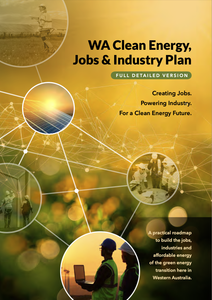
WA needs a clear and forward-thinking plan if it is going to become a competitive renewable energy powerhouse and maintain its economic strength through the energy transition.
“Western Australians know a faster renewable energy transition will lower their household expenses and prevent harmful climate pollution. But the community also needs clear direction to ensure this transition will create jobs, lower costs and not cause undue environmental harm.
“Here, sectors representing a broad range of interests have laid the groundwork for those outcomes, clearly outlining what is needed to create a future for WA that is good for the environment, for the climate, for workers and for the economy.
Summary
The WA Clean Energy, Jobs & Industry Plan sets out a strategic roadmap to position Western Australia as a global clean energy superpower while creating thousands of secure local jobs.
The report establishes three overarching goals:
- Creating local employment.
- Maintaining industrial competitiveness.
- Lowering household energy costs
To realize this vision, the framework details actionable measures to follow on from the recent WA Government announcement of a 75% Renewable Energy Target by 2031 for the South West Interconnected System. This includes developing a statewide Renewable Energy Target, coordinating statewide workforce and training pipelines, strategically planning regional infrastructure to safeguard high-value biodiversity and cultural heritage, and ensuring equitable benefit-sharing through household electrification incentives and First Nations equity partnerships. Ultimately, the plan highlights that establishing clear policy and regulatory certainty will unlock lower energy bills, boost power reliability, and secure the state’s global competitiveness in emerging green commodity export markets.

Key Findings
- Statewide Renewable Energy Target and Emissions Reduction Targets: The report calls for a statewide RET and 1.5°C aligned emission reduction targets to remove policy risk, lower capital costs, and attract clean energy investment.
- Transformative Job Creation: Accelerating the transition offers massive employment prospects, including up to 8,800 solar and battery jobs by 2050, as well as 24,000 ongoing and 11,000 construction jobs in a commercial green iron industry.
- Industrial Electrification & Competitiveness: Requiring large gas users to adopt binding electrification timetables and providing concessional financing will protect existing energy-intensive manufacturers from rising energy costs and impending domestic gas shortfalls.
- Green Commodity Export Leadership: Western Australia can build new export markets in green iron, green ammonia, and offshore oil/gas decommissioning by constructing shared common-user infrastructure and setting dedicated Green Commodity Export Targets.
- Coordinated Workforce & Training Pipeline: To address critical skill shortages the plan recommends establishing a WA Clean Energy Jobs Plan 2050, three regional training hubs, and dedicated pathways for female and under-represented apprentices.
- Environmental Safeguards & Community Benefits: Fast-tracked development must be paired with State Planning Policies that avoid high-biodiversity and cultural heritage lands, mandate new data centres to run on additional renewable power, and deliver household electrification rebates and First Nations equity partnerships.
What you can do
WA has an opportunity to lead on sustainable, clean energy and associated industries. You can help by:
- Sending an email to Environment Minister Murray Watt and Prime Minister Anthony Albanese, calling on them to reject Browse.
- Sharing this story to help more Australians understand what’s at stake.
- Encouraging your friends and family to take action.
Countries have completed the first “global review” of their progress towards reversing nature loss by 2030 at the COP17 biodiversity talks in Yerevan, Armenia.
The review “notes with deep concern” that, unless action is “rapidly accelerated”, the goal to reverse nature loss and meet a set of 23 targets by 2030 “will not be achieved”.
It “urges” countries to accelerate action, including by “increased ambition in addressing the gaps”.
Much of the discussions in Yerevan focused on how to raise the necessary funds to help developing countries protect nature.
Some major economies pushed to expand the range of nations that are expected to provide finance, with countries agreeing at the end of the two weeks of talks that non-donors that want to contribute can “signal interest” before COP18.
This came after developed countries failed to meet a target to significantly ramp up nature finance over the last few years.
It also came as a landmark fund agreed at COP16 in Colombia to pay communities for the genetic resources derived from nature stands nearly empty two years on.
The Yerevan talks marked the halfway point of the “Kunming-Montreal Global Biodiversity Framework” (GBF), the “Paris Agreement for nature” first made in 2022 and due to be achieved by 2030.
During the nearly 12-hour-long final plenary, countries voted for Quito, Ecuador, to host the COP18 nature talks, which will be held in 2028.
Countries managed to sign off on all the major negotiation texts, marking a stark contrast to COP16, which ran so far over time that the Colombian presidency lost “quorum”, forcing talks to resume in Rome months later.
Below, Carbon Brief has detailed analysis of all of the key outcomes from COP17.