

China has said that hydrogen is a key “future industry”, important to both its energy transition and its industrial policy.
Hydrogen frequently goes through hype cycles, most recently driven by rising oil and gas prices due to the conflict in the Middle East.
Yet, even in China, the world’s largest producer and consumer of the fuel, hydrogen remains expensive and inefficient to produce.
This is especially the case for “green” hydrogen derived from renewables.
Moreover, there is limited supporting infrastructure and there is little incentive to use hydrogen over other energy sources.
As a result, uptake in China of hydrogen as an alternative fuel remains low.
Nevertheless, these challenges echo the early circumstances of another key clean-energy technology – electric vehicles (EVs).
In China, EVs benefited from a policy environment that included consistent signals of support, financial aid and the development of supporting infrastructure.
Many similar policies are now being deployed – and in some cases improved upon – to support the development of China’s hydrogen industry.
This article examines China’s approach to developing hydrogen and how its evolving industrial policy could make the fuel viable.
How is China using hydrogen and where does it come from?
Electrification and rising installations of solar and wind power have been the biggest drivers of China’s decarbonisation story so far. However, how China will address the more energy-intensive, hard-to-electrify segments of its economy remains an open question.
Hydrogen is seen by some in China as a potential solution for reducing emissions in a range of “hard-to-abate” industries, from steel and chemicals to aviation and shipping.
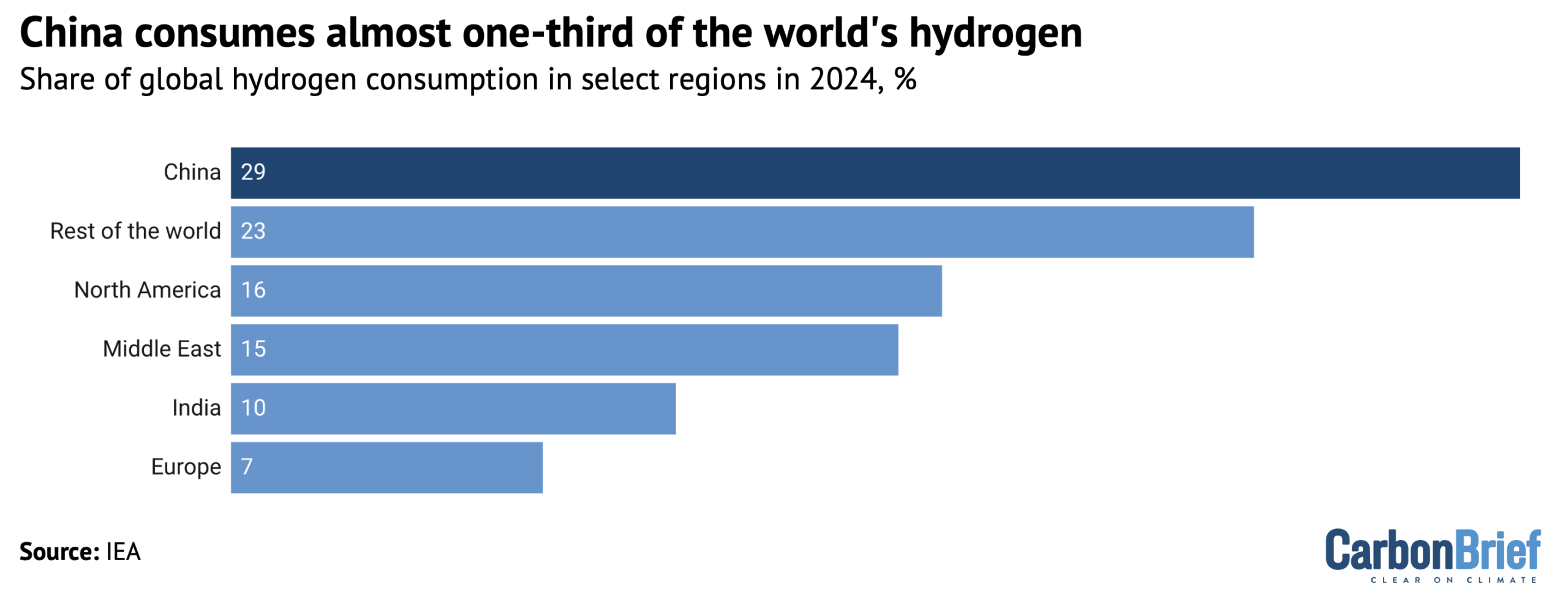
The country is the world’s foremost producer and consumer of hydrogen. It produced 36.5m tonnes of the gas in 2024, with maximum production capacity standing at 50m tonnes that year.
It also consumed nearly a third of the world’s hydrogen in 2024, as shown below.
Most of China’s production capacity is in regions with potential for high demand, such as Shandong, Inner Mongolia, Shaanxi, Ningxia, Shanxi and other provinces with significant heavy industry.
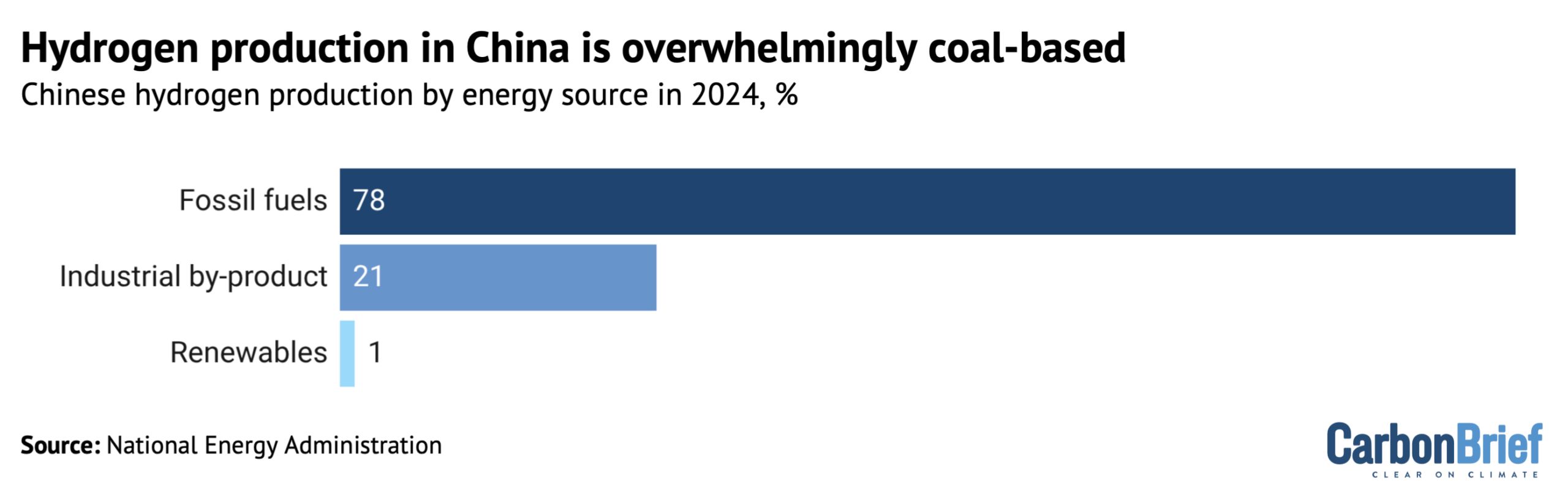
In 2024, the vast majority of China’s hydrogen – around 78% – was produced using fossil fuels, predominantly coal and gas, as shown in the figure below.
Another 21% was produced as an industrial by-product, while only 1% – just 320,000 tonnes – was derived from renewable-powered electrolysis of water.
One study found that, for every kilogram of hydrogen produced, 38.6kg of carbon dioxide (CO2) is emitted if the hydrogen is produced using coal-fired power. Hydrogen made through coal gasification results in 28.5kg of CO2 for every kilogram of hydrogen, while gas-based hydrogen creates 13kg of emissions.
By contrast, one kilogram of renewables-based hydrogen results in 0.5kg of CO2.
The International Energy Agency (IEA) calculates that hydrogen and hydrogen-based fuels could help China avoid close to 16bn tonnes of CO2 cumulatively by 2060 – but only if it comes from low-carbon sources.
The biggest reductions, it adds, would come from heavy industry, particularly chemicals and steel, with the maritime and shipping sectors also seeing some benefit.
Currently, around half of the hydrogen produced in China is used in synthetic ammonia and methanol production.
Ammonia is primarily used to manufacture fertiliser and is seen as a possible fuel technology for shipping. Methanol is used as a fuel for the transport industry, as well as for heating.
Another quarter of China’s current hydrogen usage is consumed by the oil refining and coal-to-chemical sectors. The remaining amount is used in other industries, including transport, heating and metallurgy.
What are the barriers to scaling up hydrogen?
Although China is the largest producer and consumer of hydrogen globally, the industry faces several barriers to becoming a viable clean-energy technology.
Agora Energiewende, a thinktank focused on the energy sector, says that, in order to make hydrogen a practical clean-energy solution, China would need to expand the scale and range of its application, as well as improving the conversion efficiency of production and use.
Both BloombergNEF and the IEA highlight the importance of China creating demand for hydrogen, such as through quotas for industrial usage.
Hydrogen “suffers from a relatively large efficiency loss during various conversion processes”, adds Agora. For example, it notes that only around 22% of the energy put into hydrogen fuel-cell electric vehicles (FCEVs) is converted into motion, compared to 73% for battery electric vehicles. Producing hydrogen with renewable energy is also less efficient than coal-to-hydrogen processes.
Cui Chuansheng, technical director at East China Engineering Science and Technology, tells state news agency Xinhua that the variability of wind and solar power often leads to low utilisation of electrolysers, resulting in “efficiency losses”.
Meanwhile, the cost of producing hydrogen – particularly green hydrogen – remains high.
One study placed the cost of hydrogen produced through alkaline water electrolysis (AWE), the most common method for producing green hydrogen in China, at $4-6 per kilogram, compared with $1.20-2.50/kg for steam methane reforming and $1.30-2 for coal gasification.
In some specific cases, such as blending hydrogen with gas, researchers find that hydrogen prices would need to fall to one-third of gas prices to incentivise uptake.
These constraints are all “interdependent”, Kevin Tu, managing director of Agora Energy China, tells Carbon Brief, with the need to ensure “bankable demand” while also reducing costs and developing infrastructure. He adds:
“Without credible offtake in the right sectors, costs will not fall; without lower costs and better logistics, downstream users will not commit.”
The IEA says that green hydrogen “could become cost-competitive by the end of this decade due to low technology costs and cost of capital”.
For now, however, the China Hydrogen Bulletin Substack reports that China’s four listed hydrogen equipment manufacturers all reported significant losses in 2025.
Meanwhile, a senior executive at a Chinese hydrogen company told economic news outlet Jiemian that he expected 40% of companies in the sector to have closed down by the end of 2026, with surviving companies only turning a profit in 2029 at the earliest.
The industry also lacks refueling and pipeline infrastructure. China’s development of a pipeline network for hydrogen remains in its early stages, with around 400km of pipelines currently in operation. By contrast, its long-distance gas network stands at 128,000km. Similarly, storage remains expensive and inefficient, creating a further obstacle to wider uptake.
How is China supporting hydrogen development?
China began considering the use of hydrogen as an energy source in earnest in the early 2000s, to address concerns around pollution and dependence on imported oil for the transport sector.
A clearer signal of its importance came in 2015, when the State Council included the technology in a 10-year national industrial strategy known as the “Made in China” initiative. This pitched hydrogen as a way to contribute to electrification of China’s road-transport system through the development of FCEVs.
Yuki Yu, founder of research firm Energy Iceberg, tells Carbon Brief that, from 2018-2021, hydrogen was treated as a “FCEV and manufacturing technology challenge”.
This has since evolved, she says, given that battery electric vehicles have emerged as the more popular technology.
Shen Xinyi, senior advisor at the Centre for Research on Energy and Clean Air (CREA), agrees, telling Carbon Brief that recent policy documents suggest the aim is now for hydrogen to be targeted at areas where direct electrification is harder, such as hydrogen-based chemicals, hydrogen metallurgy and some heavy-duty transport applications.
This is in line with the “hydrogen ladder”, an analysis of how likely different possibilities for applying hydrogen as a clean alternative are to become significant. The ladder sees significant future use of hydrogen in these hard-to-electrify areas as much more likely than for light vehicles.
Notable policy moves are being made in “three layers”, says Agora’s Tu, which are combining to improve the technology’s chances of scaling up. These are: the “legal and institutional” layer; “application-oriented” policies; and targeted measures to address “practical bottlenecks” at the local level.
One of the documents underpinning this pivot was the “medium- and long-term plan for the development of the hydrogen energy industry (2021-2035)”, issued in March 2022.
According to a report by the National Energy Administration (NEA), the plan is an attempt to develop an “industrial ecosystem” for hydrogen that features “diverse stakeholders, coordinated innovation and clustered development”.
The plan was the first government document to “lay out a long-term vision for China’s hydrogen economy”, unifying a previously disparate policy push into one document, according to the Oxford Institute for Energy Studies, a UK-based thinktank.
Following on from the 2022 plan, the importance of hydrogen as a broad clean-energy solution has been emphasised in a number of policies. These include its classification being changed from a hazardous chemical to an energy carrier in China’s Energy Law, a 2024 action plan to “accelerate” the use of low-carbon hydrogen in industry and a new pilot scheme offering subsidies for projects that achieve specific targets.
The table below sets out the timeline and content of China’s hydrogen-related policies over the past 25 years.
| Policy | Year published | Key features |
|---|---|---|
| 10th five-year plan (2001–2005) | 2001 | Calls for “actively developing” low-emission vehicles, understood to include hydrogen vehicles |
| Made in China 2025 | 2015 | Pledges to “continue to support” development of fuel cell vehicles and “master core technologies” for low-carbon vehicles |
| Notice on implementation of demonstration projects for fuel cell vehicles | 2020 | Creates a dedicated subsidy programme for finding breakthroughs in FCEV core technologies and industrial applications |
| 14th five-year plan (2021-2025) | 2021 | Hydrogen listed as a future industry |
| Medium- and long-term plan for the development of the hydrogen energy industry (2021–2035) | 2022 | Aims to reach 100,000-200,000 tonnes of green hydrogen production [this target has been met]. Also aims to get 50,000 FCEVs on the road by 2025, leading to a “diversified” hydrogen industry by 2035 |
| Opinions on accelerating the comprehensive green transformation of economic and social development | 2024 | Promotes further development of hydrogen production, transport, storage and applications |
| Implementation plan for accelerating the application of clean and low-carbon hydrogen in the industrial sector | 2025 | Outlines tasks to promote use of low-carbon hydrogen to reduce emissions in heavy industries, such as steel and chemicals |
| Energy law | 2025 | Sees hydrogen included in national legislation for the first time, re-classifies it from a hazardous chemical to an energy carrier |
| 15th five-year plan (2026-2030) | 2026 | Again lists as a future industry, and calls for the development of green fuels derived from green hydrogen |
| Notice on the implementation of pilot projects for the comprehensive application of hydrogen energy | 2026 | Provides subsidies to projects to reduce hydrogen costs to 15-25 yuan/kilogram ($2.20-3.67/kg) and help develop a fleet of 100,000 FCEVs |
Key policies in the development of China’s hydrogen sector.
In addition, the NEA said in 2025 that local governments across China had issued more than 560 hydrogen-related energy policies by the end of 2024.
Tu notes that these local policies cover everything from permitting reforms and pipeline planning to exempting FCEVs from paying road toll.
Different provinces across China adopt distinct strategies for developing hydrogen industries, based on local conditions, says the US-based Center on Global Energy Policy, such as energy mix, availability of coal and industrial needs.
However, these local policies and targets are frequently more ambitious than the “conservative” national-level targets, it adds.
Could a new pilot programme boost hydrogen’s prospects?
A new pilot programme, announced in March 2026, aims to commercialise the country’s hydrogen industry by funding projects to reduce the cost of the fuel to 15-25 yuan/kilogram ($2.20-3.67/kg) by 2030, as well as other targets.
Unlike the 2020 subsidies, which focused on FCEVs, the new programme reaffirms China’s interest in a broader series of sectoral applications for hydrogen, including in clean heating, production of low-carbon iron and steel, and production of “green fuels” and other chemicals.
This new pilot is the “strongest financial instrument ever released for China’s green hydrogen application” in terms of creating a comprehensive hydrogen policy that covers a broad swathe of the economy, supporting it with financial backing and targeting application scenarios, Yu says.
However, she argues that strict grant caps – 240m yuan ($35m) per project and 1.6bn yuan ($235m) per selected region across only five regions – limited the overall funding scale available to the industry.
Energy Iceberg has calculated that only around 60-70 projects nationally could receive funding under the current rules, out of more than 670 active green hydrogen proposals in China.
Shen agrees that the pilot programme is significant and that it will expand the use of hydrogen in China’s climate strategy, particularly green hydrogen.
She notes a provision that “explicitly states that coal-based ammonia and methanol projects cannot be labelled as ‘green’ ammonia or methanol”, suggesting that policymakers are increasingly paying attention to the “integrity” of definitions for hydrogen and hydrogen-derived fuel.
The “real value” of the pilot scheme, says Tu, is that it focuses on developing “integrated city-cluster ecosystems linking supply, transport, infrastructure and end-use demand”, rather than only supporting individual projects.
This “should help identify viable business models, accelerate cost discovery and concentrate support on applications with stronger scale potential”, as well as boost investor confidence, adds Tu.
However, he continues that the broader effect it will have on boosting production of hydrogen will “depend on how quickly the selected clusters can translate the programme into real offtake and lower delivered hydrogen prices”.
How does this compare to China’s EV policy push?
The debate around the viability of hydrogen is reminiscent of critiques of EVs.
Until recently, EVs were seen as too expensive for consumers, inefficient and challenging to use without supporting infrastructure. As a result, many western automakers chose to temper their focus on EVs, while continuing to develop internal combustion engines.
However, China has managed to develop a competitive EV industry with products that top global sales.
Part of the playbook that spurred China’s success on EVs included consistent policy signalling in favour of the technology, including mentions in high-level documents and committing resources to building charging infrastructure.
“The defining features of China’s industrial-policy success are its persistence and adaptability,” says Kyle Chan, fellow at the Brookings Institution, adding that “long before the technology and economics of EVs and batteries were proven, China was making long-term investments and policy bets [in the sectors]”.
More tangible measures included direct and indirect subsidies and policy support in the shape of favourable loan rates and low-cost land. One estimate by US-based thinktank the Center for Strategic and International Studies (CSIS) pegs the amount of support allocated to the EV industry between 2009-2023 at $230.9bn.
This coupled with the success of private Chinese manufacturers in creating innovative, nimble companies that “forc[ed] policymakers to adapt”, as well as growing links between the automotive and information technology industries, according to a separate CSIS report.
But this progress on EVs also reportedly came with significant fraud. In 2016, one investigation found that 33 companies were involved in subsidy fraud totalling 9.2bn yuan ($1.3bn).
(It should also be noted that profitability in the industry lags far behind the average for downstream industrial sectors, according to the Hong Kong-based South China Morning Post, which says that “only a handful” of nearly 50 EV makers have reported profits.)
Being the subject of an industrial policy push alone does not guarantee success, states CSIS. It says the strength of the EV industry “was neither inevitable nor the result of a single master plan” and that China’s aims to develop globally-competitive industries in areas such as commercial aviation remain unaccomplished.
China’s approach to hydrogen has been markedly different.
Instead of offering blanket subsidies, the fuel cell demonstration programme it established in 2020 focused on performance-based rewards.
To avoid the subsidy issues seen in the solar and EV industries, the ministry of finance deliberately chose this indirect funding model, says Yu.
However, Yu argues, the programme did not work as well as hoped, due to the funding ceiling and the siloed attempts made by different regional governments to develop hydrogen ecosystems .
But Chinese policy thinking is becoming more selective and pragmatic for hydrogen compared with EVs, says Shen. She says:
“Electrification remains the primary decarbonisation pathway [for road transport], while hydrogen is increasingly positioned for applications where direct electrification is more difficult.”
Tu echoes this, adding that China is “clearly moving toward a more supportive policy environment for hydrogen”.
But its approach is “unlikely to replicate the EV story one-for-one”, he adds.
China’s concerted hydrogen push is also unlikely to echo the EV story at a global level, according to the IEA.
In terms of green hydrogen, around 60% of global electrolyser manufacturing capacity is currently in China, prompting concerns from the EU about a repeat of China’s global dominance in the solar and EV sectors.
However, the IEA says, electrolysers made in China “might not supply other markets at scale in the short term”, due to difficulties transporting the bulky technology globally, expectations that costs will only fall gradually, uncertainty around global demand and questions over how well Chinese electrolysers perform against global alternatives.
China’s industrial focus on hydrogen is centred more on domestic use, Shen argues. “It is less about near-term export competitiveness and more about building domestic industrial ecosystems,” she says.


The post Q&A: Can China turn hydrogen into its next clean-energy industry? appeared first on Carbon Brief.
Q&A: Can China turn hydrogen into its next clean-energy industry?

Climate Change
Commencement of NSW Forestry assessment a ‘chance to fix a broken system’ and deliver urgent forest protection
SYDNEY, Friday 18 September 2026 — In response to the Federal and NSW government’s announcement to commence an assessment of NSW forestry under the new national nature laws, Adele Chasson, Nature Policy Lead at Greenpeace Australia Pacific said:
“This is the Federal Government’s chance to fix a broken system that has enabled the destruction of NSW’s precious forests for far too long.
“Native forest logging continues to smash threatened species habitat. In NSW, it is pushing unique wildlife like koalas, greater gliders and glossy black cockatoos towards extinction. The state-owned logging agency has a disastrous record of environmental damage and breaches.
“The Regional Forest Agreement (RFA) system has failed, allowing the industrial logging of special forests for decades across Australia with no oversight. Thankfully, the Federal Government has started the process to finally remove the logging industry’s exemption from national nature laws.
“It’s time for the Federal Government to deliver the protection that forests urgently need, and that Australians overwhelmingly want. The Government must ensure a thorough assessment of the devastating impacts of native forest logging in NSW, and establish strong environmental rules that states must follow.
“These forests have been cared for by First Nations people for tens of thousands of years. They are some of the most biodiverse on the planet, store carbon, clean our air and water. It’s critical we protect them.”
ENDS
Media contact:
Kate O’Callaghan on 0406 231 892 or kate.ocallaghan@greenpeace.org
What happens when a love of marine life meets a playful imagination?
Sydney artist, illustrator and children’s author Sha’an d’Anthes, better known as Furry Little Peach, has teamed up with Greenpeace to create Happy Ocean Happy Planet: a joyful celebration of the extraordinary creatures that call our oceans home.
Sha’an felt inspired to create an illustration celebrating the beauty and resilience of marine life. Its hopeful message, A Happy Ocean is a Happy Planet, sparked a special collaboration with Greenpeace and a limited-edition t-shirt designed to help protect the oceans that inspired it.
The exclusive Furry Little Peach tee is available as a gift to new regular Greenpeace donors who give $30 or more and make at least three donations. By becoming a regular giver, you’ll help Greenpeace campaign for ocean protection.

ARTIST INTERVIEW: Sha’an d’Anthes (Furry Little Peach)
Sha’an shares the story behind the artwork, the local marine creatures featured in the design and why hope can be such a powerful force for action.
Hi Sha’an! Can you tell us a little about yourself and what you do?
My name is Sha’an d’Anthes, I also go by the pseudonym Furry Little Peach and I’m an illustrator, artist and children’s author based in Sydney, Australia. I love creating joyful, vibrant and nostalgic art that looks at the world through the lens of childlike wonder.

What do you love about drawing animals and nature?
I love all of the different shapes, colour and narrative you get to explore when drawing animals and nature. I’m also a city-slicker these days, and so I think that my work is a sort of escapism (for myself and hopefully for my audience).
How did the Greenpeace collaboration come about?
I went to the premiere of David Attenborough’s documentary Ocean, and felt compelled to create something to share the message of the film. This t-shirt is actually based off of that illustration including the tagline in I included when I shared it “A Happy Ocean is a Happy Planet”. I’m so grateful Greenpeace approached me for the project – it was a blast.
Where did you start when creating the Happy Ocean Happy Planet design?
The Happy Ocean tee starts the same as all of my work – with a brainstorm/braindump and really loose concept sketches.
How did you choose the animals for the illustration?
I actually asked Greenpeace to help me with the research of local marine life and they were so accommodating. They very quickly delivered me a huge list of local species of fish, mammals and coral and I just went through and looked up each creature and curated a little group of sea life that I thought would look sweet together – a mix of sizes, types, colours, textures and shapes.
What did you use to create the artwork?
So much of my work is traditional, but when it comes to things like t-shirts I always use digital drawing programs because I like to draw each colour in a separate layer which requires me to jump in and out of layers because it allows me to control colour and printing. When working digitally I always sketch in Procreate (an Australian digital art app), and then with this project I created final art in Adobe Fresco because it called for a vector graphic (an image that can be blown up to any size).
Do you have a favourite creature in the design?
I love painting Humpback Whales and always have, but I also have a soft spot for the sweet little Jelly Blubber jellyfish.
What did you want people to feel when they saw the artwork?
I specifically wanted to focus on the outcome that all of us want to see – a happy, thriving ocean where creatures are given the time and space to balance themselves. I feel that even when tackling tough subjects, leaning into hope is my natural inclination. As long as we have hope that things can be better, we will continue to take action.
What was the most fun part of creating it?
I actually documented the entire process of this project in a studio vlog on YouTube – and you can see how much fun I’m having doing final art jumping between layers and building the image. I had just come off completing final art for two books which are multi-year long projects, so being able to do a project that from start to finish in just a few days was really freeing at the time.
What does a “happy ocean” mean to you?
An ocean that given the time and space to repair and balance itself. Something I really took away from David Attenborough’s Ocean is that ocean ecosystems are actually really good at repairing themselves if we just let them do their thing.
How can people get their hands on the t-shirt?
The shirt is a reward for regular givers to Greenpeace – those who commit to at least 3 months of donations will receive the tee as a gift. Read about how at http://act.gp/flp-tee
How is Greenpeace helping to make our oceans happier places?
They have a deep focus on the health and happiness of our oceans through advocating for the set up of marine sanctuaries, holding big ocean polluters to account and calling for a ban on deep sea mining.
What are you working on next?
I will be jumping headfirst into Peachtober – an annual daily art challenge I run each year in October, if there are any artists reading this it’s a great time so please come join! In terms of publications my next picture book The Late Bird will be out in February 2027 (published by Harper Collins US) and then I have an creative activity book for adults coming out next August with Chronicle US and Penguin Australia. Otherwise you can always check out what I’m tinkering away with in my studio on Instagram and YouTube.

Climate Change
AI giant Anthropic’s first Australian data centre deal an “egregious” example of Big Tech double talk
SYDNEY, Thursday 17 September 2026 — Greenpeace Australia Pacific has slammed AI giant Anthropic’s deal for its first Australian site in Queensland’s Western Downs, the heart of coal seam gas country, saying the project will entrench gas and turbocharge climate pollution.
The expected electricity demand from the data centre site, situated in the middle of the Western Downs coal seam gas fields, is comparable to 1.5 million Australian households. Greenpeace’s report Energy Vampires: The AI data centres draining Australia called for a moratorium on frenzied data centre development until appropriate guardrails are in place.
Joe Rafalowicz, Head of Climate and Energy at Greenpeace Australia Pacific, said: “This is an egregious example of Big Tech giants being given carte blanche to drain energy and water, and use polluting gas to fuel their hyperscale data centres.
“AI and Big Tech corporations claim to bring new renewable energy to the grid, while blatantly planning to power their operations with polluting fossil fuels.
“Planning documents show the first stage of this behemoth project could be powered by ‘behind the metre’ gas — the same playbook AI companies have used in the US, leading to a 20% increase in climate pollution from electricity. Now these companies want to bring their cowboy plans to Australia and the Federal Government is allowing it.
“If they plugged into the local grid, the power required would increase Queensland’s electricity grid emissions by around 6.6 million tonnes — an 18% rise. If they build their own gas-fired power plants, this will drive up Queensland’s emissions even more.
“Billions of dollars are now pouring into a massive pipeline of proposed new data centres, of unprecedented size, being built at incredible speed across the country. Australians should be worried about the extreme lack of scrutiny being applied to these projects, and the corporations leading the data centre charge.
“The data centre build-out is happening without the endorsement of the Australian people, yet we are the ones who will pay the price. We can not allow unchecked data centre expansion to derail our renewable energy transition, entrench gas and turbocharge climate pollution — that’s why Greenpeace has called for an urgent moratorium until appropriate guardrails are in place.”
ENDS
Media contact: Kate O’Callaghan on 0406 231 892 or kate.ocallaghan@greenpeace.org



-

 Greenhouse Gases2 years ago
嘉宾来稿:满足中国增长的用电需求 光伏加储能“比新建煤电更实惠”
-
Climate Change1 year ago
Guest post: Why China is still building new coal – and when it might stop
-
Greenhouse Gases1 year ago
Guest post: Why China is still building new coal – and when it might stop
-

 Climate Change2 years ago
嘉宾来稿:满足中国增长的用电需求 光伏加储能“比新建煤电更实惠”
-

 Renewable Energy11 months ago
Sending Progressive Philanthropist George Soros to Prison?
-
Climate Change2 years ago
Bill Discounting Climate Change in Florida’s Energy Policy Awaits DeSantis’ Approval
-
Greenhouse Gases1 year ago
嘉宾来稿:探究火山喷发如何影响气候预测
-

 Carbon Footprint2 years ago
US SEC’s Climate Disclosure Rules Spur Renewed Interest in Carbon Credits