

The right-wing populist Hungarian government led by Viktor Orbán has suffered a landslide electoral defeat to the centre-right Tisza party, led by Péter Magyar.
This brings to an end 16 years of rule by Orbán and his Fidesz party, a move welcomed by many around the world who were concerned about Hungary’s “slide toward authoritarianism”.
Hungary has played a disproportionate role in EU climate and energy policy in recent years, by repeatedly vetoing climate action and by delaying the phaseout of Russian fossil-fuel imports.
Magyar did not prioritise climate and energy issues in his electoral campaign, but he has championed cooperation with the EU and proposed a 2035 deadline for “eliminating Russian energy dependence”.
Hungarian experts tell Carbon Brief that, while the new government is yet to be formed, it is likely that Magyar will move quickly to secure EU funds for “green” measures.
One expert notes that “this is not a progressive pivot”, with Hungary unlikely to emerge as a climate leader in the EU, even if it is less disruptive to the bloc’s wider climate strategy.
- What was Orbán’s approach to climate action?
- What will be the new Hungarian government’s climate and energy policies?
- How will the new government approach EU climate policy?
- What has the new leadership said about Russian fossil fuels?
What was Orbán’s approach to climate action?
Hungary has had a mixed record on climate change under then prime minister Orbán, supporting some relevant actions while opposing others – particularly those taken at an EU level. This broadly reflects his Fidesz party’s populist and Eurosceptic leanings.
Orbán has described the EU’s climate goals as a “utopian fantasy” that would “destroy the middle class”. He has also accused “western elites” of wanting people to “live in fear” of climate change.
Yet, despite being embraced by climate sceptics elsewhere and supporting climate-sceptic lobbyists, Orbán’s government has not overtly adopted such sceptical rhetoric.
In fact, reflecting broad Hungarian support for climate action, Orbán has framed his nation as a “climate champion” – albeit one taking a “pragmatic” approach. This was captured in his speech at the COP29 summit in 2024, when he said:
“We must continue advancing the green transition, while also maintaining our use of natural gas, oil and nuclear energy…Our climate policy should be guided by careful consideration and common sense, not by ideology, alarmism or panic.”
Domestically, Orbán’s government has pursued various climate goals, including a 2050 net-zero target, phasing out coal power by 2029 and supporting the expansion of solar power.
What will be the new Hungarian government’s climate and energy policies?
Climate change was not a major issue in the April election and Magyar, the incoming prime minister, hardly mentioned it in his campaign.
However, the 243-page manifesto released by his Tisza party includes many climate-related proposals, such as home insulation, railway electrification and tackling drought.
The document says some of these measures – notably “energy modernisation and efficiency programmes” – will be funded with billions of euros in EU funds that have been frozen under Orbán. (See: How will the new government approach EU climate policy?)
One notable pledge is to “double the share of renewable energy in domestic energy supply” by 2040. As the chart below shows, Hungary already generates three-quarters of its electricity from clean sources – predominantly Paks, its single nuclear power plant.
Nearly a third of Hungary’s electricity comes from solar, which has benefited from supportive government schemes in recent years. In contrast, for years, the Orbán government blocked the construction of wind turbines, meaning there is virtually no wind power in Hungary.
The Tisza manifesto recognises this imbalance, stating that “we will abolish the unnecessary restrictions preventing the installation of new wind turbines”, while also supporting geothermal energy.
Energy prices are a key political issue in Hungary, as they are in many nations around the world. Orbán’s “utility cost reduction” has been a flagship policy for many years, capping household prices using large state subsidies.
During the election, Orbán accused his opponent of planning to get rid of the energy price cap. In fact, the Tizsa manifesto says the new government will “maintain and expand” the scheme and add new VAT cuts on firewood.
Despite having few batteries and electric vehicles (EVs) domestically, Hungary has emerged in recent years as a major battery manufacturer, driven by Chinese and South Korean investment. However, this boom has sparked environmental and social concerns.
Zsolt Lengyel, founder and chair of the Institute for European Energy and Climate Policy (IEECP), tells Carbon Brief:
“Orbán’s battery and EV strategy – in theory, a flagship of the transition – has backfired politically…So Tisza inherits a paradox: it needs to accelerate the transition, but does so in an environment where parts of that transition have already lost public legitimacy.”
With much still unknown about Magyar’s attitude to climate and energy policy, some Hungarian experts that Carbon Brief spoke to cautioned against “speculation” and “wishful thinking” when assessing his climate credentials.
How will the new government approach EU climate policy?
There is cautious optimism among EU officials and leaders that a Hungarian government led by Magyar will be more cooperative on EU-led initiatives.
Under Orbán, Hungary has been a vocal and persistent opponent of EU climate policies.
Since 2011, 21 of all the 48 vetoes on joint EU actions have been used by Hungary. These include blocking efforts to sanction Russia following the country’s invasion of Ukraine. (See: What has the new leadership said about Russian fossil fuels?)
Among other issues, Hungary has vetoed or obstructed progress on the EU’s 2050 net-zero target, the “fit for 55” legislative package to help meet that goal and the 2035 ban on petrol and diesel cars.
Generally, this opposition did not totally block these policies, as most did not require unanimous agreement among EU member states. However, it did tend to slow down or complicate the process. Hungary was also not acting alone – it was often joined by fellow eastern and central European states, claiming the policies would have high costs.
Nevertheless, the Orbán government’s aversion to the EU has taken it further than other states. In recent months, for example, Hungary has launched a legal case against the EU over its phaseout plan for Russian oil and gas imports.
In this context, Lengyel tells Carbon Brief:
“Orbán’s exit removes Hungary’s most damaging feature in EU climate politics: the ideological reflex to oppose ‘anything Brussels does’.”
However, just because Magyar is less hostile to the EU does not mean his government will be a climate leader.
Magyar’s centre-right Tisza party is aligned with the European People’s Party (EPP) grouping in the European parliament, which has been instrumental in weakening EU climate goals in recent months. Given this, Lengyel tells Carbon Brief.
“Let’s be clear: this is not a progressive pivot. Tisza sits close to the EPP mainstream and is unlikely to challenge it. If anything, it will follow it, including on any watering down of green-deal elements.”
Crucially, Hungary is entitled to billions of euros of EU funds that have been blocked due to breaches of conditions regarding the rule of law and human rights under Orbán.
These include €9.5bn for Hungary’s recovery and resilience plan, the EU’s post-Covid recovery fund, much of which is earmarked for the “green transition”.
This finance needs to be disbursed before the end of August – and both Magyar and the EU have been clear that unlocking the funds is a priority.
Jozsef Feiler, director of the south-east Europe and Hungary programme at the European Climate Foundation, which funds Carbon Brief, says “full EU compliance” will be crucial for Hungary over the coming months, in order to obtain these funds. He tells Carbon Brief:
“The economic and financial stability of the new government [will depend] on obtaining the recovery and resilience facility funds and managing some kind of absorption before the 26 August hard deadline.”
Another early challenge will be the new government’s approach to the new part of the EU’s emissions trading scheme (ETS) – known as ETS2 – which will put a price on emissions from buildings, cars and other sources not covered in the original ETS.
ETS2 is already facing criticism from member states concerned about rising fuel costs. Moreover, Hungary is likely to be one of the countries that is most exposed to high fossil-fuel prices.
István Bart, a senior director in carbon pricing at the Environmental Defence Fund, tells Carbon Brief that Orbán’s government has done little to help with the implementation of ETS2, which is currently due to start in 2028. He notes that, with the question of affordability so fraught in Hungary, it is unclear how Magyar will tackle this issue.
What has the new leadership said about Russian fossil fuels?
One of the most notable policy statements made in Tisza’s manifesto is a commitment that:
“By 2035, we will eliminate Russian energy dependence and diversify our domestic energy supply.”
Despite its relatively clean electricity supply, Hungary is still heavily reliant on fossil fuels – including in its transport, heating and industrial sectors – the majority of which are imported.
Russia is Hungary’s main fossil-fuel trading partner, with the Druzhba and TurkStream pipelines supplying much of the smaller nation’s needs for oil and gas, respectively.
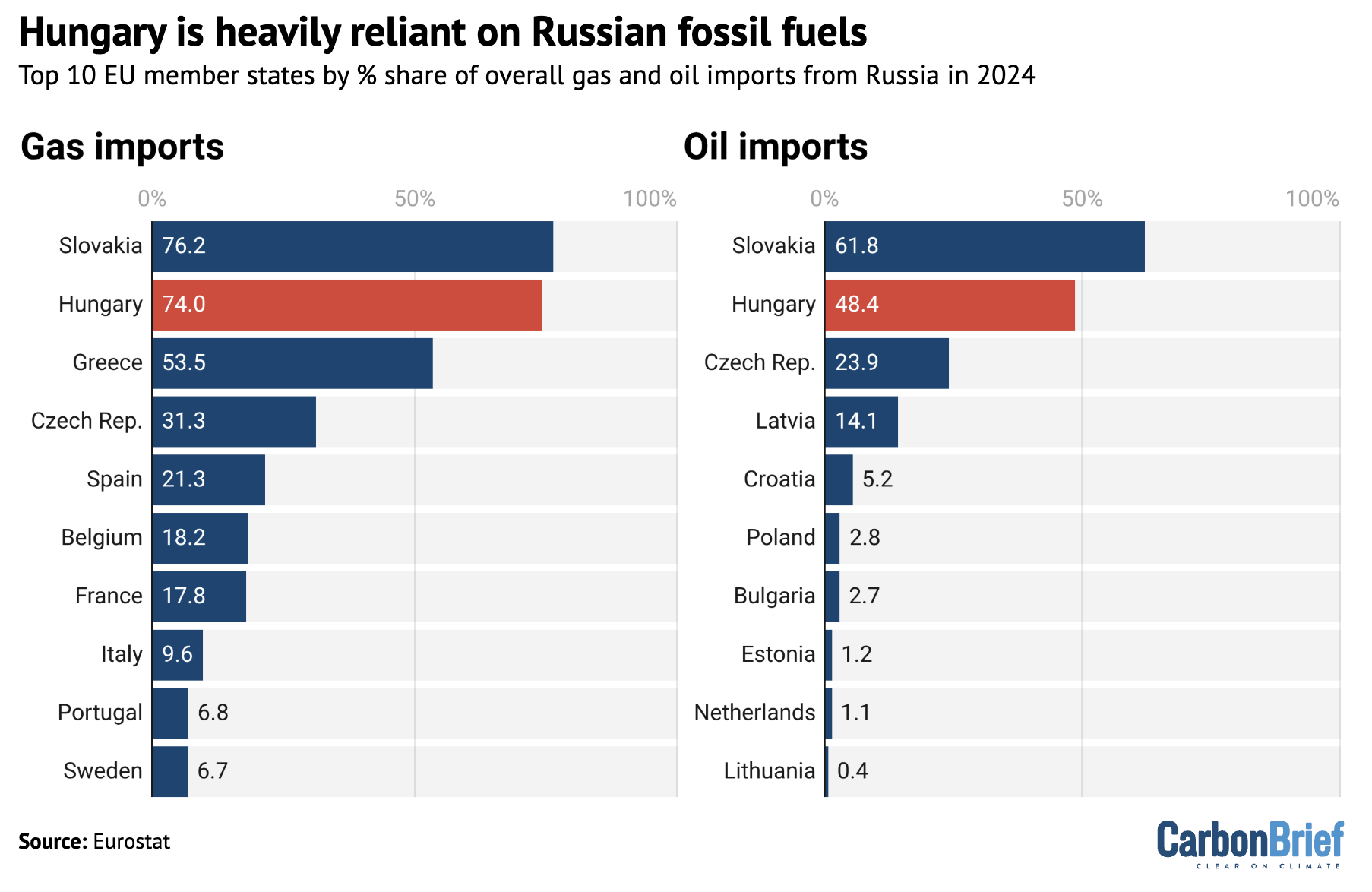
Among EU member states, Hungary is second only to Slovakia in terms of reliance on Russian fossil fuels. In 2024, 74% of Hungary’s gas and 48% of its oil were imported from Russia, as shown in the chart below.
Since Russia’s full-scale invasion of Ukraine in 2022, most EU nations have taken steps to reduce their dependence on Russian fossil fuels.
The EU has implemented a series of sanctions on Russia and the European Commission launched the REPowerEU plan to “fully end dependency on Russian energy”.
Under Orbán, however, Hungary has obstructed efforts to wean the EU off Russian fossil fuels, citing energy-security concerns. It has successfully negotiated exemptions from Russian oil sanctions, allowing the country to increase its reliance on cheap Russian crude.
The REPowerEU regulation involves a ban on Russian pipeline gas by September 2027. Unlike sanctions, the EU did not need unanimity among states to pass this.
It is notable that Tisza has only committed to end reliance on Russian energy by 2035 – eight years after the EU deadline. It is unclear how Magyar’s new government will negotiate this discrepancy, especially given long-term contracts with Russian suppliers.
Hungary also relies on Russia for nuclear technology and supplies of uranium for its nuclear plant. In its manifesto, Tisza says it will explore the possibility of sourcing nuclear fuel from US or French suppliers, as well as building small modular reactors.
Orbán had already started pursuing diversified nuclear and fossil-fuel supplies by buying from the US, even as it secured exemptions from US sanctions on Russian energy imports. It is possible that Tisza may maintain this approach.
However, with the Iran war and energy crisis looming in recent months, Bart, from EDF, tells Carbon Brief:
“Before the Iran war started, you could have said: ‘Why don’t you just buy LNG [liquified natural gas]?’…Now it seems like less of an option, so, unfortunately, in the short term, [Russian gas] has to stay because we don’t really have an alternative.”



The post Q&A: What Magyar’s defeat of Orbán in Hungary means for climate and energy appeared first on Carbon Brief.
Q&A: What Magyar’s defeat of Orbán in Hungary means for climate and energy

An Lambrechts is a biodiversity politics expert at Greenpeace International with extensive experience in biodiversity-related multilateral negotiations. She is the head of the Greenpeace delegation at the Convention on Biological Diversity (CBD) COP17 happening in Yerevan, Armenia.
In 2022, COP15 delivered the landmark Kunming-Montreal Global Biodiversity Framework to halt and reverse biodiversity loss by 2030. With COP17 starting in Yerevan, we are now halfway to the deadline, and according to the first Global Review of progress, countries are not on track to meet the biodiversity targets, and implementation must accelerate fast.
One of the main findings of the Global Review is that funding falls far short of the scale needed to halt and reverse nature loss. But the crisis facing the world’s biodiversity is not an absolute scarcity of capital – it is a profound public policy distortion.
The global economy currently spends roughly $30 destroying nature for every single dollar invested in its protection. According to a report from the Intergovernmental Science-Policy Platform on Biodiversity and Ecosystem Services, a staggering $2.4 trillion is spent in public subsidies for fossil fuels, agriculture and water use, while global investment in biodiversity conservation and restoration stands at a mere $220 billion.
Countries urged to ramp up “insufficient” nature policies at COP17
Yet, discussions about how to close the biodiversity finance gap continue to claim that salvation lies in mobilising private capital, scaling offsets and “derisking” investments in nature. This is a fundamental misunderstanding of both the nature of ecological stewardship and of the global financial architecture.
Biodiversity conservation is not a speculative investment portfolio – it is the foundation of human survival. The health of our planet is a non-monetisable, non-excludable public good. Expecting profit-seeking private capital to protect nature perpetuates the structural drivers of ecosystem destruction in the first place.
But if private market mechanisms cannot save biodiversity, where will the necessary public resources come from?
Money going to the wrong places
The answer lies in recovering the vast public wealth currently drained by cross-border tax abuse, financial secrecy and corporate impunity. Finance and environment ministers meeting in Yerevan must give a strong political signal that, to avert ecological breakdown, countries need to take swift action to reform global tax rules, eliminate harmful public subsidies and cancel unsustainable sovereign debts for the public revenues to end up where they belong.
Extractive sectors such as industrial agriculture, fishing, timber and mining continue business-as-usual, often heavily subsidised by public treasuries, while voluntary carbon and biodiversity offset markets pose a serious risk to nature conservation. Offset schemes have delivered only a negligible fraction of the funding needed to preserve ecosystems, allowing industries to continue with their destructive business-as-usual practices.
-
Global deforestation slowed in 2025 but Brazil’s election could undo “fragile” gains
Countries remain 70% off track to meet a goal to end deforestation by 2030, as progress in Latin America offset by failures in Africa -
Brazil confident new rainforest fund will reach $10bn donor milestone
Brazil’s environment minister said the Tropical Forest Forever Facility has raised billions in record time – which he hopes will convince more investors


In advanced economies, public funding often actively undermines biodiversity. In Europe, over €5.3 billion in public subsidies is funnelled annually into intensive forest biomass harvesting under renewable energy directives, degrading primary forest ecosystems and undermining long-term climate resilience. Pleading with private investors to fill a “finance gap” while pouring billions into ecological destruction is an exercise in futility.
Developing countries struggle with debt burden
For developing countries, reliance on private finance is further compounded by a crushing sovereign debt crisis. In 2024, public debt in developing economies reached record levels, with net interest payments alone absorbing $921 billion. A record 61 developing countries now spend more than 10% of government revenue on foreign debt service, with many climate-vulnerable nations spending twice as much servicing external debt as they receive in climate and biodiversity finance combined.
This burden acts as a structural driver of ecosystem destruction. Under pressure from external creditors and international financial institutions to avoid default and secure foreign exchange, governments are routinely forced into austerity measures and pushed to expand raw commodity exports into pristine biomes.
Comment: World Bank and IMF should lead the financial system in responding to the climate crisis
The current negotiations for a United Nations Framework Convention on International Tax Cooperation (UNFCITC) also offer a way forward. An estimated $492 billion in tax revenue is lost every year to offshore tax havens. Multinational corporations account for around $348 billion of this total by shifting profits away from the countries where real economic extraction and environmental degradation occur.
In the mining sector alone, developing nations lose tens of billions annually to corporate tax dodging. Furthermore, international financial secrecy shields environmental criminals, with illicit financial flows from illegal logging draining between $51 billion and $152 billion annually.
At COP17, leaders must seize the opportunity to build a bridge between the two conventions and enhance cooperation. Governments must put the world on a firm path to securing predictable, sufficient, sovereign public finance for biodiversity conservation. It’s the only path to a restorative, rights-based future for people and the planet.
The post Protecting nature is a public duty, not a Wall Street profit opportunity appeared first on Climate Home News.
Protecting nature is a public duty, not a Wall Street profit opportunity
Climate Change
Greenpeace delivers 47 metre-long petition with half a million signatures to Woodside HQ following major gas protest
Greenpeace delivers 47 metre-long petition with half a million signatures to Woodside HQ following major gas protest
PERTH, Monday 19 October 2026 — Dozens of Perth community members delivered a giant petition, signed by almost half a million people, to Woodside’s corporate headquarters this morning, calling on the government to save Scott Reef from Woodside’s reckless Browse gas proposal.
Dressed in sea creature costumes and hats, supporters carried one of Australia’s biggest environmental petitions to Woodside’s headquarters, and a local choir performed a ‘Scott Reef’ rendition of Angie McMahon’s iconic cover of ‘Reckless’ by Australian Crawl.
On the sidelines of the Perth Global Citizen Now event, it comes following a two day-long protest at Woodside’s Scarborough gas platform that saw activists scale and occupy the Floating Production Unit calling to “Stop Woodside’s Dirty Gas” and “Save Scott Reef”. The activists were taken from the platform by police helicopter on Sunday afternoon.
David Ritter, CEO at Greenpeace Australia Pacific, said: “Less than a day after two Greenpeace Australia Pacific activists were arrested for their peaceful protest at Woodside’s Scarborough gas platform to save Scott Reef, we are here again with another message to Woodside: half a million of us do not want your dirty gas at Scott Reef.
“Community pressure on Woodside is rising. Today we are here to show Woodside that they can’t ignore half a million people who want Scott Reef protected, not turned into an industrialised gas zone.
“Woodside can’t be trusted with our oceans. Woodside’s plans to drill up to 57 toxic wells at Scott Reef, Australia’s largest oceanic reef, putting endangered pygmy blue whales at risk, and jeopardising a nesting ground for unique green sea turtles.
“We Australians love our oceans and this is an opportunity for our governments to do the right thing, to reject Woodside’s reckless drilling plans, and save Scott Reef.”
-ENDS-
Media contact
Kate O’Callaghan on +61 406 231 892 or Emma Sangalli on +61 431 513 465