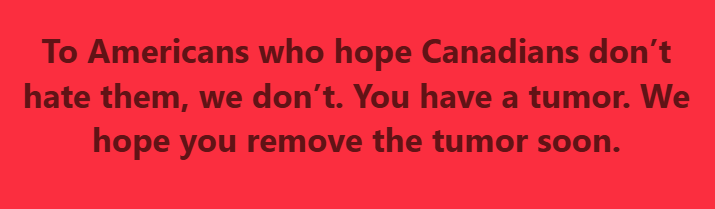
At left we see an extremely generous viewpoint on the United States as we Americans are seen from Canada.
I have to think that a more honest statement on the topic would be, “You have a tumor, but you voted it into office. We never would have thought you were so stupid and mean.”
At left we see an extremely generous viewpoint on the United States as we Americans are seen from Canada.
I have to think that a more honest statement on the topic would be, “You have a tumor, but you voted it into office. We never would have thought you were so stupid and mean.”

Renewable Energy
Insulting U.S. Allies
The point made at left is an interesting one, but it raises the question: Would our NATO allies have participated in a useless and illegal war even if Trump hadn’t insulted, bullied, and threatened them with military invasion?
I doubt it.
Renewable Energy
The “Flat Earth” Theory
This issue was solved long before our journeys into space began 65 years ago. Yes, the spherical shape of the Earth was proved 2000+ years ago by the ancient Greeks, but understanding that requires some fluency with high school math, which many Americans lack.
I’m referring to telephony, that spread around the globe in the late 19th Century. Someone in say, South Carolina, can call a friend who lives on the West Coast and ask about the sun’s position in the sky. Try to explain the discrepancy if you believe the Earth is flat.
Why would we need 24 different time zones, each 15 degrees apart?
Renewable Energy
UK Drops Offshore Wind Tariffs, Ming Yang in Germany
Weather Guard Lightning Tech
UK Drops Offshore Wind Tariffs, Ming Yang in Germany
The crew discusses the UK removing tariffs on offshore wind equipment, Vineyard Wind’s final blade shipment from New Bedford, and Ming Yang joining Germany’s offshore wind association.
Sign up now for Uptime Tech News, our weekly newsletter on all things wind technology. This episode is sponsored by Weather Guard Lightning Tech. Learn more about Weather Guard’s StrikeTape Wind Turbine LPS retrofit. Follow the show on YouTube, Linkedin and visit Weather Guard on the web. And subscribe to Rosemary’s “Engineering with Rosie” YouTube channel here. Have a question we can answer on the show? Email us!
The Uptime Wind Energy Podcast brought to you by Strike Tape, protecting thousands of wind turbines from lightning damage worldwide. Visit strike tape.com. And now your hosts.
Allen Hall: Welcome to the Uptime Wind Energy Podcast. I’m your host, Allen Hall. I’m here with Matthew Stead, Rosemary Barnes and Yolanda Padron.
And the UK is really gearing up for offshore wind and they’re making some really smart moves and. One of them is, uh, the change in tariffs. So the British offshore wind manufacturers have been fighting really an uphill battle for a long time and for years. The companies that build turbines and components in the UK have faced import tariffs on the materials needed most, which tends to be steels like steel.
Uh, cables, specialized parts from overseas all carried a tariff with it. Well, now the federal government has acted to [00:01:00] remove those tariffs on offshore wind equipment. The move is expected to save UK manufacturers tens of millions of pounds every year. And for an industry trying to cut costs and scale up that kind of relief could make the difference between winning.
Losing contracts, and I’m surprised the UK has waited this long and I think other countries have the same problem. Obviously the US is taring the heck out of everything at the minute, but uh, a lot of European countries do put tariffs on the raw materials and the components that are used to make wind turbines.
That’s not a smart long term move if you’re trying to deploy. Gigawatts of offshore wind.
Matthew Stead: Well, I, I think, uh, the recent events in the world show that energy security and not importing energy is a wonderful thing. And so this completely aligns with that, um, that objective. So I think that’s why we all agree with you, Alan.
Allen Hall: Well do, is there a, a. A threshold here where other countries start to do it [00:02:00] and for whatever reason there’s, there’s tends to be tariffs on energy in all forms of it. Right. And there and on steel in particular, that seems to be a big area of concern. Are we gonna start to see some of those come down just to lower the cost of wind turbines and to deploy the middle of the water?
’cause there is a lot of steel in an offshore wind turbine.
Matthew Stead: It’s been like China. I mean China has, you know, a lot of clean energy, low cost energy and it is to their advantage. So I, I think it’s a entirely logical approach and I would’ve thought it’s, if you’re a good on policy, you would definitely be looking at this.
Allen Hall: Is this has been a concern of the UK steel industry, which has been diminishing over the years? Uh, so it’s always been a pain point with the uk. They’ve been trying to stand up their own steel industry and forever they had a big steel industry In the uk you think of all the. The steel that was built from late 18 hundreds all the way up to the 1980s and nineties.
Uh, but it does sound like you, you gotta pick and choose your battles here. And maybe the UK has [00:03:00] finally said, okay, the, the steel battle is a separate issue within offshore wind, and maybe we gotta do something different.
Matthew Stead: I mean, I think Australia did the same thing ages ago. I mean, we had a car, car industry and you know, we just didn’t have the scale.
So, you know, Australia’s picking its battles and um, yeah, I mean, you can’t be good at everything, so you know why not. Uh, get the, the lower cost energy and um, deal with it that way.
Rosemary Barnes: Australia has actually just announced, you know how Australia’s got the policy to support clean energy technology manufacturing in Australia.
And they started with, um, solar panels and then they’ve also got something related to battery cells. Well, they just announced wind turbine tower manufacturing, um, which is very simple. The reason why Australia doesn’t have, um, wind turbine tower manufacturing anymore. Is just because we can’t compete on price with Asia, um, in general and China specifically.
It’s interesting now to be like, okay, let’s support Australian [00:04:00]manufacturing of wind turbine towers when like there’s no technological barrier. It’s pure cost, cost issues. I would really love to see the Australian government supporting some of the new manufacturing methods and you know, like we’ve seen that Fortescue has invested in.
Um, in Ena Lift, the Spanish, Spanish company, um, ESCU has, has bought their tower manufacturing. Um, it’s, it’s like modular, advanced thing that’s gonna work well for remote areas. Otherwise it’s just like, pay a bunch of money so that we can make towers more expensively, but we can sell them at a competitive rate with the Chinese.
And I don’t know, to me that’s not very strategic. I always prefer we support the next, the next thing.
Allen Hall: Whatever happened to spiral welding and making towers on site. I think that died about a year or two ago because they were trying it here in the United States and about building ’em at the wind farm.
But it sounded like just setting it up to [00:05:00] build the spiral mechanism, the, the cold, uh, forming plus all the welding on top of it. It got to be so expensive to install on site that it was just easier to, to build a central location, which I think they were going for. I’m not even sure that in today’s world, because of the advanced technology in the existing way of manufacturing is so good and inexpensive that it makes any sense to try anything else.
It just seems like it’s, there’s just stamping out parts right now.
Rosemary Barnes: Oh, no. I mean, we definitely need new, new methods because we’re really constrained on how tall towers can get if you just wanna make a steel cylinder and ship it out in, you know, whole pieces, like whole cross sections and. Um, put them together vertically.
That’s you. You know, like we’ve, we’ve gotten about as tall as we’re gonna get for that because if you want to go any taller, you’re gonna have to start massively increasing the thickness of the tower to make it stiffen up. And that just means way more steel to keep material costs reasonable. You need to increase the diameter, um, beyond [00:06:00] what you can transport on the road.
Um, but I think that it’s like the, the, the problem is definitely real and well established, but it’s like with many other. Problems. You know when you start thinking, okay, we’ve got a solution to this problem at that time, there aren’t other solutions, so you’re sure that you know you’re gonna win. And so spiral welding was one of the early ones.
Oh, we can fix this problem, but. While they’re developing that and trying to get the capabilities where it needs to be, the cost down, you’ve got a dozen other competing ways that you could solve that problem. And they include like, um, some manufacturers, I think Vestus is one. They’re cutting longitudinally.
And so instead of, um, shipping out towers in a single cross section, it’ll be like four. And then they’re bolted together on site. Um, and then Concrete Towers is another one. The Naber Lift, um, thing that I mentioned.
Matthew Stead: Wooden towers.
Rosemary Barnes: Yeah, wooden Wooden towers is, uh, another one I’ve covered, uh, [00:07:00] on my YouTube channel.
Matthew Stead: They really should make them out of carbon fiber, shouldn’t they?
Rosemary Barnes: Well, I have, it’s not, it’s You’re saying that as a, as a crazy thing. It’s not, it’s not such a crazy thing. And I have, I have, I have looked into it. You wouldn’t do it outta carbon fiber. You’d do it outta glass. Um, there’s a lot of. There’s a lot of benefits to it, and I actually do believe that we might eventually see like 3D printed glass, um, towers.
Allen Hall: No.
Rosemary Barnes: Now we’re just getting into our standard. I, I believe the future might look different to the, to the present day, and Alan never thinks that anything’s ever gonna change.
Matthew Stead: I would’ve. 3D uh, printed concrete towers would have some logic.
Rosemary Barnes: There’s been pilots of 3D printed concrete, concrete towers. I’m, I’m pretty sure GE had a, um, a project on that and there might have been somebody else that did, took it a bit further.
It’s all possible. It’s also like concrete towers are, are good, but it is local. Like it depends on having the right materials around locally. ’cause you don’t want to have to transport Hess of. Concrete and water to site. Um, [00:08:00] so yeah, anyway, the point is that like, just because you’ve identified a real problem and you’ve got a solution to it, if you are gonna take five or 10 years to develop your technology and get it to the right price point, you are not gonna be the only, the only solution anymore.
So people often like massively overestimate how valuable their idea is. Um, and by the time that it’s ready, it’s not the best solution anymore. So I think like the lesson from that is to just. You need to just move really, really fast and keep your peripheral vision available to see what other technologies are developing in tandem and know when, when to pull the pin.
If you are no longer, you no longer have a path to be the best solution, then. Stop. Even if you’ve got 90% of a solution, don’t bother with the last 10%. If you’re never gonna sell it, you know it’s a waste go. Um, let, let all your smart people work on something else.
Allen Hall: Delamination and bottom line, failures and blades are [00:09:00]difficult problems to detect early. These hidden issues can cost you millions in repairs and lost energy production. C-I-C-N-D-T are specialists to detect these critical flaws before they become expensive burdens. Their non-destructive test technology penetrates deep to blade materials to find voids and cracks.
Traditional inspections, completely. Miss C-I-C-N-D-T Maps. Every critical defect delivers actionable reports and provides support to get your blades. Back in service, so visit cic ndt.com because catching blade problems early will save you millions.
Can we pull the pin? On digital twins. I came across another company that was pushing digital twins in the wind turbine space. And I thought, I thought we got rid of that a year ago. Can we stop doing that?
Rosemary Barnes: I, um, in general, like I think a lot of times you see digital twins and I can’t see the point, but there are some applications where you [00:10:00] definitely can,
Matthew Stead: uh, I can add on the digital twin, so the IEC 61 400 dash 32, the new blade o and m standard has in the, in its current draft, it has a section on digital twins.
Um, and um, at the last meeting there was a debate as to whether that should be taken out because actually, um, AI, ml, um, all these, um, approaches will just overrun the concept of the traditional digital twin. So, um, I was voting for it to be removed, um, but. Other people didn’t. And so it’s still in the current draft.
Yolanda Padron: I am a little bit tired around digital twins at the idea of, like, I’ve seen the title slapped around a lot of things that just aren’t digital twins. And I think that gets even more confusing to a lot of people who are just new to the space or new to the idea that then they, they, they hear digital twin, they have like an idea about it or like, oh, it’s really great, and then they pursue something that just [00:11:00] really isn’t, it’s just a.
A monitoring system that they wanted to name something else.
Allen Hall: Yes, that’s it.
Rosemary Barnes: I’ve seen it used well in manufacturing, which is not usually what people are selling it as, but you know, if you have a new composite part, for example, and like a wind turbine blade is a really good example, you design it. And then you can only test it to a certain extent.
Um, and you never know exactly what you’ve made, right? And so it’s really hard to kind of relate, like to validate your design tools when not every blade is the same. You know, it’s aiming to be the same. The design is the same every time, but you’re gonna get different results every time you test it. But with some advanced, uh, manufacturing, like my favorite thing to argue with Alan about 3D printing, um, fiber reinforced composites.
You can really precisely know exactly what your part looks like all through the structure. You know where every void is. Um, you know where every fiber is and then so you know that exact part. Then you can test that exact part, and you do that with, you know, a dozen of them and you can really [00:12:00] build up a model of what kinds of defects are really, um, you know, doing what to the performance output.
And then that can help you to get your quality, um, acceptance to really, like you, you can do the things that matter instead of guessing, oh, okay, yeah, we know that we want this much. Bond line, you can actually know, okay, well like where does that matter? Where doesn’t it? What’s the actual threshold?
However, it’s very expensive to do that, and I don’t know that it would make sense for wind turbine blades economically, maybe. Maybe it will one day. I mean, if we can get the quality data that we need, there are big pro quality problems that need to be solved with blades so. I think it’s something to not totally rule out anyway.
Matthew Stead: That’s quality control. That’s not a digital twin.
Rosemary Barnes: No, but it is. You have the di you have the make up a digital twin of the, of the part that you’ve made, and then you test it and then you can, um, digitally test the [00:13:00] part that you, the model that you have. So it is a digital twin. Um, it’s just used in a very different way to what digital twins are usually sold as.
It’s not at the right level yet for a hundred meter long. Composite wind turbine blade. Um, and also because you would need to destructively test, you know, a, a whole bunch of blades which no one can afford to, to do that.
Yolanda Padron: What if we were to take all the money from like FSAs and stuff that they have to spend, like the OEMs actually have to spend from all of the manufacturing defects from, oh, I tweaked this on this blade type in this.
Factory and set it to print and then I tweaked it over here and then I set it to print for like hundreds and hundreds of blades. Um, you know, all of that money spent accumulates too, if we really wanna look at the business case. But eventually, I think maybe it’d be great if it were to work out. I am also.[00:14:00]
Hoping
Rosemary Barnes: I, I think it would be a really interesting project to work, and I bet I could. I, I bet that, you know, a good project manager could get, get a positive business case out of it. At the end. One of the problems is that like service, the service department bucket of money is not at all related to the manufacturing bucket of money.
Um, so, or the, yeah, the engineering back of the money that, that, that would be a really big problem and make it harder to find a positive business case. But I still think that it’s, um. Yeah, it, there’s a lot of potential there. It would be really interesting project to work on.
Matthew Stead: In terms of the operational phase, I, I think, um, like I said before, the A IML tools.
A way more powerful with anomaly detection rather than building a, a fancy digital model, which is not accurate. Um, actually you’re better off looking at the deviations and then the anomalies from what you expect. And I, and there are quite a few people that are doing that, and I, I personally think that’s a way more effective method during the operations and maintenance phase.
Rosemary Barnes: But I think that that [00:15:00] would be related. It would be a way to improve what you’re doing there because you said, yeah, digital twin, that’s not. Accurate. So you would need to be accurate. That would be the project to figure out like how you can get accuracy in the right places that you need it. You wouldn’t be able to afford to have accuracy over the entire blade ’cause it’s just way too much data.
And then, um, it would help you to figure out like what anoma, what anomalies do we need to look for that are the, the critical ones. I, I think that they would, they would work in partnership. Um, not as two separate things. Can I just plug, because I’m gonna go to China in April and can I just plug that if anyone has any projects, I’ll be there anyway.
And um, yeah, so I am sharing the cost of the trip between a few different collaborations and there will be a chance. To, to get me out there to see some manufacturing, et cetera. Would be really excited to go visit some Chinese [00:16:00] manufacturing, some Chinese development. Got a few, few tentative irons in fires at the moment, but would love to have Chinese companies reach out to me and see if we can arrange a collaboration
Allen Hall: as wind energy professionals.
Staying informed is crucial, and let’s face it difficult. That’s why the Uptime podcast recommends PES Wind Magazine. PES Wind offers a diverse range of in-depth articles and expert insights that dive into the most pressing issues facing our energy future. Whether you’re an industry veteran or new to wind, PES Wind has the high quality content you need.
Don’t miss out. Visit PS wind.com today. It has been a turbulent chapter in offshore wind in America. No doubt about that vineyard wind. The first large scale offshore wind project in the US has faced a crazy difficult road after months of uncertainty, partial construction, and a federally ordered pause.
The [00:17:00] project has reached a telling milestone the first. And final shipment of the last blade has departed the port of New Bedford, Massachusetts. And, uh, the blades were just sitting on port for a little while. Uh, Keyside. So this is the last blades or set of blades that’s going out to a turbine. This should sort of wrap it up.
I, although I do think there are a couple of blades that may still need some modification updates, something of the sort. But in terms of getting termites out in the water. This should be it. And remember a few months ago, GE and uh, a number of others, vineyard was saying that they’re trying to be done in March.
So they’re going to come really close to doing that. And that I know they’re trying to get power all turned on for the site. Because once that happens, it’s really hard for the, uh, the federal government to put any stops on them. I, I guess the question is now, is there any future for offshore wind for [00:18:00]ge now that this is complete and, and it’s kind of off the books, which is what they’ve been trying to do for the last roughly two years, is get it off the books.
Matthew Stead: Um, as a positive, I mean. You know, every industry goes through challenges and improve. So I mean, despite all the turmoil, you know, there has to be some good come from it, even though it is been a painful, horrible process. You know, surely there’s some good come from it in terms of improved quality in the future, improved processes, so,
Allen Hall: well, I, I guess that’s the question is are they taking some of these lessons learned and applying them, or are they taking the lessons learned and saying we’re not gonna do that again in, in terms of going down the pathway for offshore wind.
Matthew Stead: Well, I think if, uh, if they don’t apply the lessons, that’s sort of, it shows a massive failure of an organization.
Allen Hall: Yeah. It may, I guess it’s a question if it’s a technical failure or a financial failure. Maybe it’s both at the minute until they get everything up and running. But I think the financial side has been.
Driving a number of the, of the decisions because the [00:19:00] technical side hasn’t gone all that well.
Matthew Stead: Uh, I think, uh, I think the financial side is an art, which I don’t understand.
Allen Hall: Yeah. Yeah. There’s a lot of moving pieces in financing offshore wind. Now, Vestas has won a, a couple of big. Uh, orders from RWB offshore and Vestus has obviously been in, in some offshore, not at the scale as originally as some of the other OEMs.
It does look like the future is bright for Vestus offshore. Is that just gonna continue on that? Vestus is going to invest heavily in offshore and basically dominate that market. Or compete against a a Chinese manufacturer. It doesn’t seem like Siemens is gonna win a lot of offshore contracts off. At least today it doesn’t.
You don’t see a lot of noise about that. You see mostly Vestas winning these gigawatt orders. It almost seems inevitable they’re gonna win most of them.
Matthew Stead: Um, I don’t, being long way, way away from where these projects are being made, uh, installed. Um, I don’t have the same sort of insights. [00:20:00] Um, but, um, I mean, obviously yeah, vest, MHI, the previous, um, you know, joint venture with MHI, which especially heavy industries.
Um, obviously they’ve come from a, a long pedigree of, um, working offshore, so yeah, I mean, why not? And, um, it seems to be a more of a gradual ramp up, um, and a more orderly, systematic ramp up for offshore. So, yeah. Why, why wouldn’t that work?
Allen Hall: Well, we should hop on the. China discussion because, uh, China’s when turbine makers obviously been trying to build turbines in, in Europe at scale for quite a while now.
Uh, and Ying Yang is talking about focusing their efforts on. Germany and they have joined the German Offshore Wind Association BWO. And this is not just a membership cards, uh, that they have subscribed to. It is really like, in a lot of people’s opinion, a strategic signal that Ming Yang intends to compete in the European off.[00:21:00]
Market, maybe starting with Germany. Ming Yang was trying to get into Scotland originally, and they were talking about a billion and a half pounds being poured into Scotland to develop factories for offshore wind. Maybe that has come, uh, time has passed and Ming Yang is moving on to Germany. That’s what it reads like to me.
Or, or they’re gonna hedge their bets and, and look at both places to see if they can get a foot. Print established in either country.
Matthew Stead: I mean, reputation matters. So you really need to build up a, a footprint. And why would you apply a scatter gun approach? So, I mean, you know, just targeting, you know, one region or, um, you know, makes complete sense to me.
So, you know, get, get, get some turbines in the water, get them up and running, get them, get the reliability and the, the reputation, and then, and then go from there. I mean, made complete business sense.
Allen Hall: Well, does that mean that, uh, a mean yang is going to have to lose a little bit of money early on to get some turbines in the water just to demonstrate that they [00:22:00] can do it at scale in Europe?
Matthew Stead: I might defer to Rosie, but I would’ve thought they don’t need to, you know, cut costs. I think they’re already cost effective. So you would’ve thought they would just go in, um, with their, their normal product offering and still be successful. Uh, but maybe I’m, I’m on the wrong mark there.
Rosemary Barnes: My understanding is, and I, I don’t know heaps.
But my understanding is with Chinese when turbines, that there’s a separate version for the Chinese market, and then if they wanna sell it internationally, then they need to make a new version of it that will pass the IEC, um, standards and the kinds of, you know, certification testing that everybody in those markets is used to.
So you’re not always getting, or I don’t think you, I think you’re usually not getting the exact same product. So just because the product exists in China doesn’t mean that it is. Um, without risk in new markets.
Allen Hall: Well, I’m, I’m just curious if ING Yang will have to do a complete IEC certification process because they haven’t done it yet.
Uh, is that what you’re saying?
Rosemary Barnes: They do [00:23:00] a, actually a redesign so that they can pass the, um. Certification and then they, yes, they do the whole certification process. However, Mingan hasn’t sold no turbines outside of China. So they have, or it’s not like this is a brand new thing for them that they’ll have to have to, you know, figure out as they go.
Um, they’ve, they’ve, you know, I, I, if they haven’t done it for these specific turbines that they’re planning to manufacture in that factory, they’ve at least done it for others and know the process. Um, yeah, and I think we all know it’s not that hard to pass a certification test, so it’s not like a huge obstacle for them.
But it will add, it will add cost to the, um, to the process and to the product. Probab probably, you know, there are some design changes that will be needed that will increase the cost of the product. So I don’t think that we’re gonna see, um, you know, Chinese turbines from any, any manufacturer outside of China that are as cheap as the prices that you see within China.
Matthew Stead: To be fair though, um, there is a strong, um, Chinese involvement in the IAC committees. So, um, [00:24:00] definitely the, the standards are being used. So, you know, the standards are being used in China, and so I, I don’t think it’s a huge stretch from, you know, the, the domestic product versus the international product.
Allen Hall: That wraps up another episode of the Uptime Wind Energy Podcast. If today’s discussion sparked any questions or ideas, we’d love to hear from you. Reach out to us on LinkedIn. Don’t forget to subscribe. So if you never miss an episode, and if you found value in today’s conversation, please leave us a review.
It really helps other wind energy professionals discover this show for Rosa, Yolanda, and Matthew. I’m Alan Hall, and we’ll see you here next time on the Uptime Wind Energy Podcast.
-
Greenhouse Gases7 months ago
Guest post: Why China is still building new coal – and when it might stop
-
Climate Change7 months ago
Guest post: Why China is still building new coal – and when it might stop
-
Greenhouse Gases2 years ago嘉宾来稿:满足中国增长的用电需求 光伏加储能“比新建煤电更实惠”
-

Climate Change2 years ago
Bill Discounting Climate Change in Florida’s Energy Policy Awaits DeSantis’ Approval
-
Climate Change2 years ago
Spanish-language misinformation on renewable energy spreads online, report shows
-
Climate Change2 years ago嘉宾来稿:满足中国增长的用电需求 光伏加储能“比新建煤电更实惠”
-
Climate Change Videos2 years ago
The toxic gas flares fuelling Nigeria’s climate change – BBC News
-
Carbon Footprint2 years agoUS SEC’s Climate Disclosure Rules Spur Renewed Interest in Carbon Credits