

Welcome to Carbon Brief’s DeBriefed.
An essential guide to the week’s key developments relating to climate change.
This week
War and oil
HISTORIC: Leaders from 32 countries agreed to the “biggest emergency oil release in history” in response to the energy crisis sparked by the Iran war, reported Politico. The coordinated release of 400m barrels of oil by member nations of the International Energy Agency (IEA) is “more than twice” the amount released following Russia’s invasion of Ukraine in 2022, the outlet continued.
$100 BARREL: The agreement came as oil surged past $100 a barrel for the first time in four years on Monday, as “traders bet widening conflict in the Middle East would lead to weeks-long supply disruptions”, said the Financial Times. According to a report from the US Energy Information Administration, crude oil prices are likely to remain above $95 a barrel in the next two months, before falling to around $70 by the end of this year, reported Reuters. Research consultancy Wood Mackenzie, meanwhile, said oil prices could yet reach $150 per barrel, according to Reuters.
KREMLIN: The war in Iran has pushed up demand for Russian oil and gas, with the nation making €6bn (£5bn) in fossil-fuel sales in the last fortnight, according to analysis by the Centre for Research on Energy and Clean Air covered by the Guardian. Read Carbon Brief’s Q&A on what the war means for the energy transition and climate action.
Around the world
- FLOODS: A month’s worth of rain in 24 hours triggered floods that killed more than 40 people in Kenya, reported the country’s Daily Nation newspaper.
- NET-ZERO: A new report from the UK’s Climate Change Committee outlined that achieving net-zero by 2050 will have less of a financial impact than the kind of fossil-fuel price rises experienced during the 2022 energy crisis, reported Carbon Brief.
- SOLAR: The amount of solar energy installed in the US fell by 14% between 2024 and 2025, according to an industry report, reported the New York Times.
- WATCHING: A Paris Agreement “watchdog” will discuss this month how to respond to countries who have failed to submit their latest national climate plan, Climate Home News reported, adding that about a third of countries are yet to submit more than a year after the deadline.
99%
The amount by which UK gas production in the North Sea is set to fall by 2050, when compared to 2025, as a result of a long-term decline in the basin.
97%
The amount by which North Sea gas production is set to decline from 2025 to 2050 if the government allows new drilling, according to new Carbon Brief analysis.
Latest climate research
- One-third of the world’s population lives in areas where heat and humidity would “severely limit activity for younger adults” | Environmental Research: Health
- The increase in extreme fire weather over 1980-2023 bears a “clear externally-forced signal” that is attributable to human-caused climate change | Science
- More than 85,000 social media posts from commuters in Boston, London and New York reveal “widespread thermal discomfort” in metro systems | Nature Cities
(For more, see Carbon Brief’s in-depth daily summaries of the top climate news stories on Monday, Tuesday, Wednesday, Thursday and Friday.)
Captured
Gas almost always sets the price of power in the UK and many other European countries, due to the “marginal pricing” system used in most electricity markets. A new Carbon Brief Q&A explored why this is the case and whether there are alternatives.
Spotlight
Japan’s ‘vulnerability’ to Iran energy crisis
Carbon Brief talks to experts about the implications of the Iran war for Japan’s energy and economy.
Japan, the world’s fifth largest economy and eighth largest greenhouse gas emitter, is among the countries reeling from the energy crisis fuelled by war in Iran.
Japan’s energy system is “structurally dependent” on imported fossil fuels, making the country “highly vulnerable” to geopolitical shocks, Yuri Okubo, a senior researcher at the Renewable Energy Institute in Tokyo, told Carbon Brief.
Japan currently imports 87% of its energy supply, with the vast majority of that coming from fossil fuels. According to the IEA, 36% of its total supply is met by oil alone.
Some 95% of Japan’s oil comes from the Middle East, with about 70% travelling via the Strait of Hormuz – a crucial shipping route currently under effective blockade, reported Reuters.
That means approximately two-thirds of Japan’s oil supply could currently be prevented from reaching its destination.
‘80 million barrels’
On Wednesday, as the International Energy Agency called for an emergency release of global oil reserves, Japanese prime minister Sanae Takaichi announced she would “release” 45 days of stockpiled oil, the largest volume in Japan’s history, according to the Asahi Shimbun.
This is only a portion of the 254 days of oil Japan has stockpiled, but if a supply shortage were to become severe, the prime minister may have to consider “restriction of energy usage”, like that seen during the oil shocks of the 1970s, Ichiro Kutani, director of the energy security unit at the Institute of Energy Economics, told Carbon Brief.
In 1973, the Organization of Arab Petroleum Exporting Countries (OAPEC) launched an oil embargo against countries suspected of supporting Israel during the 1973 Yom Kippur war, including Japan.
The subsequent shock for Japan’s economy was a major factor in the country’s shift from heavy industries to lighter industries such as electronics, academics have said.
Kutani told Carbon Brief:
“The failure to achieve the goal of reducing dependence on the Middle East for crude oil – pursued for more than 50 years since the 1970s oil crisis – is a bitter lesson.”
‘Nuclear’
On Monday, an opposition leader called on Takaichi to reopen Japan’s remaining fleet of nuclear power plants “as a carbon-free power source with less dependence on overseas sources”.
Prior to the Fukushima disaster in 2011, nuclear power provided roughly 30% of Japan’s electricity.
All 54 of Japan’s nuclear power plants were taken offline in 2011 after the Fukushima Daiichi nuclear plant meltdowns.
Over the past decade these have been slowly coming back online, but 18 out of 33 operable plants remain closed.
Takaichi has previously been vocal in her support of restarting Japan’s fleet of nuclear power plants, but developments in Iran “may add urgency to the debate”, Yuko Nakano of the Center for Strategic and International Studies told Carbon Brief.
Takeo Kikkawa, president of the International University of Japan, told S&P Global that the expansion of renewables has played a role in making up the shortfall from less nuclear power, adding:
“Now, with nuclear reduced to about 8%, renewables, especially solar, have increased to make up some of the difference. But overall, the combined self-sufficiency rate is still only about 15%.”
‘US-Japan summit’
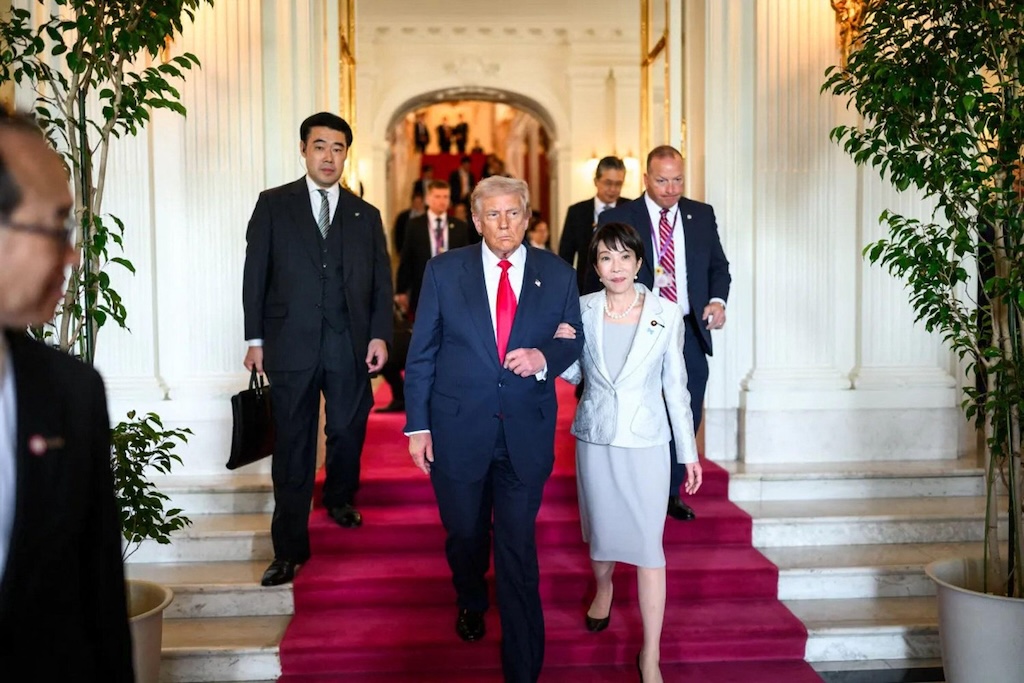
Takaichi has so far resisted condemning or endorsing the attacks on Iran and refrained from making an assessment on the legality of US-Israeli strikes.
This could change next week, however, when she meets president Donald Trump for a US-Japan summit arranged before the war broke out.
In Washington DC, she may be expected to provide a more “full-throated endorsement” of the US war effort, “if not an outright request for Japan to dispatch its forces in support of US military activities in the Persian Gulf,” Tobias Harris, founder of Japan Foresight, a Japan-focused advisory firm in the US, said in a statement.
The Japanese government was already increasing oil imports from the US to diversify after the supply shocks from the Russia-Ukraine war – a trend that will likely be “further encouraged” by the Middle East war, said Dr Jennifer Sklarew, assistant professor of energy and sustainability at George Mason University. She told Carbon Brief:
“The overall effect of the war in the Middle East, thus, may be greater Japanese dependence on US oil and gas.”
Watch, read, listen
PLEDGE WATCH: The Cypress Climate Advisory group released a “NDC benchmarker” that monitors countries’ emissions against their nationally determined contributions (NDC) under the Paris Agreement.
FEMALE LEADERSHIP: A comment piece in Climate Home News explored why women’s leadership is “central” to unlocking the global phaseout of fossil fuels.
NOW OR NEVER: Martin Wolf, the chief economics commentator at the Financial Times, argued that one of the economic lessons from the Iran war is the “need to invest in renewables, in order to reduce vulnerability”.
Coming up
- 9-19 March: 31st Annual Session of the International Seabed Authority, Kingston, Jamaica
- 15 March: Republic of the Congo presidential election
- 15 March: Vietnam parliamentary election
Pick of the jobs
- Grantham Institute for Climate Change, assistant professor or associate professor | Salary: £70,718-£80,148 or £82,969. Location: London
- Centre for Research on Energy and Clean Air (CREA), China analyst | Salary: Unknown. Location: Remote/London
- Climate Action Network, campaign officer | Salary: £31,069-£33,140. Location: Flexible
DeBriefed is edited by Daisy Dunne. Please send any tips or feedback to debriefed@carbonbrief.org.
This is an online version of Carbon Brief’s weekly DeBriefed email newsletter. Subscribe for free here.


The post DeBriefed 13 March 2026: War and oil | Why gas drives electricity prices | Japan’s ‘vulnerability’ to Iran crisis appeared first on Carbon Brief.

SYDNEY, Thursday 30 October 2026 — In response to reports that the Albanese government is set to introduce draft legislation this year that would seek to ban data centres in Australia’s suburbs, Joe Rafalowicz, Head of Climate and Energy at Greenpeace Australia Pacific, said:
“These reports are a testament to the growing community opposition to these completely inappropriate AI factories that have sprung up across our suburbs, and Big Tech corporations should take heed — the data centre build-out must not happen without the endorsement of the Australian people.
“But the government can’t simply ship this problem out to regional Australia without addressing the fundamental issues with this extractive new industry.
“We’re already seeing a trend of AI data centre proposals moving to the regions, in areas that are more water-scarce, more environmentally sensitive, and next to sources of fracked and coal seam gas to support their massive BYO gas-fired power plans — a pattern we’ve seen play out in the United States.
“From the Beetaloo Basin in the NT to the Western Downs in Qld, we’re seeing a wave of AI data centre proposals that would see new gas fast-tracked to support their massive energy demand, and threaten to completely derail Australia’s energy transition.
“Just as suburban Australians are asking, “what for?”, regional communities like Berry Springs and Dalby do not want dirty data centres setting up shop with absolutely no benefit to their communities. Greenpeace is calling for a moratorium on AI data centre developments until strict and enforceable safeguards are in place to protect our climate and our communities.”
-ENDS-
Media contact
Kate O’Callaghan on +61 406 231 892 or kate.ocallaghan@greenpeace.org
AI data centre ban in suburbs would not address fundamental issues: Greenpeace
In the thick of the COP29 climate summit in Azerbaijan in 2024, the UN climate talks were rattled by what can only be described as a major PR disaster. The BBC, Reuters and The Guardian all carried headlines, attributed to leading climate policy experts, that the COPs were “no longer fit for purpose”.
The articles outlined a series of reforms called for in an open letter signed by 22 eminent scientists and politicians, including a former UN secretary-general and previous UN climate chief, with a further 150 lending their support. The headlines shook confidence in the COP process, just as governments were wrestling over a new climate finance goal.
The Club of Rome – which handled the media relations for the letter – hurried to say that its “constructive, supportive ideas” had been “misinterpreted”. Negotiators kept calm(ish) and carried on, in the end landing the finance goal after some high-stakes drama on the final day.
-
Early speakers’ list suggests few powerful leaders will attend COP31
Just 77 heads of state or government are scheduled to address the COP31 climate summit in Antalya, a third less than the COP28 peak -
Africa wants adaptation finance on COP31 agenda, raising risk of a fight
The African Group wants dedicated space on tripling adaptation finance, the Green Climate Fund and trade, setting up a possible clash

To my surprise, when I went back this week to read the letter again, I could not find the offending line about the COPs not being fit for purpose. The Club of Rome has yet to respond to my query about its disappearance.
Whatever happened to the wording, that sentiment has been widely shared. COPs have ballooned in size while the importance of their outcomes seems to have diminished since the 2015 Paris Agreement (with the exception of the 2023 COP in Dubai where countries agreed to transition away from fossil fuels in energy systems).
The same on the surface
Two years on from those painful headlines in Baku, has anything changed for the better? You might be forgiven for thinking not. Official decisions are still made by consensus rather than the majority voting some have called for to stop blockers.
Tens of thousands of officials, activists and business execs still scurry around the halls to an ever-growing list of side events, roundtables and dialogues, while deals still come down to rows, all-nighters and jargon-filled texts adopted to rounds of applause.
But it would not be true to say that COPs have completely failed to respond to the very real need to translate the words of the Paris Agreement into action in the outside world.
Global warming is projected to be around 1.3C lower this century than it would have been if the world had not committed to tackle the climate crisis under that accord. Developing countries have a valued space at COPs in which their voices have equal weight in decision-making, unlike in many other international fora. And most importantly, perhaps, there has been a subtle shift, tipping the balance away from negotiating towards doing.
Brazil branded last year’s summit in Belém as the “COP of Implementation”, corralling the sprawling Action Agenda into six axes. This was a bid to impose some structure on the mushrooming efforts between governments, UN agencies, cities, businesses and civil society to set targets and spur faster results on their pet issues, from methane emissions to health and adaptation in conflict zones. COP30 alone saw the launch of 120 “plans to accelerate solutions”.
COP30 roadmaps off the cuff
Meanwhile, as the formal negotiations drew to a close, it was clear that consensus decision-making was evolving into something a little more improvised.
With only around half of all countries on board with the idea of a roadmap to transition away from fossil fuels, COP30 President André Corrêa do Lago announced his team would put one together over the coming year, along with another on how to meet a global goal to halt deforestation by 2030. Those roadmaps will be launched next week, presented and discussed at COP31, though it’s still unclear whether or how they’ll be incorporated into the formal negotiating agenda.

Some leading policy-makers don’t think that matters too much. Speaking to journalists before the Antalya summit, COP30 CEO Ana Toni and Dutch climate minister Stientje van Veldhoven said “coalitions of the willing” can move ahead without needing consensus from the COPs. This, they said, was evident this year at the first global conference on TAFF, co-chaired by van Veldhoven and attended by 60 countries.
“Consensus or no-consensus in the general COP doesn’t make a difference for the choices I have to make in my country to get my country to phase out fossil fuels,” said the Dutch minister. The Netherlands recently became one of the first to publish a national TAFF plan.
COP31 banks on flagship voluntary initiatives
This thinking has permeated the management and expected outcomes of this year’s COP too. Earlier this year, Türkiye, supported by international energy agencies, floated the idea of a voluntary goal to boost electrification to 35% of the world’s final energy consumption by 2035 – and this is now being touted as one of the main results to be expected from Antalya.
Türkiye is also championing a pledge on AI and climate, while co-host Australia is pushing to ease access to climate finance for least developed countries and small island states.
COP31 presidency announces AI pledge as UN climate chief says Big Tech ‘on thin ice’
None of these needs consensus. But with a political cover decision already in the works, as trailed by the COP presidents, they – and perhaps the fossil fuel roadmap – may find a home in the official text if language acceptable to most can be found, giving them them additional weight.
UNFCCC reform process in the shadows
Formal reform is underway too, if quietly. UN climate chief Simon Stiell is leading a review informed by ongoing consultations with a group of 15 well-respected climate policy experts, three of whom signed the open letter in 2024.
Among them is leading Swedish climate and sustainability scientist Johan Rockström who has strong ideas about how to make COPs function better, including a switch to majority voting. He told the same press briefing nothing stands in the way of this, because the rules of procedure for making decisions at COPs have never been formally agreed.
Still, to get away from the default setting of consensus would require agreement on a new system that may be impossible to achieve given the rise in bullying tactics by fossil fuel heavyweights.
Comment: The UN climate process was built for negotiation – now it must support implementation
The deliberations with the high-level policy gurus, as reflected in a summary of June’s session in Bonn, largely echo what’s already happening organically, calling for stronger partnerships and accountability both in and between the Action Agenda and negotiations. It doesn’t mention voting.
A general overview of the reform exercise says that “improving and optimizing the [UN climate] process over the medium to long term… will be critical to fostering trust, enhancing collaboration, and catalyzing increased ambition”.
In the short term, don’t hold your breath for anything concrete on reform at COP31 but watch for signs in what ends up dominating the headlines from Türkiye.
The post Editor’s Desk: COP reform is happening quietly, behind the headlines appeared first on Climate Home News.
Editor’s Desk: COP reform is happening quietly, behind the headlines