

Eliot Whittington is Executive Director of Cambridge Institute for Sustainability Leadership.
Last week, the Trump Administration reversed the critical finding that greenhouse gases threaten the public health and welfare of current and future generations, a scientific and legal foundation that has underpinned US climate regulations since 2009.
In doing so, the US government not only lost its ability to regulate emissions from vehicles, power plants and heavy industry, but created massive uncertainty for businesses and jeopardises the benefits of the energy transition.
This action is the latest step in a growing battle over the future of climate and energy policy that extends far beyond the US borders and is currently increasing challenging UK and European policy makers.
The so called “endangerment finding” was based on overwhelming evidence and widely discussed when it was introduced – with over 380,000 public comments. A rigorous analysis or critique would not overturn it, given the huge and still-growing body of evidence showing the impact of emissions.
But repealing the finding is not evidence-based policy making; it is bad policy, terrible economics and incorrect science, driven by an ideology that is seeing the US pour money into uneconomic coal power plants.
-
The more Europe relies on the US for energy, the more it’s vulnerable to pressure by Trump
Risking energy security suicide through dependency on US gas, Europe’s leaders must instead reject resource colonialism -
After disappointing COP30, EU mulls “less naive” strategy for climate talks
EU environment ministers are discussing how to show more “realism” and “pragmatism” in international climate negotiations -
Climate action is “weapon” for security in unstable world, UN climate chief says
With geopolitical tensions rising, Simon Stiell urges leaders to accelerate global climate cooperation in pursuit of a safer world


US firms face uncertainty and regulatory chaos
Even the most powerful politician cannot change scientific reality, and attempts to do so undermine the health, wealth, and safety of Americans and, ultimately, people everywhere.
Trump has been celebrated by the coal industry as its strongest champion and has thrown his weight behind fossil fuels, but that has not and will not stop the US’s energy transition. Even in his first term, there were record coal retirements, and the US shows no sign of a coal renaissance any time soon.
Instead, Trump’s actions take a wrecking ball to US regulation, one that is likely to be challenged in court, leaving companies facing years of uncertainty, delaying investment and risking the loss of innovation to global competitors.
Repealing the “endangerment finding” is a self-inflicted wound to climate action and a strategic error as the energy system is rewired around technologies like solar, wind, electric vehicles, heat pumps, batteries, and digitalised grids. These are increasingly outcompeting fossil fuels on efficiency and cost.
The US government setting its weight against the market will not hold back the tide, but it will lead to regulatory chaos, cede ground to competitors, and slash the benefits the US could reap.
Clean technologies outcompete incumbents
While the US has chosen slow innovation and investment in the clean economy, China is pursuing the industries of the future and leading on solar power, batteries, electric vehicles and more.
New analysis shows its emissions are now flat or possibly even falling and, while it will take time for this clean energy juggernaut to push coal and industry emissions out of the system, the direction of travel is becoming ever clearer.
China is not just doing this because it is good for the climate. Clean technologies and an electricity-centred economy outcompete the incumbents.
-
China maximises battery recycling to shore up critical mineral supplies
Beijing is bracing for a tsunami of spent EV batteries by taking steps to boost recycling – a strategy that could also cut its reliance on imports of clean energy minerals -
Explainer: What is the petrodollar and why is it under pressure?
As the US seeks to carve out a sphere of influence in the Western Hemisphere, questions grow about the dollar’s future as the lynchpin of the global economy -
EU weakening of corporate sustainability rules ‘jeopardises’ climate action, critics say
A major revision to the EU’s law on corporate due diligence removes a requirement for large companies to publish plans to align their business model with global climate goals


Analysis by energy think tank Ember shows that these clean, electricity based technologies are three times more efficient than burning fuels. Not only this, but costs are also falling and domestic production bolsters energy security, providing a competitive edge.
The US will find itself isolated in its return to fossil fuels. In 2024, clean power surpassed 40% of global electricity, led by record solar growth, while electrification is now responsible for almost all the demand growth in road transport and is surging in buildings and parts of industry.
With China – and a growing group of other emerging markets – progressing in their energy transitions, and the US turning its back, incumbent clean-economy champions, the UK and Europe, seem caught in the headlights, wanting to simultaneously leap forward while also glancing back at supposedly affordable fossil fuel resources.
It is paramount that they resist the urge to take a leaf from Donald Trump’s book and legislate for a fossil fuel ideal rather than a clean energy reality. Instead, they need to ensure the investment and political will to be brave and walk the road ahead without the US.
The post As China builds the future, Trump’s repeal of climate finding is self-inflicted wound appeared first on Climate Home News.
As China builds the future, Trump’s repeal of climate finding is self-inflicted wound

Three countries have been named by the Paris Agreement’s compliance committee for failing to submit a nationally determined contribution (NDC) and repeatedly snubbing offers of help with their climate plans.
After months of internal debate over whether to identify serial non-responders, the Paris Agreement’s Implementation and Compliance Committee (PAICC) named the three countries which have failed to engage with it over their NDCs on Friday.
It named Democratic Republic of Congo, Senegal and North Korea in a footnote of its annual report, adding that it decided to name them “with a view to facilitating engagement”, adding that representatives of the three nations had been invited to its meeting in early 2027 “with the purpose of identifying any challenges and constraints”.
“The Committee noted the importance of Parties engaging with the Committee in a timely manner, while noting that some delays may be due to the national capabilities and circumstances of the Parties”, the report said.
-
Under US pressure, World Bank says it will back gas “where appropriate”
The US wants the World Bank to expand its gas support while climate campaigners are pushing for it to end – its head spoke this week of limited backing for the fossil fuel -
IPCC scientists vow to press on with climate reports despite political deadlock
After governments again failed to agree a timeline, nearly 120 IPCC authors pledged to complete their assessment on time and with full scientific rigour -
Paris Agreement committee snubbed over missing NDC climate plans
Many governments have still not submitted a nationally determined contribution to the UN, breaching a key requirement of the Paris Agreement

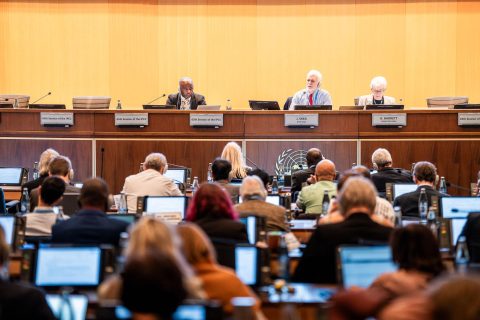

In July, PAICC said 12 countries had ignored its repeated attempts to discuss why they had not published an NDC as required every five years under the 2015 Paris accord.
Members of the committee had been divided over whether to name them, but at a September meeting decided to do so in their annual report to the annual climate COP summit.
By the time the report was published on Friday, only Congo, Senegal and North Korea “had not communicated an NDC or submitted a [Biennial Transparency Report] and had not yet responded to any of the Committee’s notifications, despite several reminders issued by the Committee in this regard”.
Rainforest and renewable energy ambitions
The silence from Congo and Senegal is notable because the former is home to much of the Congo Basin rainforest while the latter has sought billions of dollars in climate finance to support its renewable energy ambitions.
After Brazil, Congo has more rainforest than any country in the world. This forest, and the country’s peatlands, absorb huge amounts of greenhouse gas but are fast being lost to expanding farmland, charcoal production, logging and mining.
Senegal signed a Just Energy Transition Partnership with Canada and wealthy European nations in 2023, to help it meet its renewable energy targets under the-then government of Macky Sall. It was chair of the Least Developed Countries group between January 2022 and December 2023.

Tejas Rao, who is researching the PAICC as part of a doctoral thesis at Cambridge University, said the governments of the three countries should engage with the committee.
“Engagement costs these governments very little and the committee has shown it will listen,” he said.
“Silence leaves the committee with no basis to help, and it leaves the [governments] exposed to the narrative that they are simply disengaged,” he told Climate Home News.
Paris Agreement requirement
The 2015 Paris Agreement requires all parties to publish an NDC every five years outlining their emissions reduction targets, with each plan meant to be more ambitious than the country’s last NDC.
The latest set – the third round of plans, with new targets for 2035 – was due in February 2025. While most countries missed this deadline, all but around 30 – mostly small emitters but including Egypt, Vietnam and Argentina – have now submitted them.
Over the year, the PAICC – which is made up of government climate officials from developed and developing countries – has been communicating with governments that have not submitted NDCs and trying to overcome barriers to them doing so.
Some nations have cited exceptional circumstances as the reason for not submitting an NDC, a process that requires a significant amount of work in tracking emissions and consulting on how to curb them across the economy. For example, a letter from a Sudanese official to the PAICC, seen by Climate Home News, said that the country’s civil war had led to the suspension of its NDC preparation.
-
IPCC scientists vow to press on with climate reports despite political deadlock
After governments again failed to agree a timeline, nearly 120 IPCC authors pledged to complete their assessment on time and with full scientific rigour -
Under US pressure, World Bank says it will back gas “where appropriate”
The US wants the World Bank to expand its gas support while climate campaigners are pushing for it to end – its head spoke this week of limited backing for the fossil fuel -
Who shapes climate science? The equity question facing the IPCC
Early completion of the next global climate science assessment reports risks excluding research from the Global South, which is key to ensuring the findings are fair
The US and Iran are not signed up to the Paris Agreement and so do not have active NDCs, nor does Taiwan, which is not a UN member state.
Rao said that because the PAICC is “facilitative and non-punitive”, naming the countries “is meant to open a door, not close one – the invited consultation is the point”.
“In recent months, governments that explained their constraints, whether capacity, finance or domestic process, have been met with follow-up and support rather than sanction, and the number of silent governments has fallen sharply,” Rao said.
The post Paris Agreement committee names three countries snubbing it over NDCs appeared first on Climate Home News.
Paris Agreement committee names three countries snubbing it over NDCs