

The European Union and the UK are not on track to meet their 2030 offshore wind targets.
At the same time, Chinese wind-turbine manufacturers – who account for more than half of global wind-turbine capacity – are looking to grow their footprint in the European market, where their presence is currently tiny.
To some, the solution seems clear: allowing Chinese manufacturers to invest in Europe could boost competition, alleviate supply chain bottlenecks and lower costs – not to mention bring climate targets within reach.
But the possibility of a growing role for Chinese wind-turbine manufacturers in the European market has sparked heated debate among European policymakers and industry participants.
In 2024, three of China’s top wind-turbine companies accounted for less than 1% of Europe’s installed wind capacity.
But their focus is increasingly shifting to the continent, which some are concerned could hollow out the one clean-energy industry in which Europe is still competitive.
Competition between European and Chinese manufacturers would be “unfair”, according to critics, because the discounts Chinese firms are offering seem to be at least in part due to state subsidies.
In a recent report published by the Oxford Institute for Energy Studies, we explore whether Chinese wind turbine companies are competitive in Europe and the real risks and benefits of Chinese participation in European offshore wind markets.
Our findings build on interviews with policymakers and industry experts, who have been granted anonymity to allow for candid discussion.
Cost advantages are less clear-cut than they appear
China ranks first for many of the global statistics for offshore wind. It has been by far the largest offshore wind market in the world for several years running.
China had 47 gigawatts (GW) of offshore wind installed, as of September 2025, more than all other countries combined. Furthermore, China also dominates several key fields critical to offshore wind globally, ranging from permanent magnets to offshore installation vessels.
This stands in firm contrast to Europe – where offshore development has experienced several years of slow growth – and the US, which faces an almost complete halt in new development under the Trump administration.
As happened before in solar and batteries, China’s offshore wind industry scale-up has brought about stunning declines in installation costs.
However, this cost advantage is not as straightforward as these headline numbers would suggest. Despite the vast difference in capacity cost, the electricity produced by Chinese offshore wind farms is only 30% cheaper.
A key reason for this is the lower overall capacity factor of China’s offshore wind sector, referring to the actual output of windfarms in China, compared to their maximum possible output. This can be partly explained by lower wind speeds at China’s offshore sites, but could also relate to lower performance of Chinese turbines, as well as power transmission issues.
Lower production costs in China also would not necessarily translate to the European market, as Chinese cost advantages would be partly offset by transport costs, as well as higher insurance and financing premiums.
Greater localisation of turbine production could mitigate against some of these premiums, but would be offset by higher input costs in Europe.
Nonetheless, as more European governments add local content requirements, Chinese manufacturers have announced plans to set up European factories for turbine blades and towers, with core components shipped from China.
These factories could also be costlier to finance than those back home if financing for investments also comes from Europe, further reducing the cost advantage enjoyed by China’s domestic offshore-energy infrastructure.
Issues beyond costs and bottlenecks
European offshore wind development plans have faced a number of hurdles, including rising costs, slow permitting processes, inefficient auction designs, lengthy grid connection times and limited availability of parts, port capacity and installation vessels.
The small number of players in Europe’s offshore wind sector is seen as part of the problem, according to our interviews.
Currently, there are only three major wind turbine manufacturers in the European offshore wind market: Vestas, Siemens Gamesa and GE Vernova.
The latter announced in 2024 that it is downsizing its offshore wind business and has not taken new offshore orders, although it remains active in onshore wind projects. This reduces competition and could hinder efforts to bring down the cost of offshore wind projects.
Bottlenecks, inadequate industry capacity and lack of competition cannot in themselves explain the current European predicament. Developers we interviewed also note that offshore wind auctions with price caps and stringent contractual terms, designed with an expectation of falling costs, have also been part of the problem.
When these auctions have failed – as in the UK in 2023 and Germany in 2025 – this led to capacity contraction, higher costs and industry consolidation, which have only made it more difficult to reach policy targets, according to a report by European offshore wind company Ørsted.
Even with improved European auction design, it may take years for Europe’s offshore wind installation numbers to recover. With or without Chinese participation, it will also take time to build domestic manufacturing bases and installation vessels.
Pathways to Chinese involvement
Meanwhile, Chinese developers benefit from a large and growing domestic market in China. At the same time, however, intense competition on price and quality is spurring them to seek opportunities overseas.
Throughout Europe’s supply chain, Chinese components and services are already helping alleviate shortages and bottlenecks.
Still, our report found there are divergent views on whether a greater Chinese presence in Europe’s wind markets represents a threat or an opportunity – or both.
Policymakers are expected to continue to emphasise concerns about technology dependence and cybersecurity risks, leading to more domestic content requirements and increased scrutiny of Chinese deals.
The case of the 300 megawatt (MW) Luxcara project in Germany highlights the difficulties for Chinese market entry. Chinese manufacturer Mingyang was initially selected by the project owner in 2024, but was later replaced by Siemens-Gamesa, reportedly due to concerns about security and political risks.
The recent announcement of a deal between the UK’s Octopus Energy and Mingyang may illustrate an emerging model. According to Octopus, Mingyang will supply the physical equipment, while Octopus will supply the software and manage the turbines.
Mingyang will still need access to operational data to support ongoing maintenance, but this can be provided periodically by Octopus without compromising security, the energy company told us.
Meanwhile, following policy signals such as the EU’s new pricing mechanism for electric vehicle imports from China, it seems likely that policymakers will continue to encourage Chinese players to establish production bases in Europe and to require technology licensing or technology transfer in exchange for market access. This would amount to applying the Chinese industrial development model in Europe.
This could allow for technological learning in Europe. In China, the largest players have deployed advanced automated manufacturing lines, including robotic blade bonding, modular stator assembly and real-time quality monitoring – although this may have implications for job creation, a stated aim in Europe’s clean-energy policy.
Despite pointing to some advantages, our interviews suggest that Chinese participation in Europe’s offshore wind market is not a panacea.
Its low costs are unlikely to be transferrable to the European context. But greater Chinese participation in auctions and in manufacturing, with local content requirements and other guardrails, could help spur competition in Europe.
At the same time, our report suggests that the focus on China distracts from deeper issues. Without a growing domestic market, it may be difficult for European players to reduce manufacturing costs and upgrade production, with or without Chinese partners.
Ultimately, industry participants tell us that the greatest determinant of success in Europe’s offshore wind market will be consistent policy support, rather than a decision to allow – or to block – Chinese participation.


The post Experts: Will Chinese wind power help or hinder Europe’s climate goals? appeared first on Carbon Brief.
Experts: Will Chinese wind power help or hinder Europe’s climate goals?

One of the key expected outcomes from the upcoming COP31 climate summit in Antalya, Turkey, is the launch of a “just transition mechanism”.
This follows years of calls from civil society to support a “just transition” as countries shift towards low-emissions energy systems and away from fossil fuels.
At the COP30 UN climate talks last year in the Brazilian city of Belém parties agreed to establish a “mechanism” to support this goal, called the “Belém-Antalya mechanism” (BAM).
Groups that have championed the BAM want it to act as a central hub on just transitions, providing support for workers and communities around the world.
However, the details of exactly what the much-touted BAM will consist of remain vague, with developed and developing countries disagreeing about its functions and purpose.
Disagreements continued at the UN climate talks in Bonn in June 2026, including on the crucial question of how the BAM will be financed.
Here, Carbon Brief looks at where the idea for the BAM came from, how it could support just transitions and what to expect from COP31.
How has a ‘just transition’ featured in UN climate talks?
A “just transition” is the idea that workers and communities should be supported in the shift to a low-carbon economy. It is a central principle behind the idea of climate justice.
Often, the term refers to those linked to the fossil-fuel industry, but it can also refer to transitions taking place in agriculture, heavy industry and various other sectors.
The concept originated in the 1980s, when US labour unions forged alliances with environmental justice groups. It has since become a key part of international climate discussions.
The preamble to the 2015 Paris Agreement includes a commitment to “tak[e] into account the imperatives of a just transition of the workforce and the creation of decent work and quality jobs in accordance with nationally defined development priorities”.
Bert De Wel, policy officer at the International Trade Union Confederation (ITUC), tells Carbon Brief:
“The labour movement is very happy with the wide audience and broad political support that the concept has received since its inception in the 1980s. The inclusion in the Paris Agreement, with the reference to the creation of decent work and quality jobs was a milestone for the movement. While other demands have been added…we continue to stress the labour dimension as being central to the concept.”
Three years after the creation of the Paris Agreement, at COP24 in the former coal-mining city of Katowice, the Polish presidency highlighted the issue of just transitions.
The need for carbon-cutting policies to ensure “a just transition of the workforce” that creates “decent work and quality jobs” was included in the “Silesia declaration”, issued by the presidency during the first week of COP24.
While the declaration was only signed by 50 countries – roughly a quarter of the parties at the summit – it was still “noted” in the final COP text.
This helped to drive momentum behind the idea, culminating in formal agreement at COP27 in Egypt to launch a “work programme on just transition” (JTWP).
De Wel says the establishment of the JTWP was a “major step forward” that allowed parties to “speak about just transition in more concrete terms”.
In the years since, negotiators have worked to flesh out the JTWP, with disagreements between parties about what its purpose should be.
Broadly, developed countries would like it to focus on domestic workforces, while some nations want a more global outlook, including support for transitions in developing countries.
The JTWP has proved a challenging negotiating space, with talks at the COP29 summit in 2024 closing without an agreement, in what one observer dubbed a “betrayal”.
However, despite these frustrations, parties at COP30 in Brazil agreed to establish a new institutional mechanism on just transitions, which has become widely known as the BAM. The move was hailed as a “victory” by civil society.
Where did the ‘just transition mechanism’ come from?
In the run-up to COP30, civil society began to push for the establishment of an “institutional arrangement” that would move work under the JTWP from talk into action.
(This was originally called the “Belém action mechanism” by civil society groups, who subsequently updated this to the “Belém-Antalya mechanism” following the outcome at COP30. However, in the JTWP text agreed at COP30 it is only described as a “mechanism”, sometimes also referred to as the “just transition mechanism”.)
Anabella Rosemberg, senior advisor on just transition at NGO umbrella group Climate Action Network (CAN) International, tells Carbon Brief:
“The idea of the mechanism emerged from the collaboration of civil society, trade unions, feminist groups, youth and Indigenous peoples in the UNFCCC.
“It was clear that the kind of activities being run under the JTWP – two dialogues a year and one ministerial – would not support the delivery of just-transition strategies on the ground, so a new approach was developed to get words into action.”
Following the inception of the idea, civil society did “tonnes of stuff to boost it up the agenda”, Dr Leon Sealey-Huggins, a senior campaigner at the charity War on Want, tells Carbon Brief.
This ranged from presenting demands and proposals to different constituents, organising joint letters and writing policy papers, all the way through to designing logos, creating memes and even a song.
These efforts ultimately paid off: during the Bonn climate negotiations in June 2025, one draft text included the idea for a new institutional arrangement. One of the options in the draft text was for a “toolbox, guidance framework, global platform, technical assistance network [or] mechanism”.
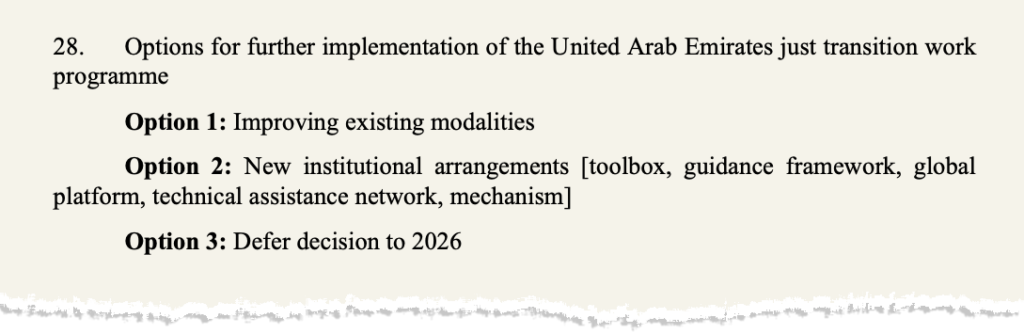
This inclusion was broadly welcomed as a “big win” for civil society groups, although parties acknowledged that more needed to be done to flesh out the idea.
Going into COP30, civil society groups continued to push the idea of creating a BAM, with protests, banners and badges visible around the venue.
Early in negotiations, the G77 and China – a large coalition of developing countries at UN climate talks – put forward their own proposal for a just transition “mechanism”. This, they suggested, could provide technical assistance, support international cooperation and help to foster partnerships in an effort to address implementation gaps.
Their proposal faced initial pushback from developed-country parties including Norway, the UK and others, who opposed it due to concerns that it would duplicate existing systems and require additional funding.
Developed countries also opposed the use of the term “mechanism”, with the EU suggesting an “action plan” as a potential alternative. Nevertheless, the creation of a “mechanism” was included in the final draft text on the JTWP.
This text was formally approved during the COP30 closing plenary to extended applause from many in the hall.
In a statement at the time, Chiara Martinelli, director at CAN Europe, welcomed the decision:
“Delivering BAM was a major civil society win. It creates a coordinated institutional home to drive forward progress on the just transition.”
The decision to develop the mechanism included a request for parties to work over the subsequent year – through to COP31 – on a plan to get things started.
What role could the mechanism play in facilitating ‘just transitions’?
According to civil society, the BAM could help tackle the fractured just-transition landscape by centralising resources and helping to overcome a number of barriers.
Speaking to Carbon Brief, Rosemberg says the just-transition space “lacks coordination and the right kind of support and is quite disconnected from climate action imperatives”. She adds:
“The BAM can play a role in bringing those [people] trying to make just transition happen together, identify gaps and barriers, foster cooperation and accelerate support.”
Civil society has put forward a number of proposals likely to inform the structure of the BAM. Most consist of a mechanism with three parts, which would encompass and expand upon the work that is currently being carried out under the JTWP.
One proposal by a coalition of five NGOs suggests the mechanism is formed of a steering body, a “knowledge arm” and an “implementation arm”.
The steering body would coordinate the work of the two arms of the BAM, including deciding the topics that should be discussed under the ongoing JTWP, which will continue to feature in climate negotiations. They suggest the body would recommend topics that require negotiation when “gaps that require political guidance are identified”.
Their proposal is illustrated in the infographic below, showing the steering body acting as a central hub for work within the BAM.
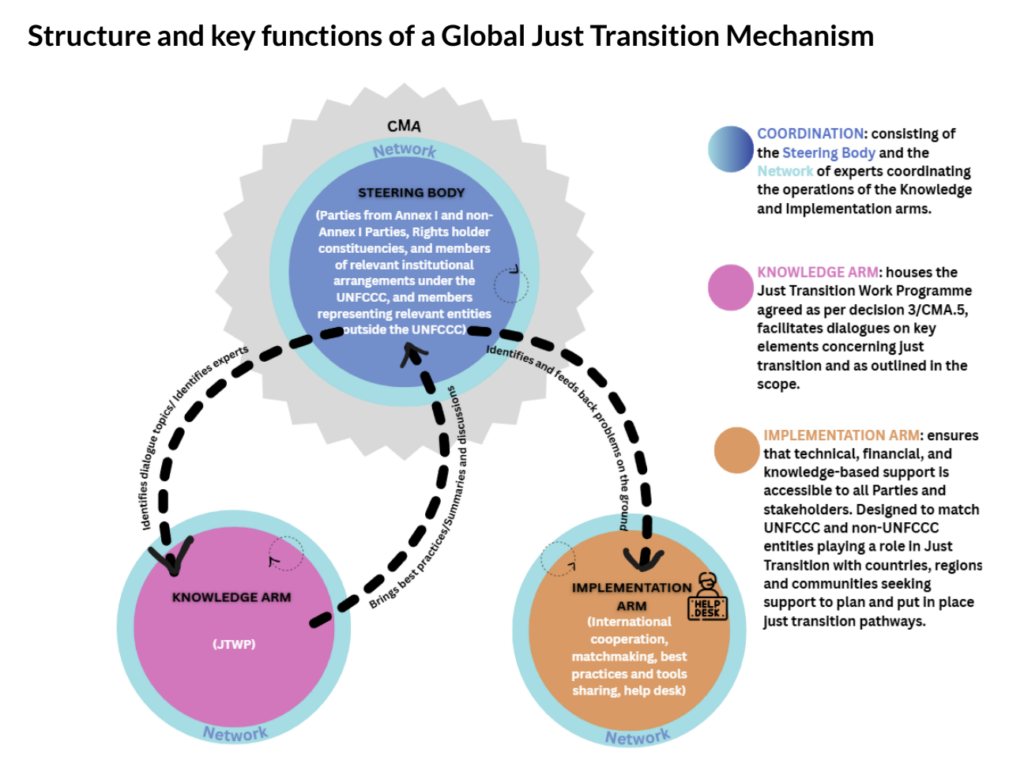
The final part of the BAM, the “implementation arm”, would act as a hub to enable and coordinate technical, financial and knowledge-based assistance for those pursuing a just transition.
Rosemberg says the vision of civil society is for work to go “beyond negotiators’ dialogues”. She says the BAM could enable the organisation of a “matchmaking platform” to provide support faster, as well as dedicated groups to identify and mobilise financial resources. She adds:
“Finally, through bottom-up identification of barriers, the BAM can also allow a discussion on enabling just transition that is informed by practitioners. The BAM can show that implementation does not necessarily mean taking issues outside of the UNFCCC.”
A separate proposal for the structure of the BAM from the Global Campaign to Demand Climate Justice (DCJ) – a separate coalition of NGOs – similarly proposes three elements. These would be: coordination and coherence; knowledge generation; and international cooperation and support.
Sealey-Huggins, who is affiliated with DCJ, notes:
“If it works in practice, what we’ll see is a cascade of just-transition policies implemented across countries, across sectors in a unifying, transformational moment for justice-centered climate action, and that will be the key to unlocking the transition that’s been missing so far.”
Another proposal for the BAM comes from the Grantham Institute at the London School of Economics. It suggests the three functions of the mechanism should be capacity-building, technical assistance and knowledge-sharing, but it recommends a dual-arm structure comprising a policy arm and an operational arm.
De Wel tells Carbon Brief that while there is “rather broad consensus on the functions”, parties are pushing in “very different directions” on how the BAM will be set up.
What are the financial implications of the mechanism?
Within UN climate negotiations, some parties have raised concerns about the potential cost of the mechanism.
The push to launch the BAM comes at a time when the UNFCCC itself is facing a funding gap, following the US withdrawal. Several other parties have also delayed or reduced their contributions, in response to changes in domestic priorities.
This has led to the UNFCCC cancelling events and not filling vacated positions, as the organisation struggles to carry out its existing functions.

Membership