

At the end of the first year in which global average temperatures are almost certain to top the key threshold of 1.5C above pre-industrial times, scientists have sounded the alarm about the extremes of climate and weather we’re already experiencing – and are warning things could get even more serious.
At the same time, they say it’s not too late both to limit the damage by phasing out planet-heating fossil fuels and doing more to protect communities from the dangers of worsening heatwaves, droughts, floods and storms.
After Cyclone Chido, France accused of neglecting climate threat to “fragile” Mayotte
In a report outlining their findings for 2024, researchers collaborating with the World Weather Attribution (WWA) and Climate Central projects said climate change had intensified 26 of the 29 weather events they studied during the year.
Those disasters killed at least 3,700 people and displaced millions – but are only a small sample of what was experienced on the frontlines of a warming world. They included severe floods in eastern Spain, hurricanes in the US, drought in South America’s Amazon rainforest, and flooding across West and Central Africa.
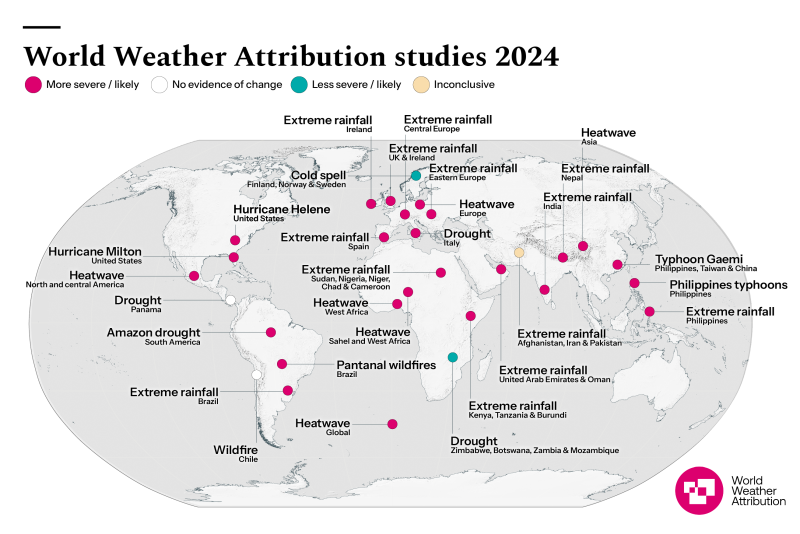
Source: “When Risks Become Reality: Extreme Weather in 2024” report from World Weather Attribution & Climate Central
The scientists also found that people around the world experienced, on average, 41 extra days of dangerous heat in 2024 due to human-caused warming.
Friederike Otto, WWA’s lead and a senior lecturer in climate science at Imperial College London, said the “unrelenting suffering” could be alleviated if we stop burning coal, oil and gas, use renewable energy to power our economies instead, and adapt to climate impacts.
“The top resolution for 2025 must be transitioning away from fossil fuels, which will make the world a safer and more stable place,” she said in a statement.
Here are some key facts and figures from the report:
Heat: Too hot to handle
2024 is set to be the hottest year on record – again. The first six months saw record-breaking temperatures, extending a streak started in 2023 to 13 months. The world’s hottest day in history was recorded on July 22, while a day earlier more than 5 billion people were exposed to high temperatures made at least two times more likely due to climate change.
However, the scientists note that surpassing global warming of 1.5C for a one-year period, as expected for 2024, does not mean the Paris Agreement’s aim of limiting it to that level has failed, because that would require several years with temperatures above 1.5C. “However, it is a warning that we are getting dangerously close,” the report said.
The El Niño climate phenomenon, caused by warmer temperatures in the Pacific Ocean, added some heat in the first half of this year, but rising emissions were the main culprit for so many record-shattering temperatures, it added.
The countries with the highest number of risky heat days were largely small island developing states (SIDS), accounting for 18 out of the top 20. Their residents – also threatened by rising sea levels and powerful storms – experienced more than 130 additional days of dangerous heat in 2024. SIDS, many of them highly indebted, pushed for more financial support for vulnerable countries at COP29 and were disappointed with the outcome.
Flooding: Be warned
The high heat levels of 2024 also translated into record-breaking downpours, as warmer air holds more moisture and hotter seas cause increased evaporation. As a result, devastating floods hit many places worldwide, from Dubai to Kathmandu and Brazil’s Rio Grande do Sul.
The scientists said their work this year highlighted how early warning – and acting on it – often makes the difference between life and death.
In September, for example, four days of record rainfall brought by Storm Boris flooded regions of Central Europe, but people were evacuated days in advance, reservoirs were drained and flood defences built up, meaning that less than 30 people lost their lives.

Source: “When Risks Become Reality: Extreme Weather in 2024” report from World Weather Attribution & Climate Central
Meanwhile, floods in Sudan, Nigeria, Niger, Cameroon and Chad were the deadliest event studied by WWA in 2024, with at least 2,000 people killed and millions displaced. The group found that if warming reaches 2C, which could happen as soon as the 2040s or 2050s, those regions could experience similar periods of heavy rainfall every year.
“Our studies continue to show the need to enhance preparedness for extreme weather to reduce loss of life and damages,” said Julie Arrighi, director of programmes at the Red Cross Red Crescent Climate Centre. “In 2025, it’s crucial that every country accelerate efforts to adapt to climate change.”
Storms: Blown away
Scientists said that as the world and its oceans warm, a bigger share of the most powerful tropical cyclones are reaching category 3 or above (5 being the highest), with faster maximum wind speeds, heavier rainfall and much greater destructive potential.
Other shifts in tropical cyclones include storms strengthening faster, migrating towards the poles and moving more slowly over land, often leading to more severe impacts.
This year the typhoon-prone Philippines was hit by six consecutive storms in just a few weeks from mid-October to mid-November – including three classed as “super typhoons” – affecting 13 million people and killing more than 160. The likelihood of three or more major typhoons making landfall in the Philippines in a given year has increased by about 25% due to human-induced climate change, WWA said.

Source: “When Risks Become Reality: Extreme Weather in 2024” report from World Weather Attribution & Climate Central
Also this year, Hurricane Helene killed more than 230 people after extreme rainfall affected communities in the southern Appalachians, making it the deadliest hurricane to strike the mainland United States since Katrina in 2005.
Drought and wildfires: Drier – and more flammable
Rising temperatures make droughts worse by increasing water loss from soils through evaporation and plant transpiration.
In 2024, the Italian islands of Sicily and Sardinia suffered severe droughts that led to water rationing and huge losses of wheat crops. They were made 50% more likely by climate change, WWA’s study found.
As Earth dries out, countries fail to reach drought agreement
Persistent heat also intensified the devastating drought in the Amazon River Basin this year, provoking concerns about tree dieback in the world’s largest rainforest, which could release large amounts of carbon dioxide into the atmosphere, further accelerating global warming.
Regina Rodrigues, professor of physical oceanography and climate at Brazil’s Federal University of Santa Catarina, said worsening droughts might push the Amazon forest irreversibly into a drier state, reducing its moisture flow and ability to absorb and store carbon, as well as its biodiversity.
“All these critical processes are essential not only locally and regionally but also globally in order to maintain life as we know it. We are already witnessing some of these devastating consequences,” she warned.

Source: “When Risks Become Reality: Extreme Weather in 2024” report from World Weather Attribution & Climate Central
One study published in Nature by an international team this year warned that parts of the Amazon may have already passed a safe boundary, and as much as half of the rainforest could hit this tipping point by 2050 unless deforestation – which harms the forest’s ability to hold water – is halted.
Hot and dry conditions also mean that if fires ignite in forests, the chances of the blazes spreading are much higher and they are far harder to control.
2024 was an extremely active year for wildfires, particularly in the Americas – from Chile and Brazil’s drought-hit Pantanal wetland to western Canada and the United States.
The report said smoke from the fires in North America impacted air quality across the region and as far away as Europe, with recent research suggesting the number of people dying due to inhaling smoke from wildfires is rising due to global heating.
(Reporting by Megan Rowling; editing by Mariel Lozada)
The post 2024: A year of extreme heat and growing climate danger appeared first on Climate Home News.

Climate Change
‘COP-out’: COP31 fails to deliver the ambition needed to phase out fossil fuels and address climate breakdown
Antalya, Türkiye, Sunday 22 November 2026 — The COP31 climate summit in Antalya has ended in disappointment and anger, as the final COP31 outcome failed to deliver on critical issues like overshooting the 1.5°C limit, fossil fuel phase out and climate finance. Greenpeace Australia Pacific says that Australia did not deliver the deal that the world needed in a time of escalating climate breakdown.
In Antalya, Dr Susie Byers, Head of Advocacy at Greenpeace Australia Pacific, said: “We need to call this COP outcome what it is: a COP-out that has failed to deliver what the world urgently needs given the scale of the crisis we’re facing. It’s a colossal lost opportunity, and one that the world won’t easily forget.
“Coming out of Belém there was momentum to phase out fossil fuels, but COP31 wasn’t able to harness that energy and drive the world forward. The failure to adopt the Cover Decision means there’s now no acknowledgement of, let alone response to, 1.5°C overshoot — the survival line for Pacific nations. Electrification, defence of science, protection for the oceans, and advances on climate finance were all casualties of cynical attempts to derail climate action with dangerous distractions like CCUS.
“Australia knew how hard this task would be and put their hand up anyway. In the end, they didn’t get it done. This outcome validates exactly why so many countries are looking towards parallel tracks like the International Court of Justice Advisory Opinion and national transition roadmaps, where we’ve seen microdiplomacy and Pacific leadership again lead the way. This spirit of multilateralism and collaboration is how we will move beyond rhetoric to concrete actions, and end the fossil fuel chokehold.”
Also in Antalya, Shiva Gounden, Head of Pacific at Greenpeace Australia Pacific, said: “They called this an ‘implementation’ COP, but implementation means nothing when the foundation is broken. The frontline communities leading this fight came to Antalya demanding the urgent, definitive action required to confront the sickening realities of 1.5°C overshoot. Instead, developed countries turned their backs on their historical responsibilities, held climate finance hostage, and treated the debt they owe as a cheap bargaining chip.
“At the exact same time, Parties and negotiating blocs deliberately blocked the bold action the world needed on mitigation, peddled toxic distractions like CCUS, and intentionally scrubbed the words ‘fossil fuels’ from the final text. A strong Presidency that understood the urgency of the situation would not have let this happen; Australia failed to deliver what it promised the Pacific.
“Billions of people across the world are fiercely defending their lives, their homes, their cultures, and their livelihoods, and we came here with their voices demanding real action. By choking off the money and refusing to name the root cause of this collapse, polluting nations made a calculated choice to protect their own interests over our shared future. The Pacific will increasingly look towards parallel paths like the ICJ climate advisory opinion, and the Santa Marta process, to continue finding solutions because that is what our people need.”
ENDS
COP31 images and video available here in Greenpeace Media Library
Media contact: Kate O’Callaghan in Antalya (GMT+3) on +61 406 231 892 (Whatsapp/Signal)
Climate Change
COP31 Bulletin Day 13: New draft retains electrification goal but delays adaptation finance and science decisions
After an evening of tense discussions, a new version of the cover text was finally released at around 2am on Sunday morning. But, with many delegates flying home, it is unclear if – and for how long – there will be the two-thirds of governments present needed to legally adopt a decision.
The latest draft, which is – as of 9.30 – scheduled to be put to a plenary session for approval at 10am – retains a goal to boost electrification and links it more strongly with clean energy and storage. It does not, however, include language on transitioning away from fossil fuels as many countries had called for.
It ditches a specific numerical target for carbon capture, use and storage (CCUS), a controversial technology that is favoured by fossil fuel producers, which is now only an aim “to achieve gigatonne scale globally by 2035 as a collective global aspiration”. The previous version had two alternative targets, a weaker one of 0.5Gt “working towards” 1.3-2.5Gt and a stronger one of 2.5Gt.
The draft cover decision has strong language on responding to an almost certain overshoot of the 1.5C warming limit, recognising that it will increase loss and damage and result “in increasingly adverse, and in some cases irreversible, impacts and risks to human and natural systems”. As President of Negotiations Chris Bowen has repeatedly drawn attention to, this is the first COP held since the UN acknowledged that overshoot is inevitable.
In pursuing efforts to limit any overshoot, the decision recognises the need for “deep, rapid and sustained reductions in greenhouse gas emissions in line with 1.5 °C pathways” – which is a push towards greater ambition.
The text also resolves to close adaptation gaps and boost action and support to help countries and communities to better cope with adverse climate impacts. But it does not put a figure to a goal agreed at COP30 last year to triple adaptation finance by 2035.
The goal did not specify a baseline year and African nations, least-developed countries and small island states had pushed for it to be a later and higher baseline and therefore a larger target number of $120 bn a year. Instead, the text launches a “roadmap” on adaptation finance to be considered at COP32.
Loss and damage finance has been cut from the roadmap’s scope, as have references to about half the money pledged to the loss and damage fund having yet to be sent to the fund’s bank account and the gap between the $2.8 billion of loss and damage funding requested by developing countries in the fund’s start-up stage and the $0.342 billion allocated to fund these projects. “Erasing the shortfall doesn’t make it disappear for families who have lost everything”, said Harjeet Singh, global convenor of Fill the Fund.
The new text drops its invitation to the Intergovernmental Panel on Climate Change (IPCC) to publish all of its next three reports in time for the 2028 global stocktake of climate progress. Instead, it just invites them to “continue to provide policy-relevant information as input to the UNFCCC processes, including outputs from the seventh assessment cycle to the next global stocktake”. It no longer specifies that all their reports, including the third on reducing emissions, are published. The IPCC will have an online meeting in December to discuss this issue but COP31 guidance will be influential in its decision.
As Climate Home News entered the venue around 7.30am, tired-looking negotiators from Saudi Arabia and from the Alliance of Small Island Developing States were seen entering the area which houses the Presidency’s offices, as others dozed on sofas. A source close to the German delegation said that negotiations had been intense and were not necessarily resolved.
If the Presidency does not think it can get agreement on a cover text, then it can withdraw it or it can issue it a Presidency declaration, which does not have much weight. Some of its provisions could be added into other agenda items and adopted seperately. Governments could also decide to reconvene COP31 at a later date – known as a bis – as happened at COP6.
The post COP31 Bulletin Day 13: New draft retains electrification goal but delays adaptation finance and science decisions appeared first on Climate Home News.
COP31 Bulletin Day 13: Germany rejects text moments before plenary meeting
On Friday night, COP31 approved a series of less controversial agenda items and then COP President Murat Kurum told governments to hang around the venue until midnight in case his team wanted to consult them on the cover text, which is still Thursday’s version.
If you don’t hear from us, Kurum said, go home and get some rest and don’t bother coming in before 9am. Governments appear to have taken his advice. Around 10am, the conference centre was ghostly and there was still no sign of a new draft cover text.
COP31 Bulletin Day 11: Countries decry cover text for omitting fossil fuels
Friday night’s plenary did offer a few moments of drama. An activist was ushered out of the room by security after holding a rope around his neck and shouting “you keep doing nothing, nothing at all” and “you are killing the future, just kill me now” to a smattering of applause.

Panama’s environment minister Juan Carlos Navarro urged Kurum to ensure full respect of the rules of procedure when gavelling decisions through this weekend. Given he has led threats to object to the cover text if it is not ambitious enough, this sounded like a warning to Kurum not to ignore objections, as previous COP presidents have been accused of doing.
Another significant development on Friday night was a joint statement from Australia and China which, among other things, expressed China’s backing for the 35×35 electrification goal. More on that here.
The post COP31 Bulletin Day 12: ‘Don’t ignore us,’ Panama warns as COP31 runs into overtime appeared first on Climate Home News.
COP31 Bulletin Day 12: ‘Don’t ignore us,’ Panama warns as COP31 runs into overtime

‘COP-out’: COP31 fails to deliver the ambition needed to phase out fossil fuels and address climate breakdown
COP31 Bulletin Day 13: New draft retains electrification goal but delays adaptation finance and science decisions

How “Marie Antoinnete” Can We Get?

-
Climate Change1 year ago
Guest post: Why China is still building new coal – and when it might stop
-
Greenhouse Gases1 year ago
Guest post: Why China is still building new coal – and when it might stop
-

 Renewable Energy1 year ago
Sending Progressive Philanthropist George Soros to Prison?
-
Greenhouse Gases1 year ago
嘉宾来稿:探究火山喷发如何影响气候预测
-

 Climate Change2 years ago
Analysis: China’s CO2 falls 1% in Q2 2024 in first quarterly drop since Covid-19
-

 Climate Change1 year ago
嘉宾来稿:探究火山喷发如何影响气候预测
-

 Renewable Energy5 months ago
Send a Bible to a Starving C