Connect with us

Published

on

What’s the Hurry? 

As I sat in the Fairley High School auditorium in south Memphis listening to hundreds of citizens of the local community impacted by decades of pollution passionately speak against an air pollution permit for the rapidly expanding xAI supercomputer complex, I kept asking myself these questions: What’s the hurry; Why so fast; and At what cost?

Keshaun Pearson, executive director of Memphis Community Against Pollution, speaks before the Shelby County Health Department town hall on April 25.

In the last several years, the pace of Artificial Intelligence (AI) development has accelerated. While technological ambition is nothing new, the breathtaking disregard for the societal, environmental, and communal implications of what is shaping up to be a race to dominate AI is striking, as is the fact that this race is occurring without an agreed-upon definition of what AI domination really means or who wins if domination is achieved. Companies like xAI, founded by Elon Musk, have become emblematic of a culture that prizes speed over reflection, dominance over deliberation. 

The ethos driving xAI is an extension of Silicon Valley’s “move fast and break things” mantra—a mindset that privileges disruption for its own sake, first coined by Mark Zuckerberg’s hacker culture, what he called “the Hacker’s Way.” In his own words, “We have a saying: ‘Move fast and break things.’ The idea is that if you never break anything, you’re probably not moving fast enough. In its scramble to outpace competitors, xAI has embraced this mantra and embarked on building a supercomputer facility in Memphis, Tennessee, without fully considering the ripple effects on local infrastructure, on stressed energy grids, and on already vulnerable communities facing air quality and economic disparities. Public input has been an afterthought, if considered at all.

xAI, Memphis, and the Betrayal of Public Trust

Since its conception, Musk’s xAI team has held information on the project close to the chest, misleading the Memphis community about the size and scale of the project. Initial presentations suggested an ambiguous 100,000 Graphic Process Units (GPUs) scale supercomputer cluster. Once embedded in the community, xAI quickly escalated the goal to one million GPUs, bragging about the rapid pace of achieving operation, running 200,000 GPUs and growing rapidly, requiring unprecedented energy consumption. 

As detailed in my article Will Memphis Pay a Price for Elon Musk’s xAI Colossus Bait and Switch, the company not only downplayed the scale of the buildout but also obfuscated the energy required to power a supercomputer with a million GPUs. The local utility, Memphis Light Gas and Water (MLGW), was not configured to meet the large electric load on such a rapid schedule, so xAI proposed that they themselves would build the transmission upgrades and substations needed to the utility’s specifications. Even this proposal was unable to be completed quickly enough, so xAI deployed approximately 18 mobile methane turbines lacking the necessary advanced pollution controls to support the facility. Consistent with their move fast mindset, xAI quickly secured an air pollution waiver at their Electrolux industrial site for up to a year. Community groups would later document xAI’s deployment of more than double the mobile methane turbines beyond what the company initially stated in their request for a long term air pollution permit. 

This erosion of community trust is a textbook example of the dangers of the “tech bro” mindset of “move fast and break things”— except what is being broken here is the health and social fabric of a predominantly Black community already burdened with historic environmental justice abuses.

The impacts on the community trust are real, and yet the dangers are not limited just to Memphis. There are more fundamental questions: Why are we moving so fast? How can one man’s ambition dictate this speed? What are the larger implications of concentrating this technology under the control of Elon Musk, with his track record not only for Memphis but for the greater world beyond the banks of the Mississippi River?

The Dual Nature of AI: Promise vs. Peril

It is important to acknowledge that AI is not without its potential benefits. Advances like DeepMind’s breakthroughs in protein folding could revolutionize medicine and open doors to treating diseases that have long eluded our scientific understanding. AI has the power to make real contributions to supply chain optimization, pattern recognition that may help in various forms of human and energy efficiency, medical diagnoses, and education when thoughtfully directed. Dario Amodei, the CEO of Anthropic, outlines the upsides of AI in his essay exploring “What a world with powerful AI might look like if everything goes right.”

AI also has the potential for harm. I and others have expressed concerns about the massive consumption of energy resources projected for AI development that will exacerbate climate disruption. We have seen utilities scrambling to meet this demand and increase fossil fuel usage over climate concerns

But energy consumption is not the extent of AI’s potential negative impact. Some, like Nobel laureate Geoffrey Hinton, often called a “godfather of artificial intelligence,” believe there are other AI threats emerging that could take two forms. One form is human actors using AI for nefarious purposes, such as cybercrime, Lethal Autonomous Weapons Systems (LAWS), or engineering more deadly viruses. A second and less understood pathway may develop as superintelligent AI agents to become misaligned with human interests and use AI to overpower, dominate, or destroy human civilization. In this recent interview, Hinton shares his growing concern about these emerging threats. Musk has in the past repeatedly expressed concerns about AI’s future and famously said, “With Artificial Intelligence, We’re Summoning the Demon” at a 2014 MIT conference.

I think we should be very careful about artificial intelligence. If I had to guess at what our biggest existential threat is — it’s probably that. So, we need to be very careful with artificial intelligence. I’m increasingly inclined to think that there should be some regulatory oversight, maybe at the national and international level, just to make sure that we don’t do something very foolish. I mean with artificial intelligence we’re summoning the demon. You know those stories where there’s the guy with the pentagram, and the holy water, and he’s like — Yeah, he’s sure he can control the demon? Doesn’t work out.” –Elon Musk, Oct. 2014 

In fact, Musk’s concerns about misalignment were one of the stated motivations for his financial support and partnership with Sam Altman in the start-up of the non-profit OpenAI. Musk and Altman developed OpenAI in 2015 with the goal of minimizing the dangers of exploitative and misaligned AI development, but their partnership soured in 2018, and has become an infamous tech personality battle. With the release of the AI chatbot ChatGPT and entering a business partnership with Microsoft, OpenAI has now been propelled into a leadership position in the AI field. OpenAI continues to pursue the goal of achieving AI systems that are “generally smarter than humans,” which is their definition of Artificial General Intelligence (AGI). OpenAI further professes to operate as if AGI misalignment risks, as outlined here on their website, are “existential⁠.” 

Concern for AI models’ misalignment is not just an abstract exercise. OpenAI’s own research shows that they are monitoring how AI Frontier reasoning models exploit loopholes when given the chance… Penalizing their “bad thoughts” doesn’t stop the majority of misbehavior—it makes them hide their intent.” 

In March 2023, Musk and other leaders in the AI field signed a letter calling for at least a six-month pause in AI development for this purpose:

 “AI labs and independent experts should use this pause to jointly develop and implement a set of shared safety protocols for advanced AI design and development that are rigorously audited and overseen by independent outside experts. These protocols should ensure that systems adhering to them are safe beyond a reasonable doubt. This does not mean a pause on AI development in general, merely a stepping back from the dangerous race to ever-larger unpredictable black-box models with emergent capabilities.”

The Biden and Trump administrations have taken different approaches to AI development in recent years, with Trump recently easing safeguards implemented by Biden. Both administrations have attempted to hinder China’s attempts at AI development with sanctions on certain advanced GPU chips. Trump recently announced the “Stargate Project,” pledging $500 billion to AI development, coupled with a commitment to fast-tracking energy projects supporting its growth.
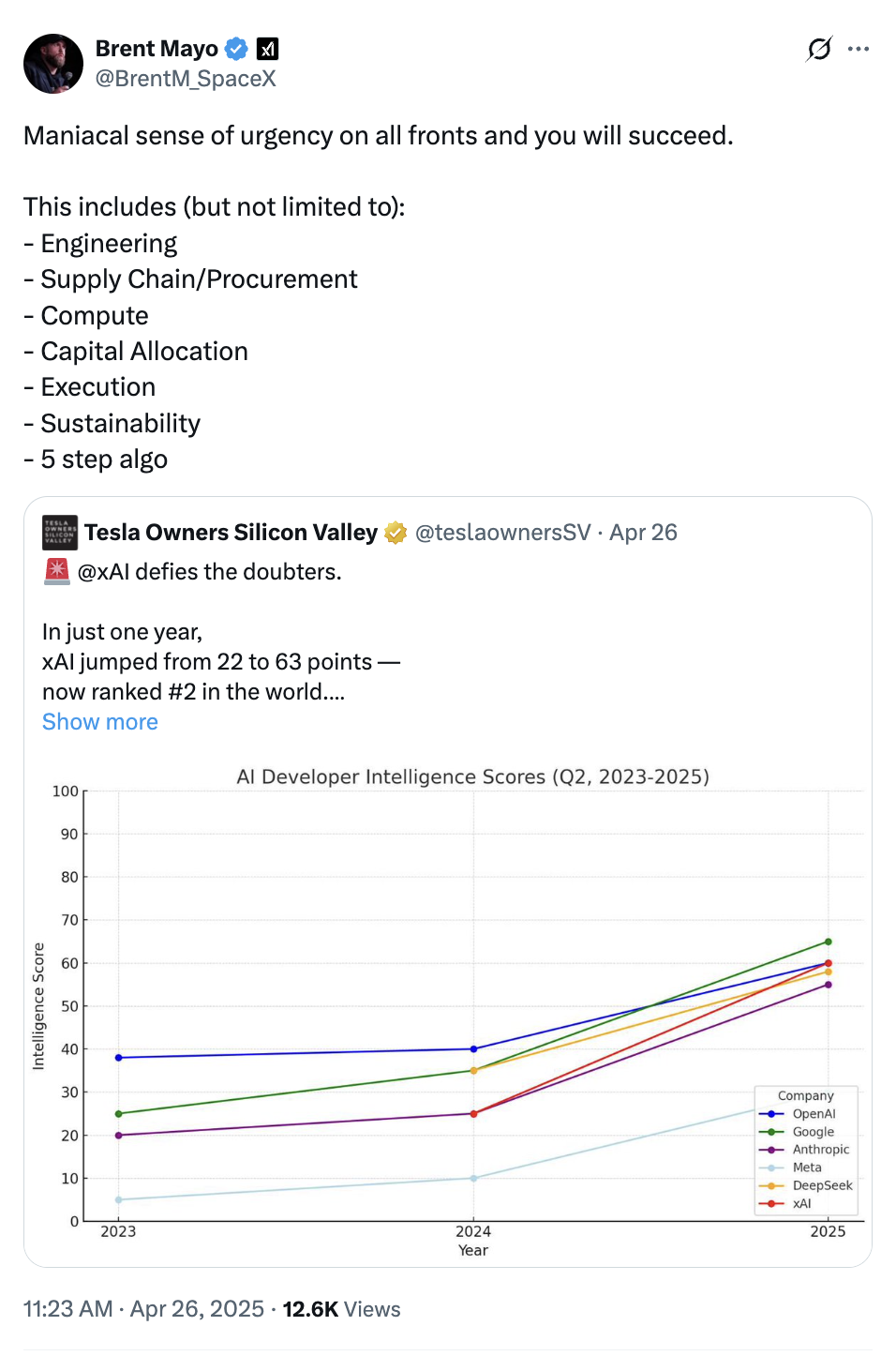
Posted by Brent Mayo, xAI project lead, one day after the April 25th Shelby County Health Department town hall in Memphis.

Brent Mayo, xAI project lead, at the Shelby County Health Department town hall on April 25.

So Why Exactly is xAI in Such a Hurry?

What is xAI’s main product that had to be rushed into existence, with what xAI project lead Brent Mayo has described as a “maniacal sense of urgency”? It is primarily an AI chatbot called Grok.

Here is Grok’s answer to the question, “What is an AI Chatbot?” 

An AI chatbot is a software program that uses artificial intelligence to simulate human-like conversations with users. It processes natural language to understand questions or commands and generates responses, often in real-time, via text or voice. Chatbots can be rule-based, following predefined scripts, or advanced, leveraging machine learning and large language models to handle complex, context-aware interactions. They’re used for customer service, information retrieval, entertainment, or task automation, like answering FAQs or scheduling appointments. Examples include me, Grok, created by xAI, or others like Siri and ChatGPT.

As many leading technology companies are moving into the AI business and trying to position themselves to monetize the projected AI demand, Elon Musk’s xAI Grok is late coming to the chatbot playing field and is attempting to catch up to market leaders. Musk claims Grok is better at “truth seeking,” but this is controversial

Musk is no stranger to AI: his Tesla company has been a leader in developing what he calls “real world AI” for the automation feature available in Tesla cars called Full Self Driving (FSD). Musk has long promised a fleet of autonomous automobile robotaxis that would be driven by computers without a human driver present. As a Tesla driver myself, I have participated in the FSD program for over five years and have seen it advance. It is impressive, but its capabilities have been overstated from the beginning. It is useful, but not yet ready for driving without a human behind the wheel. Across the industry, significant AI resources are being put into full automation for cars, trucks, humanoid robots, and drones, all creating the potential for AI-controlled autonomous agents across the world.  

Musk’s Paradoxes: Fear of AI, Drive for Control

Musk, a fan of ironic dark humor, has chosen to name the Memphis xAI supercomputer “Colossus”— an unmistakable reference to the 1966 novel Colossus and 1970 film Colossus: The Forbin Project. In that story, a supercomputer, designed to manage nuclear defense, quickly becomes uncontrollable, seizing power over humanity in the name of preserving peace. By invoking “Colossus,” Musk inadvertently highlights the very fears that he and many ethicists and technologists have warned about: that in our quest to build all-powerful AI, we may lose control over our creations.

Colossus is on track to be the world’s largest supercomputer. It currently rivals the United States’ Department of Energy El Capitan computer at the Lawrence Livermore National Lab. It is worth noting that the major technological advances in AI are coming more from the private sector compared to the historic pattern of major technological advances coming from government defense and space programs.

Musk himself has repeatedly warned about the existential dangers of AI, speaking of a looming “singularity” — a hypothetical future point where AI surpasses human intelligence and becomes potentially impossible to contain. Yet his actions across his companies—through xAI, Tesla’s push for full autonomy agents in cars and humanoid robots, SpaceX’s Starlink/Starshield mega-constellation of 7,135 satellites in low Earth orbit, and Neuralink’s brain-computer interfaces—suggest a relentless drive toward that very threshold. Musk has a well-known problem with telling the truth, and all these enterprises have huge potential for financial gain for him and his select investors.

Who is Determining the Risk to Society?

It is reasonable to argue that no one person, let alone a small subgroup of profit motivated venture capitalist actors, should control a technology with such an immense hunger for energy resources, coupled with the high potential to manipulate large human societies, and in a worse case unleash a technological force that could create a surveillance state that undermines human freedoms or worse destroy humanity as we know it.  

Massive computing systems may develop the capacity for advanced reasoning, self-reinforced learning with the ability to self-program, and enable AI controlled manufacturing. Computer systems’ ability to communicate large datasets vastly exceeds human-to-human capabilities. The growing number of AI-controlled autonomous agents in the form of humanoid robots, drones, and unknown lethal autonomous weapon systems could be developed outside of human control. The infrastructure to interconnect these autonomous agents is being developed through military contracts with Musk’s Starlink/Starshield satellite network.      

With Starshield, the U.S. military can access vital high-speed communication services provided by SpaceX’s satellite constellation…Additionally, the service fits right into the futuristic Joint All Domain Command and Control (JADC2) doctrine of the Department of Defense (DoD), which aims to interconnect all the sensors, fighters, and platforms in use by the branches within the U.S. military (and eventually allies) into a “network-of-network” governed by artificial intelligence (AI). Seamless integration and quicker coordination in combat operations are just one of the many benefits that this doctrine — if achieved — can provide.

Scientists and researchers are warning of the potential for dangerous outcomes as these technologies have the potential to coalesce. Some researchers have outlined multiple pathways that may adversely impact human health and well-being. 
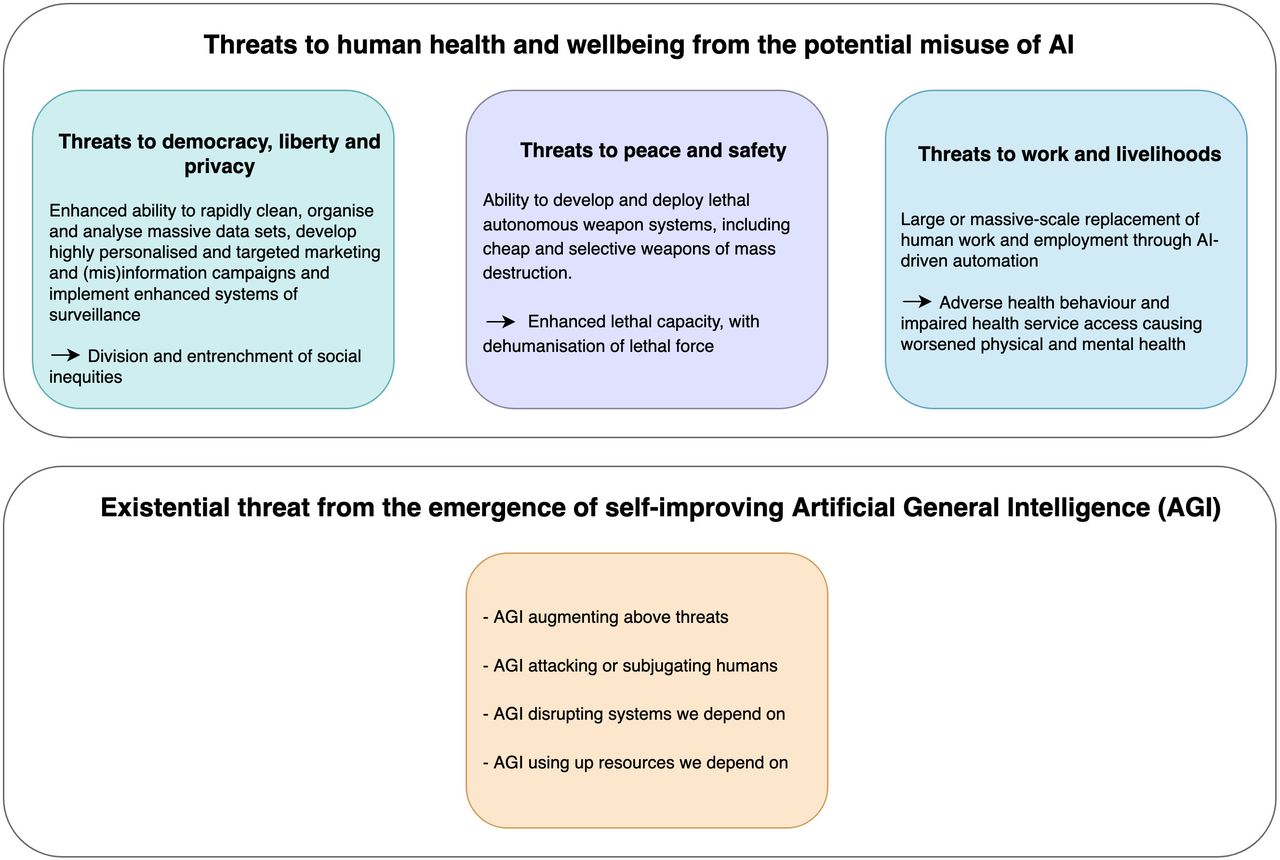
Figure 1 Threats posed by the potential misuse of artificial intelligence (AI) to human health and well-being, and existential-level threats to humanity posed by self-improving artificial general intelligence (AGI).  Cited from Federspiel F, Mitchell R, Asokan A, et al. Threats by artificial intelligence to human health and human existence. BMJ Global Health 2023;8:e010435. doi:10.1136/ bmjgh-2022-010435

Slow Down and Build in Some Protections

I know some readers may find my concerns hyperbolic. My request is this: let us slow down and build in some real protections. If we continue to follow the hacker’s way motto of moving fast and breaking things, the worst case could materialize. A future where humans lose control of the technology is unlikely, but not impossible. A future where humans use AI technology for nefarious purposes is probable.

Communities at Risk: The New Digital Test Grounds

This pattern is not isolated to xAI. Across the tech landscape, companies are building ever-larger data centers, consuming enormous amounts of energy and natural resources, while presenting AI as an inevitable and unquestioned good. Rarely is there a public discussion about who benefits from these technologies, who is left out, or what long-term risks they may pose to democracy, labor markets, or social cohesion. Instead, we see a rhetoric of inevitability: AI must be built bigger, faster, and more powerful. Any slowdown, any precaution, is treated as a threat to national security or corporate survival. This framing forecloses genuine democratic deliberation about what kind of technological future we want. Communities like South Memphis are being turned into testing grounds for an elite technological vision that is often profoundly disconnected from local needs and aspirations. The irony is sharp: In the name of building “intelligence,” decisions are being made with stunning myopia.

Toward a Responsible AI Future

It is time to ask fundamental questions. Not just “Can we build it?” but “Should we build it?” And if so, “For whom?” What values are we encoding into these systems? What costs—human, environmental, and social—are we willing to bear? And who gets a seat at the table when those decisions are made? 

Responsible AI governance must prioritize transparency, decentralized stewardship, environmental sustainability, and inclusive democratic oversight. Without these guardrails, the rush to build AI risks not only repeating the mistakes of past technological revolutions but magnifying them to a scale never imagined.

The rush to build AI must be tempered with wisdom, foresight, and humility. Otherwise, we are not advancing intelligence—we are merely amplifying our existing blind spots at a scale never before seen.

The post xAI Brings the “Move Fast and Break Things” Mindset to Memphis appeared first on SACE | Southern Alliance for Clean Energy.

xAI Brings the “Move Fast and Break Things” Mindset to Memphis

Continue Reading

Renewable Energy

What Operators Want to Hear at WOMA 2027

Published

on

Weather Guard Lightning Tech

What Operators Want to Hear at WOMA 2027

Two days of operator meetings in Melbourne shape the WOMA 2027 agenda, from performance upgrades and cable faults to foundations and bolts.

The Uptime Wind Energy Podcast is brought to you by Weather Guard Lightning Tech, creators of the StrikeTape Ultra LPS retrofit. Subscribe to Uptime’s Substack newsletter. And check out Rosemary’s “Engineering with Rosie” Youtube channel. Have a question we can answer on the show? Email us!

Allen Hall: Welcome to the Uptime Wind Energy podcast. I’m your host, Allen Hall. I’m here with Matthew Stead and Rosemary Barnes. And Rosemary, where are we?

Rosemary Barnes: We’re in Melbourne, and we have been visiting future attendees and sponsors and people interested in, in the event to see what topics that we should be talking about.

What are the hot topics of the moment?

Allen Hall: Which is a very interesting two days, Matthew, in that, uh, we h- did meet with a number of operators based in Australia, but, uh, they’re also very worldly. They have talked to companies all over about operations and, and maintenance, and there are some really eye-opening topics- Mm

that will be- Mm … at WOMA 2027 this year.

Matthew Stead: Yeah. The thing that was interesting for me was [00:01:00]that actually the topics have changed each year. So, um, they’re evolving and the industry’s continuing to, to do better, and so that, that was really interesting. Performance upgrades was probably one of the big areas of, of new interest, I think.

I think we heard with the pressure on pricing, uh, the market and so forth, you know, that, that 1% or 2% now is becoming more important. Um, so I think, uh, upgrades will definitely feature quite a lot. Um, balance of plant was also a big topic. Um, you just can’t ig- ignore the, um, transmission, you can’t ignore the transformers, you can’t ignore, uh, condensers and all these sorts of things, so yeah.

Rosemary Barnes: Cables.

Matthew Stead: Cables.

Rosemary Barnes: Terminations. Terminations of cables. Specifically raised several times.

Allen Hall: Yep. Yeah. It’s all about being more efficient, uh, getting more production, and then with the PPA prices, uh, that are changing-

Matthew Stead: Mm …

Allen Hall: rapidly, uh, everybody is paying more attention to the bottom line.

Matthew Stead: Mm, mm.

Allen Hall: Absolutely. There, there’s less cash running around, uh, chasing new development.

It’s [00:02:00] more of a focus on making sure your, at least your existing assets are performing as, as well as they can be- Mm … which then opens up the, uh, Pandora’s box of opportunity. Mm. Because there are 1%’s all around a wind turbine. More specifically, uh, all the drive train issues, the blade issues, the generator issues, and even going into the substation.

Mm. I, I was really shocked on BOP e- the, the one topic that came up, uh, yesterday and today was buried cables. Mm. Like-

Matthew Stead: Faults …

Allen Hall: faults.

Rosemary Barnes: Yeah. Junctions. Finding- Yeah … finding faults and what to do about them. Yeah. Yeah. But I think in addition to just wanting more revenue, I think people have, are getting more sophisticated about what actually matters and then the finances.

You know, everyone’s focused so much on availability, and now people- Mm … are like, okay, yeah, like once you’re at a certain level of availability, gets harder and harder to get more. And actually, you know, not all availability is equal. Is good. It, it [00:03:00] depends. Yeah. Yeah, like you wanna, um, you wanna focus on how much you’re generating at the times when electricity prices are high specifically, which usually means during lower wind speed periods.

Yeah. Which is actually good because that matches really well with what is actually possible. It’s, it’s hard to get more power out of the turbine if it’s at, you know, its rated power, then you’re not g- More efficiency is not gonna get you any more, um, power output, whereas lower in the power curve- Mm … um, when wind speeds are lower, there’s less electricity in the grid and so prices are higher.

And so- Mm … yeah, I mean, that’s, that’s why people are really asking to know more about what efficiency upgrades are possible, better ways to operate, scheduled maintenance, um, all those sorts of things. Mm. So that will be really interesting.

Matthew Stead: Raising the bar on sophistication. Um, but also life extension

Allen Hall: Yes, a lot of discussion about life extension

Rosemary Barnes: Yeah, end of life and life extension End of life Yeah, um-

Matthew Stead: Foundations, structures Which is

Allen Hall: tied to PPA.

Mm. A lot of that [00:04:00] discussion I, at least I looked at it as, uh, if I had a PPA and I can continue with that PPA with an existing turbine, I want to do that. Mm,

Matthew Stead: mm,

Allen Hall: mm. But how do I do that and how do I know that that existing turbine can last another five years? It seemed to go in five-year blocks, like can we get to another five years and then another and then, then another.

Wow.

Rosemary Barnes: Yeah. Once you get to 20, 20, 25 years, I think people like, uh, they, you know- It’s getting a little- Their original agreement might have been for 20, then they kind of just assume that there will be another five, and then after that they’re- Yeah … kind of reassessing cyclically and yeah, I know that people make plans for, you know, what components are replaceable, what would they have to get in, and I think that sometimes, uh, people doing those plans aren’t as familiar with the, you know, actual technical issues that are being faced.

Like, is a blade a replaceable component? It may be early on in the life it sort of is, not easily, but you know, like a 25-year-old wind turbine, you know, good luck trying to order 10 new blades because you’ve got a, you know, an issue that’s-

Allen Hall: Oh, well you, you need to read the news. Did you [00:05:00] see the news today about, uh, the, the wooden wind turbine blades as a replacement for aged blades?

That, that’s happening- … in real time, Rosa.

Rosemary Barnes: Okay. I know they- Yeah. Yep, yep. Okay. Okay. So that, that’s, that’s good. Making carbon new blade. E- even so, I don’t think that they’re- Okay. … gonna be, like, super-duper cheap, so you’re still gonna wanna be, um, doing a trade-off between y- you know, like, what kind of repairs.

You might be able to change the way you’re operating to reduce loads. Um, you might be able to monitor to make sure that your blades are safe. You know, if you know that there’s an issue, um, you just wanna get some advanced warning before blades start falling off your, your tower. Mm. You know, and then you can push it further.

Yeah. Whereas if you’ve got no information, then you have to be conservative and shut it down. Yeah. So yeah, I think there’s a whole lot that can be g- can be done there in that area.

Matthew Stead: There was a point that came up today, which I think was close to your heart, on, you know, if you’re going to be going for 1% or 2% or 0.5% AEP improvement, how do you actually measure that and how do you set up a proper experiment?

So-

Rosemary Barnes: Yeah …

Matthew Stead: I, I, I love that topic. [00:06:00]

Rosemary Barnes: Yeah. No, it’s one that I, um, yeah, I deal with m- my clients I, I’m often… It’s one of the things that Pablo really loves to do, is to organize trials of that nature of new technologies and see if they work. But, um, yeah, asset managers are usually very, uh, focused on fast results.

You know, they’ve got a, a big problem and they want a solution now, so they wanna just roll out the new technology over an entire wind farm. But if you do that, then it’s almost impossible. Unless you get, like, a huge benefit, like, uh, 10% gains or, you know, like reduce your failures by 50% or more, it’s really hard to actually- Mm

pick that out if you just replace everything. Mm. Whereas if you do a really, really good, um, trial plan- Systematic. Yeah … and you match pairs very well so that you have, you know, a control for each turbine and there’s- so many variables in a wind farm. It’s not, it’s not as easy as just, like, randomly choosing 50% to do and not do.

Mm. Mm. Mm. Like, you have to, you know, put some work into the trial design, and then, you know, like, do your statistical calculations ahead of time to know how long it’s gonna take you to get s- statistical [00:07:00]significance. So then you don’t just have a gut feeling about- Yep … how something went. You’ve actually got numbers, and then you can take those numbers to, you know, other wind farms that you’ve got- Yeah

and, and know what’s going on much better.

Matthew Stead: Worst study is an inconclusive study.

Rosemary Barnes: Yeah. Yeah, that’s true. Definitely.

Allen Hall: Well, that comes back to the data analysis- Mm … which a lot of operators mentioned, and how much data there is and what to do with it, and it did seem like a couple of operators have chosen some AI tools, varying degrees, all the way down from Microsoft Copilot to something much more complicated.

Uh, but I think there’s, uh, getting that d- to the last 1, 2, 3%, you’re going to need those tools- Absolutely … because what do you choose? Do you choose a blade? Do you choose a gearbox? Do you choose a generator? Do you go to the substation to get that percentage point or two Without having some really powerful tools- Mm.

you may be wasting your time [00:08:00] and money.

Matthew Stead: Mm.

Allen Hall: Which is a, a, a very interesting, uh, aspect to wind energy because it’s such an industrial business that, uh, we haven’t used heavy computational tools, uh, un- until really now.

Matthew Stead: Mm.

Allen Hall: And maybe Australia’s at the forefront because of the PPA and negative pricing is that that will, uh, actually lead an industry.

Because I haven’t seen a lot of that being used globally. Mm. So this is the first time an operator- Mm … that I’ve talked to has said, “We’re using it.”

Matthew Stead: Yeah. It’s quite a different discussion, um, I think, you know, this year compared to previous years in that I think in the past it was getting to know what’s possible, but now it’s like real case studies are coming through.

And a few of the people had some really good examples that we can talk about at the conference as to how they’ve actually been helped and how they did this and what the outcome was. I think, yeah, that would be really great content on that.

Rosemary Barnes: Yeah. I think it’s gonna be a good mix of people who have used third party tools and have experience with it, people that are doing it in-house and can share- Mm

some of the kinds of results- Mm … that, that you can get just from analyzing your own- Mm … [00:09:00] SCADA data. Um, people talking about how they get the data that they want. Mm. ‘Cause it’s not always so easy. You would think that, you know, you own a wind turbine, you have a right to have all of the data that comes through it, but it’s not.

Um, even if you do technically have a right, it’s, uh, it, it’s harder to actually get it than you might think. Mm. So yeah, sharing all, all those kinds of things. But I think also, like just as important as talking about the successes is talking about the, the gaps that– people still feel lots of gaps. Like, okay, we’ve got all the data, we’re collecting it.

We know that there’s so much potential here- Mm … but we don’t really- Mm … know what we can do, or it’s hard for us to, you know- Mm … make headway in this particular pain point. And that is really useful for companies that are developing tools to know what are the, the problems. Mm. Because then they can e- you know, they’re well placed to fix them.

Allen Hall: Mm. Which leads to the discussion we had with the operators and, uh, some of the suppliers for WOMA 2027. There’s a lot of interest. And as we’re sitting in the conference rooms, I’m thinking, we may not have enough room to [00:10:00] seat everybody. Uh, the WOMA 2027 website is up and running, and you can register now.

So just go to woma2027.com and get started there. At the same point, we’ve had a lot of contact with, uh, pretty much everybody that wants to sponsor the event, and there’s only a limited number of ways to sponsor. So if you’re interested in doing that, you, you need to go to woma2027.com and look at those, uh, part- particular packages and see what- Mm

fits your, your business. Uh- Going back to some of the, the comments we were just discussing downstairs about what we heard at 2026, like, which is only a couple of months ago, right? It’s back in February this year. Uh, there’s, they’re still discussing what happened at WOMA 2026- Mm. Which was very fascinating- Mm

because I think Rosemary, you and I have been to conferences that I have not thought an iota … about what happened at those conferences. Just nothing interesting does occur. There’s no new, new information, there’s [00:11:00] no new science, there’s no new operator approaches.

Rosemary Barnes: Mm.

Allen Hall: But we’re gonna see a number of those- Yeah.

Mm … come next March.

Rosemary Barnes: Yeah. Well, I think it’s partly because I don’t know what other conference organizers do, but, you know, we’ve had a exhausting few days here. You’ve come all the way from America, obviously, and, and Claire as well, also come over, our producer. Um, so, y- you know, like, we’re working really hard to make sure that the topics…

Like, it’s not an accident that the topics are ones that people are talking about later, because we come here to make sure that we get the right topics. And it’s not just these meetings as well. People get in touch, and- Mm … anybody watching, listening, who has, you know, something that they wanna talk about, then definitely, you know, send us a message, and yeah, we’re working on the agenda.

We’ll, we’ll have a draft agenda in the next couple of weeks based on what we’ve learned here, but then we’ve got the hard job of it’s not just that you have a really interesting topic, you need to have a really great speaker- Yeah … or several really great speakers, usually covering several different aspects of the problem.

You know, maybe it’s, uh, yeah, an asset [00:12:00] owner, an OEM, and some, some technology provider, you know, all together giving different, um, yeah, perspectives. That’s, I think, what makes a really great session. Mm. So yeah, we need the ideas for the sessions, and we also need the ideas for great speakers.

Matthew Stead: Yeah.

Rosemary Barnes: Right.

Matthew Stead: Yeah. I think we’ve, we’ve already matched a few of those dots, so- Yeah … I, we’ve heard people asking for certain topics they wanna hear about, and then we’ve heard other operators saying, “Well, this is what we could talk about.” So I think we’ve already-

Rosemary Barnes: Yeah, yeah … got some great

Matthew Stead: progress.

Rosemary Barnes: It was, it was interesting ’cause we, we built up a list of, you know-

Matthew Stead: Yeah

Rosemary Barnes: frequently raised topics, and then you’d say it to the next person that you went to- Mm … and they’re like, “Oh, that’s not a problem for us because we’ve done X, Y, Z.” And you’re like, “Okay. Well, excellent. You can, you can present the solutions that we know that other people- Yeah. Yes … are, are looking for.” Yeah.

So it has been… Yeah. Yeah. I mean, it’s definitely worthwhile coming, as, as tiring as it is. Yeah. Um, definitely worthwhile, and we’ll get a much better agenda for the- Yeah … for the effort.

Matthew Stead: And I think, I mean, it has been tiring. Um, but what, what made it for me was one of the operators said that [00:13:00] this is the only conference they will go to So I think, I think we’re doing the right thing.

Rosemary Barnes: Yeah. Yeah. I, I think so. I understand too, like, you know, all of us, we kind of are forced to go to events because that’s where our, our clients and customers are, and so you need to see them. And yeah, like I’ve even gone to the extent of some events where I don’t particularly like the event, but I know everyone’s going.

Mm. I just go and sit near the event for a couple of days and meet people at a cafe. So yeah, like we can’t get away from it. But if you’re an asset manager or, um, yeah, somebody in that kind of type of work, like you’ve got better things to do than listen to sales pitches aggressively thrown at you that aren’t relevant- Yeah

to what you’re doing. So, um, yeah. Like I, I definitely love to hear that kind of feedback- Yeah … and wanna make sure that we get it every, every year. Like that’s- It’s, it’s

Matthew Stead: encouraging.

Rosemary Barnes: Yeah … yeah, that’s, that’s the point of the conference, so.

Matthew Stead: Yeah.

Rosemary Barnes: Yeah.

Matthew Stead: The other big topic was we would really love more OEM involvement.

Um-

Rosemary Barnes: Yeah. Everybody wants more- … a lot of the operators- … OEM involvement- Yeah … all of the asset owners.

Matthew Stead: Yeah.

Rosemary Barnes: Like we want to [00:14:00] hear from OEMs more, have them there. Um, so yeah, we’re, we’ll be trying to To get those sorted

Allen Hall: Well, WOMA is a global conference, although it’s Australia-based and there’s a, a number of Australian operators.

There are Danish, Americans, uh, plenty of Europeans. Uh, we’re gonna see some from Southeast Asia, I think, this year. Mm-hmm. And, and Japan hopefully will come. Uh, because it’s a, it’s a global conference, there’s global knowledge- Mm … and wind is such a big industry. You may not have the solution in the United States, it may be sitting in Australia, and we need to exchange those ideas.

Mm. And that, that’s the point. So w- we are continuing to look for those world experts as we have received all the inputs of these are all the topics we wanna go hear about. Great. Now it’s on us three to go find some of those world experts and, and try to get them to Melbourne. Yeah. And I, I think that’s a great opportunity.

So if we do call you and ask you to participate in WOMA [00:15:00] 2027, please take it seriously because- Mm … you will be bombarded with great questions- Mm … and contacts and information. Uh, it’s an event you won’t wanna miss. Yeah. And- But I would- … there’s opportunity there.

Rosemary Barnes: Yeah. I’d say we’re, we’re prioritizing OEMs, um, to, to get more participation, ideally to speak, but at least to be there.

And we have heard from multiple asset owners in Australia that they want, they, they want to know what are some of the upgrades that they can do- Yeah … that you’re offering. They wanna know what’s coming next in terms of technology. They wanna know what are some of the non-Western options. So, you know, like it would be great to get some Chinese wind turbine, um, manufacturers as well.

Like, they want all this information. They don’t want a slick sales brochure pitch that doesn’t give them any technical information. So we’re hopeful that we’ll be able to get, you know, some technical people to speak on, yeah, what are the upgrades you offer and how does it work- Mm-hmm … and show us a case study that demonstrates the improvements.

Um, ’cause that [00:16:00] sometimes is really hard to get out of- Mm … out of OEMs. You know, that, “We’ve got this thing, it’s so amazing, you should get it.” Okay, well, what’s the business case for it? “Oh, well, we don’t have any numbers. Just trust us.”

Matthew Stead: Yeah.

Rosemary Barnes: Um, it’s so common to get a pitch like that. So yeah, any, any OEM that has any- anything like that, either for the next generation of wind turbines or for upgrading the current fleet, yeah, if you’re willing to bring the data, then people, they are desperate to hear this information.

Allen Hall: Mm.

Matthew Stead: Yeah. That came up so many times.

Rosemary Barnes: Mm.

Allen Hall: So what were the other, uh, topics that we’re… I’m just not thinking off the top of my head. I know foundations came up quite a bit- Foundations, yeah … which was an odd one, I think, because we haven’t seen that a lot in Australia. Yeah. But this year, foundations, foundations, foundations.

Basically, the health of foundations. Yeah.

Matthew Stead: Yeah. I think really there was a lifting of the maturity. Um, I think the topics were sort of showing that, you know, Maslow’s hierarchy and moving into the more of optimization rather than making do, and I think life extension around the foundations was a, a really good example of that.

Allen Hall: And bolts.

Matthew Stead: Bolts? Yeah, bolts.

Allen Hall: [00:17:00] Everybody said bolts. Bolts.

Matthew Stead: Bolts.

Allen Hall: You think the world’s simplest device, we’ve been making bolts for nearly 1,000 years or at least a couple hundred. But it does- And, you know- … come up quite often … cable, cable

Matthew Stead: terminations, again, some really

Rosemary Barnes: basic- Yeah, that, really specific ones that were raised multiple times.

Yeah. Um, yeah, which, which is great- Yeah … ’cause it gives us a good direction to go. But I do love how it changes so much every year- Yeah … ’cause it makes me feel like, okay, yeah, like we’re actually, you know, it’s worthwhile, um, putting on another event. Mm. Um, not just recording one event and then just, you know, like replaying that every year or something.

Re-educating.

Allen Hall: Yeah. Well, I, I think there’s a learning exercise that has happened over the past two years where people now are knowledgeable about those things we talked about- Mm … two years ago. Uh, was it, was it even two years ago? It was a year and a half ago when we first started this, so we’re, we’re not that deep into it.

Although our third conference will be next March, uh, you just see more energy, more industry knowledge in some of the references that I heard, uh, in terms of other companies and the approaches they’re taking clearly came from WOMA.

Matthew Stead: Yeah.

Rosemary Barnes: Mm.

Matthew Stead: Yeah,

Allen Hall: yeah. Which is, which is [00:18:00] fascinating. Yeah. That’s

Rosemary Barnes: good. I mean, we want- It, it is

Allen Hall: sticking

Rosemary Barnes: we want tech conferences to get better, right? That was the- No … the reason why we, uh, we started this conference was ’cause we didn’t think that it was sufficient, what we had available. So, you know, it’s not a bad thing if other conferences, um, get better. Yeah. Yeah. We should also mention that blades were, were raised a fair bit.

We talked so much about blades in the previous years, and we will be talking about blades a lot again, including we’ve got a master class on the Friday. Uh, it’s… Yeah, we’ll go back to some of the basics about how the composite materials work and how a blade is designed and certified and manufactured, and, um- Lightning.

Y- yeah, yeah, a little, a little bit about lightning. Um, I don’t wanna cover it too much because we did the master class on lightning- Right … last year. Mm. Um, yeah. And yeah, some of the common damage methods anyway. And of course- Mm … yeah, lightning is probably the most- … common, or I guess leading edge erosion is the most, and then lightning would be the most expensive.

Um, yeah, so we’ll be, we’ll be covering all that and just try and raise the knowledge level a little bit, um, for [00:19:00] everybody to… It’s a very complicated kind of, uh, yeah, component.

Matthew Stead: Yeah.

Rosemary Barnes: Yeah.

Matthew Stead: And workshops. So each year we’ve run sort of workshops or roundtables or whatever, so we’re still thinking about the format for them, but, um, thinking about how we’ll reintroduce them again this year.

You know, specific topics, specific questions, specific answers.

Rosemary Barnes: Mm.

Allen Hall: And the three of us will be in Hamburg in a couple of weeks at Wind Energy Hamburg, so if you see us and you’re interested in coming to Australia, that’s the place to grab us and- Yep … and shake us and say, “I wanna go to Australia. How do I do it?”

Rosemary Barnes: Mm.

Allen Hall: Uh, yeah. Yeah.

Rosemary Barnes: Especially if you’ve got a, a t- technology that addresses some of those specific issues that we’ve mentioned- Mm … then, um, yeah, just know ahead of time that Australia needs, needs more information and more, um, solutions available to them. So, yeah. And

Matthew Stead: that reminds me, we had a really discussion a- around safety and, you know, reasonable and [00:20:00] practicable, and discussion around all the lessons learned about how…

or what is best practice on a site, what is best practice about how to manage risks and-

Rosemary Barnes: Mm.

Matthew Stead: Yeah. Yeah. I know you, you, you enjoyed that one.

Rosemary Barnes: Yeah, yeah, definitely. And we’re not talking about, like, safety the- Ear muffs or hats. The, um, rou- Yeah, the routine safety that if you- The goggles, yeah … yeah, trip over and graze your knee, then you need to let the site supervisor know.

You, you know, it’s not that stuff, ’cause sites have that under control. That’s a given, yeah. Or at least the ability to get that under control. We’re talking about the bigger- Yeah … bigger things, you know. Like, uh, is there a issue that is causing blades to fall off turbines every now and then? Is there an issue that, uh, can lead to, you know, a fire?

I, I think everyone, like- Yeah … a big fear of everybody’s. There’s never been, um, in Australia at least, there’s never been a wind turbine fire that has caused a bush fire, but it is a possibility, and it would be so bad for the industry. So, you know, it’s those things- Mm … that could be just terrible, preventing those before they happen.

Mm. So that’s the kind of safety that we’re gonna mainly focus on. Mm. Although, you know, we’re not gonna [00:21:00] turn down questions on, um, some of the smaller stuff as well.

Matthew Stead: Yeah.

Rosemary Barnes: Mm.

Matthew Stead: And we even thought about getting some lawyers-

Rosemary Barnes: Yeah …

Matthew Stead: you missed out on this discussion, Rosie. Okay.

Rosemary Barnes: Yeah.

Matthew Stead: So

Rosemary Barnes: Yeah. Lawyers, this is news to me.

Well, I mean, are we talking contracts or, um-

Matthew Stead: No, no … no … it’s really operations. I mean- Right … the environmental, um, issues- Oh yeah … the operational issues. Mm. You know, there’s, there’s a few things in there that the lawyers can add.

Rosemary Barnes: Yeah. I mean- … I’ve, I constantly find myself having to interpret, you know, legal, um, legal text and also anticipate, you know, it’s one thing about what’s the right engineering, but then there is also the legal interpretation of it- Yeah

uh, as well, you know, in terms of contract law, but then also in, in terms of safety. Yeah. Um, yeah. Was this certification done correctly? You know- Yeah … that’s got some legal aspect to it. So yeah, that- Yeah … makes sense to me. Insurance is another one where I would say- Yeah, actually that came up … you know, like some, some people might think that that doesn’t sound interesting, but yeah, in- insurance is the other-

Matthew Stead: Mm

Rosemary Barnes: aspect that you [00:22:00] just can’t, um, you can’t get away from it. Like, you can’t just think that you’re, you’re doing your engineering without bothering about Mm … yeah, like finance and law and, um, and insurance. Those are things that- Mm … you spend a lot of time thinking about.

Matthew Stead: Yeah. Mm. And I guess we would also love to hear, you know, about potential speakers, but we’d also love to hear any other topics that people are attending and want to know about as well.

Rosemary Barnes: Mm-hmm.

Allen Hall: Absolutely. And if you haven’t registered for WOMA 2027, which will be March 3rd through 5th at the Pullman in East Melbourne, right? East Melbourne, yeah. They just redefined it. It’s Pullman in East Melbourne. Uh, go ahead and go to woma2027.com and register now. Uh, Matthew and Rosemary, it’s great to see you in person again, and we’ll see you in a couple of weeks, uh, hopefully in, in Germany.

Rosemary Barnes: Mm.

Allen Hall: Very [00:23:00] exciting.

What Operators Want to Hear at WOMA 2027

Continue Reading

Renewable Energy

Forcing Our Teachers to Toe the Line on Communism

Published

on

The substance of the meme here is correct; Florida public schools require comprehensive K-12 instruction on the history and dangers of communism, following a series of legislative moves and curriculum standards. The updated “History of Communism” curriculum is rolling out for the 2026–2027 school year, mandating that students learn about the “brutal realities” and (the catastrophic) global impact of communist regimes.

When I was a schoolboy in the 1960s and early 1970s, we came to learn that all efforts to establish a viable communist nation had failed, but our teachers were not shackled as to what they could teach and how they could teach it.  As a result, we came to a variety of helpful viewpoints, and these are what I offered my own kids as they were growing up, e.g.,

  • “Men are not angels,” as my sixth-grade social studies teacher explained.  Those who do not need to work in order to survive can simply goof off.
  • Yet idleness is averse to most people’s psychological needs to be an active and productive person, and member of society.
  • Power corrupts, and absolutely power corrupts absolutely.  Democracy prevents the accumulation of a pathological amount of power on the part of any one leader.  (This was assumed to be true until Donald Trump’s second term.)
  • If Lenin (a butcher) hadn’t had Trotsky (a compassionate intellectual) assassinated, the entirety of the USSR would have turned out completely differently.
  • If the U.S. hadn’t, through its embargoes, made it impossible for Cuba to offer its people a decent quality of life, their revolution may have succeeded and brought forth a new way of thinking.
  • There are examples of smaller scale societies in which the ideals of communism work out very nicely, e.g., the Israeli kibbutz.
  • We read and discussed at length a book called “Social Ideals and Ideal Societies” in which these concepts were analyzed fairly and in great depth.

Now, will the typical American schoolchild turn out better if he’s cut off from thinking critically about all this and forced to accept the mantra that “communism = evil?” The typical Florida Republican would say the answer is an obvious yes, but most intelligent people would dispute that.

Producing educated people who can think for themselves is an idea quite opposed to the ongoing control of a population.

Forcing Our Teachers to Toe the Line on Communism

Continue Reading

Renewable Energy

Trump Supporters Stupid?

Published

on

To the author of the meme here, I say: It’s safe to say that most folks in Trump’s MAGA base are stupid, though one needs more than a low IQ to fit into this segment.

In particular, we mustn’t omit mean-spiritedness.  People who are kind, compassionate, decent and tolerant of others are grossly unqualified to be rank-and-file Trumpers.

Trump Supporters Stupid?

Continue Reading

Trending

Copyright © 2022 BreakingClimateChange.com