

This July, we marked a milestone, Climate Generation’s 20th annual Summer Institute! For two decades, this cornerstone event of the Teach Climate Network (TCN) has brought educators together to share teaching tips, instructional resources, and build community.
Each year, the TCN Cohort Coalition and participants of the Summer Institute help shape the TCN offerings by identifying what teachers need most. In 2025, needs are changing quickly. With the Trump Administration back in the White House, shifts at the Department of Education, and a steady stream of discouraging climate headlines, uncertainty is high. But one thing remains steady: educators’ commitment to their students and to teaching climate change with honesty and hope.
That’s why this year we are taking a fresh approach to reground in how we center the realities educators face and help them build resilience in the classroom and beyond. Here are five key lessons we’re carrying forward from the Summer Institute into another year TCN programming:
- Strengthen relationships, especially local ones
If there’s one thing we know, it’s that we thrive on connection. Over 80% of Institute attendees said they loved building local connections and wanted to stay connected with their cohort leaders.
Why does this matter? Because climate change isn’t a faraway problem and it shows up differently in every community. What flooding looks like in Vermont isn’t the same as wildfire smoke in California or heat waves in Phoenix. When educators build local connections, they’re better equipped to ground climate lessons in the realities their students see and feel around them. These place-based connections help make climate change less abstract and more personally relevant, sparking deeper student engagement.
Local networks also act as support systems for educators themselves. Teaching climate change can feel isolating or even politically charged. But when teachers connect with others in their district, county, or region, they gain confidence, share strategies, and learn how to navigate challenges together. These relationships don’t just strengthen individual classrooms, they strengthen entire communities.
As one Summer Institute participant put it:
“Being part of a group with shared interests was refreshing. Despite being in different regions, we faced many of the same challenges. It helped me see the power of collective learning and the importance of localized solutions within a global issue.”
Climate Generation will keep nurturing these connections throughout the year, because when educators feel supported by one another, they’re more empowered to bring climate education to their students in impactful ways.
- Pair accurate information with actionable tools
In a time when reliable climate information can disappear from websites overnight, educators need trusted sources they can count on. But here’s the thing: resources alone are not enough. Teachers also need support and time to translate information into age-appropriate, standards-aligned lessons that resonate with their students. When educators have both reliable information and support for embedding it into their classrooms, they can shift from simply delivering content to equipping students with tools for understanding, critical thinking, and meaningful action. That’s why the Teach Climate Network provides practical examples, activities and curriculum, ready-to-use strategies offered in 1:1 coaching, and workshop time.
The Teach Climate Network remains a go-to hub for both accurate content and instructional strategies. And we’ll continue sharing resources, lesson guides, and professional development opportunities from our partners because we know building from what already exists is how we can best move forward together.

- Use multiple entry points to make climate approachable
Yes, science matters. But teaching climate change isn’t only about graphs and greenhouse gases. It’s also about art, storytelling, history, civic engagement, and student empowerment. By weaving climate topics into subjects students love and are already learning, educators can make learning both accessible and inspiring.
Why does this matter? Because not every teacher or student connects with climate change through the same lens. For some, data spark curiosity. For others, exploring climate themes through a novel, a piece of art, or a local history project creates the “aha” moment. Having multiple entry points makes it easier for educators to integrate climate content into their existing curriculum without feeling like it’s one more thing to teach. It also helps students connect climate issues to their personal interests, which deepens learning, strengthens retention, and encourages students to imagine how climate can be woven into their anything they do. When climate education is relevant to a student’s life, they’re more likely to remember it and more likely to act on it.
As one Summer Institute attendee shared:
“I came in focused mainly on the science, but I now see the value of a broader, more inclusive approach — one that connects climate issues to equity, local communities, and student empowerment. This experience reshaped how I think about teaching climate change.”
This year, the TCN will highlight teaching pathways that span disciplines, science, english language arts, social studies, health, and more, so educators can find entry points that feel engaging and tailored to their classrooms. By broadening how we approach climate change, we give teachers the tools to feel confident and students the opportunity to connect meaningfully with the most important issue of our time.
- Recognize that every classroom is different, and that means every teacher’s needs are different
Teaching climate change in the U.S. is a patchwork. Some districts fully embrace it, others barely mention it. While 44 states, representing 71% of U.S. students, have science standards that include climate change, the how it’s taught varies widely. In some places, climate shows up as a single unit in science; in others, it’s integrated across disciplines; and in many classrooms, it’s still left out entirely.
Because of this, teachers’ needs differ dramatically. Some are searching for ready-to-use lesson plans that fit into a tightly scripted curriculum. Others are looking for strategies to navigate political pushback in their communities. Still others want to connect climate content with student well-being, resilience, or social justice. In short, the way climate change is taught shapes what support teachers need most.That’s why Climate Generation remains committed to being needs-based in our work. We’ll keep a pulse on what’s happening in classrooms by staying connected with Teach Climate Network members throughout the year. That way, our resources and professional development remain grounded in the real challenges and opportunities that educators face every day.

- Offer flexible ways to engage
Let’s be real; life happens. This year, 20% of registrants couldn’t attend the Institute after signing up. Schedule changes, strikes, job loss, burnout; sometimes it’s just too much. We get it.
That’s exactly why flexibility matters. Teaching climate change isn’t just another item on an already packed to-do list, it’s something educators want to do well, but it can feel overwhelming without the right kind of support. Some teachers are just starting their journey and need quick, approachable entry points. Others are ready to dive deep into interdisciplinary curriculum or community projects. And many fall somewhere in between.
Providing multiple pathways helps ensure that every educator, no matter their time, experience level, or teaching context, can find a way to build confidence and capacity. Short online workshops give teachers fast tools they can use tomorrow. Recordings allow busy educators to catch up on their own time. Longer-term fellowships provide a space to collaborate, reflect, and grow as leaders in climate education. Together, these options make climate professional development more accessible, equitable, and impactful.
We’ll continue offering a range of opportunities in different formats so educators can plug in however it works best for them.
Find the schedule of events and recordings of past workshops on our website.
Moving Forward Together
Even if it feels like climate change is being pushed to the back burner nationally, it remains the most pressing issue of our time. As educators, we have the opportunity to empower the next generation not only to understand the challenges ahead, but to lead with creativity, courage, and care. If you aren’t a Teach Climate Network member yet, we encourage you to join!

Lindsey Kirkland supports on-going climate change education programs for K-12 educators and public audiences. As the Education Manager, she also develops a vision for and provides strategic coordination for programs focusing primarily on professional development for teachers and informal educators. Lindsey is adjunct faculty at Hamline University and supported the development of their Climate Literacy Certificate, a contributing author of NSTA’s Connect Science Learning journal, and an active member of Climate Literacy and the Energy Awareness Network (CLEAN) and the North American Association of Environmental Education (NAAEE) Guidelines for Excellence writing team. Lindsey has served as an environmental educator with the AmeriCorps program the NJ Watershed Ambassadors, worked as a naturalist and education program coordinator for the NJ Audubon Society, and assisted in program development for museums, universities, and new nonprofit organizations in the United States and Australia. Lindsey holds a BS in Environment, Conservation and Fisheries Sciences from the University of Washington in Seattle, WA and a MEd in Science Education from Rutgers University in New Brunswick, NJ. In her spare time, Lindsey enjoys spending time with her husband and her son.
The post What Educators Need This Year, and How We’re Showing Up appeared first on Climate Generation.

Three countries have been named by the Paris Agreement’s compliance committee for failing to submit a nationally determined contribution (NDC) and repeatedly snubbing offers of help with their climate plans.
After months of internal debate over whether to identify serial non-responders, the Paris Agreement’s Implementation and Compliance Committee (PAICC) named the three countries which have failed to engage with it over their NDCs on Friday.
It named Democratic Republic of Congo, Senegal and North Korea in a footnote of its annual report, adding that it decided to name them “with a view to facilitating engagement”, adding that representatives of the three nations had been invited to its meeting in early 2027 “with the purpose of identifying any challenges and constraints”.
“The Committee noted the importance of Parties engaging with the Committee in a timely manner, while noting that some delays may be due to the national capabilities and circumstances of the Parties”, the report said.
-
Under US pressure, World Bank says it will back gas “where appropriate”
The US wants the World Bank to expand its gas support while climate campaigners are pushing for it to end – its head spoke this week of limited backing for the fossil fuel -
IPCC scientists vow to press on with climate reports despite political deadlock
After governments again failed to agree a timeline, nearly 120 IPCC authors pledged to complete their assessment on time and with full scientific rigour -
Paris Agreement committee snubbed over missing NDC climate plans
Many governments have still not submitted a nationally determined contribution to the UN, breaching a key requirement of the Paris Agreement

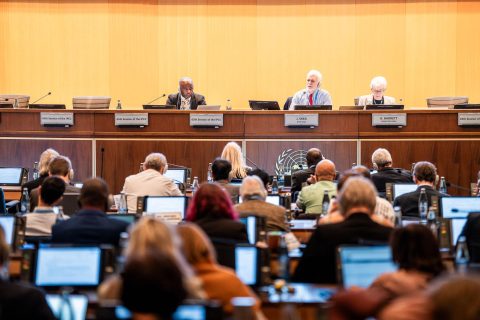

In July, PAICC said 12 countries had ignored its repeated attempts to discuss why they had not published an NDC as required every five years under the 2015 Paris accord.
Members of the committee had been divided over whether to name them, but at a September meeting decided to do so in their annual report to the annual climate COP summit.
By the time the report was published on Friday, only Congo, Senegal and North Korea “had not communicated an NDC or submitted a [Biennial Transparency Report] and had not yet responded to any of the Committee’s notifications, despite several reminders issued by the Committee in this regard”.
Rainforest and renewable energy ambitions
The silence from Congo and Senegal is notable because the former is home to much of the Congo Basin rainforest while the latter has sought billions of dollars in climate finance to support its renewable energy ambitions.
After Brazil, Congo has more rainforest than any country in the world. This forest, and the country’s peatlands, absorb huge amounts of greenhouse gas but are fast being lost to expanding farmland, charcoal production, logging and mining.
Senegal signed a Just Energy Transition Partnership with Canada and wealthy European nations in 2023, to help it meet its renewable energy targets under the-then government of Macky Sall. It was chair of the Least Developed Countries group between January 2022 and December 2023.

Tejas Rao, who is researching the PAICC as part of a doctoral thesis at Cambridge University, said the governments of the three countries should engage with the committee.
“Engagement costs these governments very little and the committee has shown it will listen,” he said.
“Silence leaves the committee with no basis to help, and it leaves the [governments] exposed to the narrative that they are simply disengaged,” he told Climate Home News.
Paris Agreement requirement
The 2015 Paris Agreement requires all parties to publish an NDC every five years outlining their emissions reduction targets, with each plan meant to be more ambitious than the country’s last NDC.
The latest set – the third round of plans, with new targets for 2035 – was due in February 2025. While most countries missed this deadline, all but around 30 – mostly small emitters but including Egypt, Vietnam and Argentina – have now submitted them.
Over the year, the PAICC – which is made up of government climate officials from developed and developing countries – has been communicating with governments that have not submitted NDCs and trying to overcome barriers to them doing so.
Some nations have cited exceptional circumstances as the reason for not submitting an NDC, a process that requires a significant amount of work in tracking emissions and consulting on how to curb them across the economy. For example, a letter from a Sudanese official to the PAICC, seen by Climate Home News, said that the country’s civil war had led to the suspension of its NDC preparation.
-
IPCC scientists vow to press on with climate reports despite political deadlock
After governments again failed to agree a timeline, nearly 120 IPCC authors pledged to complete their assessment on time and with full scientific rigour -
Under US pressure, World Bank says it will back gas “where appropriate”
The US wants the World Bank to expand its gas support while climate campaigners are pushing for it to end – its head spoke this week of limited backing for the fossil fuel -
Who shapes climate science? The equity question facing the IPCC
Early completion of the next global climate science assessment reports risks excluding research from the Global South, which is key to ensuring the findings are fair
The US and Iran are not signed up to the Paris Agreement and so do not have active NDCs, nor does Taiwan, which is not a UN member state.
Rao said that because the PAICC is “facilitative and non-punitive”, naming the countries “is meant to open a door, not close one – the invited consultation is the point”.
“In recent months, governments that explained their constraints, whether capacity, finance or domestic process, have been met with follow-up and support rather than sanction, and the number of silent governments has fallen sharply,” Rao said.
The post Paris Agreement committee names three countries snubbing it over NDCs appeared first on Climate Home News.
Paris Agreement committee names three countries snubbing it over NDCs