

- Formal negotiations
- Finance
- Global review
- Global report
- Digital sequence information
- Harmful subsidies
- Marine biodiversity
- Planning, monitoring, reporting and review
- Article 8(j) implementation
- Biodiversity and climate change
- Links with other bodies
- Around the COP
- Armenian presidency
- Protests
- Lobbying and influence
- Carbon and biodiversity markets

Indigenous women across Canada are emerging as powerful leaders in climate resilience and adaptation efforts. Drawing on traditional knowledge, community connections, and a deep commitment to environmental stewardship, Indigenous women are spearheading innovative methodologies to address climate change impacts in their communities and beyond.
Rematriation, Traditional Roles and Modern Leadership
The restoration of Indigenous women’s traditional roles through rematriation represents a powerful force in environmental leadership and climate action. This movement recognizes and reinstates women’s sacred responsibilities as water protectors and land guardians, roles deeply embedded in many Indigenous cultures’ traditional governance systems.
Indigenous women’s leadership emerges from matriarchal traditions where women held significant decision-making power in environmental stewardship. These traditional governance models recognized women’s unique relationship with water as life-givers and their profound understanding of environmental cycles and relationships. Today, this traditional authority finds new expression in climate action and environmental protection.
The rematriation of environmental leadership manifests through the restoration of women’s traditional decision-making roles and sacred responsibilities to water and land. This process involves revitalizing matriarchal governance systems that have historically guided sustainable resource management. Women’s ecological knowledge, passed down through generations, provides crucial insights for addressing current environmental challenges. The integration of traditional female leadership models emphasizes the importance of intergenerational knowledge transfer and cultural continuity while celebrating women’s environmental wisdom.
This rematriated approach brings a distinctive perspective to environmental stewardship, characterized by a holistic understanding of ecological relationships and long-term, intergenerational thinking. Women leaders demonstrate the essential balance between development and protection, integrating cultural and spiritual values into environmental decision-making. Their approach emphasizes collective well-being and recognizes the sacred nature of water, understanding the profound connections between environmental and community health.
Through rematriation, Indigenous women are leading climate action initiatives that combine traditional knowledge with contemporary environmental challenges. Their leadership in sustainable resource management and protection of traditional territories demonstrates the effectiveness of matriarchal governance models. Women’s roles in water protection initiatives and environmental justice advocacy reflect their traditional responsibilities as environmental stewards. By teaching traditional ecological practices and building community resilience, they ensure the preservation of cultural knowledge while fostering environmental responsibility for future generations.
Indigenous Women in Climate Science and Policy
Indigenous women are revolutionizing climate science and policy by integrating traditional knowledge with contemporary environmental research. Their unique perspectives combine multi-generational ecological observations with spiritual and cultural understandings of land and water. Through advocacy and leadership, they shape environmental policy while emphasizing community-based solutions and traditional governance models. Their research methodologies enhance scientific approaches by incorporating relationship-based and culturally appropriate methods. Indigenous women’s documentation of environmental changes, combined with traditional adaptation strategies, provides crucial insights for climate action policy.
Traditional Food Revitalization
Indigenous women are leading transformative efforts in food sovereignty, combining traditional knowledge with innovative approaches to address climate change impacts on food security. Their leadership in restoring traditional food systems encompasses the protection of ancestral food sources, preservation of Indigenous dietary knowledge, and maintenance of ceremonial food practices. Through community initiatives like gardens and seed sanctuaries, traditional food education programs, and youth mentorship, they ensure the transmission of crucial food knowledge across generations. Their work recognizes Indigenous diets as fundamental to holistic health, embracing traditional nutritional wisdom and cultural healing practices. These food sovereignty efforts extend to environmental stewardship, incorporating sustainable harvesting practices, habitat conservation, and biodiversity protection. As they develop climate-resilient food systems and strengthen community food networks, Indigenous women demonstrate how traditional food practices can address contemporary challenges while maintaining cultural connections and promoting community well-being.
Sustainable Crafts and Economic Resilience
Indigenous women are leading a powerful resurgence of traditional craft economies, weaving together ancestral knowledge with innovative approaches to address contemporary challenges. This revival honours the sacred relationships and protocols inherent in Indigenous craft practices while creating sustainable economic opportunities. Through their work, traditional techniques and materials merge with modern adaptations, maintaining cultural authenticity while meeting current market demands.
These initiatives extend beyond economic development to encompass environmental stewardship and cultural preservation. Women entrepreneurs integrate sustainable harvesting practices and climate-adaptive techniques while maintaining the ceremonial significance of their crafts. Their approach to material sourcing and production emphasizes ecological conservation and waste reduction, demonstrating how traditional practices can address modern environmental challenges.
Through community-based economies and fair-trade practices, these initiatives support economic self-determination while ensuring the transmission of cultural knowledge to future generations. This renaissance in Indigenous craft economies demonstrates how traditional practices can evolve to meet contemporary needs while maintaining spiritual and cultural foundations.
Addressing the Gendered Impacts of Climate Change
Indigenous women face unique challenges from climate change that intersect with their traditional roles as caregivers, food providers, water protectors, and Knowledge Keepers. Their experiences encompass disruptions to food gathering, changes in water availability, reduced access to medicinal plants, and increased pressures on ceremonial and cultural practices. Despite these challenges, Indigenous women demonstrate remarkable leadership in developing comprehensive responses to climate impacts.
Their initiatives include community-based adaptation strategies that honour traditional knowledge while creating innovative solutions. Through women’s support networks and intergenerational teaching programs, they strengthen community resilience while preserving cultural practices. Their gender-specific approaches recognize the distinct responsibilities and knowledge systems of women, incorporating traditional healing practices and matriarchal leadership models.
These leaders advocate for gender-responsive climate policies while building economic opportunities and strengthening health support systems, demonstrating how women’s traditional roles as leaders and innovators can inform effective climate adaptation strategies.
The Path Forward: Supporting Indigenous Women’s Leadership
The path forward demonstrates the critical need to strengthen and amplify Indigenous women’s roles in environmental stewardship and climate resilience. This support framework encompasses multiple dimensions that recognize and enhance Indigenous women’s traditional authority and knowledge.
Increased funding represents a fundamental shift in supporting Indigenous women-led climate initiatives. Rematriarchal funding resources must be developed by Indigenous Peoples and Canada and flow directly to community-based adaptation programs and traditional knowledge preservation projects. This funding should be sustained and flexible, allowing communities to define their own priorities and approaches. Support must extend beyond short-term projects to enable long-term planning and implementation of climate initiatives, cultural revitalization efforts, and sustainable economic development. Such investment acknowledges the vital role of Indigenous women in environmental protection while supporting intergenerational knowledge transfer and community-led research.
Meaningful policy inclusion requires transformative change in how decision-making processes engage Indigenous women. Their participation must extend beyond consultation to embrace true partnership and leadership, recognizing their unique perspectives and traditional authority. This involves direct participation in environmental governance, recognition of traditional systems, and support for Indigenous-led policy development. Policy frameworks must protect Indigenous rights and sovereignty while acknowledging matriarchal leadership models that have successfully guided environmental stewardship for generations.
Capacity-building initiatives must honour traditional knowledge while creating opportunities for enhanced leadership in climate action. These programs should combine respect for traditional teaching methods with access to contemporary tools and resources. Through women’s leadership development opportunities, technical training, and cross-cultural exchanges, Indigenous women strengthen their ability to address climate challenges. Mentorship programs and professional development support ensure the continuation of traditional knowledge while building new skills for current environmental challenges.
Recognition of Indigenous women’s contributions to climate action must transcend superficial acknowledgment to include meaningful support and respect for their environmental authority. This involves formal recognition of their contributions while protecting intellectual property rights and supporting Indigenous-led initiatives. Celebrating traditional knowledge and preserving cultural practices ensures these vital approaches continue to inform climate solutions. Documentation and sharing of success stories inspire future generations while demonstrating the effectiveness of Indigenous women’s leadership in environmental stewardship.
Blog by Rye Karonhiowanen Barberstock
(Image Credit: Shutterstock, Licensed)
The post The Role of Indigenous Women in Climate Resilience and Adaptation appeared first on Indigenous Climate Hub.
The Role of Indigenous Women in Climate Resilience and Adaptation
Continue Reading
Countries have completed the first “global review” of their progress towards reversing nature loss by 2030 at the COP17 biodiversity talks in Yerevan, Armenia.
The review “notes with deep concern” that, unless action is “rapidly accelerated”, the goal to reverse nature loss and meet a set of 23 targets by 2030 “will not be achieved”.
It “urges” countries to accelerate action, including by “increased ambition in addressing the gaps”.
Much of the discussions in Yerevan focused on how to raise the necessary funds to help developing countries protect nature.
Some major economies pushed to expand the range of nations that are expected to provide finance, with countries agreeing at the end of the two weeks of talks that non-donors that want to contribute can “signal interest” before COP18.
This came after developed countries failed to meet a target to significantly ramp up nature finance over the last few years.
It also came as a landmark fund agreed at COP16 in Colombia to pay communities for the genetic resources derived from nature stands nearly empty two years on.
The Yerevan talks marked the halfway point of the “Kunming-Montreal Global Biodiversity Framework” (GBF), the “Paris Agreement for nature” first made in 2022 and due to be achieved by 2030.
During the nearly 12-hour-long final plenary, countries voted for Quito, Ecuador, to host the COP18 nature talks, which will be held in 2028.
Countries managed to sign off on all the major negotiation texts, marking a stark contrast to COP16, which ran so far over time that the Colombian presidency lost “quorum”, forcing talks to resume in Rome months later.
Below, Carbon Brief has detailed analysis of all of the key outcomes from COP17.
Formal negotiations
Finance
Finance, predictably, was at the heart of the discord and deadlock at the Yerevan talks.
At COP17, discussions on finance had to achieve several outcomes.
The first part – to take stock of biodiversity finance mobilised so far to meet the nature deal’s goals – fell under the global review.
As the global report noted, developed countries failed to meet their commitments to raise “at least $20bn a year by 2025” for nature. Delegates pointed to falling aid levels and a sharp 27% decline in environmental funding for the 2026-30 period.
The second part was to agree on how to mobilise resources for the next four years, to meet the GBF’s goals and targets.
Calls to “broaden the contributor base” of who pays to protect nature – and whether that should include emerging economies – became the most fraught element of the talks.
Eventually, countries agreed on what Switzerland described as a “super, mega-delicate” text. It hinged on major “political compromises”, with “no major winner or loser”, according to Kenya.
Per the decision, countries that want to be included on a list of developed country donors can “signal interest” through bilateral, confidential consultations before COP18 and every alternate COP after.
Finally, countries also agreed on criteria to shape and resource a new, permanent financial mechanism to protect nature after 2030.
However, this did not immediately take the form of a new fund under the COP that biodiverse countries have demanded since 2022, deferring the mechanism’s institutional structure to COP18.
Resource mobilisation discussions at the GBF’s halfway mark were supposed to agree on how to close the “biodiversity finance gap” and to “increase resources from all sources” to “at least” $200bn per year by 2030, as set out in target 19 of the GBF.
The talks were largely dominated by a push, led by the JUSCANZ bloc of developed countries, to “broaden the contributor base”. This could see emerging economies, such as Qatar, China, Saudi Arabia and India, being added to the list of countries that pay to protect nature.
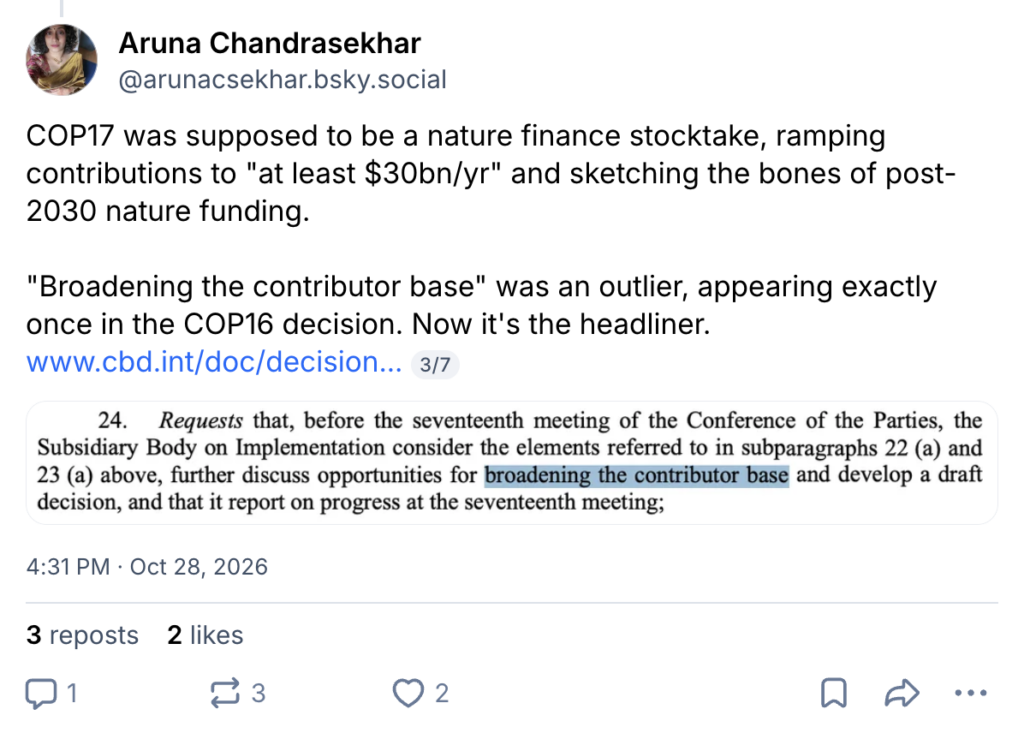
Article 20 of the UN Convention on Biological Diversity (CBD) states that developed countries “shall provide new and additional financial resources” to developing countries to meet the costs of implementing measures to protect nature.
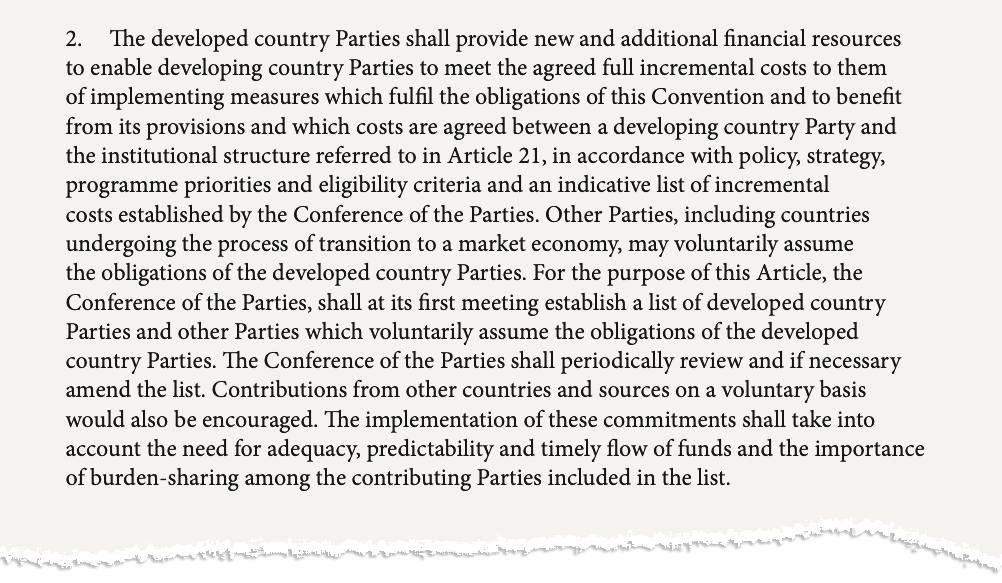
The text states that other countries – including emerging economies – may “voluntarily assume” these obligations to pay. However, it adds that this list of developed countries “shall” be reviewed periodically and amended “if necessary”.
The list was last amended in 2006.
(See this “jargon buster” which explains the specific meaning and legal weight of various terms and verbs used in UN formal documents.)
Discussions around this fraught subject had reached a dead end at intersessional talks this year, but resurfaced in Yerevan.
The first “non-paper” had four different options for expanding the contributor base. These ranged from using the World Bank’s country income groups “as a proxy” to identify high-income countries, to commissioning a study on the impacts of being included on the list.
By 21 October, the number of options swelled to eight, including two from Saudi Arabia and one from Peru.
Some countries “expressed concern” that certain options were based on a CBD secretariat study on “what constitutes a developed country”, Earth Negotiations Bulletin reported.
By the end of the first week, it was clear that the finance deadlock would have to go into informal ministerial consultations for any consensus to emerge.
At a press conference on 28 October, Christopher O’Sullivan, Ireland’s nature minister and representing the EU delegation, told Carbon Brief:
“Our position isn’t that we want to pull back in terms of contributing…but it’s been 20 years since that list was added to, times have changed and there are new realities. We just simply want those new realities reflected. I don’t fully understand why there’s so much opposition to that.”
The EU chose not to comment on which countries it would like to see on that list.
Lim Li Ching from the Third World Network, meanwhile, called the push for others to “assume the obligations” of developed countries “sheer hypocrisy”, adding that any country could make a voluntary contribution. She told Carbon Brief:
“At a forum like the CBD, this linking of income status with finance does not take into account where historical and current responsibilities lie. If you want to generate more funding for biodiversity, let’s look at sovereign debt burdens and rules, which are inequitable for developing countries. But if you can fund wars, and provide resources for your defence industry, then you know where the priorities are.”
On 29 October – at a plenary meant to adopt final texts for the most contentious subjects – Norway’s Gaute Hanssen announced that resource-mobilisation discussions would go into a smaller “friends of the chair” meeting.
Facilitated by Carolina Caceres from Canada and Imèn Meliane from Tunisia, the meeting would discuss the most contentious elements of a draft decision that had swelled to 112 brackets, denoting areas of disagreement on specific details in the text.
While the meeting was open to all, countries that were called to be present included Brazil, Canada, Chile, China, the EU, Fiji, Norway, Russia, Switzerland, Saudi Arabia, South Africa and the UK.
At the same time, a “non-paper” text by finance and environment ministers laid out countries’ red lines and compromises.
At the end of COP17, countries welcomed a final compromise text, with Kenya thanking the “strong women” co-chairs who strove to strike a “delicate” balance.
China, Saudi Arabia, Switzerland and Fiji cautioned against any further interventions, with Brazil warning: “If we open this text, we will never close it again.”
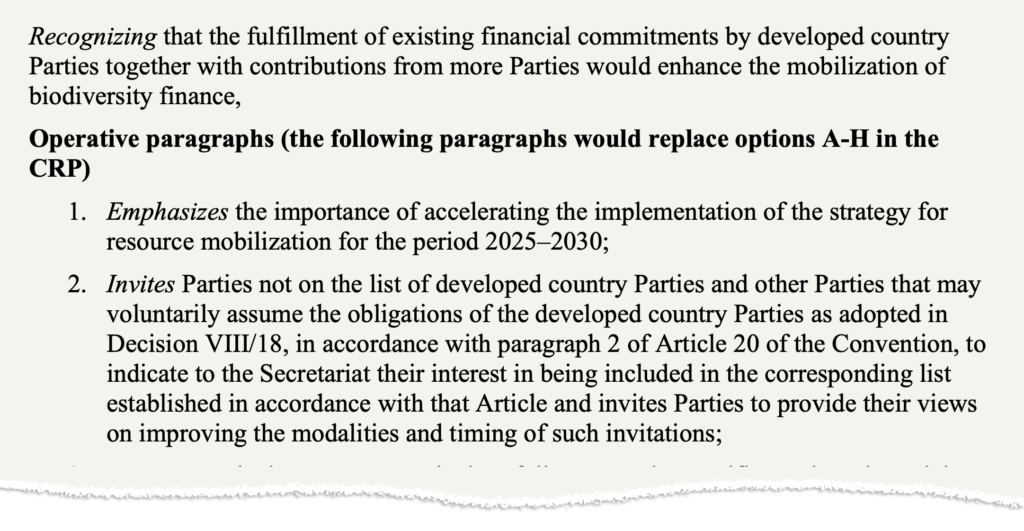
While the final decision “recognises” that “contributions from more parties would improve the mobilisation” of biodiversity finance, it steered away from issuing criteria to expand the list of donor countries.
The text makes it clear that no additions to the list would be made without inviting and confidentially consulting with interested countries, to secure their explicit consent.
Instead, the CBD secretariat “invites” countries keen to be on the list and “assume the obligations” of developed countries to “signal interest” before COP18 and at every alternate COP thereafter.
At the same time, developing countries can contribute to meeting the GBF and biodiversity convention’s goals on a “voluntary basis”, with contributions not implying inclusion on the list.
A negotiator for China told Carbon Brief at the closing plenary:
“We welcome this balanced document. It was a very long discussion that has gone [on] since [2022 nature talks in] Nairobi. But actually this time, there were a lot of sensitive issues, [there were] a lot of critical things we didn’t open in the contact groups; it mainly went to the high-level discussion.”
The decision also establishes a financial mechanism for nature funding after 2030 under the governance of the COP, a key ask from developing countries.
However, it defers decisions on what form this mechanism would take – whether this would be a new fund or based on existing arrangements – until COP18.
Oscar Soria at the Common Initiative told Carbon Brief that the decision on the financial mechanism leaves things “very open”, with “no movement” towards a new fund or money and no upgrades to existing funding arrangements.
The text acknowledges the links between debt and biodiversity eight times, mentioning how debt-related instruments can be included in biodiversity plans, but does not go further.
“It is almost as if the debt studies they called for at COP16 didn’t happen,” said Soria, who had earlier flagged serious methodological issues with the first-ever COP-commissioned report on debt and biodiversity.
Global review
In Yerevan, countries agreed on the first stocktake of progress towards the 2030 nature targets – known as the “global review”.
The review was one of the keenly anticipated outcomes from COP17 and was seen as less controversial than some of the other major negotiation strands.
It was swiftly signed off by countries at the start of the final COP17 plenary, with just one last-minute addition.
The concept of carrying out a global review on “collective progress” was