


- Formal negotiations
- Finance
- Global review
- Global report
- Digital sequence information
- Harmful subsidies
- Marine biodiversity
- Planning, monitoring, reporting and review
- Article 8(j) implementation
- Biodiversity and climate change
- Links with other bodies
- Around the COP
- Armenian presidency
- Protests
- Lobbying and influence
- Carbon and biodiversity markets

Tiago Pitta e Cunha is chief executive of the Oceano Azul Foundation.
The recent COP30 in Belém, Brazil, brought nations together to confront the escalating climate crisis. But amid their discussions, there was a paradox: while a growing number of countries see the ocean as essential to climate action, there is still no institutional mechanism to integrate this critical ally into global climate deliberations.
One way of doing that could be to establish a dedicated ocean agenda item within the official COP agenda, upgrading the existing informal ocean climate dialogue created in COP26 in Glasgow and in doing so, opening a door to unlock the ocean’s potential for climate change mitigation and adaptation.
The ocean is the forgotten hero of the climate system. It absorbs more than 90% of excess heat generated by global warming, regulates temperatures across all continents and stores 25% of the greenhouse gases emitted annually into the atmosphere.
It is also the ultimate destination of more than 90% of the accumulated stock of all man-made carbon since the beginning of the industrial revolution, making it Earth’s most vital carbon sink.
Ocean-based solutions
But despite this indispensable role, the ocean has historically been almost absent in climate strategies and finance. For years, ocean action received less than 1% of global climate finance.
There has been some progress, however. Initiatives such as the “Blue NDC Challenge”, which calls on countries to insert the ocean into their national climate action plans (NDCs), co-led by France and Brazil and supported by nations including Belgium, Cambodia, Canada, Indonesia, Portugal and Singapore, demonstrate a growing political will.
-
US set to push fossil fuels under its G20 presidency
But Trump’s attempts to undermine climate action could face blowback as most other nations remain committed -
As coral reefs pass tipping point, ocean protection rises up political agenda
New scientific studies show coral reefs are under severe pressure from global warming, while ocean acidification poses a threat to marine life -
Treaty to protect deep ocean reaches key threshold for entry into force
The High Seas Treaty, now signed into law by 60 countries, is seen as crucial to achieving a global goal of protecting 30% of land and sea ecosystems by 2030
As more countries incorporate ocean-based measures into their national climate plans, there’s clear momentum. Research suggests that fully deploying ocean-based solutions – from decarbonising shipping to expanding marine protected areas – could deliver up to 35% of the emissions reductions needed to stay on a 1.5C pathway by 2050.
Yet, this recognition has not translated into formal institutionalisation within the process of the United Nations Framework Convention on Climate Change (UNFCCC). For its first 25 years, the ocean was largely absent from COP discussions. While recent efforts have integrated some ocean references into important climate texts, ocean consideration remains informal and scattered – almost a footnote.
The recently revealed breach of the seventh planetary boundary for ocean acidification – and rebukes from the International Court of Justice and the International Tribunal for the Law of the Sea – underscore the dire need for formal integration.
Ocean agenda item at future COPs
A dedicated ocean agenda item at future COPs, starting with COP31, is not merely desirable; it is a necessity. This would elevate the ocean’s status, provide the meaningful integration of the ocean into the climate regime, and bring transparency to discussions on the key ocean-climate related issues.
It would also empower the UNFCCC secretariat to take more meaningful ocean-climate action. Countries are starting to become convinced of this imperative, with Fiji leading the charge in Belém by calling for a dedicated ocean agenda item.
Peter Thomson, the UN Secretary-General’s special envoy for the ocean, similarly emphasised that without a dedicated agenda item, the ocean will remain invisible in the very negotiations that depend on it.

Additionally, the global target of 30×30 encompassing the protection of 30% of the ocean by 2030, must be formally acknowledged as essential in the fight against climate change.
Marine Protected Areas (MPAs) offer a prime example of the ocean’s untapped power. These designated zones safeguard critical marine ecosystems, increase biomass, expand fish stocks and enhance biodiversity.
Crucially, MPAs significantly boost the ocean’s natural capacity for carbon sequestration, particularly in blue carbon ecosystems such as mangroves, salt marsh lands and seagrass beds, and by enhancing the biological carbon pump in the high seas.
Furthermore, with the High Seas Treaty entering into force in January 2026, creating MPAs in areas beyond national jurisdiction becomes a reality, offering an opportunity to integrate ocean and climate solutions on a global scale. MPAs offer thus a strong and often overlooked pathway for countries to meet their climate targets and accelerate their journey towards net zero.
The urgency of securing results from the ocean-climate nexus demands a fundamental re-evaluation of its position within the UNFCCC process. The cross-cutting nature of ocean issues means that without a formal agenda item, discussions will remain fragmented and ineffective. The momentum generated by the Blue NDC Challenge and the growing number of nations championing ocean solutions must be formalised before COP31.
We have run out of time and can no longer afford to treat our ocean as an optional extra. The moment for the ocean to secure a permanent, central position in global climate action is now.
The post The ocean, our planet’s forgotten hero, deserves a formal place in UN climate talks appeared first on Climate Home News.
The ocean, our planet’s forgotten hero, deserves a formal place in UN climate talks
Continue Reading
Countries have completed the first “global review” of their progress towards reversing nature loss by 2030 at the COP17 biodiversity talks in Yerevan, Armenia.
The review “notes with deep concern” that, unless action is “rapidly accelerated”, the goal to reverse nature loss and meet a set of 23 targets by 2030 “will not be achieved”.
It “urges” countries to accelerate action, including by “increased ambition in addressing the gaps”.
Much of the discussions in Yerevan focused on how to raise the necessary funds to help developing countries protect nature.
Some major economies pushed to expand the range of nations that are expected to provide finance, with countries agreeing at the end of the two weeks of talks that non-donors that want to contribute can “signal interest” before COP18.
This came after developed countries failed to meet a target to significantly ramp up nature finance over the last few years.
It also came as a landmark fund agreed at COP16 in Colombia to pay communities for the genetic resources derived from nature stands nearly empty two years on.
The Yerevan talks marked the halfway point of the “Kunming-Montreal Global Biodiversity Framework” (GBF), the “Paris Agreement for nature” first made in 2022 and due to be achieved by 2030.
During the nearly 12-hour-long final plenary, countries voted for Quito, Ecuador, to host the COP18 nature talks, which will be held in 2028.
Countries managed to sign off on all the major negotiation texts, marking a stark contrast to COP16, which ran so far over time that the Colombian presidency lost “quorum”, forcing talks to resume in Rome months later.
Below, Carbon Brief has detailed analysis of all of the key outcomes from COP17.
Formal negotiations
Finance
Finance, predictably, was at the heart of the discord and deadlock at the Yerevan talks.
At COP17, discussions on finance had to achieve several outcomes.
The first part – to take stock of biodiversity finance mobilised so far to meet the nature deal’s goals – fell under the global review.
As the global report noted, developed countries failed to meet their commitments to raise “at least $20bn a year by 2025” for nature. Delegates pointed to falling aid levels and a sharp 27% decline in environmental funding for the 2026-30 period.
The second part was to agree on how to mobilise resources for the next four years, to meet the GBF’s goals and targets.
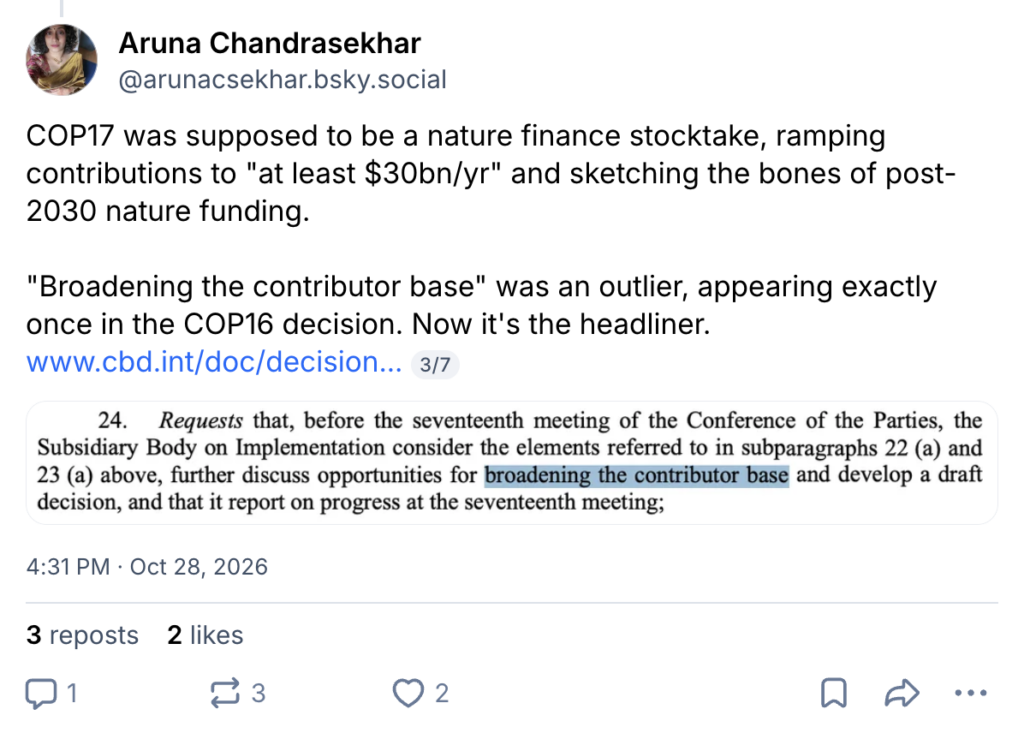
Calls to “broaden the contributor base” of who pays to protect nature – and whether that should include emerging economies – became the most fraught element of the talks.
Eventually, countries agreed on what Switzerland described as a “super, mega-delicate” text. It hinged on major “political compromises”, with “no major winner or loser”, according to Kenya.
Per the decision, countries that want to be included on a list of developed country donors can “signal interest” through bilateral, confidential consultations before COP18 and every alternate COP after.
Finally, countries also agreed on criteria to shape and resource a new, permanent financial mechanism to protect nature after 2030.
However, this did not immediately take the form of a new fund under the COP that biodiverse countries have demanded since 2022, deferring the mechanism’s institutional structure to COP18.
Resource mobilisation discussions at the GBF’s halfway mark were supposed to agree on how to close the “biodiversity finance gap” and to “increase resources from all sources” to “at least” $200bn per year by 2030, as set out in target 19 of the GBF.
The talks were largely dominated by a push, led by the JUSCANZ bloc of developed countries, to “broaden the contributor base”. This could see emerging economies, such as Qatar, China, Saudi Arabia and India, being added to the list of countries that pay to protect nature.
Article 20 of the UN Convention on Biological Diversity (CBD) states that developed countries “shall provide new and additional financial resources” to developing countries to meet the costs of implementing measures to protect nature.
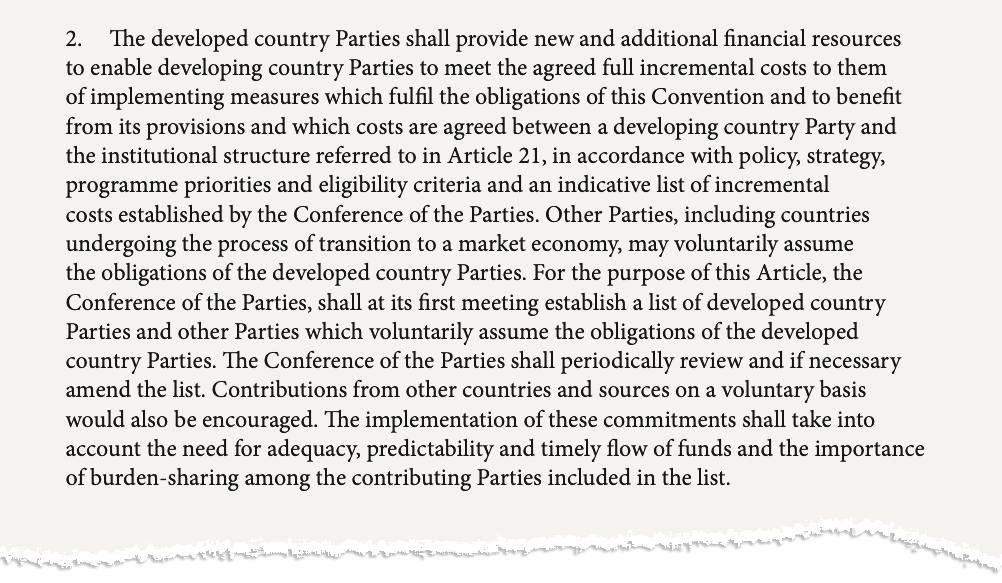
The text states that other countries – including emerging economies – may “voluntarily assume” these obligations to pay. However, it adds that this list of developed countries “shall” be reviewed periodically and amended “if necessary”.
The list was last amended in 2006.
(See this “jargon buster” which explains the specific meaning and legal weight of various terms and verbs used in UN formal documents.)
Discussions around this fraught subject had reached a dead end at intersessional talks this year, but resurfaced in Yerevan.
The first “non-paper” had four different options for expanding the contributor base. These ranged from using the World Bank’s country income groups “as a proxy” to identify high-income countries, to commissioning a study on the impacts of being included on the list.
By 21 October, the number of options swelled to eight, including two from Saudi Arabia and one from Peru.
Some countries “expressed concern” that certain options were based on a CBD secretariat study on “what constitutes a developed country”, Earth Negotiations Bulletin reported.
By the end of the first week, it was clear that the finance deadlock would have to go into informal ministerial consultations for any consensus to emerge.
At a press conference on 28 October, Christopher O’Sullivan, Ireland’s nature minister and representing the EU delegation, told Carbon Brief:
“Our position isn’t that we want to pull back in terms of contributing…but it’s been 20 years since that list was added to, times have changed and there are new realities. We just simply want those new realities reflected. I don’t fully understand why there’s so much opposition to that.”
The EU chose not to comment on which countries it would like to see on that list.
Lim Li Ching from the Third World Network, meanwhile, called the push for others to “assume the obligations” of developed countries “sheer hypocrisy”, adding that any country could make a voluntary contribution. She told Carbon Brief:
“At a forum like the CBD, this linking of income status with finance does not take into account where historical and current responsibilities lie. If you want to generate more funding for biodiversity, let’s look at sovereign debt burdens and rules, which are inequitable for developing countries. But if you can fund wars, and provide resources for your defence industry, then you know where the priorities are.”
On 29 October – at a plenary meant to adopt final texts for the most contentious subjects – Norway’s