

 Here’s Nobel Prize-winning economist Paul Krugman’s recent column in the New York Times addressing the oft-discussed issue: Are efforts to achieve environmental sustainability necessarily damaging to the strength of the economy?
As usual, as we dig deeper into subjects like this, we learn that there are important complexities.
In this case, some efforts to decarbonize open up huge economic opportunities.
Krugman uses the “carrot and stick” metaphor and points out that carrots like financial bonanzas tends to work better than sticks, like taxes. Yet, in reality, our society is too far from where it was a few decades ago, where the consumption of fossil fuels becomes extremely unattractive the moment someone is asked to cover the costs of the environmental damage associated with climate change, ocean acidification, and loss of biodiversity.

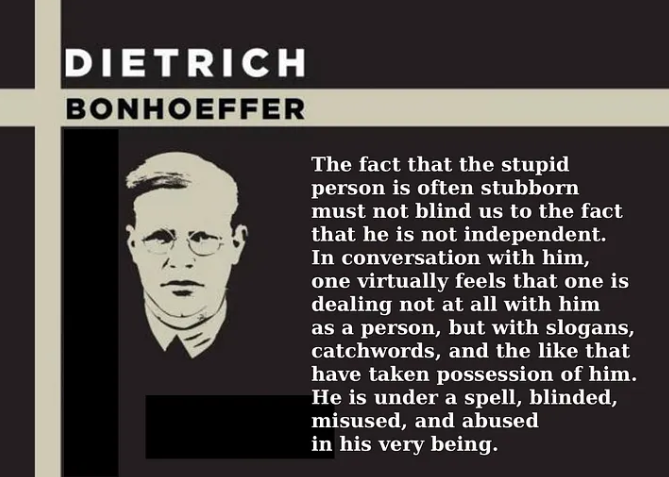 At left is something that theologian Dietrich Bonhoeffer said shortly before he was executed by the Third Reich for his protest against the fascist regime.
Most of us have had the thought he expressed here. We may be talking with an old friend who went to a prestigious college and showed when we were young considerable intelligence, who now, when it comes to world politics is now limited to the talking points of Newsmax and Fox News.
How did this happen?
Nobody knows, but, over the last couple of decades, this subject has caught the attention of neuroscientists who believe that liberals’ and conservatives’ brains are internally connected differently from each other.
As an example, tests show that the brain activity of self-identified liberals and conservatives are vastly different when experimental subjects are shown photographs of potentially threatening animals, like spiders and snakes. Those who think of themselves as conservatives have brain activity that show fear and hatred, while self-described liberals’ brains suggest that they perceive such animals as simply members of the planet on which we live.
Maybe no one is to blame; perhaps we just live in different worlds of consciousness.
Those hankering for a great read on this subject, albeit fiction, should check out Ian McEwan’s masterpiece “Saturday.”
 At left is an interesting thought exercise. Here’s everything I can think of, and it’s not much. When I was in elementary school in the early 1960s, it was believed that:
The main types of rocks: sedimentary, metamorphic, and igneous, had been in place and remained the same since the formation of the earth. Now we have the “rock cycle,” where rock compounds are known to be continually changing form over very long periods of geologic time.
Every atom in our bodies and elsewhere on our planet is the result of the explosion of stars somewhere in the universe. As Neil DeGrasse Tyson puts it, “You are in the universe, and the universe is in you.”
Science Is Not a Set of Facts; It’s a Process of Learning More About Our Universe
 The support for Alberta’s seceding from Canada is about 5%, according to a physician I know up there.
I know it’s hard to believe, but Fox News is a thoroughly dishonest organization.



-
Climate Change8 months ago
Guest post: Why China is still building new coal – and when it might stop
-
Greenhouse Gases8 months ago
Guest post: Why China is still building new coal – and when it might stop
-

 Greenhouse Gases2 years ago
嘉宾来稿:满足中国增长的用电需求 光伏加储能“比新建煤电更实惠”
-
Climate Change2 years ago
Bill Discounting Climate Change in Florida’s Energy Policy Awaits DeSantis’ Approval
-

 Climate Change2 years ago
嘉宾来稿:满足中国增长的用电需求 光伏加储能“比新建煤电更实惠”
-
Climate Change Videos2 years ago
The toxic gas flares fuelling Nigeria’s climate change – BBC News
-

 Renewable Energy5 months ago
Sending Progressive Philanthropist George Soros to Prison?
-

 Carbon Footprint2 years ago
US SEC’s Climate Disclosure Rules Spur Renewed Interest in Carbon Credits