

Average global yields of six staple crops could fall by more than 11% under a moderate warming scenario by the end of the century – even when accounting for how farmers could adapt to climate change, new research finds.
The study, published in Nature, examines changes in yields for cassava, maize, rice, sorghum, soya bean and wheat under two different warming scenarios.
But, unlike previous studies, it also factors in adaptive measures that farmers may employ to adjust to the changing climate.
It finds that implementing adaptation could reduce total yield losses by around 12% by the end of the century – although the world would still face “substantial losses”, it says.
The study also finds that the world’s “breadbaskets” – such as the US and Europe – will have less adaptive capacity than poorer regions, as their farming industries have been optimised for high yields, rather than resilience.
One researcher, who was not involved in the new study, tells Carbon Brief that these types of studies “are essential steps” towards better understanding adaptation in agriculture.
‘Partially protective’ adaptation
Globally, agriculture is projected to be one of the industries that is hit hardest by the impacts of climate change.
Along with rising average temperatures and changing rainfall patterns, increasingly frequent and severe weather extremes threaten planted crops.
However, large uncertainties remain around how farmers will adapt to future climate change.
Most previous research on the yield impacts of climate change either assumes that farmers will not adapt to the changes at all or that they can adapt infinitely, explains Dr Andrew Hultgren, an environmental economist at the University of Illinois Urbana-Champaign.
Hultgren, who led the new study, tells Carbon Brief:
“The question is: ‘What do real world farmers actually do?’ So that’s what we really set out to tackle…And what we find is that, essentially, neither of these extreme stories is really accurate. Farmers do adapt, but that adaptation is partially protective – not fully protective.”
The researchers model the impacts on crop yields under two emissions scenarios – moderate (RCP4.5) and very high (RCP8.5) – for two time periods – 2050 and 2098. They select six staple crops for their study: cassava, maize, rice, sorghum, soya bean and wheat.
For both emissions scenarios, the researchers apply projected future incomes consistent with SSP3 socioeconomic pathway. This portrays a “rocky road” of global development in the future due to rising geopolitical tensions driven by “regional rivalry”.
Under the moderate-emissions scenario, they find an overall decrease in staple crop yield of 8.3% in 2050 and 12.7% in 2098.
However, they find that these losses can be reduced somewhat by the introduction of adaptive measures, such as switching to different varieties of a crop or adjusting irrigation levels.
In order to account for adaptation, the researchers use data on crop yields from 12,658 sub-national regions to create a model that links changes in yields to exposure to extremely hot days.
This allows the researchers to project the impacts of adaptive measures without having to prescribe what, exactly, those measures would be, Hultgren says. Relatively lower losses on extreme heat days are “reflective of adaptation”, he adds.
In other words, if two regions with similar baseline climates and yields both experience a season of extreme heat, the one that has lower yield losses has more adaptations to climate change.
Factoring in adaptation and income growth, they find that the yield losses fall to 7.8% in 2050 and 11.2% in 2098 under moderate emissions. While these changes are relatively small, they are not insignificant, Hultgren argues:
“Twelve percent mitigation of losses is still a globally important amount of gains from adaptation.”
Dr Jyoti Singh, a climate-crop modeller at Columbia University’s Center for Climate Systems Research, tells Carbon Brief that the dataset assembled for the new study is its “most noteworthy strength”. Singh, who was not involved in the new work, adds that it “significantly contributes to empirical agricultural impact modelling”.
However, she says, there is a “big limitation” of the study in that empirical models are based only on past data – they cannot account for the full range of potential futures. Therefore, the results from the new study cannot be compared directly to results from models that more explicitly represent the processes that influence crop growth, she says.
Regional loss patterns
The losses are not equal across all six staples. The end-of-century losses range from just over 1% loss for rice yields to 22.4% loss for soya bean yields. This is because each of the crops has a different response to changes in temperature and rainfall.
The change in rice yield is particularly low, Hultgren explains, because the losses associated with overall warming are somewhat counterbalanced by yield increases due to rising nighttime temperatures.
In addition to the differences between crops, the researchers identify strong regional differences in the amount of future losses – as well as the extent to which adaptation will offset these losses.
In Africa, for example, the researchers project an overall yield decrease of 16% by 2098 with no adaptive measures in place. Adding in these adaptations reduces that yield loss to 11.6%. By contrast, adding adaptation to projections of staple yields in North America makes almost no change – reducing the losses from 21.0% to 20.8%.
The maps below show the percentage of yield losses for (clockwise from top-left) maize, soya bean, wheat, sorghum, cassava and rice in 2098 under a moderate-warming scenario that factors in adaptation.
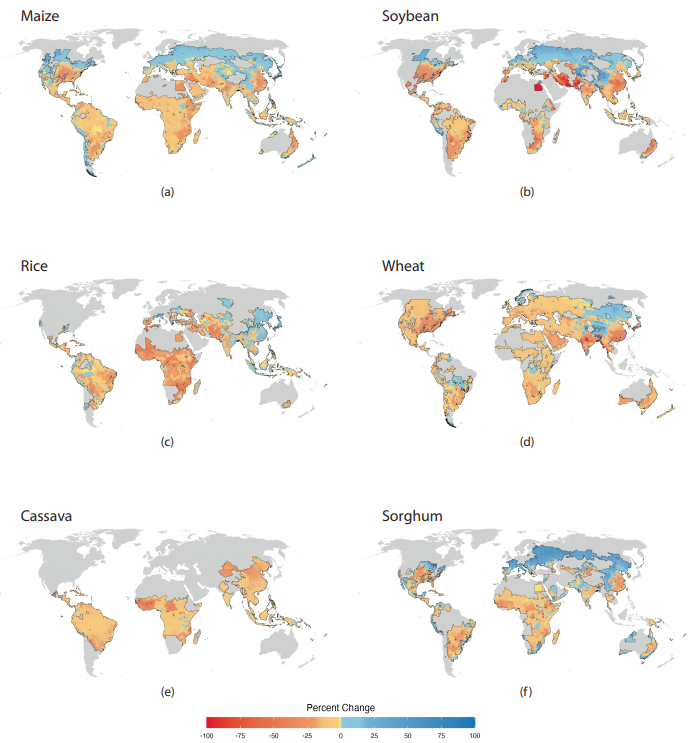
The maps show that many of the staple crops studied suffer the most significant losses in current “breadbasket” regions of the world that produce much of the world’s calories, such as the US and Europe. In contrast, many lower-income, tropical regions see more modest losses. The authors write:
“Because such a large fraction of agricultural production is concentrated in these wealthy-but-low-adaption regions, they dominate projections of global calorie production, generating much of the global food security risk we document.”
However, Hultgren points out, subsistence farmers – particularly those who rely on cassava – will also be significantly impacted by climate change. The researchers identify the highest losses among the top two deciles of the global income distribution and the bottom decile.
This result was “surprising”, Hultgren says. Typically, he explains, research has shown that poorer areas are the hardest-hit by climate change.
He adds that the finding is reflective of the trade-off between average yields and adaptive measures. In high-producing regions, farmers have generally relied on planting the highest-yielding varieties, instead of crop varieties that might have lower average yields, but are more resilient to changes in climate.
Hultgren tells Carbon Brief:
“Adaptation is costly…That’s why losses in the breadbasket portion of the world are so large, because farmers have to essentially pay a high price. Either in terms of actual financial inputs or in terms of just average yield losses, they have to pay a high price in order to get the adaptation they need.”
‘Giving up breakfast’
By combining the projected yields for all six crops, the researchers also estimate the total impact of warming on global calories.
They find a “nearly linear” decrease in global calorific output of 554tn kilocalories per 1C of warming – equivalent to about 120 kcal per person per day per 1C. (The recommended daily intake is typically around 2,000kcal for women and 2,500kcal for men.)
Hultgren tells Carbon Brief:
“If you think about a 3C warmer future, that’s like a population that is giving up breakfast every day – that would be the level of the caloric output loss.”
That result “should raise questions” about global food security and international political stability, Hultgren says.
The study’s method of linking global calories to changes in temperature is one of the “key innovations” of the new study, Singh says. She adds that it “improve[s the] policy relevance” of the work.
Singh tells Carbon Brief:
“Real-world adaptation decisions, from changing crop types to investing in irrigation or adopting resilient varieties, vary significantly depending on policies and farmers’ knowledge, resource access and financial capacity.
“Studies like this one, even if not fully comprehensive, are essential steps toward understanding and incorporating adaptive capacity into yield projections, moving us closer to more realistic agricultural impact assessment efforts.”

The post Staple crops yields face ‘substantial losses’ in warming world – even with adaptation appeared first on Carbon Brief.
Staple crops yields face ‘substantial losses’ in warming world – even with adaptation

Scientists have vowed to keep working on the next flagship set of reports for the Intergovernmental Panel on Climate Change (IPCC), after a political row over the timeline for their release saw its latest session suspended on Friday evening without agreement.
During the weekend, government officials and scientists alike expressed disappointment over the inability to reach a compromise before some delegates from developing countries and small island states had to leave the week-long meeting in Ethiopia to catch flights home.
The disagreement – which has persisted since early 2024 – turns on whether the three key parts of the AR7 assessment should all be published before the conclusion of the UN’s next Global Stocktake of global climate action, which is due to be completed in late 2028.
The IPCC issued a statement after the close of the session, saying that “key agenda items” – the timelines for the three AR7 reports, as well as the IPCC budget – remain open and under discussion. It said the IPCC’s plenary session and its deliberations on the pending agenda “will resume at the earliest opportunity”, giving no further details of when.
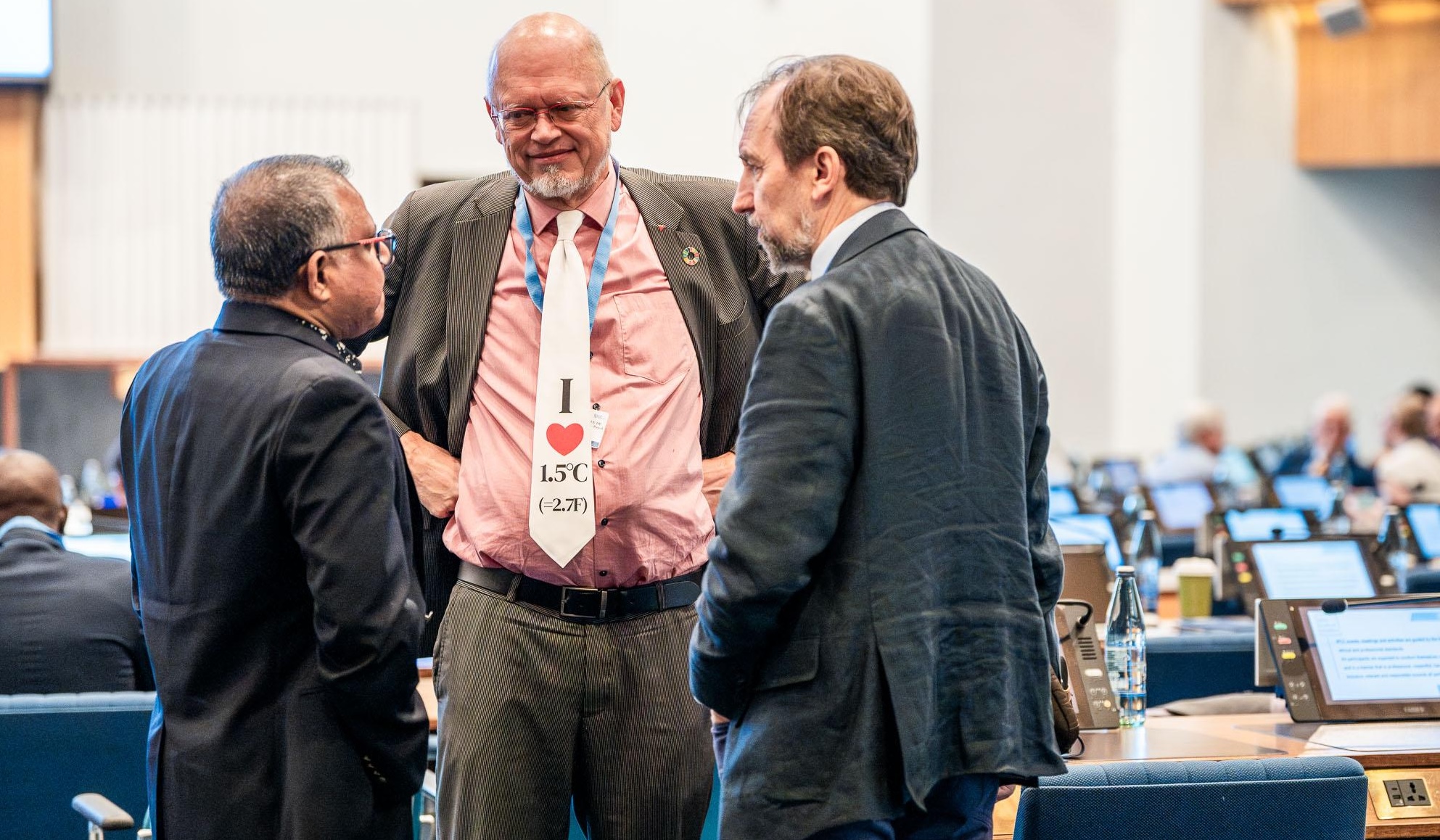
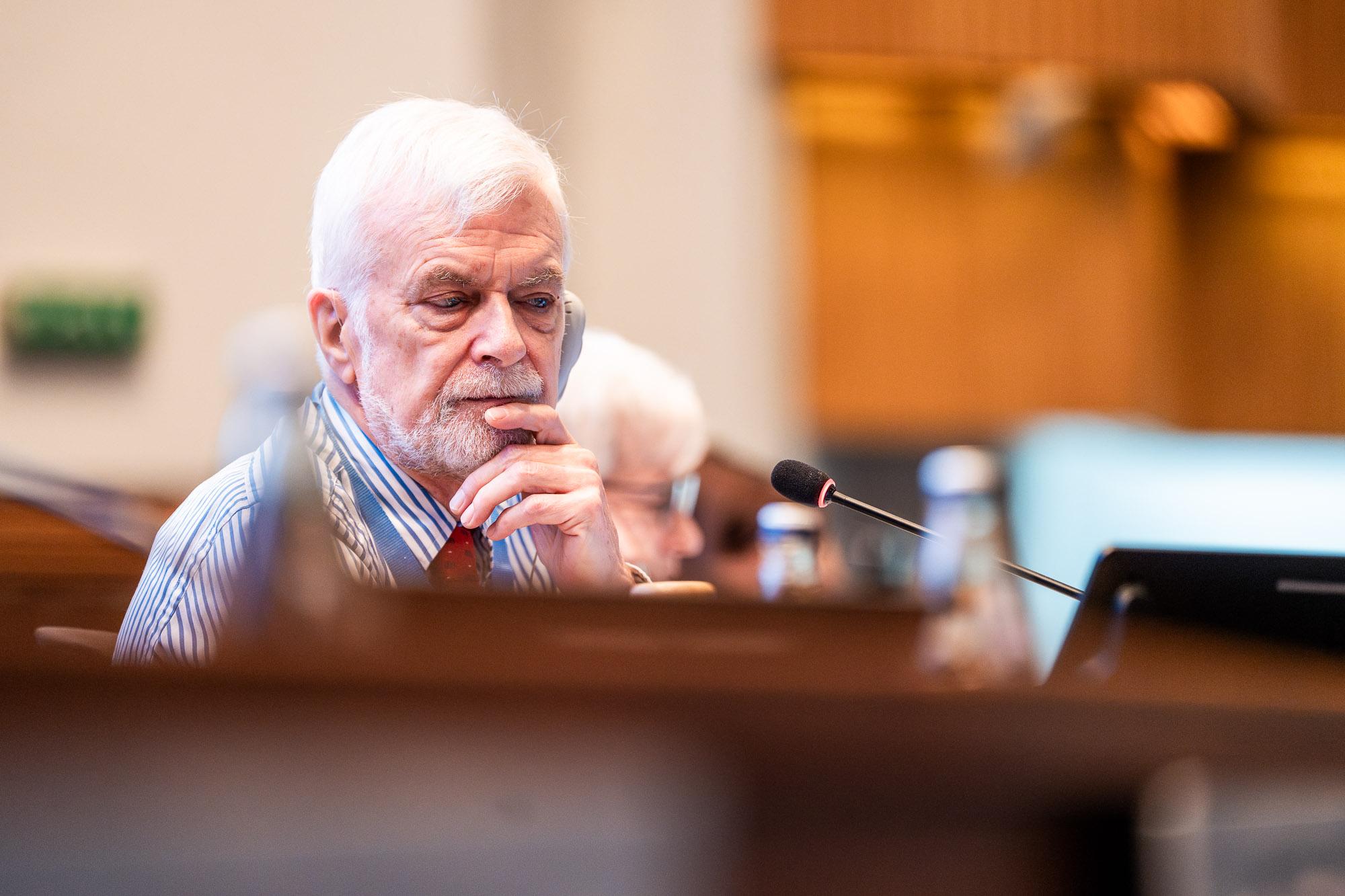
IPCC Chair Jim Skea told delegates in closing remarks that recent months had been some of the most turbulent for the climate science panel and that, if there were stronger words than “profound disappointment” he would use them, according to a summary published by the Earth Negotiators Bulletin (ENB). IPCC discussions happen behind closed doors.
IPCC scientists remained committed
In an open letter, issued on Monday, a group of nearly 120 scientists – from a total of 664 AR7 authors – said they “stand committed to continue working to deliver the AR7 reports in a manner that is rigorous, timely and inclusive, in line with our mandate to be policy-relevant”.
“An assessment that arrives after the decisions it is meant to inform cannot serve its purpose,” they emphasised. “The second Global Stocktake in 2028 is such a decision point, and the world should not have to face it without the IPCCʼs latest assessment.”
Europe, small islands and the least developed countries, plus many Latin American and developed nations, want the IPCC to meet this deadline, arguing that the findings from the UN climate science body are irreplaceable in the UN climate policy-making process.
However, around a dozen developing countries plus Russia have argued that the reports should come later in order to allow for greater research input from the Global South – something that, in their view, would make the findings fairer. They also claim that a shorter timeline would put excessive pressure on experts.
-
Who shapes climate science? The equity question facing the IPCC
Early completion of the next global climate science assessment reports risks excluding research from the Global South, which is key to ensuring the findings are fair -
Governments that support climate science must stand firm against naysayers
The IPCC is meeting to decide the timing of its next major report, as some countries try to delay it and weaken the case for faster emissions cuts


The most vocal of this group at last week’s meeting were India and Saudi Arabia, according to the ENB summary and a developed country diplomat. Critics see this push for a longer timeline as an excuse to deprive government decision-makers of the latest science and ease pressure on emerging economies to raise their ambition, particularly on cutting emissions.
Commenting on last week’s meeting, France’s ambassador for climate negotiations Benoît Faraco said a broad coalition of developed and developing countries from all five continents, “united in their support for science and the timeline proposed by scientists”, had withstood pressure “from a few countries” seeking to slow down the process of adopting the IPCC reports.
He added that France would not back down and would “continue to fight tirelessly for science, protect the integrity of information, and convince our partners that without the best available scientific data, we will be less effective in tackling climate change and protecting our populations”.
Inclusivity proposal stalled
In a bid to unlock a solution for the AR7 timeline, countries discussed ways to improve the inclusivity of the IPCC’s work. One option put on the table was for the IPCC to expand its funding for delegates from developing countries to attend some or all of its sessions from one to two participants, according to the ENB summary and a delegate speaking to Climate Home News.
That would increase the costs for the IPCC to complete AR7 by up to a quarter, according to an assessment shared by the secretariat. The panel’s budget is under severe strain and its officials have warned that, without additional voluntary contributions, it risks running out of money before it can deliver on this assessment cycle.
Climate Home News understands that some of the IPCC’s traditional donors – which mainly include European countries, Japan and Australia – indicated a willingness to support funding for an additional developing country participant. But without an agreement over the budget or the timeline for the reports, that option was ultimately not adopted.
‘Disappointed and worried’
The three reports are managed by working groups that collate and draw overall findings from the latest scientific studies and data on the physical effects of global warming around the world, how to adapt to it, and pathways for cutting planet-heating emissions in order to meet the temperature goals of the Paris Agreement.
Winston Chow, an urban climate professor at Singapore Management University who co-chairs Working Group II on adaptation, wrote in a LinkedIn post that he was “disappointed and worried” for the IPCC authors who have worked “extraordinarily hard” to assess the relevant climate science over the past two years.
He said he shared their concern that “the rigour, time and goodwill they’ve invested are now being put at risk by the Panel’s stalemate”.
As science comes under attack at UN talks, climate movement splits over how to respond
For Working Group II, a meeting for 250 experts writing that report is scheduled for January 2027, followed by the approval of a special report on cities and climate change in Singapore next March.
But because the IPCC’s budget has not been confirmed due to uncertainty about the AR7 schedule, travel support for those researchers is at risk, wrote Chow. “If they cannot participate, our assessments will lose vital expertise, perspectives and scientific breadth, and the collective effort of our authors will be undermined,” he warned.
Scientific work continues
Despite the political holdups, he – together with French climate scientist Robert Vautard, co-chair of Working Group 1 – agreed with IPCC head Skea who told the IPCC’s closing session on Friday: “The engine room of the IPCC is working, and it’s healthy.”
Vautard commented in a separate post on LinkedIn after it ended: “The boat is at full steam.” Working groups I and II are due to start revising the first drafts of their reports, while Working Group III on reducing emissions is finalising its first draft which will be out soon, he wrote.
“The most exciting two years of the cycle are ahead, for the authors. The momentum in the engine room is here and now. Trust the engine room!” he added.
The IPCC and some scientists report that progress has been made towards achieving an equitable balance of authors from the Global North and the Global South.
The group of researchers who signed the open letter on Monday noted that “inclusivity is at the heart of how we work”, with author teams bringing together experts from developed and developing countries with diverse backgrounds and at different stages of their careers.
Plea to overcome political differences
The signatories include several scientists from some of the countries opposed to the alignment of all IPCC reports with the Global Stocktake.
“We are committed to an assessment in which the knowledge, experience and priorities of every region are fully reflected, a commitment we share with the leadership of the IPCC.
Equity is built into how our assessment is being drafted,” they added.
They appealed to governments that make up the IPCC “to overcome their political differences and work together as we do as a global scientific community, so that we can deliver the IPCC reports the world needs to hear”.
In a statement published on Monday, IPCC chair Skea said reaching consensus on the schedule for the reports is “vital”. He added that the assessments provide authoritative scientific evidence to inform national climate policies, strengthen adaptation and resilience and support access to climate finance, as well as helping communicate the scale of the climate crisis and the urgency of efforts to tackle it.
The post IPCC scientists vow to press on with climate reports despite political deadlock appeared first on Climate Home News.
IPCC scientists vow to press on with climate reports despite political deadlock
An Lambrechts is a biodiversity politics expert at Greenpeace International with extensive experience in biodiversity-related multilateral negotiations. She is the head of the Greenpeace delegation at the Convention on Biological Diversity (CBD) COP17 happening in Yerevan, Armenia.
In 2022, COP15 delivered the landmark Kunming-Montreal Global Biodiversity Framework to halt and reverse biodiversity loss by 2030. With COP17 starting in Yerevan, we are now halfway to the deadline, and according to the first Global Review of progress, countries are not on track to meet the biodiversity targets, and implementation must accelerate fast.
One of the main findings of the Global Review is that funding falls far short of the scale needed to halt and reverse nature loss. But the crisis facing the world’s biodiversity is not an absolute scarcity of capital – it is a profound public policy distortion.
The global economy currently spends roughly $30 destroying nature for every single dollar invested in its protection. According to a report from the Intergovernmental Science-Policy Platform on Biodiversity and Ecosystem Services, a staggering $2.4 trillion is spent in public subsidies for fossil fuels, agriculture and water use, while global investment in biodiversity conservation and restoration stands at a mere $220 billion.
Countries urged to ramp up “insufficient” nature policies at COP17
Yet, discussions about how to close the biodiversity finance gap continue to claim that salvation lies in mobilising private capital, scaling offsets and “derisking” investments in nature. This is a fundamental misunderstanding of both the nature of ecological stewardship and of the global financial architecture.
Biodiversity conservation is not a speculative investment portfolio – it is the foundation of human survival. The health of our planet is a non-monetisable, non-excludable public good. Expecting profit-seeking private capital to protect nature perpetuates the structural drivers of ecosystem destruction in the first place.
But if private market mechanisms cannot save biodiversity, where will the necessary public resources come from?
Money going to the wrong places
The answer lies in recovering the vast public wealth currently drained by cross-border tax abuse, financial secrecy and corporate impunity. Finance and environment ministers meeting in Yerevan must give a strong political signal that, to avert ecological breakdown, countries need to take swift action to reform global tax rules, eliminate harmful public subsidies and cancel unsustainable sovereign debts for the public revenues to end up where they belong.
Extractive sectors such as industrial agriculture, fishing, timber and mining continue business-as-usual, often heavily subsidised by public treasuries, while voluntary carbon and biodiversity offset markets pose a serious risk to nature conservation. Offset schemes have delivered only a negligible fraction of the funding needed to preserve ecosystems, allowing industries to continue with their destructive business-as-usual practices.
-
Global deforestation slowed in 2025 but Brazil’s election could undo “fragile” gains
Countries remain 70% off track to meet a goal to end deforestation by 2030, as progress in Latin America offset by failures in Africa -
Brazil confident new rainforest fund will reach $10bn donor milestone
Brazil’s environment minister said the Tropical Forest Forever Facility has raised billions in record time – which he hopes will convince more investors


In advanced economies, public funding often actively undermines biodiversity. In Europe, over €5.3 billion in public subsidies is funnelled annually into intensive forest biomass harvesting under renewable energy directives, degrading primary forest ecosystems and undermining long-term climate resilience. Pleading with private investors to fill a “finance gap” while pouring billions into ecological destruction is an exercise in futility.
Developing countries struggle with debt burden
For developing countries, reliance on private finance is further compounded by a crushing sovereign debt crisis. In 2024, public debt in developing economies reached record levels, with net interes