

- Formal negotiations
- Finance
- Global review
- Global report
- Digital sequence information
- Harmful subsidies
- Marine biodiversity
- Planning, monitoring, reporting and review
- Article 8(j) implementation
- Biodiversity and climate change
- Links with other bodies
- Around the COP
- Armenian presidency
- Protests
- Lobbying and influence
- Carbon and biodiversity markets


© Greenpeace
The invigorating thing about public speaking is that you never quite know who is in the audience. There’s always a chance, of course, that someone wants to have a bit of a go at you, or maybe there’s an attendee with a particular take on things, who wants to ask one of those ‘questions that is more of a statement’; and then there’s those precious moments when the stars align and a memorable connection is made.
A couple of weeks ago, I’d participated in a panel discussion at an event, and the crowd was beginning to dissipate when a couple of strangers approached me to introduce themselves and say ‘hello’.
It turned out that Helen, Miranda, and I had all been in the same room in April, when each of us was part of the Greenpeace contingent inside Woodside’s 2026 Annual General Meeting in Perth, though we did not meet that day.
AGMs are significant set-piece occasions for companies, at which their corporate leadership wants to project competence and boost investor confidence. But for those of us with other concerns on our minds, an AGM is an opportunity to hold corporate leaders to account.
This year, a significant number of community advocacy groups, including Greenpeace, were present at Woodside’s AGM to challenge the company on its plans to drill for gas around Scott Reef—Australia’s largest freestanding oceanic reef atoll, and host to an incredible array of rare and endangered creatures, including green sea turtles and pygmy blue whales.
My role was to accept a shareholder proxy, suit up, and ask the company’s chair, Richard Goyder, some direct questions about the environmental damage that Woodside’s plans threaten to Scott Reef and the global climate.
Helen and Miranda, though, were present to play a completely different role. ‘We were a bit nervous that day’, Miranda told me. And no wonder, given what they were planning to do.
As new CEO Liz Westcott took the lectern, she was abruptly interrupted by a literally unearthly sound: whale song, playing from a speaker that Greenpeace activists had snuck into the room.
It was an aural haunting of Woodside’s AGM by the ghosts of its business strategy. Westcott opted to try to continue speaking, while security moved among the rows, attempting without success to work out where the sound was coming from.
When the whale track had played through, the relief on the podium felt palpable; but the return to corporate calm was short-lived.
Miranda, Helen, and other small groups of choristers—all evidently talented singers in their own right—began to stand up in small groups to perform a bespoke ‘Save Scott Reef’ variation on an iconic Australian song:
Hands off Scott Reef
Don’t be so Reckless
She don’t like that kind of behaviour…
It is a cliche, but true, to say that bravery comes in many different forms. It demands guts and resolve to stand up in a closed and heavily securitised room, with an unsympathetic audience; and to sing a song of no denying to one of the most powerful corporations in Australia, unaccompanied, from a cold start, with only your voices to fill the cavernous corporate space.
It was a wonderful thing to witness: the moral clarity of the message and the bold cheekiness of the activity; and a profoundly galvanising thing to feel, the indefatigable lifting of the spirit that we experience when we hear human voices rising in harmony and purpose. Miranda, Helen and their mates were brilliant.
Don’t be so Reckless…
As each small group rose in choreographed turn to pick up the song, they were apprehended by security and escorted out, singing to the last, as they were exited from the room.
Already, more than 500,000 people have joined the campaign to stop Woodside from drilling gas at Scott Reef. So when Helen, Miranda and friends stood up to sing, they did so on behalf of more than half a million people.
‘I’d never done anything like that before’, Helen told me, ‘I’d definitely do it again’.
Protest songs are both catalytic and emblematic of dynamic moments of social change. There is beauty, creativity, defiance, camaraderie and love to be found in singing together.
Helen and Miranda, it was great to meet you both. To you and all the other amazing folks who stood up and sang, thank you for your courage, commitment and the power of your voices. Your singing mattered for the half million, for the whales and the other creatures of Scott Reef, and for life in the ocean and on earth itself.
*As anyone of a certain age will probably recognise, the phrase is derived from the Midnight Oil anthem, US Forces.

Q and A

A few people have asked me recently about where the implementation of the national nature law reforms stand? Specifically, It seemed like good news when the Environment Protection and Biodiversity Conservation Act (EPBC) reforms were passed last year, but now it appears that they could be going wrong in the implementation. What’s happening?
We welcomed the Australian parliament’s passing of long-awaited nature law reforms just before Christmas last year as a fulfilment of an election promise, but remained clear-eyed that the proof of these reforms would be in how well they were implemented.
At this stage, the first two draft National Environmental Standards (NES) released by Federal Environment Minister Murray Watt’s department fall well short of what is required to actually protect nature. So things are once again in the balance.
The NES are the rules intended to guide decisions on projects that require assessment under the EPBC Act. They should draw a hard line to protect nature, but instead, the proposed standards are full of loopholes that legal experts warn are inimical to achieving the whole point of the Act–the protection of nature.
Glenn Walker who is Greenpeace Australia Pacific’s Head of Nature Program has mapped out the shortcomings of the NES in great detail on our blog. Greenpeace has made is views clear to both the Federal Environment Department and Minister Murray Watt, urging that the NES must be fixed, as have many others.
We are continuing to work closely with other environmental organisations, both to engage closely and to campaign publicly–there is still the opportunity to get this right to achieve the potential of the amended EPBC Act to actually do what it says on the cover–protect the environment.
Continue Reading
Prepared by a coalition of nine Western Australian union, industry, conservation, and community organisations—including UnionsWA, the Conservation Council WA, and the Smart Energy Council—the WA Clean Energy, Jobs & Industry Plan provides a practical roadmap to transform Western Australia into a clean energy powerhouse while creating thousands of secure local jobs.
Western Australia stands at a pivotal crossroads: lead the global clean energy economy or watch investment, future industries, and secure jobs go elsewhere. The WA Clean Energy, Jobs & Industry Plan outlines a transformative blueprint to harness the state’s world-class solar and wind resources. Discover how legislated renewable targets, green iron manufacturing, and a dedicated regional training strategy can generate tens of thousands of local jobs, lower household bills, and build a resilient, net-zero future for all Western Australians.

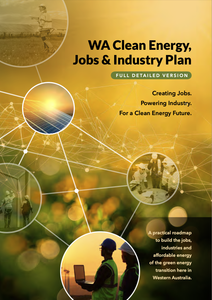
WA needs a clear and forward-thinking plan if it is going to become a competitive renewable energy powerhouse and maintain its economic strength through the energy transition.
“Western Australians know a faster renewable energy transition will lower their household expenses and prevent harmful climate pollution. But the community also needs clear direction to ensure this transition will create jobs, lower costs and not cause undue environmental harm.
“Here, sectors representing a broad range of interests have laid the groundwork for those outcomes, clearly outlining what is needed to create a future for WA that is good for the environment, for the climate, for workers and for the economy.
Summary
The WA Clean Energy, Jobs & Industry Plan sets out a strategic roadmap to position Western Australia as a global clean energy superpower while creating thousands of secure local jobs.
The report establishes three overarching goals:
- Creating local employment.
- Maintaining industrial competitiveness.
- Lowering household energy costs
To realize this vision, the framework details actionable measures to follow on from the recent WA Government announcement of a 75% Renewable Energy Target by 2031 for the South West Interconnected System. This includes developing a statewide Renewable Energy Target, coordinating statewide workforce and training pipelines, strategically planning regional infrastructure to safeguard high-value biodiversity and cultural heritage, and ensuring equitable benefit-sharing through household electrification incentives and First Nations equity partnerships. Ultimately, the plan highlights that establishing clear policy and regulatory certainty will unlock lower energy bills, boost power reliability, and secure the state’s global competitiveness in emerging green commodity export markets.

Key Findings
- Statewide Renewable Energy Target and Emissions Reduction Targets: The report calls for a statewide RET and 1.5°C aligned emission reduction targets to remove policy risk, lower capital costs, and attract clean energy investment.
- Transformative Job Creation: Accelerating the transition offers massive employment prospects, including up to 8,800 solar and battery jobs by 2050, as well as 24,000 ongoing and 11,000 construction jobs in a commercial green iron industry.
- Industrial Electrification & Competitiveness: Requiring large gas users to adopt binding electrification timetables and providing concessional financing will protect existing energy-intensive manufacturers from rising energy costs and impending domestic gas shortfalls.
- Green Commodity Export Leadership: Western Australia can build new export markets in green iron, green ammonia, and offshore oil/gas decommissioning by constructing shared common-user infrastructure and setting dedicated Green Commodity Export Targets.
- Coordinated Workforce & Training Pipeline: To address critical skill shortages the plan recommends establishing a WA Clean Energy Jobs Plan 2050, three regional training hubs, and dedicated pathways for female and under-represented apprentices.
- Environmental Safeguards & Community Benefits: Fast-tracked development must be paired with State Planning Policies that avoid high-biodiversity and cultural heritage lands, mandate new data centres to run on additional renewable power, and deliver household electrification rebates and First Nations equity partnerships.
What you can do
WA has an opportunity to lead on sustainable, clean energy and associated industries. You can help by:
- Sending an email to Environment Minister Murray Watt and Prime Minister Anthony Albanese, calling on them to reject Browse.
- Sharing this story to help more Australians understand what’s at stake.
- Encouraging your friends and family to take action.
Countries have completed the first “global review” of their progress towards reversing nature loss by 2030 at the COP17 biodiversity talks in Yerevan, Armenia.
The review “notes with deep concern” that, unless action is “rapidly accelerated”, the goal to reverse nature loss and meet a set of 23 targets by 2030 “will not be achieved”.
It “urges” countries to accelerate action, including by “increased ambition in addressing the gaps”.
Much of the discussions in Yerevan focused on how to raise the necessary funds to help developing countries protect nature.
Some major economies pushed to expand the range of nations that are expected to provide finance, with countries agreeing at the end of the two weeks of talks that non-donors that want to contribute can “signal interest” before COP18.
This came after developed countries failed to meet a target to significantly ramp up nature finance over the last few years.
It also came as a landmark fund agreed at COP16 in Colombia to pay communities for the genetic resources derived from nature stands nearly empty two years on.
The Yerevan talks marked the halfway point of the “Kunming-Montreal Global Biodiversity Framework” (GBF), the “Paris Agreement for nature” first made in 2022 and due to be achieved by 2030.
During the nearly 12-hour-long final plenary, countries voted for Quito, Ecuador, to host the COP18 nature talks, which will be held in 2028.
Countries managed to sign off on all the major negotiation texts, marking a stark contrast to COP16, which ran so far over time that the Colombian presidency lost “quorum”, forcing talks to resume in Rome months later.
Below, Carbon Brief has detailed analysis of all of the key outcomes from COP17.