

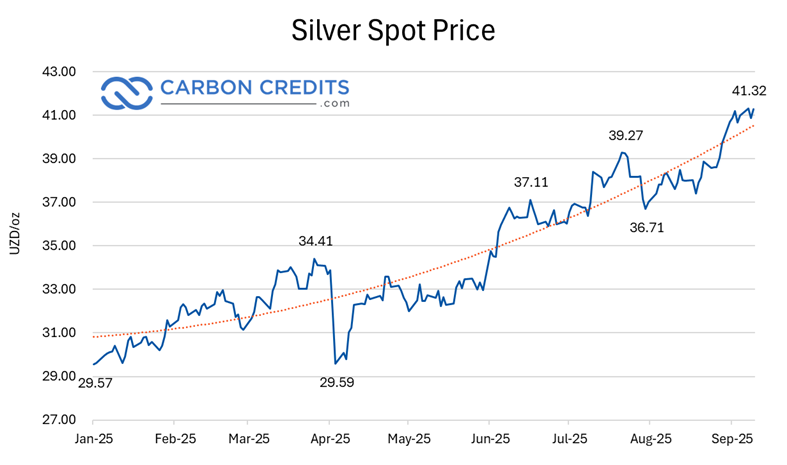
Silver prices are making headlines once again as the metal approaches its highest levels in more than a decade. On September 10, 2025, silver traded in the range of $41 to $42 per ounce in global markets, holding near levels not seen since 2011.
In the United States, the silver spot price stood at $41.2 per troy ounce, with futures trading slightly higher at around $41.50 per ounce. The day’s trading range stretched between $41.44 and $42.12, showing strong investor activity.
In India, one of the largest silver markets, the Multi-Commodity Exchange (MCX) saw silver climb to around ₹125,000 per kilogram. That represents a nearly 45% gain so far in 2025, outpacing the performance of both gold and the country’s stock markets.
This price surge has placed silver at the center of global commodity discussions, drawing comparisons with gold’s record-breaking rally.
What Is Driving Silver Higher?
Several forces are converging to push silver toward decade-high levels.
One of the most important drivers is monetary policy. With the U.S. Federal Reserve expected to cut interest rates later this year, both the U.S. dollar and bond yields have weakened.
For investors, this lowers the opportunity cost of holding precious metals. These metals don’t pay interest or dividends, but they usually retain value during economic uncertainty.
At the same time, silver plays a unique dual role. Like gold, it is a safe-haven asset, often sought out during times of geopolitical tension or financial instability. Yet silver also has extensive industrial uses, making it more sensitive to global economic trends.
The demand from industries such as electronics, semiconductors, and especially renewable energy is particularly important. Silver is a critical material in solar panels, where it is used in photovoltaic cells to conduct electricity.
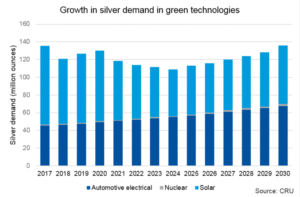
As countries accelerate their shift to cleaner energy, demand for silver in solar technology is growing rapidly. Electric vehicles (EVs) and 5G technology need a lot of silver. This boosts long-term demand even more.
In July 2025, the U.S. Department of the Interior added silver to its draft list of critical minerals, recognizing its strategic importance for clean energy technologies. The designation highlights silver’s essential role in solar panels, electronics, and the broader transition to a low-carbon economy
- SEE MORE: U.S. Releases New Draft Critical Minerals List: Silver and Copper Join the Clean Energy Race
Silver vs. Gold: A Tale of Two Metals
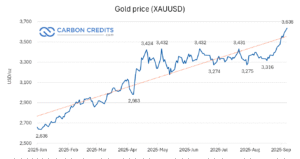
The silver rally is unfolding alongside gold’s historic surge. On the same day, silver touched $41, and gold set a new record at $3,671 per ounce. Both metals are gaining from investors looking for safety in uncertain times. However, their price trends are different.
The gold-to-silver ratio, which measures how many ounces of silver are equal to one ounce of gold, remains at elevated levels historically. A high ratio suggests silver may be undervalued compared to gold, leading some analysts to argue that silver could have more room to rise.
For investors, silver’s lower entry price compared to gold also makes it an attractive option. Retail investors who may find gold too expensive often turn to silver as a more accessible precious metal investment. This affordability factor could bring additional momentum if gold continues to climb to new highs.
Flashback to 2011: Will History Repeat?
To understand today’s silver price rally, it helps to look back at history. The last time silver traded near these levels was in 2011, when it spiked close to $50 per ounce. At that time, global markets were still healing from the 2008 financial crisis. Investors put their money into safe-haven assets.
The rally was quick but brief. Silver prices fell as monetary policy tightened and demand weakened. That history brings up a key question for today’s market:
Will silver keep its momentum, or will it drop again when central banks change their strategies?
Some experts believe this rally could last longer. They point to silver’s rising industrial demand, which is linked to the energy transition. Unlike in 2011, silver today has a stronger fundamental base beyond just investment demand.
India’s Silver Fever: Fueling Global Momentum
India plays an especially important role in silver demand. The country has long been a major consumer of precious metals, and silver is widely used in jewelry, ornaments, and investment products.
In 2025, the MCX reported silver prices hitting a record high of ₹125,000 per kilogram. Some analysts say the rally might reach ₹150,000 if the momentum keeps going.
Silver’s strong returns this year have surpassed equities and gold for Indian investors. This makes silver one of the most appealing assets in the country’s commodity markets.
India’s rising demand affects global prices because it makes up a large part of silver use worldwide.
Green Silver: Mining Meets Clean Energy Goals
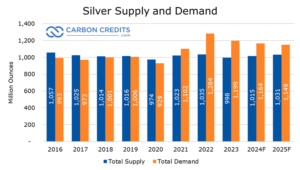
While demand for silver continues to rise, supply growth has been slower. Silver is mined both as a primary product and as a byproduct of other metals such as lead, zinc, and copper. Global mining output has struggled to keep pace with growing demand, tightening the market balance.
Another factor shaping the silver industry is sustainability. Mining companies face growing pressure to cut carbon emissions, use renewable energy, and lessen their environmental impact.
Silver plays a vital role in clean technologies, especially solar energy. Because of this, there’s increasing focus on making sure its production meets global climate goals.
Who’s Leading Silver’s Green Shift?
Major mining companies aim for net-zero by 2050. Some are already using renewable energy in their operations. This adds to silver’s investment story. It’s not just a metal for clean energy; the industry is also moving toward more sustainable practices.
Investors want to be sure that silver production meets environmental, social, and governance (ESG) standards. Several of the world’s largest silver producers have introduced ambitious sustainability goals:
Fresnillo plc (Mexico):
The company is the biggest primary silver producer in the world. The company plans to cut its carbon footprint by switching to renewable energy for its operations. The company aims for a 50% cut in greenhouse gas emissions by 2030. It has started using solar and wind power at its mining sites in Mexico.
Pan American Silver (Canada):
Pan American has pledged to reach net-zero greenhouse gas emissions by 2050. It has invested in water recycling systems. It supports energy efficiency programs. It also protects biodiversity around its mining projects in South America. The company also publishes detailed annual sustainability reports that track emissions, safety, and community engagement.
First Majestic Silver (Canada/Mexico):
First Majestic has focused on reducing its environmental impact by upgrading processing technologies that minimize water and chemical use. The company has also increased the share of hydropower and solar energy in its electricity mix. First Majestic also backs community development in its operating regions. This ties sustainability to social responsibility.
Hecla Mining (U.S.):
As one of the oldest U.S. silver producers, Hecla has modernized its operations to improve safety and reduce emissions. The company has set a net-zero by 2050 goal and is currently working on electrifying parts of its mining fleet. Hecla also highlights worker safety and inclusion programs as part of its ESG priorities.
These efforts highlight an important trend. The silver industry is supplying materials for clean energy tech. At the same time, it is also undergoing its own green transformation. For investors, silver companies with strong ESG strategies might gain from rising demand and good sustainability ratings.
The Road Ahead: Can Silver Hold the Shine?
Looking ahead, the outlook for silver depends on a mix of short-term monetary policy and long-term industrial trends.
In the near term, the Federal Reserve’s decision on interest rates will be critical. A rate cut could weaken the dollar further and support additional gains in both gold and silver. However, if U.S. economic data surprises to the upside, it could dampen expectations and cool off the rally.
Over the longer horizon, silver’s industrial demand appears solid. With global investment in solar energy and EVs accelerating, silver’s role as a “green metal” is likely to remain strong. Supply constraints could amplify this trend, pushing prices higher if production struggles to catch up.
Some analysts think international silver prices might rise above $45 per ounce soon. They also believe Indian prices could reach ₹150,000 per kilogram if both global and local demand keep growing.
For investors, silver offers both a hedge against economic uncertainty and exposure to the growth of renewable energy and electric vehicles. Risks are still present, especially if interest rates change suddenly. However, the fundamentals show that silver’s position in global markets is stronger than ever.
With gold setting new records and silver price climbing toward decade highs, 2025 is shaping up to be a defining year for precious metals.
- READ MORE: Gold Price Today Surges to All-Time High at $3,671 as Miners Push ESG and Carbon Reduction Goals
The post Silver Price Nears Highest Level Since 2011 Amid Precious Metals Rally appeared first on Carbon Credits.

The accounting differences that decide whether your nature investment shows up in inventory, in BVCM, or nowhere at all.
The question reaches a procurement team about three weeks before the next sustainability committee meeting. Someone has read about insetting. Someone else has just signed off on an offset purchase. The CSO wants to know if the two are interchangeable. The answer is no, and the GHG Protocol Land Sector and Removals Standard is the reason why.
This article walks through what each term means at audit-grade specificity, what the standards actually say about how each gets counted, and how to decide which tool fits which target. The insetting vs offsetting question is one of the most-searched in corporate climate strategy, and one of the most poorly answered. By the end of this piece, you should be able to brief a committee on the difference without notes.
The two definitions, in plain English
Offsetting means buying carbon credits generated outside your value chain and retiring them against your residual emissions. The reduction happens somewhere else, financed by you, and the credit is the receipt.
Insetting means investing in emission reductions or removals inside your own value chain, typically with suppliers, where the reduction is directly linked to the products and services you buy. The reduction happens inside the boundary of your Scope 3 inventory, and the accounting treatment is fundamentally different.
The shorthand from the University of Oxford’s Nature-based Insetting Initiative is useful: insetting is what you do with the supply chain you have; offsetting is what you do with the supply chain you do not have.
What the GHG Protocol Land Sector Standard actually says
The GHG Protocol Land Sector and Removals Standard, finalised in 2024 after a multi-year pilot, sets the rules for how land-based emission reductions and removals enter corporate inventories. The Standard distinguishes between inventory accounting (Scope 1, 2, and 3) and project or intervention accounting (a separate methodology for crediting).
For insetting, the practical implication is that supplier-level interventions, when properly measured and attributed, can reduce your Scope 3 category 1 (purchased goods and services) emissions in your inventory. The reduction is not a credit retired against the inventory; it is a lower inventory number, period.
For offsetting, the credit is retired separately. It can be reported as a contribution toward a net-zero claim under the SBTi Beyond Value Chain Mitigation framework or as part of a VCMI Carbon Integrity claim, but it does not lower the inventory number.
A practical consequence: if your Science Based Target requires a 50% absolute reduction in Scope 3 emissions by 2030, insetting moves you toward the target. Offsetting does not. This single point of difference reshapes the procurement decision.
When insetting counts toward Scope 3 (and when it does not)
Insetting counts toward Scope 3 only when several conditions are met:
- The intervention must occur with an entity in your value chain.
- The emissions reduction or removal must be measured against a defensible baseline.
- The reduction must be attributed to your share of that supplier’s output, not double-counted with other buyers.
- It must follow the inventory accounting rules in the GHG Protocol Land Sector Standard, not the project accounting rules used to generate credits.
The most common failure mode is double counting. If your supplier sells the same reduction as a credit on the voluntary market and also reports it to you as a Scope 3 reduction, the math breaks. The Standard requires you to address this risk, typically by purchasing and retiring the supplier-issued credit as part of your inventory or by contractual provisions that prevent the supplier from selling the reduction twice.
When insetting does not count toward Scope 3: when the intervention sits with a supplier you do not buy from, when the baseline is not defensible, when the attribution is unclear, or when the documentation does not survive audit. Those cases default to Beyond Value Chain Mitigation, which is still useful but operates on a different ledger.
The procurement and supplier engagement question
Insetting is harder than offsetting. That is the unfashionable truth most buyers eventually confront. Offsetting is a transaction; insetting is a relationship.
To run an insetting program, you need supplier mapping precise enough to know which farms or facilities sit at which Scope 3 boundary. You need an engagement model that gets suppliers to participate, which usually requires multi-year commitments and shared economics. You need an MRV architecture that measures the right things and produces audit-ready documentation. And you need a contractual structure that prevents double counting and protects both sides.
The trade-off you receive in return is significant. Reductions count against your inventory rather than your residual. Supplier relationships deepen, which protects sourcing continuity. Yield and quality improvements often follow regenerative interventions, which reduces your input cost over time. And the regulatory file, under CSRD, CSDDD, EUDR, and the SBTi FLAG Guidance, is materially stronger.
Choosing the right tool for the right target
A practical decision rule. If your target is a science-based Scope 3 reduction and you operate in a FLAG sector or source FLAG commodities, insetting is the structurally correct tool. If your target is a net-zero claim that includes neutralising hard-to-abate residual emissions outside your value chain, BVCM via high-integrity offsets is the structurally correct tool. Most companies with material Scope 3 exposure need both, in different proportions, sequenced over time.
The sequencing matters. Insetting takes longer to stand up but produces a permanent reduction in the inventory. Offsetting can be transacted faster but does not change the inventory and now sits under tighter claim restrictions. Treat them as complementary tools with different jobs, not as substitutes. The Accountability Framework Initiative and the IUCN Global Standard for Nature-based Solutions both provide useful guardrails for the insetting side, with biodiversity, human rights, and benefit-sharing requirements that go beyond carbon math.
If you are mapping a Scope 3 reduction roadmap and need to scope which interventions count toward your inventory versus which sit in Beyond Value Chain Mitigation, the carbon and sustainability experts at Carbon Credit Capital can help you structure a nature-based supply chain investment program that fits your FLAG exposure, your target architecture, and your audit horizon. Schedule a consultation.
Net zero is often described as a balancing act: cut what you can, account for the rest, and reach zero on the ledger. That framing is useful, but it leaves something out. It treats every tonne of carbon as interchangeable and every route to zero as equally sound, while the science tells a more specific story.

Malawi has lost a striking share of its forests over the past three decades. Woodlands that once covered well over a third of the country now cover less than a quarter, and the pressure on what remains is increasing. Behind those figures sit two practical questions: what is driving the loss, and what reverses it?




-
Climate Change1 year ago
Guest post: Why China is still building new coal – and when it might stop
-
Greenhouse Gases1 year ago
Guest post: Why China is still building new coal – and when it might stop
-

 Greenhouse Gases2 years ago
嘉宾来稿:满足中国增长的用电需求 光伏加储能“比新建煤电更实惠”
-

 Climate Change2 years ago
嘉宾来稿:满足中国增长的用电需求 光伏加储能“比新建煤电更实惠”
-
Climate Change2 years ago
Bill Discounting Climate Change in Florida’s Energy Policy Awaits DeSantis’ Approval
-

 Renewable Energy10 months ago
Sending Progressive Philanthropist George Soros to Prison?
-
Greenhouse Gases1 year ago
嘉宾来稿:探究火山喷发如何影响气候预测
-

 Carbon Footprint2 years ago
US SEC’s Climate Disclosure Rules Spur Renewed Interest in Carbon Credits