

In a Q&A with Climate Home News, the head of sustainability at global lighting company Signify explains how the firm is doubling down on its efforts to protect the climate and strengthen resilience.
In March, Signify launched its latest corporate sustainability programme, “Brighter Lives, Better World 2030”.
The programme is the third iteration of a project that started in 2016, aimed at shifting how the company – and its customers – can reduce their environmental impact.
It centres on enhanced targets to improve energy efficiency, cut greenhouse gas emissions and promote the circular economy. In addition, Signify has set itself a challenging goal to source 41% of its revenue from solutions “that support benefits beyond illumination” by the end of 2030, up from 31% in 2024. Those benefits include efficient food production and increased access to solar lighting.
Signify is aiming to save 60 terawatt hours (TWh) of electricity for its customers; achieve a 35% reduction in the CO2 emissions intensity of its portfolio; and grow its circular product business from 10% to 27.5% of revenue.
Climate Home News spoke with the company’s global head of sustainability, Maurice Loosschilder, to find out how the Netherlands-based multinational plans to reach its targets despite a tough political landscape for green action.
Q: How does Signify’s new sustainability programme build on lessons learned from previous versions?
A: If we look back a little bit, it is a natural next step. Signify [formerly Philips Lighting] became a standalone company roughly 10 years ago and in 2016 we launched our first “Brighter Lives, Better World 2020” programme at the same time.
The first programme mirrored developments in the lighting industry and was very much based on our own operations: reaching 100% renewable electricity, zero waste to landfill in our manufacturing facilities, increasing the energy efficiency in our own portfolio.
Since then, we’ve moved on to think about our entire value chain and the wider social contributions we want our work to be making. But we still want to be thinking about how to improve our own business. Our continued target to double the amount of women in leadership positions is an example of that.
Q: Looking at the political climate, both in the US and Europe, there isn’t the same concern for environmental issues as there was a few years ago. Many corporates are perceived to be rolling back on their environmental commitments. How are you as a company navigating some of these challenges?
A: This is not something new. If we look back on the last five to 10 years, we’ve seen a lot of disruption and change in the market. We’ve had a global pandemic, supply chain disruptions, energy insecurity. At the same time we’ve seen the increased impacts of climate change and all of that is changing the dynamics of doing business right now.
I think these changes have really tested resilience – the resilience of companies, the resilience of people, the resilience of societies. We really believe that resilience is becoming more and more important to businesses right now. And if you look at what a resilient company is, it is one that decarbonises faster, invests in people, invests in circular solutions and makes its business model more circular. And that’s exactly what we have focused on. It’s about making sure we can cope, and help our customers cope, with changing market circumstances and the geopolitical tensions we see in the world.
Q: Turning to your own commitments, do you feel you have set the right balance between ambitious and achievable?
A: Yes, we strongly believe this programme is the right one for us and our customers, and has been informed by a thorough double-materiality assessment. It is built on three pillars: benefits beyond illumination, energy efficiency and resource efficiency. These are supported by new initiatives, such as Signify Circle, which will support professional customers with their circular economy ambitions.
If we just look at the first pillar, it’s about the positive impact that lighting brings, in terms of productivity, in terms of safety, in terms of food availability, health and well-being, and now we have added solar in there. This is what we mean by “benefits beyond illumination”.
Q: If we take one of your targets to save 60 TWh of electricity for your customers, that seems quite hard to work out. Do you find data availability to be an issue?
A: Data is a challenge in sustainability, but we have been measuring our avoided emissions for years, so we know the data requirements behind it. We’ve done all our homework and with that we have set this target.
The 60 TWh figure is about the annual electricity usage of Switzerland so it is a substantial amount. But it also reflects the role that lighting plays in general. If you look at a typical city, street lighting alone accounts for about 40% of electricity use. So the potential is enormous.
The International Energy Agency reports that about 8% of global electricity use comes from lighting, and this translates into 2% of global greenhouse gas emissions. That’s really significant and why the opportunity here is so big.
Q: How has the new programme been informed by the UN’s Sustainable Development Goals (SDGs)?
A: Our strategic compass is the Sustainable Development Goals. We committed to six SDGs in the previous programme. The new one has been expanded to cover eight and we conducted a mapping exercise for each of the commitments. I’m hoping that, by the end of this programme, we will see a new version of the SDGs to replace the current goals when they expire in 2030. We remain committed to making our contribution to the SDGs.
Q: Are you seeing higher demand for circular products? What is it that attracts businesses to that option?
A: Yes, we do see an increased demand. For example, we see greater interest in “remanufacturing”, which is a circular business model where we take down the lighting, send it back to our manufacturing site, and upgrade it to the latest technology, but keep the majority of the hardware intact.
I think customers are becoming more and more aware of the fact that regulation is pushing resource efficiency on businesses. And in some countries we see incentives to use circular products, and penalties around sending certain material to landfill. More businesses are becoming aware of this and we strongly believe there is a market for circular products.
How off-grid solar is beating the odds to transform lives in rural Africa
Q: Do you have customers that are facing real resource pressures, in terms of scarcity, increased costs or supply chain constraints that are making them think more about circular issues?
A: The whole market is currently impacted by geopolitical tensions and the disruptions that come as a result. Light as a Service, for example, could be a way for businesses to de-risk because there is no capital expenditure involved. Customers see real value in only having to pay to keep it running.
If we look longer term, then resource and material efficiency is something the whole world should be thinking more about. How can we decouple economic growth from the increased use of natural resources? We believe the circular economy is the answer.
This interview has been shortened and edited for clarity.
Adam Wentworth is a freelance writer based in Brighton, UK.
The post Signify: “We believe resilience is becoming more important to businesses right now” appeared first on Climate Home News.
Signify: “We believe resilience is becoming more important to businesses right now”

Latin American governments cracked down on forest clearing in 2025, leading global deforestation to fall by the most this decade, but political shifts and the likely impact of a strong El Niño threaten to undo those “fragile” gains, a new report has found.
Seven million hectares of forests – roughly the size of Ireland – were lost last year, a 15% drop from 2024. This marks the first meaningful slowdown in deforestation since 145 countries committed to ending deforestation by 2030 at COP26 in Glasgow in 2021, according to an annual assessment of the pledge.
But the researchers cautioned that the world remains 70% off track from fulfilling that promise and, despite progress in Latin America, deforestation in tropical Africa, home to the Congo Basin, kept rising. For the first time, it nearly matched losses in Latin America – a trend the report’s publishers called “particularly ominous”.
Erin Matson, a lead consultant at Climate Focus and one of the report’s authors, said the slowdown in the rate of deforestation “is welcome news”, but last year’s figures “look good in part because previous years look so bad”.
She added that, at the moment, last year’s progress should be seen as an “exception and not a new trajectory because the underlying problem has not gone away”.

Lula’s policies drive progress
The decline in deforestation was primarily driven by reduced expansion of agriculture and cattle ranching in the Brazilian Amazon rainforest, thanks to a new deforestation action plan introduced by the Lula government and stronger enforcement measures, the report found.
“Brazil provides a concrete example of how national policies can be successful,” said Ana Flávia Corleto, legal analyst at Climate Policy Initiative in Brazil. “The combination of near real-time monitoring and targeted enforcement has contributed to a historical reduction in deforestation alerts in the Amazon, with a 36% decline between August 2025 and July 2026”.
-
Brazil confident new rainforest fund will reach $10bn donor milestone
Brazil’s environment minister said the Tropical Forest Forever Facility has raised billions in record time – which he hopes will convince more investors -
As El Niño intensifies, we should be investing more in the world’s farmers
Finance to help agriculture adapt to a hotter world and more extreme weather is vital for food security – but new data shows it’s on a downward trend


President Lula bolstered efforts to protect the vital Amazon ecosystem when he returned to office in 2023 after enforcement had deteriorated and deforestation skyrocketed under his far-right predecessor Jair Bolsonaro.
Neighbouring Colombia also contributed to the slowdown in forest loss in Latin America last year, posting a fourth consecutive year of falling deforestation, driven in part by reduced cattle-linked clearing.
Brazilian election puts gains at risk
But the researchers warn that this progress rests heavily on the choices of a small number of governments and it is “highly vulnerable” to political shifts in recent and upcoming elections across the Amazon basin.
On October 25, Brazilian voters will choose between Lula and Flávio Bolsonaro, the former president’s son, in a run-off election. Bolsonaro narrowly led the first round with 47% of the vote to Lula’s 45% and polls show the pair neck and neck.
In an interview with TV Globo in August, Bolsonaro said he did not believe in climate change, only in “cyclical” extreme weather events. As a senator, he voted in 2025 for a bill loosening environmental licensing rules.
Although he has pledged to end illegal deforestation by 2029, Brazilian environmental groups fear he could follow his father’s example of weakening forest protections. “Instead of restoring forests, we would face the dismantling of environmental safeguards, land grabbing, illegal mining, and deforestation,” Observatório do Clima, a network of climate NGOs, said on Tuesday. “At the worst possible moment in the global climate crisis, electing another Bolsonaro would be a gift to environmental crime and those who profit from the destruction of the planet”.
Climate Policy Initiative’s Corleto said changing political priorities in the Brazilian federal government can have significant consequences, especially for federal institutions and budgets. But she added that much of the country’s environmental policy is implemented at local or state level and some continuity can be expected there.
Deforestation growth in Congo Basin
Threats to forest conservation are already growing elsewhere in the Amazon region. In Colombia, recently elected far-right President Abelardo de la Espriella has repealed mining restrictions and promised to support oil and gas exploration, which the report’s authors said pose threats to forests.
Latin America has historically been the world’s deforestation hotspot but the second-largest tropical forest, Africa’s Congo basin, has been catching up, the assessment found. Deforestation in tropical Africa rose to 2.4 million hectares in 2025, almost level with the 2.5 million hectares lost across tropical Latin America and the Caribbean.
Forest loss there is driven primarily by smallholder agricultural expansion, logging, infrastructure development, and regulatory systems that lack either the capacity or the political mandate to counter those pressures, the authors found.
“We need to see states with very clear policies, strong legislation and very rigorous enforcement capacity,” said Samuel Nguiffo, a lawyer and founder of Cameroon’s Centre for Environment and Development. “Unfortunately, this is what we seem to be missing. There is a deficit in government capacity”.
El Niño threat
The report also warns that last year’s progress in keeping trees standing could also be eroded by a possible spike in forest fires fuelled by the so-called super El Niño weather pattern which could peak this December.
In Indonesia, which is severely affected by drought in El Niño years, wildfires are currently burning vast swathes of forest. Fire emissions in Indonesia are on track to match 2015, the country’s worst fire season this century, experts told Carbon Brief.
Matson said the world saw a “huge spike” in tree cover loss during the last “super” El Niño event in 2015 and expects to see a similar increase this year. “We can’t fully project the future, but it’s unlikely that in 2026, we’ll see the same kind of reductions that we saw last year”.
The post Global deforestation slowed in 2025 but Brazil’s election could undo “fragile” gains appeared first on Climate Home News.
Global deforestation slowed in 2025 but Brazil’s election could undo “fragile” gains
The UK government warned the Carbon Capture and Storage Association’s (CCSA) annual conference on Tuesday that the fledgling industry should prepare to receive less financial support from taxpayers in the future.
As the left-wing Labour government, under its new leader Andy Burnham, seeks to boost military spending in line with NATO allies, it is reportedly looking to cut funding for emissions-reduction projects, with subsidies for carbon capture and heat pumps among the projects in the firing line.
Martin McCluskey, a junior minister in the UK’s Department for Energy and Net Zero (DESNZ), told the CCSA conference in Westminster that, while the government supports the industry, “it is no secret that we are operating in a challenging fiscal environment and this government remains committed to meeting its fiscal rules”.
“So I owe it to you today to level with you,” he said. “The next phase of the CCUS (carbon capture, use and storage) programme will be in the context of broader, difficult decisions on funding. We must ensure that public investment is targeted where it can deliver the greatest value while continuing to build confidence in the long-term future of the sector.”

He warned that this may mean “making decisions about priorities, sequencing and pace and recognising that progress will not always happen everywhere at once”. “But this will also mean opportunity as we move beyond first-of-a-kind projects,” he added.
Earlier in the day, the energy ministry’s industrial carbon capture and storage (CCS) lead Stefanie Murphy was asked by an audience member if it had become clear that the government could not afford to support future carbon transport and storage projects at the same level as in the past.
“I think yes,” she replied. “We can all see the fiscal realities that we’re facing,” she said, adding that the government’s top priority is tackling the cost of living and, while it also wants to grow the economy, there are lots of competing priorities for its money.
She urged the industry to reduce costs and demonstrate its benefits in terms of job creation and regeneration of economically deprived areas.
-
Japan uses “diplomatic muscle” to push carbon capture as fossil fuel panacea
Two regional summits led by Japan, with a major focus on carbon capture and storage in Asia-Pacific, have drawn criticism from climate campaigners -
Q&A: “False” climate solutions help keep fossil fuel firms in business
Researcher Freddie Daley talks to Climate Home News about how fossil energy giants are using green technologies as a way to shore up their power -
Industry says carbon capture still an expensive last resort to cut emissions
Carbon capture players told a recent global conference that the technology remains a costly way to reduce CO2 and needs more government support


Opening the conference, the CCSA’s chief executive Olivia Powis made that case, arguing that CCS “engineers in Teesside, fabricators in Hartlepool, construction workers in north Wales” are “what reindustrialisation looks like”.
Speaking before the government officials took the stage, she warned that “this momentum is not inevitable. The first projects have created confidence because governments made commitments and industry invested against them.”
“If that commitment weakens now, investment and developers will not simply wait. They will go elsewhere. The UK has worked hard to establish itself as a global leader in CCUS. We cannot afford to lose that position just as delivery begins,” she said.
Eoin Devane, acting director of net zero for the UK government’s official advisers, the Climate Change Committee, said the government is relying on CCS to meet its carbon budgets and 2050 net zero target, but has “insufficient plans” to deliver these emissions cuts and there are “significant risks” it will fail.
Necessary but limited
CCS is when carbon dioxide is captured from a concentrated source – like a cement kiln’s exhaust – and then transported by pipeline, train or ship to be stored underground either at sea or on land.
It is controversial among many climate campaigners, as it is favoured as a solution to greenhouse gas emissions by fossil fuel companies that are keen to keep on making money both by producing more oil and gas and by storing carbon dioxide in reservoirs they have already exploited.
But experts describe it as having a necessary – although limited and expensive role – in the transition to clean energy. Scientists with the UK’s Climate Change Committee and the Intergovernmental Panel on Climate Change’s (IPCC) say it is required to help clean up the emissions of industries like cement and chemical production that are hard to replace with renewable electricity.
But the IPCC also says that CCS is one of the costliest ways to reduce climate-heating emissions. Whereas industries like solar and wind energy are now mostly profitable without subsidies, the CCS industry continues to rely on taxpayers for support.
Northern Lights, the crown jewel of Europe’s CCS industry, was 80% funded and “enabled very much” by the Norwegian government, its managing director Tim Heijn told the conference.
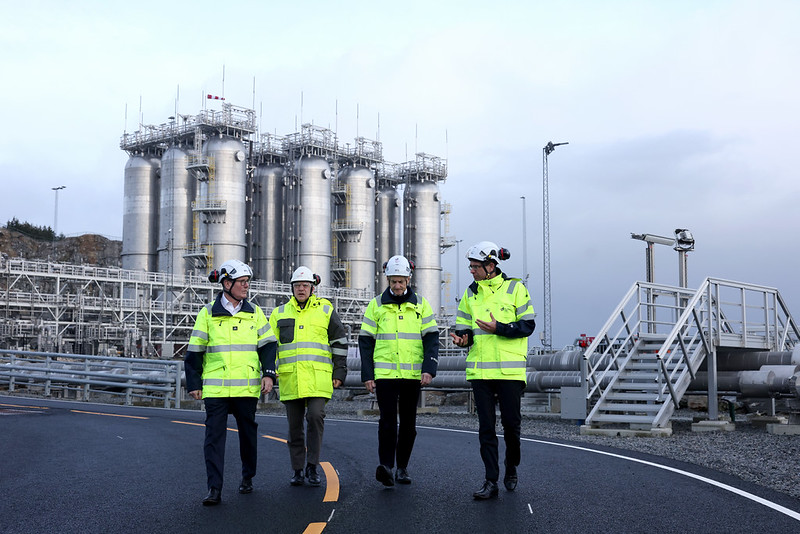
The project captures carbon dioxide from emitters ac