

Turkish officials in talks for the UN Environment Assembly (UNEA) sought to weaken language on climate change in several draft resolutions, annotated documents seen by Climate Home News show.
Often working alongside Saudi Arabia, Türkiye – host of COP31 next year – pushed to dilute wording on the climate crisis, the science of melting glaciers, and the role of young and Indigenous people, as well as on support for developing nations, in texts being prepared for approval in Nairobi this week. The final versions are still being worked out.
When asked about the issue by Climate Home News, a UN official close to the negotiations said that “certain countries” that don’t want climate change to be mentioned are now “more emboldened than they were ever before to come forward and protect their national interests”.
Türkiye’s actions have raised concern in particular. “It’s rather surprising,” said Öykü Senlen Gundogan, an analyst at think-tank E3G. “Senior Turkish politicians have often called climate change a crisis, and Türkiye is among the countries most exposed to its impacts.”
Türkiye will host COP31 in the city of Antalya in November 2026 and the meeting is expected to be presided over by Turkish environment minister Murat Kurum, but Australia’s Chris Bowen will lead the negotiations.
As host, “Türkiye will be expected to lead by example and ensure its positions are consistent with the ambition it asks of others,” Senlen said.
-
Brazil’s Lula requests national roadmap for fossil fuel transition
After countries failed to formally back a global energy transition roadmap at COP30, Brazil’s president takes the initiative by mandating a national plan -
Deep in the Amazon, forest protection cash must vie with glitter of illegal gold
The TFFF fund launched at COP30 aims to pay communities to protect the rainforest, but will it be enough? On French Guiana’s border with Brazil, the profits to be had from mining are far higher


Bill Hare, CEO of Climate Analytics, said Türkiye’s moves “look like denial of climate science and of the need for action. This is the last thing the world needs from a COP host.”
Hare noted that Türkiye’s national climate plan is considered “critically insufficient” by Climate Action Tracker – its lowest ranking which is shared by just a handful of countries.
“Instead of messing with the science, Türkiye needs to focus on strengthening its climate policies and implementation so it can be a forward-looking host of COP31, helping the world deal with the climate crisis that everyone else seems to recognise,” he told Climate Home News.
The Turkish government did not respond to a request for comment.
Push to weaken UNEA resolutions
The UNEA, which takes place every two years in the Kenyan capital, allows governments to propose and amend resolutions on environmental issues ranging this year from coral reefs to critical minerals and AI.
This time around, Saudi Arabia – often joined by Russia, Iran and Türkiye – tried to water down several texts, according to annotated drafts seen by Climate Home News. The US has not engaged, calling the UNEA “woke climate change theater”.
In a Fiji-sponsored resolution on coral reefs, Saudi Arabia proposed describing climate change and ocean acidification as “challenges” rather than “threats”.
The EU, for its part, wanted a reference in this resolution to “escalating challenges related to the climate crisis”, but Türkiye and Saudi Arabia suggested “challenges relating to the climate”.
Glacier science downplayed
In a Tajikistan-sponsored motion on preserving glaciers and the wider cryosphere, Türkiye opposed saying that “greater emphasis should be placed” on enhancing scientific work and forecasting of changes, with this information integrated into decision-making. Türkiye proposed just “recognizing the importance” of this work while Saudi Arabia objected to the whole reference to it.
Türkiye, Saudi Arabia, Russia and Iran sought to delete all or part of a sentence recognising that accelerated retreat and melting of the cryosphere – which includes glaciers – is caused by climate change.
Saudi Arabia also tried to weaken a reference to the UN’s goal to get everyone on Earth covered by early warning systems for climate disasters by 2027, changing “reaffirming” that goal to simply “recalling” it.
-
IEA: Slow transition away from fossil fuels would cost over a million energy sector jobs
A rapid transition would create enough new green roles to more than offset job losses in coal mines, power plants and oil and gas fields, a report finds -
Why the ICJ’s advisory opinion on climate change took a backseat at COP30
Vulnerable nations see the top court’s opinion as a route to reparations but high-emitting countries reject any legal liabilities over their role in the climate crisis -
China risks emissions rebound amid policy shifts, experts warn
Beijing’s policy changes on renewables pricing and an uptick in fossil fuel projects could cancel out clean energy gains and send emissions higher again, a new report warns


In several resolutions, Türkiye sought to remove or narrow references to Indigenous Peoples. Tajikistan proposed calling their role “crucial” and their knowledge “vital”. Türkiye wanted both adjectives deleted, and in another case suggested inserting “where applicable”.
Türkiye and Saudi Arabia attempted to downplay the role of young people too. The title of a Sri Lankan motion proposed enhancing their “meaningful participation” in “environmental governance”. Türkiye proposed changing “participation” to “involvement” and Saudi Arabia wanted to replace “governance” with “events”.
No approval for policy summary of key report
As UNEA opened on Monday, UN officials urged government delegates to show flexibility. UN Environment Programme head Inger Andersen said the world is in turbulent geopolitical waters, which adds “stresses and strains to the multilateral processes” and called on nations to step down “from the ramparts of individual positions to meet on common ground”.
But governments have already proven unable to approve a “summary for policymakers” of the UN’s seventh Global Environment Outlook (GEO-7) report, which outlines the financial costs of environmental degradation and the benefits of making the economy more environmentally-friendly.
In response to a question by Climate Home News, report co-chair and scientist Robert Watson said at a press conference ahead of its release that governments had been divided on issues around fossil fuels, plastics, a circular economy and conflict.
He told the BBC that a small number of countries – including the US, which disagreed with much of the content – “basically just hijacked the process” at an October meeting, meaning the document could not be approved as it requires consensus.
Instead of the expected summary for policy-makers, the authors produced an executive summary – which doesn’t require a green light from governments at the UNEA. Watson said it is still “a very good synthesis of what the larger [GEO-7] report says”.
The post Saudi Arabia and COP31 host Türkiye move to weaken climate language at UNEA appeared first on Climate Home News.
Saudi Arabia and COP31 host Türkiye move to weaken climate language at UNEA

For the first time, new-energy vehicles (NEVs) made up 67% of new car sales in China in September, according to the latest data from the China Passenger Car Association (CPCA).
The figures show that NEVs, which include battery electric cars and plug-in hybrids, captured a record share of sales, even though fewer were sold than last year.
This is because sales of combustion-engine cars are falling steeply, a trend that the CPCA has attributed to rising petrol prices following the start of the Hormuz crisis.
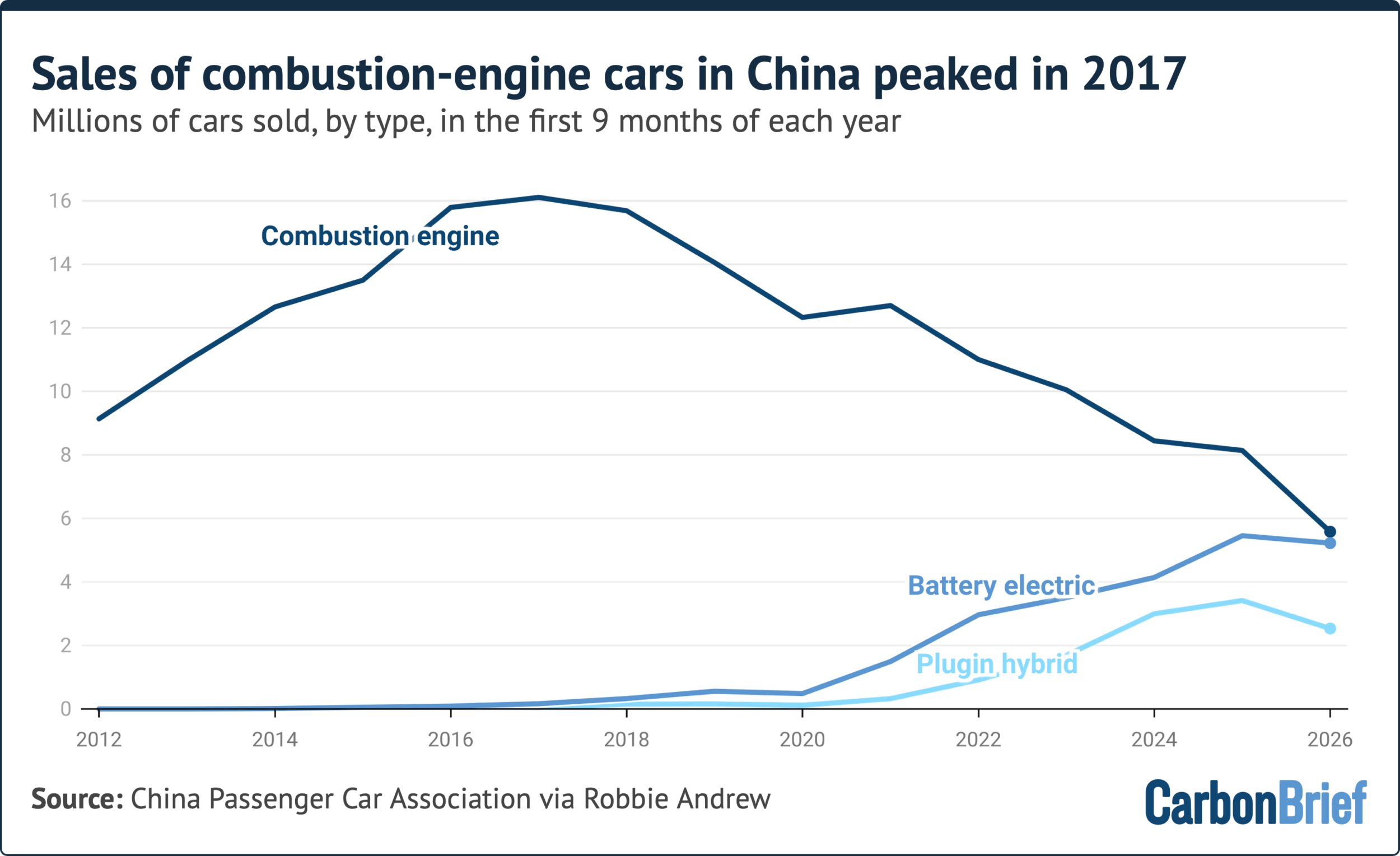
Indeed, sales of fuel-only cars were down 31% year-on-year in the first nine months of 2026, with plug-in hybrid sales down 26% – whereas battery EV sales were only down 4%.
One analyst tells Carbon Brief that China’s rapidly growing EV fleet has offset demand for 143m barrels of oil since the start of the Hormuz crisis.
Another says that the crisis is “reinforcing China’s electrification of road transport”.
Meanwhile, amid slowing domestic sales, Chinese carmakers’ exports of NEVs more than doubled [in 2026 to date / in September] from a year earlier.
NEV record
A record two out of every three cars sold in September in China were NEVs, according to CPCA data, as shown in the figure below.
(NEVs predominantly include battery electric vehicles – BEVs – and plug-in hybrids – PHEVs. BEVs only run on electricity, whereas PHEVs also have a combustion engine.)
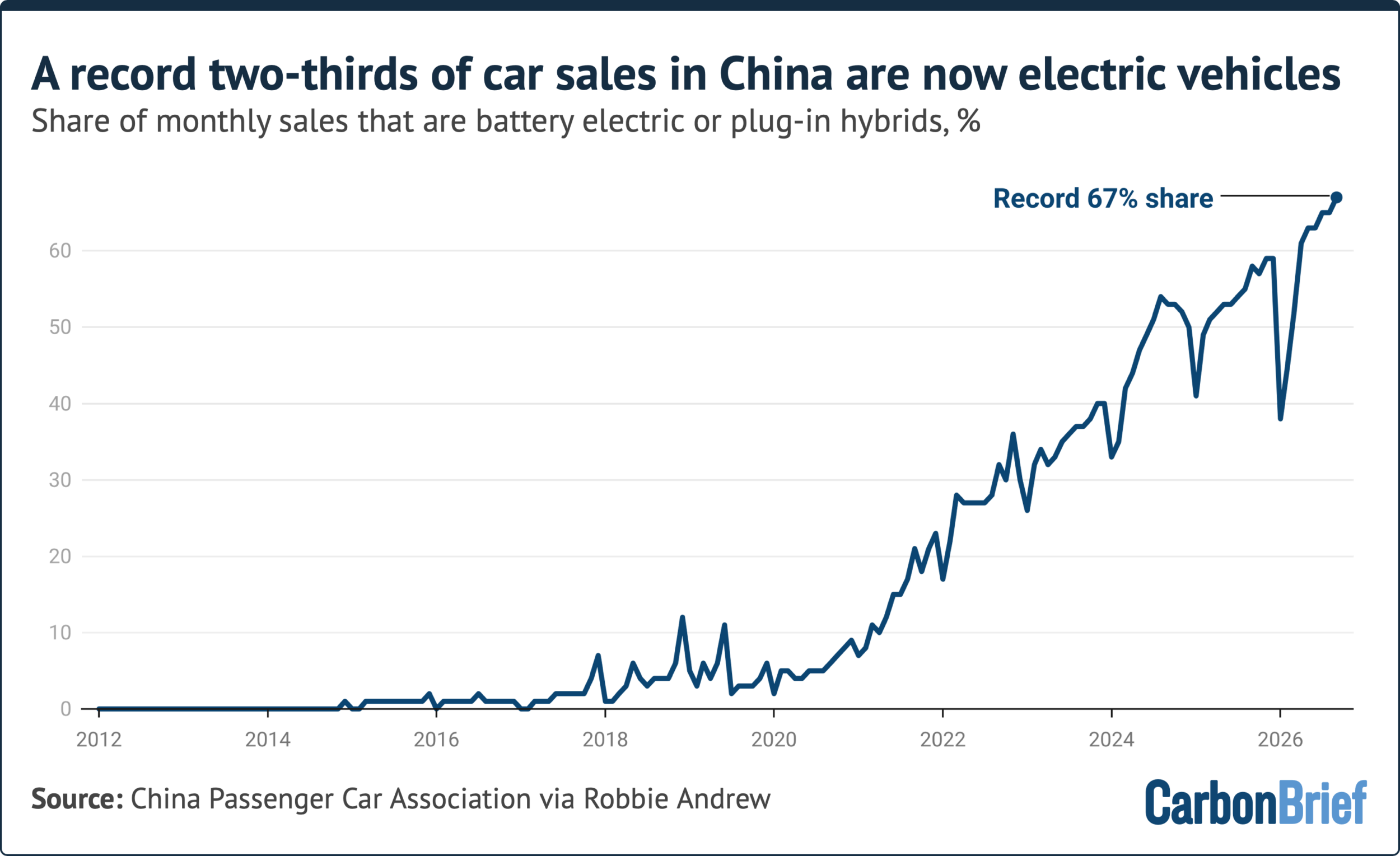
This marks a rapid rise for NEVs from just 6% of new car sales in 2020 up to 58% in 2026 to date – and a record 67% in the month of September.
This year, NEVs’ share of sales has also bounced back from a low of 39% in January, after the full purchase tax exemption that had been in place for more than a decade came to an end in December 2025.
The gain in NEV share in 2026 has come amid a slowdown across the wider domestic passenger-car market, which has hit sales of combustion-engine vehicles particularly hard.
This September, passenger-car retail sales across all categories declined, with overall sales volumes falling 28% year-on-year.
The contraction was led by combustion-engine vehicles, which saw sales fall 43% year-on-year in September and 31% in 2026 to date.
However, sales of PHEVs also fell by 36% year-on-year in September and by 26% in 2026 to date. By comparison, BEVs performed better, although sales still declined 8.5% from a year earlier in September and 4% in 2026 to date.
As a result, NEV sales overall fell by 17% in September and 13% in 2026 to date.
While the market changes in 2026 to date were particularly dramatic, they reflect a broad continuation of trends seen over the past decade.
Indeed, sales of combustion-engine cars in China peaked in 2017 and they have been declining ever since, shown in the figure below.
Impact of Hormuz
Part of the reason for the advance of NEVs in 2026, said Chinese technology news outlet OFweek, was petrol cars “giving up market share” as they were outperformed by electric alternatives.
Cui Dongshu, secretary-general of the CPCA, cited higher petrol prices as an explanation for September’s weak combustion-car sales, in comments to financial news outlet National Business Daily.
Imports of oil into China in January-September have fallen 15% compared to 2025, equivalent to 470m barrels, as ongoing conflict tightened supply and drove up prices.
China’s passenger-car NEV fleet has displaced 143m barrels of oil so far during the strait of Hormuz crisis, Euan Graham, senior energy analyst at thinktank Ember, tells Carbon Brief.
EVs “accounted for 12% of the decrease in China’s oil use post-Hormuz”, according to an estimate provided to thinktank the Brookings Institute by an unnamed analyst.