Connect with us

Published

on

2024年,清洁能源技术对中国经济的贡献率首次达到10%以上,相关销售和投资总额达到13.6万亿元人民币(1.9万亿美元)。
在2024年,清洁能源行业推动了四分之一的国内生产总值(GDP)增长,其市场规模已超过房地产销售。

Carbon Brief根据官方、行业数据和分析师报告进行的最新行业分析显示,清洁技术在中国经济中的作用日益增强,尤其是所谓的“新三样”行业,即太阳能、电动汽车和电池。

本篇分析对“清洁能源”行业的定义较为宽泛,涵盖可再生能源、核能、电网、储能、电动汽车和铁路。这些技术和基础设施是中国推动能源生产和使用脱碳的关键。

其他关键调研结果包括:

  • 2024年清洁能源投资达到6.8万亿元人民币(9400亿美元),同比增长7%。相比2023年40%的增速,这一增长有所放缓,但符合预期趋势。
  • 中国对清洁能源的投资规模接近全球对化石燃料的投资总额,其体量相当于沙特阿拉伯的经济总量。
  • 作为“新三样”,电动汽车、电池和太阳能仍然是清洁能源行业的核心驱动力,三者创造了四分之三的附加值,并吸引了该行业一半以上的投资。
  • 2024年,清洁能源行业经济产出的增长拉动了其对GDP的贡献,而2023年主要依靠投资增长带动。
  • 若考虑整个生产链的产值,清洁能源行业对中国经济的总体贡献为 13.6万亿元人民币(1.9万亿美元),略高于GDP总量的10%。
  • 该行业的增长速度是中国整体经济增速的三倍,占2024年GDP增长的26%。
  • 值得注意的是,若无清洁技术的增长,中国2024年的GDP增速可能仅为3.6%,远低于官方公布的5.0%目标。

展望2025年,清洁能源投资可能会进一步增长,因为许多大型项目正加快推进,以试图在“十四五”规划(2021-2025年)结束前完工。

在此之后,清洁能源行业的发展将很大程度上取决于下一份五年规划设定的新目标和政策,该计划即于今年制定。

清洁能源达到GDP里程碑

2023年,在清洁能源行业巨大的产能投资浪潮推动下,该行业贡献了中国约40%的经济增长。

正如去年的分析所预测,超常规的投资增长率在2024年不可避免地会降温,而新的数据也证明了这一趋势。

尽管如此,2024年清洁能源行业的投资仍然保持增长,并且该行业的商品和服务产值增速依然超过20%。

因此,正如下图所示,2024年清洁能源行业占中国GDP的比重首次超过10%。
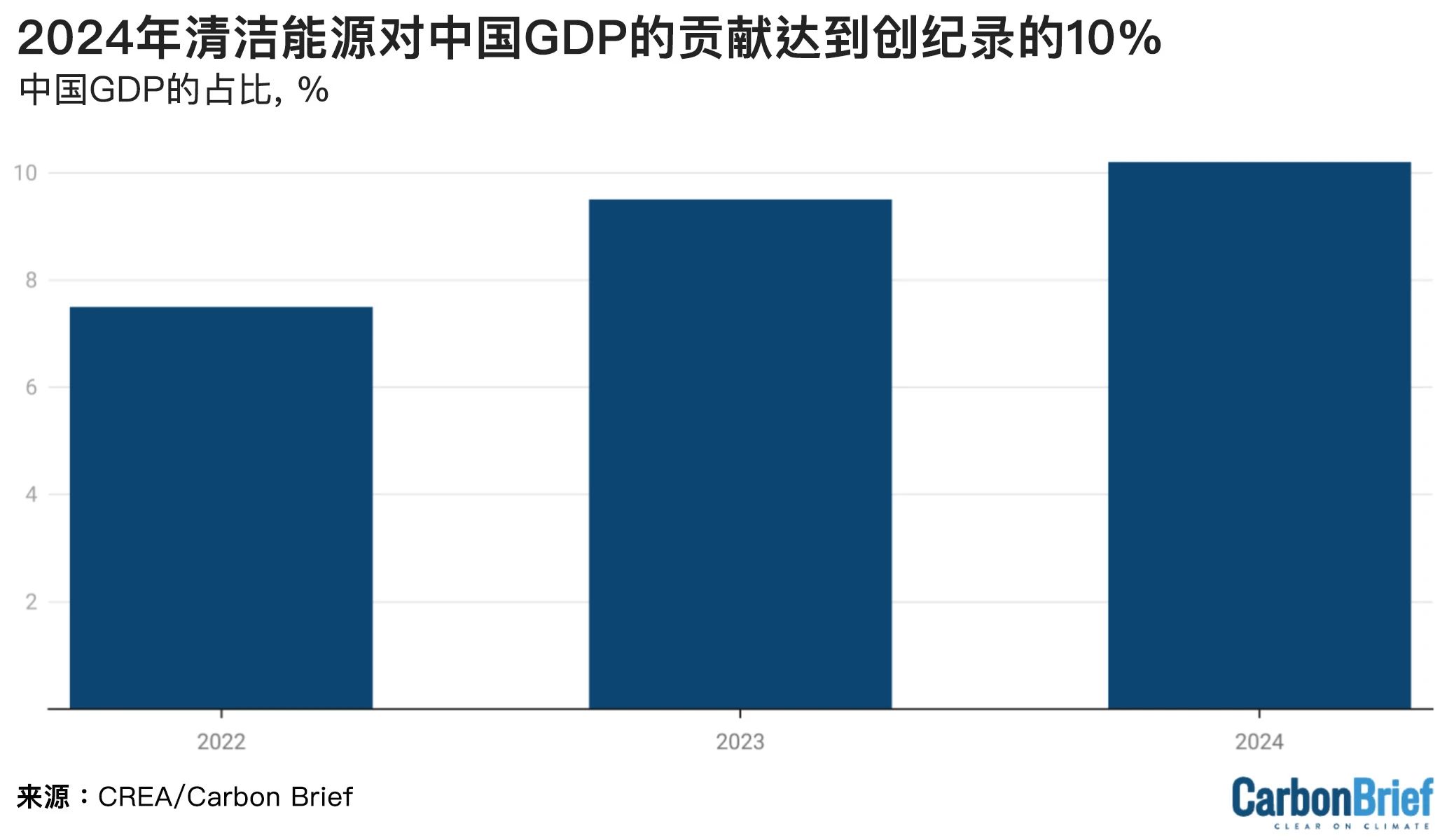
清洁能源行业对中国GDP贡献的比重,%。
清洁能源行业对中国GDP贡献的比重,%。来源:CREA / Carbon Brief

清洁能源行业对中国经济的整体贡献达到13.6万亿元人民币(1.9万亿美元),其规模与沙特阿拉伯或瑞士等主要经济体相当。

同时,该行业在中国经济中的比重已超过房地产销售(9.6万亿元人民币)和农业(9.1万亿元人民币)。

电动汽车和太阳能是增长主要驱动力

2024年清洁能源行业的生产和投资总值预计增长了13%,自2022年以来则增长了50%,如下图所示。
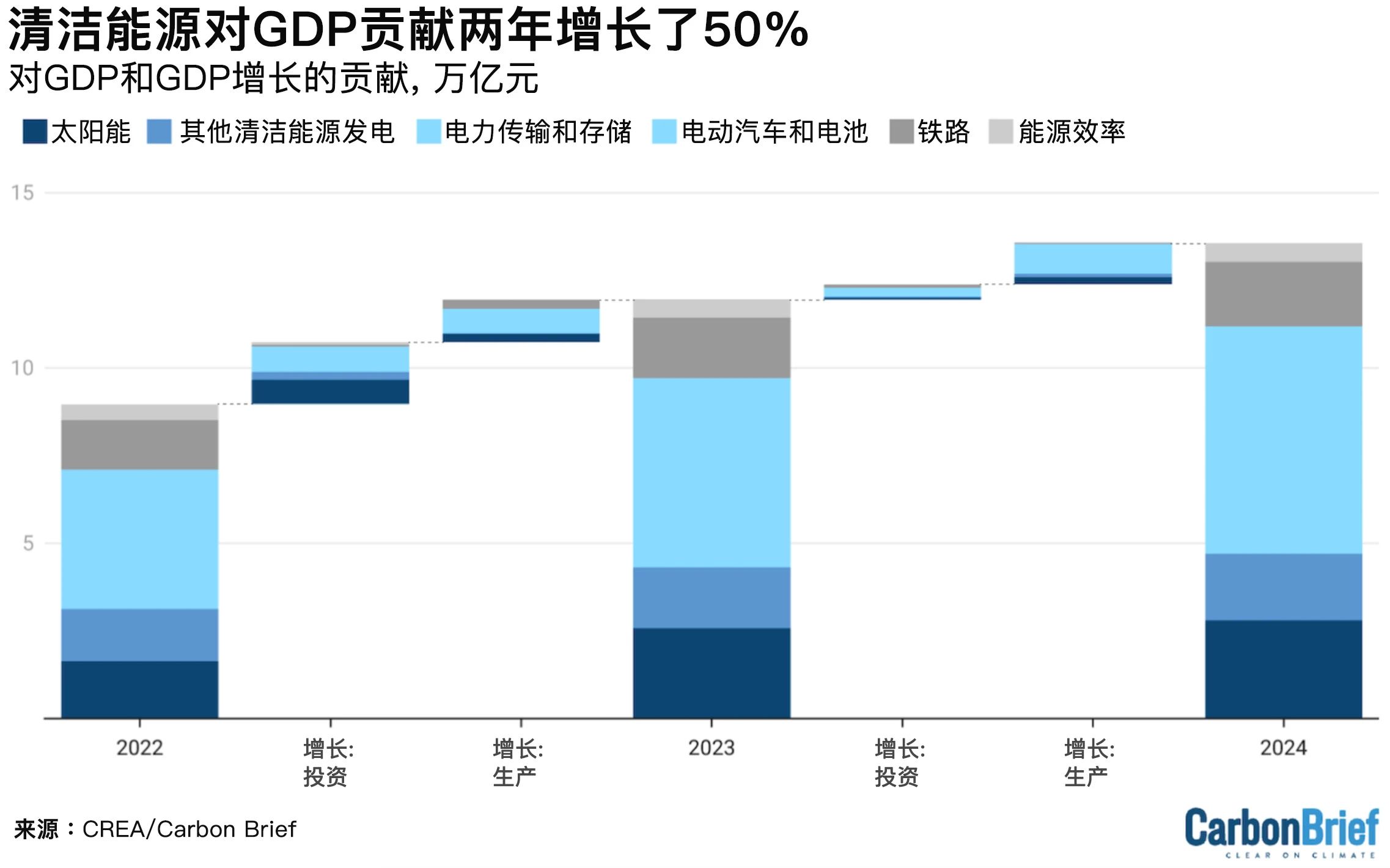
清洁能源行业对中国GDP和GDP增长的贡献;单位:万亿元,2022-2024年。
清洁能源行业对中国GDP和GDP增长的贡献;单位:万亿元,2022-2024年。来源:CREA / Carbon Brief

这些行业的商品和服务产值增长了21%,达到6.8万亿元人民币(9500亿美元)。

总体而言,电动汽车生产是最具价值的细分行业,其次是清洁能源生产、铁路运输、电力传输与储存,以及能源效率。

下表详细列出了各行业和活动的具体数据。

China-renewable-table

价格下跌促进采用,但对生产商构成挑战

在全球大多数经济体都在担忧高通胀之际,中国却面临通货紧缩的压力,主要原因是制造业快速扩张,而国内需求相对疲软。

多个关键清洁能源行业都受到这一趋势的影响。尽管产量不断增长,但供过于求导致收入和利润增长乏力,使该行业的实际贡献在一定程度上被忽视。

以太阳能电池板制造为例,尽管产量大幅增长,但行业名义产值下降了41%。

上微信关注《碳简报》

不过,由于项目数量激增,加上太阳能电池板成本仅占整个太阳能发电项目成本的不到三分之一,太阳能项目的投资名义价值仍保持稳定。

太阳能发电电力价值增长了40%,使得太阳能行业对名义GDP增长的总体贡献率上升至正值。

总体来看,清洁能源行业的增加值按名义计算增长了约8.5%,低于实际增长率的15%,但仍远高于GDP增速,占名义GDP增长的17%。

2024年12月,一场重要的年度经济政策会议强调,需要“积极营造绿色低碳产业健康发展生态”。这表明政府可能会采取措施解决清洁制造业供应过剩和该行业盈利能力较弱的问题。

清洁能源经济快速增长的影响

清洁能源行业连续第二年在中国经济增长目标的实现中发挥了关键作用。

供应增加和价格下降的双重因素,导致中国清洁能源部署速度远超几年前的预期,同时也促进了清洁能源在新兴海外市场的部署。

预计这一增长趋势将在2025年延续,这主要得益于多个重大项目都致力于在“十四五”规划(2021-2025年)收官前完工。

2025年以后,该行业的发展将在很大程度上取决于今年即将完成的下一个五年计划(2026-2030年)中的新目标和政策。

随着近几年清洁能源发电装机容量的闪电式扩张,该行业正陷入盈利能力下降和产能过剩的困境。

若要恢复行业盈利能力,中国既需要保持强劲的国内需求,也需要采取措施解决产能过剩问题。此外,弃电问题(尤其对太阳能发电产生限制)也亟需解决,以确保市场需求能持续释放。

根据中国主要部委提出的2030年和2035年目标所显示的初步迹象,中国难以将关键清洁能源技术需求维持在2023-2024年水平。

如果清洁能源行业在下一个五年规划时期的目标低于当前部署速度,该行业可能从拉动GDP增长的推动力转变为拖累因素,并加剧供过于求的问题。相反,更具雄心的清洁能源目标将有助于保持该行业对经济的积极贡献。

鉴于清洁能源在投资增长中发挥的重要作用,政府的经济刺激措施可能会支持清洁能源领域的投资。

此外,清洁能源现在在中国经济增长中的关键作用,也使得政策制定者更有动力确保该行业的健康发展。
The post 分析:2024年清洁能源对中国GDP的贡献将达到创纪录的10% appeared first on Carbon Brief.

分析:2024年清洁能源对中国GDP的贡献将达到创纪录的10%

Continue Reading

Climate Change

Will the world’s drying lands get relief from COP17 in Mongolia?

Published

on

Starting on Monday, about 10,000 government negotiators, scientists, journalists and campaigners will gather at a purpose-built venue in a national park in Mongolia’s capital Ulaanbaatar to discuss how to stop land turning into desert as the world warms.

Drought is currently sweeping much of the Northern hemisphere, leaving normally green urban parks looking like dry savannah, causing crops to fail, food prices to rise and billions to be shaved off economic output.

On Wednesday, Britain’s prime minister chaired an emergency meeting of the government’s Cobra committee. These are usually reserved for wars, terrorist attacks, riots and pandemics – but this one was on the extreme heat and drought the UK has been suffering since May. 

With many countries facing far worse with fewer resources than the UK, the issues to be discussed at the UN’s COP17 summit in Mongolia – often overlooked – should be nearer the top of policy-makers minds.

But what is COP17?  What will be decided and announced there over the next two weeks? How does it relate to climate change and how will it help restore the lands on which we all rely for our food, water and other essential resources? Climate Home News explains all below.

What is COP17?

It is the conference of parties (COP) to the United Nations Convention to Combat Desertification (UNCCD). The parties are 196 governments, which includes all of the countries recognised by the UN.

The convention was conceived at the Rio Earth Summit in 1992, at the same time as the other two larger “Rio trio” conventions on climate and biodiversity. 

While the climate convention’s COP takes place every year, the UNCCD COP happens only once every two years. COP17 will be its seventeenth gathering.

Negotiators at COP16 in Riyadh (Photo: IISD/ENB | Anastasia Rodopoulou)

What is desertification?

It is the process by which land degrades and becomes more like a desert, making it harder – and sometimes impossible – to grow crops or graze livestock there.

Climate change and other human activities – like excessive irrigation which depletes ground water – are making this process worse, causing poverty, hunger, health problems, forced migration and loss of species.

It’s a widespread problem. The UN estimates that half a billion people live within areas that have experienced desertification since the 1980s and that two-fifths of the world’s land is degraded.

What has it got to do with climate change?

The planet’s climate is heating up, mainly due to humans burning fossil fuels, and drying out its land. This kills plants and exposes the soil which can then be blown away by wind and washed away by water.

Without a top layer of soil, plants struggle to grow again and the land gets closer to being a desert. So combating desertification is a way of adapting to climate change.

It is also a way of lessening the pace of climate change, as land degradation releases carbon dioxide previously stored in healthy soils and plants.

What will be negotiated at COP17?

The main issue is what form a new initiative to tackle drought could take. The last COP saw Africa push hard for this to be a protocol – a kind of binding sub-treaty to the UNCCD.

But the US, Europe, Argentina and others argued that would take too long to set up, cost too much and take money away from what can be spent on the ground. They prefer a legally weaker alternative – a framework instead of a protocol. 

Negotiations went late into the last night of talks in Riyadh, with the Saudis hosting informal consultations, but eventually governments had to agree to disagree and pick up talks again in Ulaanbaatar. 

As Earth dries out, countries fail to reach drought agreement

Governments will also negotiate a new policy on protecting rangelands and pastoralists from degradation. Rangelands are areas where animals graze. They cover around half the Earth’s land and include almost everything other than forest, deserts, farms, glaciers and cities. Pastoralists are people who herd animals on these rangelands, often moving from place to place to find fresh pasture. 

COP17 host country Mongolia has a lot of both – and pushed successfully for the UN to declare 2026 the International Year of Rangelands and Pastoralists. It is keen to agree a decision at COP17 bringing those issues more to the forefront of the UNCCD.

Negotiators will also debate the UNCCD’s post-2030 strategic framework, which they hope to adopt at COP18 in 2028. Campaign groups like the World Wildlife Fund want a stronger focus on biodiversity and nature-positive food systems.

What will happen when?

The COP will formally open with a ceremony on Monday August 17, followed by opening statements by governments and the adoption of the agenda.

Negotiations will begin, mostly behind closed doors for two weeks until the closing plenaries on Friday August 28.

While talks rumble on in the background, the second week will see senior government representatives including ministers get involved, with a “high-level segment” running from August 24-26.

A delegate at COP16 in Riyadh (Photo: IISD/ENB | Anastasia Rodopoulou)

They will discuss issues like drought resilience, finance and pastoralist communities. This is likely to be when any announcements – of new funding, for instance – are made.

On Monday August 24, there will also be an open dialogue between government officials and civil society members. Here, local practitioners are likely to share stories of how they are helping their communities reverse land degradation. UNCCD prides itself on being a bottom-up convention.

Unlike climate COPs, which often end a day or two over time, UNCCD COPs usually finish on the evening of their last day and – while they have gone late into the night – have never run into the next day.

What else should we watch out for?

At the last COP two years ago, host Saudi Arabia led the creation of an initiative called the Riyadh Global Drought Resilience Partnership to help 80 of the poorest nations deal with drought.

It received $12 billion in pledges, mainly from Gulf-based development finance institutions. Saudi Arabia is expected to report back on whether these pledges have been delivered and how the money will reach those in need now.

There are also hopes that governments will announce financial support for Mongolia’s Rangelands Flagship Initiative, which aims to mobilise investment in projects to fight land degradation.

Who will preside over COP17?

While the last five and the next two climate COPs have been or will be presided over by men, COP17 will be woman-led with Mongolia’s foreign minister, Battsetseg Batmunkh, as president.

Mongolia’s foreign minister and COP17 president Battsetseg Batmunkh (Photo: Uugansukh Byamba)

This will also be the first COP for the UNCCD’s new executive director Yasmin Fouad. Before being appointed environment minister in her native Egypt, Fouad was a scientist and lead author of the Intergovernmental Panel on Climate Change’s special report on desertification. She played a key role at the COP27 climate summit in Egypt in 2022.

Although Saudi Arabia’s UNCCD COP presidency is ending, the Gulf power house will likely continue to be influential. It has supported the COP financially as part of the Riyadh-Ulaanbaatar action agenda and will be following up on initiatives announced two years ago.

While Saudi Arabia is often blamed for obstructing progress at climate talks, as a desert nation it is generally thought to have played a constructive role at UNCCD COPs.

What are the negotiating dynamics?

The UNCCD has six main negotiating groups: Africa, Asia, Latin America and the Caribbean, the Northern Mediterranean, Central and Eastern Europe, and developed donor countries. Governments can also speak in their own capacities.

While divisions between the Global North and Global South do exist at UNCCD COPs, they are not as stark as at climate COPs. The Global South’s umbrella group – the G77 and China – usually only speaks on finance issues, on which developing countries tend to be united.

    Civil society groups are present but not as vocal or as confrontational as at climate COPs. There are generally no protests and campaigners tend to try to hold governments accountable more quietly. There are likely to be far fewer journalists than at climate COPs too.

    What role will the US play?

    While the US has left the UN’s climate convention, it remains in the UNCCD and is expected to bring a delegation of officials from its departments of agriculture and state. It is likely to resist any renewed push from Africa for a drought protocol.

    The post Will the world’s drying lands get relief from COP17 in Mongolia? appeared first on Climate Home News.

    Will the world’s drying lands get relief from COP17 in Mongolia?

    Continue Reading

    Climate Change

    Pushing the climate crisis: How advertising fuels high-carbon lifestyles

    Published

    on

    Helen Phillips’ book, ‘Hum’, is set in a dystopian near future, in a city suffering the effects of climate breakdown and with dire air quality. Robots (the Hums) press advertising messages during conversations, meetings and even as they carry out medical procedures.

    The Hums are vehicles for these ad messages, which are often for products like cosmetics, sweets or anything that might be relevant during interactions with humans. This advertising is poorly disguised, and merges with sentiments that lean towards concerns of well-being, convincing people how much better off they’ll be if they make a purchase.

    While the novel is futuristic, the insidious way advertising permeates daily life is resonant of how adverts show up in our world today. And these ads are directly contributing to the worsening future climate Phillips describes in her book.

      Already by the summer of 2026, Europe had seen a 57% increase in wildfires in just four years with western Europe recording the hottest ever June and July on record. We’re facing droughts and floods, as well as predicted hikes in food costs or even chronic food shortages – and that’s before the expected additional effects of a strong El Niño later this year.

      Frequent flying and bigger burgers

      A portion of this climate breakdown is fuelled by over-consumption in richer countries, particularly of products that are high carbon – for which advertising can take some of the blame. Research shows that adverts drive citizens to consume about a third more goods and services in general, over and above what they might have purchased.

      Yet despite a clear link between promoting high-carbon behaviours and climate breakdown, little advertising regulation exists in the UK. Take frequent flying for instance, one of the most carbon-intensive activities we can partake in.

      EasyJet’s latest ad campaign is called “Drop Everything”. It encourages consumers to book cheap flights departing within the next 48 hours for presumably short or weekend getaways. Rather than promoting a specific destination, “Drop Everything” promotes a mindset that encourages indiscriminate consumption of flying. The ads were shown on billboards with clever creative slogans, as well as on digital media and through influencer campaigns.

      Overall, flight numbers are increasing. The UK Civil Aviation Authority reported the highest number of UK passengers in the first quarter of 2026 (more than 61 million, breaking previous records for travel between January and March). It seems we’re still not joining the dots between flying and a worsening climate.

      And how about meat consumption? Scientists advocate for less meat-eating, especially beef which has the highest carbon footprint of nearly all foods. Yet adverts from McDonald’s proliferate, helping make it one of the highest-volume sellers of fast-food chain beef burgers. In 2024, the outdoor advertising budget for McDonald’s UK rose to £86 million, an increase of 71% on previous years.

      A billboard carrying McDonald’s UK advertising for one of its biggest burgers, which won “Badvert” of the month in May 2026 (Photo: Badvertising)

      A billboard carrying McDonald’s UK advertising for one of its biggest burgers, which won “Badvert” of the month in May 2026 (Photo: Badvertising)

      Small share for sustainability

      While over half of UK ad professionals feel increasingly queasy about their profession and its effects on the climate crisis, the people running the show – the UK trade bodies – prefer to focus on the growth advertising brings.

      In the first three months of 2026, they stated that UK advertising spend increased by 9.3%, reaching a total of £11.7 billion for that quarter, fuelling consumption and market growth.

      But how many of those adverts actually promote low carbon goods and services? Kantar’s Sustainable Ads Tracker shows the percentage of ads featuring sustainability messaging in 2026 is around 4.3%. That’s woefully low, and much of this is made up of messaging that promotes recycling.

      PR firm working for Shell wins COP30 media contract

      Additionally, the ad industry continues to happily produce adverts for the large oil and gas corporations that are fuelling climate breakdown. These adverts only narrowly pass the Advertising Standards Authorities’ advertising codes, allowing the continued greenwashing of the world’s most polluting brands.

      There is essentially no leadership from the UK trade bodies, likely because they are directly funded by the brands and advertisers themselves. They are essentially ‘ad shushing’ – pushing for indiscriminate growth and directing attention to their sustainability awards, while confusingly denying that adverts drive higher consumption overall.

      Let’s ‘un-shush’

      Where does this leave us as we are subjected to hundreds, if not thousands, of persuasive advertising messages every day that support high-carbon lifestyles? Most ad professionals are unable to push back against this agenda at work, often due to the threat of job loss. The advertising trade bodies won’t take the lead as they work in service to big brands and advertisers.

      NGOs urge Brazil to prevent fossil fuel capture of COP30 climate summit

      So, who can push for the changes we need? Members of the public.

      Through pressuring our city officials and governments, we can force through restrictions, such as the watershed bans on unhealthy foods on TV before 9pm in the UK. Through supporting the efforts of organisations such as Ad Free Cities and others, we can help achieve bans on outdoor advertising for fossil fuels, aviation, meat and even single-use plastics in cities and regions such as Amsterdam, The Hague, Edinburgh, Florence, Uppsala and many more.

      If we’re serious about climate change and stopping big global brands pushing their high-carbon products onto us, then advertising restrictions are one of the best ways to achieve this. If we don’t want a world like the one Phillips describes in her book, we need to make our voices heard above the advertising noise.

      The post Pushing the climate crisis: How advertising fuels high-carbon lifestyles appeared first on Climate Home News.

      Pushing the climate crisis: How advertising fuels high-carbon lifestyles

      Continue Reading

      Climate Change

      Analysis: Weaker EV targets could cost UK consumers £3bn a year by 2030

      Published

      on

      An upcoming UK government consultation on weakening targets for electric vehicles (EVs) could cost consumers as much as £3bn a year by 2030, according to Carbon Brief analysis.

      It could require the UK to import an extra 17m barrels of oil in 2030, raising expected net imports by 8%, as well as adding 2.5% to national emissions that year, the analysis shows.

      After years of fierce lobbying by parts of the car industry – and despite the significant savings on offer for EV drivers – media reports suggest that EV targets could be “watered down”.

      Under current rules, battery EVs – BEVs, those which run only on electricity – must make up a rising share of new car sales in the UK.

      This policy, known as the “zero-emission vehicles” (ZEV) mandate, was introduced by the previous Conservative government and sets a goal for 33% BEV sales in 2026, rising to 80% in 2030.

      (Carmakers are able to use “flexibilities” to help meet their targets, which reduces the effective target under the ZEV mandate to an estimated 25% of sales in 2026.)

      Now, the government under new Labour prime minister Andy Burnham is reported to be considering a cut in the BEV target for 2030 to just 50% of new car sales, alongside options for 60% or 70%.

      Carbon Brief understands that a consultation on weakening the ZEV mandate is being reviewed by the prime minister’s office in Number 10, ahead of being formally released.

      If the mandate is weakened to 50% by 2030 – and if carmakers make more use of “flexibilities” – there could be up to 3m fewer BEVs on UK roads by 2030, according to the NGO T&E.

      Previous Carbon Brief analysis found that BEVs are around £1,100 cheaper to run per year than a petrol car, thanks to far lower fuel costs.

      Overall, BEVs are more than £1,000 per year cheaper to own than either petrol cars or plug-in hybrids (PHEVs, which can run on petrol or electricity).

      This is according to analysis of the “total cost of ownership” by the Energy and Climate Intelligence Unit (ECIU), including purchase price, fuel costs, insurance and proposed pay-per-mile charges.

      In total, Carbon Brief analysis shows that UK drivers could be hit with an extra £3bn in annual ownership costs by 2030, if the ZEV mandate is weakened, as shown below.

      Bar chart showing that weaker EV targets could cost UK consumers £3bn a year by 2030

      A weaker ZEV mandate could “put billions of pounds of committed investments at risk”, reports BusinessGreen, including in the EV charging network and battery supply chains.

      Industry group Energy UK says that the mandate is “working in the way it was designed to work” and that it is the “single biggest driver of emissions reductions” in government climate plans.

      However, Carbon Brief analysis shows that a weaker ZEV mandate could result in an extra 7.4m tonnes of carbon dioxide emissions (MtCO2) in 2030. This would add the equivalent of 2.5% to national emissions in 2030, under the UK’s international climate goal for that year.

      In addition, a weaker ZEV mandate could result in the UK needing to import an extra 17m barrels of oil in 2030, equivalent to 8% of projected net imports that year.

      Energy UK says that shifting to EVs will help to reduce household energy bills “for everyone”. This is not only through direct cost-of-ownership savings for EV drivers, but also by spreading the costs of upgrading the electricity system across a wider user base.

      Car industry group the Society of Motor Manufacturers and Traders claims that its members are spending “blilions…on discounts, finance incentives and marketing support” and that “natural” EV demand is below the level required to meet the current ZEV mandate. Its claims are disputed.

      The post Analysis: Weaker EV targets could cost UK consumers £3bn a year by 2030 appeared first on Carbon Brief.

      Analysis: Weaker EV targets could cost UK consumers £3bn a year by 2030

      Continue Reading

      Trending

      Copyright © 2022 BreakingClimateChange.com