

Carbon credits generated from renewable energy projects have failed to obtain a new quality label from a key oversight body, casting fresh doubt on popular emissions offsets favoured by multinational companies like Audi, Shell and Total.
The Integrity Council for the Voluntary Carbon Market (ICVCM) announced on Tuesday that eight renewable energy methodologies, which cover about a third of the carbon credits available on the voluntary market, cannot use its “Core Carbon Principles” (CCP) seal of approval.
The ICVCM, an independent watchdog, aims to address widespread concerns over the quality of carbon credits after many projects have been accused of overstating their climate and societal benefits. It is assessing groups of offsetting projects to determine whether they comply with the CCP criteria, which are designed to identify and encourage high-integrity carbon credits that meet requirements on governance, emissions reduction and sustainable development.
The body said existing standards are not strict enough on judging whether renewable energy projects need the funding generated by selling carbon offsets in order to go ahead – a concept known as “additionality”. But it emphasised that renewables like solar, wind and hydropower are key to tackling climate change and carbon credits “still have a role to play” in financing them.
Sign up to get our weekly newsletter straight to your inbox, plus breaking news, investigations and extra bulletins from key events
Since the eight methodologies were designed as long as 20 years ago, the cost of renewables has collapsed, and their profitability in many parts of the world has rocketed, meaning they are more likely to make money without needing extra revenue from selling carbon offsets.
The ICVCM said that “for several years, carbon market experts have noted concerns about the additionality of many renewable energy activities and the difficulties in transparently demonstrating the additionality of these activities approved under existing methodologies”.
Major carbon-credit registries like Verra and Gold Standard stopped accepting new grid-connected projects in 2019, with the exception of those located in least-developed countries (LDCs).
But pre-existing renewable energy activities continue to generate a sizeable chunk of all the offsets available on the registries.
According to a recent analysis by Carbon Market Watch, over 280 million renewable energy credits are available in the voluntary carbon market. If companies and individuals used all those credits, that would compensate on paper for emissions equivalent to the amount of carbon dioxide Thailand released into the atmosphere last year.
Inigo Wyburd, a policy expert at Carbon Market Watch, called the ICVCM’s decision “a positive step”. “It sends a clear message to tackle the issue of the many low-quality credits still in circulation and undermining the market,” he told Climate Home.
Despite long being written off as largely worthless by climate experts, renewable energy credits are still popular among corporate buyers.
Fossil fuel majors like Shell and Total, automakers and cruise operators were among the biggest purchasers of renewable energy credits over the last 12 months, an analysis of Verra’s database shows.

In one transaction last year, German carmaker Audi used nearly 100,000 carbon credits generated in 2021 from an Indian solar project to claim that its handover of electric vehicles in Europe and the United States was “CO2 neutral” despite the emissions involved in producing them.
Japanese parcel delivery service Yamato Transport Company and public entities like Australia’s Brisbane City Council and Western Sydney University also relied on renewable offsets to claim carbon neutrality in 2023.
Because of earlier concerns about whether carbon offsets generated by renewable energy deliver the emissions reductions they claim, their price has been falling over the last two years.
According to data provider MSCI, the average price is just $2 per tonne of carbon dioxide equivalent reduced – less than half the price of offsets derived from projects aiming to protect forests, tackle methane emissions or promote energy efficiency. Renewable energy credits are likely to see further falls in price after the ICVCM’s rejection.
As first airline drops goal, are aviation’s 2030 targets achievable without carbon offsets?
But Amy Merrill, CEO of the ICVCM, left the door open to better renewables methodologies obtaining CCP approval. She called on carbon crediting programmes to develop methodologies “that better reflect the rapidly changing and variable circumstances around renewable energy deployment”.
“While renewable energy costs have fallen dramatically around the globe over the past decade,” she said, “they have not fallen evenly across all countries and high up-front expenses and other barriers mean that there are still many places where it is difficult to deploy renewable capacity.”
The cost of renewables is particularly high in remote rural parts of developing countries without access to the electricity grid, on islands with small populations and in areas where the authorities are hostile to renewable energy for ideological reasons, particularly in parts of the US. Methodologies enabling projects in these places would have the best case to get CCP approval, market experts told Climate Home.
IPCC’s input into key UN climate review at risk as countries clash over timeline
Verra has announced that it will revise some of its additionality requirements “to address the deficiencies noted by the ICVCM”.
The registry plans to submit its new rulebook to the watchdog and give existing projects the possibility of updating their quantification of credits accordingly. “This is part of our commitment to providing a path for all VCS [voluntary carbon standard] projects that wish pursue a path to CCP labelling,” Verra said in a statement.
A Gold Standard spokesperson said ICVCM’s rejection of the methodologies was “ambiguous and potentially harmful to high-quality renewable energy carbon credits on the market today” as different regions across the world still face various financial and technical barriers making carbon finance necessary.
They added that Gold Standard would consider the ICVCM assessment framework among other inputs in its next review of relevant methodologies.
The ICVCM’s negative assessment of existing renewable energy credits could also have repercussions for the new United Nations carbon mechanism currently under development.
Canada’s Olympics kit provider hit with greenwashing complaint in France
Renewable energy projects make up four-fifths of all projects seeking a transfer from the old Kyoto-era Clean Development Mechanism (CDM) into the new market system being set up under Article 6 of the Paris Agreement, Climate Home revealed last January.
The projects need formal authorisation to proceed from the countries where their activities are located.
Carbon Market Watch’s Wyburd said ICVCM’s rejection of the renewable energy methodologies “will hopefully send a few shock waves” to the countries having to make those decisions. “Given their profound shortcomings, these credits should not be given a new lease of life under the future UN mechanism,” he added.
At the same time, the ICVCM approved other methodologies to capture methane from landfills and to detect and repair methane leaks in the gas industry. That means 3.6% of unretired carbon credits have now been approved to use the CCP label.
Audi, Shell, Norwegian Cruise Lines, Western Sydney University and Aviva did not respond to a request for comment on the impact of the ICVCM’s renewables decision. Total declined to comment.
(Reporting by Joe Lo and Matteo Civillini, editing by Megan Rowling)
The post Renewable-energy carbon credits rejected by high-integrity scheme appeared first on Climate Home News.
Renewable-energy carbon credits rejected by high-integrity scheme

The conference is one of the largest aimed at preparing for hurricane season, which begins June 1. A task force report on potential reforms to the agency also remains on hold.
ORLANDO, Fla.—A major conference to help communities prepare for hurricane season kicked off Monday without the agency that coordinates federal disaster response.
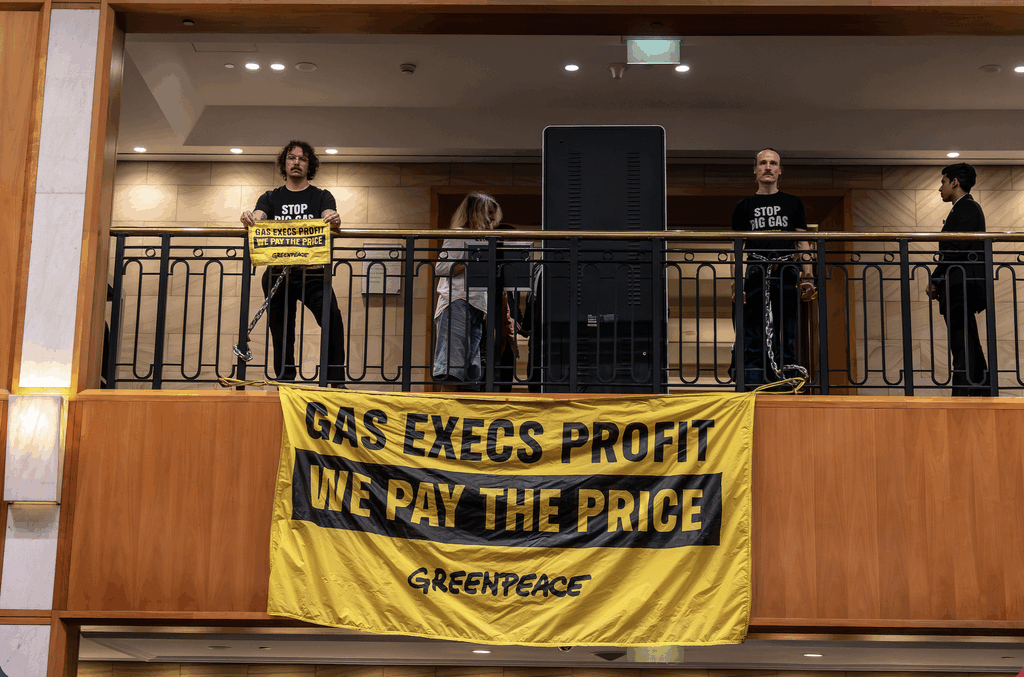
Right now, Greenpeace activists are standing up to Big Gas at a major gas conference in Sydney.
Inside the Sheraton Grand Hotel, executives from fossil fuel companies have gathered alongside lobbyists, investors and political allies to plan the future of gas in Australia – and how to maximise their profits.
So Greenpeace has stepped in to call it out. Activists have dropped a banner inside the venue with a clear message: Gas Execs Profit. We Pay The Price.
We need your help to spread the message that we won’t stand by and let this happen.
What’s really going on
Gas corporations are making billions in windfall profits from global conflicts – from Ukraine to Iran – while Australians pay the price with higher energy bills and climate damage.
And they want more.
More drilling. More exports. More profit.
Why Greenpeace took action today
This conference is where it all comes together. Behind closed doors, gas executives, lobbyists, investors and political allies are meeting to push for more gas expansion, no doubt using global instability as their justification.
That’s why Greenpeace couldn’t let this gathering go uninterrupted.
Big Gas is counting on people not paying attention. Let’s prove them wrong.
Share the video to call out Big Gas.
What needs to happen now
Gas is expensive. It’s volatile. And it ties our energy system to global instability.
But there is a better way. Renewable energy is already cheaper, more reliable, and made right here in Australia. It’s the fastest path to lower bills, real energy security and a safer climate.
To get there, we need to:
- properly tax the gas industry and its exports
- stop expanding gas
- and speed up the transition to homegrown renewable energy.
Share this video far and wide to show just how much support there is to tax Big Gas properly and speed up the transition to renewable energy.
This is just the beginning
This action is part of a growing movement to stand up to Big Gas and challenge the power it holds over our government and society. The Federal Government has a role to play – starting by taxing gas corporations properly and then accelerating the transition to homegrown renewable energy.
Together, we can show just how much support there is for change and make it impossible for decision-makers to ignore.
What you can do
- Follow along on our social channels.
- Share the video far and wide to show how much support there is.
- Sign the petition to tell Albo to stand up to Big Gas – because if we can, he can.
BREAKING: Greenpeace activists disrupt major gas conference in Sydney
SYDNEY, Tuesday 31 March 2026 — Two Greenpeace Australia Pacific activists have been arrested following a peaceful protest at the Australian Domestic Gas Outlook conference in Sydney, where they dropped a banner that said — “Gas Execs Profit. We Pay The Price” and held banners saying “Tax Gas Profits”.
Photos and B Roll video of the protest and arrests are available here
Live updates on Greenpeace Instagram
The two activists were arrested by police around 9:00am AEDT and taken to Day Street Police Station. Information on this morning’s gas conference disruption can be found here.
Solaye Snider, Campaigner at Greenpeace Australia Pacific, said: “Greenpeace activists have taken a strong stand today against profit hungry gas corporations and lobbyists, who see horrific global wars as an opportunity to price gouge and profiteer, while everyday people pay the price.
“Australians have had enough of gas corporations like Santos and ConocoPhillips ripping us off, leaving us with nothing but empty pockets and climate damage. The gas industry is aggressively lobbying against being fairly taxed and pushing to drill for more gas. Change requires showing up and speaking out, and that’s what these activists have done today.
“Greenpeace Australia Pacific stands by our activists, and stands with all communities who are peacefully fighting for a safe and clean energy future. The right to peaceful protest is a fundamental pillar of a healthy democracy and a basic right of all Australians.”
-ENDS-
Media contacts:
Lucy Keller: +61 491 135 308 or lkeller@greenpeace.org or Kate O’Callaghan: +61 406 231 892 or kate.ocallaghan@greenpeace.org
Greenpeace activists arrested after disrupting major gas conference in Sydney



-
Climate Change8 months ago
Guest post: Why China is still building new coal – and when it might stop
-
Greenhouse Gases8 months ago
Guest post: Why China is still building new coal – and when it might stop
-

 Greenhouse Gases2 years ago
嘉宾来稿:满足中国增长的用电需求 光伏加储能“比新建煤电更实惠”
-
Climate Change2 years ago
Bill Discounting Climate Change in Florida’s Energy Policy Awaits DeSantis’ Approval
-

 Climate Change2 years ago
嘉宾来稿:满足中国增长的用电需求 光伏加储能“比新建煤电更实惠”
-
Climate Change Videos2 years ago
The toxic gas flares fuelling Nigeria’s climate change – BBC News
-

 Renewable Energy5 months ago
Sending Progressive Philanthropist George Soros to Prison?
-

 Carbon Footprint2 years ago
US SEC’s Climate Disclosure Rules Spur Renewed Interest in Carbon Credits