


QuantumScape Corporation (NYSE: QS), a leader in advanced battery solutions, has made a major breakthrough in electric vehicle (EV) technology. In partnership with PowerCo SE, the battery arm of the Volkswagen Group, the companies showcased the world’s first live demonstration of a solid-state lithium-metal battery powering a motorcycle.
The event took place at the IAA Mobility conference in Munich, where a Ducati motorcycle equipped with QuantumScape’s cutting-edge QSE-5 battery cells made its debut. This demonstration marks a major milestone in the push toward safer, higher-performing energy storage systems for electric vehicles and beyond.
Why QuantumScape’s Solid-State Battery Is a Game-Changer
QuantumScape’s mission is to transform energy storage. The company highlighted that its next-generation solid-state lithium-metal batteries can potentially improve energy density, charging speed, safety, lifespan, and cost-effectiveness—all areas where traditional lithium-ion batteries face limitations.
The live demo used QSE-5 cells, built with QuantumScape’s proprietary Cobra separator manufacturing process. This process, integrated into full-scale production in June 2025, has dramatically improved performance. According to industry experts, it offers a 25-fold upgrade over the earlier model and a 200-fold improvement compared to 2023 methods.
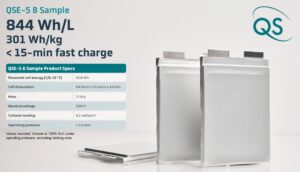
The QSE-5 battery delivered industry-leading results, including:
- 844 Wh/L energy density – enabling longer driving ranges.
- 12-minute fast charging from 10% to 80% capacity.
- 10C continuous discharge, supporting high performance under stress.
This breakthrough addresses key EV challenges, making batteries safer and more efficient for both consumers and manufacturers.
Dr. Siva Sivaram, CEO and president of QS, said,
“Today we’ve crossed the threshold from possibility to reality. We believe that our partnership with PowerCo, together with Ducati as our demonstration launch partner, positions us to scale our transformative technology to gigawatt-hour production. Our world-leading battery innovation, combined with Ducati’s uncompromising craftsmanship and legendary commitment to performance, will help usher in a new era of electrified transportation.”
Real-World Test on the Racetrack
The demonstration featured a Ducati V21L race motorcycle powered by QuantumScape’s technology. The battery pack, developed by specialists from Audi, another Volkswagen Group brand, was tailored to show how these batteries can perform in extreme conditions.
Thomas Schmall, CEO of Volkswagen Group Components, presented the technology at the event. The racetrack setting was chosen to rigorously test the batteries’ limits. QuantumScape’s cells performed reliably under high loads, showcasing how this technology can meet the demands of future high-performance EVs.
From Lab Discovery to Commercial Reality
This event is a major step in taking solid-state batteries out of the lab and into real-world applications. Solid-state batteries use a solid electrolyte instead of liquid ones, which greatly reduces the risk of overheating, fires, or explosions—common concerns with conventional lithium-ion batteries.
The QSE-5’s anode-free design, paired with advanced separators, gives it advantages in safety and efficiency. If scaled successfully, this technology could become a standard for next-generation EVs and other energy storage solutions.
QuantumScape expects to ship sample cells for testing in 2026. Commercial production could begin between 2027 and 2028, depending on regulatory approvals and manufacturing scaling.
Strategic Partnership and Market Expansion
QuantumScape’s partnership with PowerCo is expanding rapidly. In July 2025, the two companies announced an updated collaboration agreement that includes up to $131 million in milestone-based payments over two years.
This will fund the scaling of production and technology transfer needed to bring QSE-5 cells to global markets.
- Significantly, PowerCo plans to produce up to 5 gigawatt-hours of QSE-5 cells annually, serving customers beyond Volkswagen’s ecosystem.
This opens up new commercial opportunities and strengthens QuantumScape’s position in the global battery supply chain.
Frank Blome, CEO of PowerCo, said,
“The EV revolution is the biggest transformation the automotive industry has ever seen. Solid-state batteries will redefine what’s possible for high-performance, premium vehicles, and today’s historic demonstration is just the beginning. We’re combining QuantumScape’s world-class battery scientists with PowerCo’s manufacturing expertise to bring game-changing solid-state battery technology to the world as soon as possible.”
QS Stock Market Reaction: A Speculative Opportunity
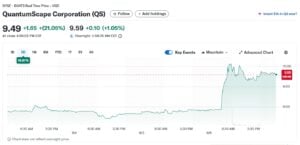
Following the announcement, QuantumScape’s (QS) stock jumped 20% to around $9.50, reflecting investor excitement. As of 2025, the company’s market cap stands at around $4.44 billion.
However, analysts warn that investing in QuantumScape carries significant risks. The technology’s success hinges on scaling production, navigating regulatory approvals, and competing with established battery players.
Solid-State Batteries: Unlocking Safer, Smarter Energy Solutions
Solid-state batteries are seen as the next major leap in energy storage. Compared to lithium-ion batteries, they offer:
- Higher energy density for longer ranges.
- Faster charging capabilities.
- Safer designs that lower fire and explosion risks.
- Longer lifespan with fewer degradation issues.
- Potential for lower costs as manufacturing processes improve.
These features make solid-state technology attractive not only for EVs but also for consumer electronics, renewable energy storage, and medical devices
Global Market Outlook: 2025 and Beyond
As per FortuneBusinessInsights, the global solid-state battery market is projected to experience rapid growth over the coming years.
- In 2024, the market size was valued at around $98.96 million, and it is forecasted to reach $119 million by 2025.
- By 2032, the market could surge to $1.36 billion, growing at a compound annual growth rate of 41.61% between 2025 and 2032.
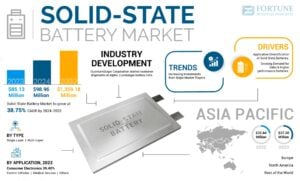
The Asia Pacific region is leading this growth, holding a 43.76% market share in 2024. Rising adoption of solid-state batteries in consumer electronics, electric vehicles, and renewable energy storage is driving this trend. The consumer electronics segment, in particular, dominated the market last year, with applications far ahead of those in EVs and medical devices.
Investment in this technology is accelerating, with companies like Toyota, BMW, QuantumScape, CATL, and BYD increasing research and development efforts. Government support is also playing a key role in the development of solid-state batteries.
Key Drivers for Adoption
The demand for safer, higher-performance batteries is pushing companies and governments to invest heavily. Additionally, solid-state designs reduce fire risks, offer greater energy density, improve charging speeds, and extend battery lifespan.
These improvements are making solid-state batteries a preferred option across multiple industries, including consumer devices, EVs, medical implants, and renewable energy storage.
With governments backing funding initiatives and industry players scaling up manufacturing, the path to widespread adoption is becoming clearer. The global market is on the cusp of a transformation, and solid-state batteries are at the forefront of this change.
All in all, QuantumScape’s demonstration is a breakthrough in EV battery technology, showcasing its potential to overcome industry challenges. While risks persist, strong partnerships, advanced specs, and rising demand position the company as a leader in energy storage. If scaled successfully, its technology could drive safer, faster, and more efficient batteries for the future of electric mobility.
The post QuantumScape’s Battery Breakthrough Powers Safer EVs – and Sends QS Stock Up 20% appeared first on Carbon Credits.

EU carbon credit claims changed on 27 September 2026, the day the Directive (EU) 2024/825 began to apply across the European Union. The change is narrow. It changes how a company can talk about the credits it buys. A product can no longer be called neutral on the strength of compensation alone; however, every specific, evidenced statement about what a company measured, reduced, and funded stays fully available.

The post Promoting Improved Cooking Practices in Nigeria appeared first on Terrapass.


-
Climate Change1 year ago
Guest post: Why China is still building new coal – and when it might stop
-

 Greenhouse Gases2 years ago
嘉宾来稿:满足中国增长的用电需求 光伏加储能“比新建煤电更实惠”
-
Greenhouse Gases1 year ago
Guest post: Why China is still building new coal – and when it might stop
-

 Climate Change2 years ago
嘉宾来稿:满足中国增长的用电需求 光伏加储能“比新建煤电更实惠”
-

 Renewable Energy12 months ago
Sending Progressive Philanthropist George Soros to Prison?
-
Climate Change2 years ago
Bill Discounting Climate Change in Florida’s Energy Policy Awaits DeSantis’ Approval
-
Greenhouse Gases1 year ago
嘉宾来稿:探究火山喷发如何影响气候预测
-

 Climate Change2 years ago
Analysis: China’s CO2 falls 1% in Q2 2024 in first quarterly drop since Covid-19