Connect with us

Published

on

Australia is moving toward a potential energy crisis, and 2027 could be the tipping point. Wondering Why? 

Well, with ageing coal plants retiring faster than replacements come online, demand surging from electrification, and delays in renewable infrastructure, experts warn of looming power shortages across some major Australian states.  

They say that if everything continues at the current pace, households and businesses may soon face blackouts, energy price spikes, and unreliable energy access all over the country.  

But how can Australia avoid a power shortage by 2027?   

From fast-tracking renewable energy projects to improving storage and transmission, several bold, actionable strategies can help Australia avoid this crisis.  

Hence, in this blog, we break down what’s really happening behind the headlines, what’s at stake, and most importantly, what needs to be done now to keep the lights on in 2027 and beyond. 

So, keep reading!

What’s Fueling the Crisis? | Key Factors Behind the Shortage

The potential power shortage crisis is expected to impact the Australian households and businesses along the eastern seaboard by 2027.  

This looming threat is the result of several converging factors, such as the rapid closure of coal-fired power stations, delays in the rollout of renewable energy projects, and a steady rise in electricity demand.  

Altogether, these challenges are putting increasing pressure on the national grid and raising serious concerns about future energy reliability. 

Recent data from AEMO said the power supply pressures are likely to worsen in the upcoming years due to the closure of five major coal plants.  

They also predict this closure will reduce the East Coast grid generation capacity by 14% of the National Energy Market’s total capacity. These closures included major plants in Victoria’s Latrobe Valley, NSW, and Queensland.  

So, here are the core reasons that fuel the crisis of power shortage by 2027: 

  • Coal plant retirements: In Australia, roughly 14 GW of coal capacity is expected to phase out by 2030.
  • Insufficient grid firming: AEMO projects that if new projects are delayed, there will be small but meaningful reliability gaps, like 25 MW in South Australia by 2026 to 2027 and 80 MW in Queensland by 2025 to 2026. 
  • Infrastructure bottlenecks: Delays in some key projects, such as Snowy 2.0 and REZ-related grid expansion, hinder the required pace for the renewable energy transition.  

AEMO’s Projections and Warnings: Where Blackouts Could Hit Hardest?

In a recent report, the Australian Energy Market Operator highlights shifts in power resource projections for Victoria, South Australia, New South Wales, and Queensland.   

The report talks about the urgency of investing in new power generation facilities and critical infrastructure projects to avert impending shortages.  

AEMO warns that energy market gaps will begin to emerge from 2025 onwards. If Earring closes, NSW may experience shortages first. Additionally, Victoria may face deficits starting from 2026 because gas-fired power stations will shut down.  

Renewable energy accounted for 40% of the power on the grid in the last quarter of 2022. This percentage represents a new record.  

However, ongoing investment in renewables continues to rise dramatically in Australia. The country is working to reduce carbon emissions, aiming to decrease greenhouse gas emissions by 42% by 2030 and reach net-zero emissions by 2050. 

States Most Vulnerable to Power Shortages 

So, which states are most affected by the power shortage by 2027 in Australia? Let’s check out the following list: 

New South Wales (NSW) 

As one of Australia’s most populous states, NSW faces frequent power outages due to ageing infrastructure, rising energy demands, and extreme weather like heatwaves and storms.  

Victoria 

Victoria experiences power outages due to overloaded transmission lines and an outdated power network, especially during peak demand. Also, the state’s mix of energy sources, including coal, adds significant challenges.  

However, Interest-Free Solar Battery Loans aim to support long-term energy sustainability. 

Queensland 

Queensland’s tropical climate leads to outages caused by cyclones, storms, and flooding. The state’s large geographical size also presents logistical challenges in maintaining a consistent power supply. 

South Australia 

South Australia is shifting to renewable energy, generating much power from wind and solar sources. However, this transition has brought reliability challenges.  

Western Australia (WA) 

With towns spread far apart, WA struggles to provide a stable power supply over large distances.  

However, some remote, off-grid areas often rely on isolated power systems, but they are vulnerable to extreme weather conditions like cyclones and heatwaves.   

Government Initiatives and Challenges: Bridging the Policy Gap!

The Albanese government aims to derive 82% of its energy from renewable sources over the next ten years.  

But the burning question is: are current policies enough to prevent a power crisis? 

The government has already taken several initiatives, including “Rewiring the Nation”, which involves using the $20 billion fund to update the electricity grid and improve transmission lines.  

Moreover, an additional $1.2 billion was later provided in the 2024-25 Mid-Year Economic and Fiscal Outlook to further expand and optimize the energy grid and speed up connections for renewable storage projects. 

With this upgrade, they are expecting to make clean energy more accessible and affordable for Australian consumers.  

AEMO expresses concern about the gradual adoption of firming generation technologies necessary for backing renewable systems during periods of low wind and sunlight.  

The Labour Party needs help in its emissions-reduction policy. They require support from the Greens.  

However, the push for gas-fired power generation for grid stability complicates things. The Greens demand a halt to new gas field development as a prerequisite for endorsement.  

Energy experts highlight significant gaps between possible and committed projects. A fraction of the upcoming projects is classified as committed.  

The market landscape is shifting, indicating potential challenges and urging stakeholders to take action.  

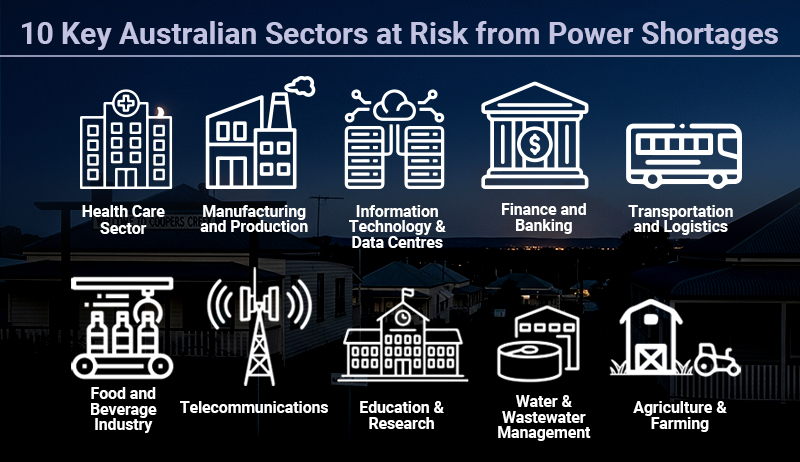
Key Australian Sectors at Risk from Power Shortages

10 Key Australian Sectors at Risk from Power Shortages

A power outage can have far-reaching and disruptive effects on various industries in Australia.  

These disruptions don’t just affect productivity; they also interrupt supply chains, impact public services, and threaten the overall economic stability of a country. 

So, here we’ve listed all the sectors that would be most affected by a power outage in Australia:  

1. Health Care Sector 

Hospitals need a steady power supply for life-saving equipment, medication temperature control, and life support systems. Power failures in the healthcare sector can threaten patient care, delay surgeries, and impact critical treatments.  

2. Manufacturing and Production 

Industries involving complex machinery and automated processes, such as manufacturing and production, depend highly on uninterrupted power to maintain operations.  

Power disruptions can lead to production halts and material wastage, potentially affecting supply chains.  

3. Information Technology (IT) and Data Centers 

Data centers and IT infrastructure require a stable power supply to ensure the accessibility and security of digital data.  

Power outages can cause data loss, disrupt online services, and impact businesses that depend on e-commerce and cloud services.  

4. Finance and Banking 

Financial institutions rely heavily on electronic transactions, trading platforms, and online banking. A power outage can disrupt economic market disruptions, hinder transactions, and impact customer access to funds and services.  

5. Transportation and Logistics 

Public transportation systems, airports, and shipping ports depend on electricity for operation and communication.  

Power failures can lead to transportation delays and flight cancellations, and impact the movement of goods and people.  

6. Food and Beverage Industry 

Restaurants, supermarkets, and food processing plants require electricity to maintain refrigeration, cooking equipment, and storage. A power outage can lead to food spoilage and inventory loss, impacting fresh product availability.  

7. Telecommunications 

Telecommunication networks, including mobile and landlines, rely on power to maintain connectivity.  

Outages can disrupt communication channels and emergency services, impacting businesses that rely on constant communication.  

8. Education and Research 

Schools, universities, and research institutions require power for electronic learning tools, research equipment, and communication systems.  

Power interruptions can disrupt classes, research projects, and remote learning programs.  

9. Water and Wastewater Management 

Water treatment and sewage systems rely on power to pump and treat water and manage wastewater. Power outages can lead to water supply disruptions, sanitation issues, and rising environmental concerns.  

10. Agriculture and Farming 

Modern agriculture relies on power for irrigation, climate control in greenhouses, and automated machinery. Power failures can impact crop yield, livestock management, and overall productivity.  

In all these industries, the effects of power outages extend beyond immediate operational disruptions.  

They can lead to financial losses, reputational damage, safety risks, and compromise public well-being. 

Avoid Power Outages and Blackouts

How To Avoid Power Outages and Blackouts in Australia?

With rapid change looming toward a nationwide power crunch, the fear is real for Australia’s residents. 

The country is already standing at a critical energy crossroads, and without urgent, coordinated action and government support, Australia could face energy instability that threatens homes, industries, and economic growth. 

How to prevent these outcomes?  

Here are the key strategies that can help avoid blackouts: 

  1. Accelerate Investment in Renewable Energy, Storage & Transmission

Australia should prioritize substantial investments in renewable energy sources such as solar, wind, hydroelectric, and geothermal power. The nation can reduce its dependency on fossil fuels and increase its resilience to supply disruptions by diversifying its energy.  

  • Major renewable projects, battery systems, and transmission infrastructure must stay on or ahead of schedule to replace retiring coal fired power plants.
  • Avoid permitting or construction delays, particularly with electric transmission lines. Investment in this sector ensures a reliable energy supply for Australian households and businesses.
  1. Boost Grid Stability Systems

Upgrading the electrical grid with modern technologies is crucial.  

  • Install more Smart grids, which use sensors, automation, and real-time monitoring to optimize energy distribution, detect faults, and redirect power during high demand.
  • Deploy grid-forming battery systems that help in both blackout recovery and provide energy security.
  1. Energy Storage Solutions

Since renewable energy is intermittent by nature, embracing diverse battery technologies can help you avoid power outages and achieve energy independence in Australia.  

  • Pumped hydro & hydrogen systems also offer long-duration storage and can act as backup in extended supply gaps.
  1. Demand Response Programs

Implementing demand response programs empowers consumers to adjust their energy usage during peak demand periods.  

  • Load-shedding reserves, fuel-powered peakers, and temporary diesel or gas backup generators also help to manage short-term volatility. 
  1. Policy & Investment Encouragement
  • Support programs like the Energy Efficiency Upgrade Program, Capacity Investment Scheme, and Rewiring the Nation drive renewable adoption and large-scale clean energy projects.
  • While renewable energy is a priority, gas remains a key source. Excluding it entirely from capacity programs may raise costs and risks, so it’s better to balance the energy mix.  

Powering Australia: Stopping the Crisis Before It Starts!

Powering Australia

In the end, the warning signs are clear, and the time for hesitation is over.  

As the demand for energy surges and our infrastructure strains under the weight of progress, we stand at a turning point in history. Avoiding a nationwide power crisis isn’t just a priority anymore; it’s a responsibility we all share.  

From the Australian government’s bold policy to individual action, every small action matters. By investing in innovation, embracing sustainability, and uniting as a nation, we can build an energy-secure future that empowers our future generations.  

Contact Cyanergy today for any of your renewable needs. Let’s rise to the challenge and power the future before the crisis begins.

Your Solution Is Just a Click Away

The post Power Shortage By 2027 In Australia and How to Avoid It? appeared first on Cyanergy.

Power Shortage By 2027 In Australia and How to Avoid It?

Continue Reading

Renewable Energy

Moral Failure

Published

on

It really is amazing that the wealthiest people on the planet are so indifferent to others’ well-being.

Instead of being remembered as the guy who eliminated world hunger, or stemmed global warming, you chose to make another $100 billion?

Why?

Moral Failure

Continue Reading

Renewable Energy

Morten Handberg Answers the Big RCA Questions

Published

on

Weather Guard Lightning Tech

Morten Handberg Answers the Big RCA Questions

Blade specialist Morten Handberg on when an RCA pays off, what SCADA data can and cannot tell you, and why erosion gets written off as wear and tear.

The Uptime Wind Energy Podcast is brought to you by Weather Guard Lightning Tech, creators of the StrikeTape Ultra LPS retrofit. Subscribe to Uptime’s Substack newsletter. And check out Rosemary’s “Engineering with Rosie” Youtube channel. Have a question we can answer on the show? Email us!

Welcome to Uptime Spotlight, shining light on wind energy’s brightest innovators. This is the progress powering tomorrow

Allen Hall: Morten, welcome back to the program.

Morten Handberg: Thanks, Allen. It’s so– It’s, it’s so such a great, great pleasure to be back again.

Allen Hall: We have a lot to talk about today because of root cause analysis and the number of operators that are really struggling with RCAs, of when to do them or when not to go down the RCA pathway.

It, it– There’s a, a ton of confusion in the industry about it, and we thought, well, this would be a great time for Morten to come back and explain when is the right time for an RCA. So Morten, when is the right time for an RCA? What should we look for? Or wh- how big of the problem sh-should it be [00:01:00]before I find somebody to help me do this RCA?

Morten Handberg: So the obvious question is typically when something really bad happens, then I think everyone can agree that, you know, we should definitely do an RCA to get to the bottom of this. And that’s also just from a– It’s both from a technical perspective to sort of figure out, you know, why did this happen, and, you know, um, who…

Well, what is the, what is the main cause? Is it, is it something that, you know, it was happening while we were operating the asset, be it turbine or whatever? Uh, was it something that was inert in the bla- in the, in the turbine, the blade, the gearbox that was just waiting to happen? So that’s always very important to know.

Also because it tells you what is the chance of this happening again, you know, and, and can you prevent it in a meaningful way? Um, and there’s also a, a safety aspect to it because it’s– so it also tells, you know, uh, what if, you know, you don’t want blade falling left and right. You don’t want gearbox ex- [00:02:00] gearboxes exploding.

You don’t want towers to collapse. We can all agree on that. Uh, and you don’t want this to happen because you don’t, you don’t want to run the risk that someone gets hurt, uh, hurt by it. So then RCA is a really important tool to investigate and find out, well, what happened here, and how can we prevent it, and what is the chances that it happens another time?

So that, that is sort of the– That we can always agree and we would do it when, when something really terrible happens. Then there is the, you know, not so critical ones where, you know, you are just in time, uh, that, that, that you catch it, and then the question is, what is the– when is then the right time for that?

Allen Hall: There seems to be a couple of phases in the lifespan of a turbine where the RCA, it becomes a little more critical. In that first year or two, particularly if the turbine is under warranty or you’re getting close to the end of the warranty, there– at least from a lot of operators I have spoken with, that, uh, [00:03:00] they would like to do an RCA as more of a documentation of what has happened on the site to then maybe claim serial defect maybe l- at another point.

There’s just like the record-keeping part of RCAs, which I’m not sure is the right level of effort for what you’re trying to accomplish. Is, is the RCA the right approach there if you have a, a gearbox issue or a blade issue early in the life cycle of a turbine?

Morten Handberg: There is definitely before the end of warranty, there is a, there is an, there is an aspect, you know, when should you actually do an RCA?

And it should, it, it should benefit you in a way where you can– where there is an economical benefit, because it might not be a massive critical issue, but something that will lead to a lot of maintenance down the t- down the line. Um, but if you want to make it successful in the warranty claim, then you really need to know what is the, what is the cost behind it.

Is it wear and tear? Is it [00:04:00] a manufacturing defect? Is it, uh, environmental conditions, uh, that are, that are causing it? And these, these becomes really important. That’s also why you can, you, you can, you can do an RCA on erosion, uh, because it, it can be important if you see massive, uh, erosion degradation that you really want to understand, what are my local conditions?

Um, and a good example here is Australia, because Australia doesn’t work like Europe. We– You can take all the experiences we have from Europe, but it does not work in Australia. So you might want to do your, your, uh, root cause on that specific issue localized, uh, to really understand it, and that’s when RCA becomes really strong to sort of find out what are the underlying mechanisms, uh, that enables this.

But you can also pour in a lot of cost and effort into relatively minor defects, uh, or issues, um, where it does not really benefit you in the long run, and that will always be a challenge before end of warranty because you don’t really know what will, [00:05:00] what will hit you down the long run, and that’s where you, you know, then, then it becomes more of a strategic decision.

You know, breaking bolts, if you’ve seen one, maybe you don’t want to do an RCA on it. That does not really seem to matter to you that much. It’s just random occurrence. But if you start to see it, uh, in, in quick succession on multiple turbines, adjacent bolts, then it’s important for several reasons. One, you might– If you’re still within warranty, you really wanna know why is this happening and, and how do you fix it long term so this not– does not become a headache for the next 25 years?

Um, so you want to, you want– you really want to understand that. And two You can, you can live with a few broken bolts on the blade, but there, there will become a critical point where the blade will liberate and then, uh, it will, it will col- it will, it will, yeah, leave the turbine or, or collapse on its own, uh, depending on the turbine model.

And, and that is really critical to, to, uh, to avoid and, and to, uh, to [00:06:00]understand that. Um, and maybe the outcome of the idea of the RCA is monitoring, but that is a really important knowledge to have.

Allen Hall: That’s a good point about the monitoring aspect because I think a lot of times when a operator chooses to go down the RCA path, what they’re expecting is just to get a report of this is the conditions that created the damage or created the unexpected outcome Uh, it, sometimes you may not be able to get to that final answer, and the answer can be, we need to put conditioning monitoring on to have a better understanding of what the fault is.

That’s not a invalid RCA. That’s a really useful tool. But a lot of operators don’t think of an RCA as being that sort of outcome. That, that is actually where a lot of the industry problems can be solved, right, is to get the engineering up in upfront to then maybe have a little longer time or maybe instrument another [00:07:00] turbine to see how big this problem is.

I- is, is that the approach that which you would, uh, aspire to apply to some of these wind sites today?

Morten Handberg: I think that monitoring, uh, understanding the monitoring requirements is a very critical point, uh, outcome of an RCA. Both– And you can use it both during your investigation to sort of find out when you have, you know, uh, to, to find out how do you detect it efficiently, uh, but also what are the right methodologies and what is it actually that you want to achieve, uh, with mitigating this issue, and then what, what kind of, what kind of monitoring do you need.

So for instance, if you have, if you have, if you have cracks starting in your laminate, you know, do you need acoustics? Uh, do you need deflection monitoring? Um, is it es- is it vibration monitoring, or is it, um, or is it some kind of, uh, video monitoring, um, that or, or infrared scan that, that, that you need to, to keep, um, to, to, to ca- And again, the essential [00:08:00] part is then how do you catch it in time that it does not become a critical issue?

Uh, and, and then by using the RCA to find out, well, what is the best methodology to, to detect this and detect it in a cost-effective way, uh, that, that leaves you in, in good shape to, to maintain your turbines. That is a, you know, that is a really strong value proposition for the RCA.

Allen Hall: Morten, when I talk to a lot of operators about doing an RCA, uh, they don’t have access to high-speed scada, scada data.

They, they have access to low speed, depending on what their arrangement is with the OEM. Uh It’s really hard to get the high-resolution data, and they do not have the algorithms that maybe be able to tell them something about the turbine. They’ll just have sort of raw data streams. How important is it to get some of that high-speed data and the understanding of how that turbine is working as a, a fault [00:09:00] happens or s- some sort of failure happens?

Morten Handberg: It kinda depends on what it is that you’re, that you’re looking for. So for a lot of… for, for, so for SCADA data, it will, it will give you, um, a more holistic view of what, how the turbine is performing. It will give you the power production, wind speeds, wind turbine, uh, the blade pitching. Um, so it kinda gives you an understanding about how it is, how, how it is operating, but it st- does not really give you any specifics about the condition of, of the blades, of the gearbox, of the bearing, of the main shaft, of the tower.

So, um, so it does, so you don’t really have any, any detailed sense of that. You do have alarm logs, and they can be quite important. But in order for, uh, to sort of, uh, to tie that in with the failure that you’re seeing, you have, need to have a very, uh, a very strong sense of, you know, have, need to have an accurate sense of when did this actually happen.

So establishing the timeline of when the failure occurred, that, that sorta increases [00:10:00] the value of SCADA data. Um, so you can– The, one of the things you can learn from SCADA data is you can see the performance was, were, versus what, how the power production is. And then you can start to see, you can start to see how the, you know, if there’s any deviation, um, uh, that ties up in environmental conditions that, that sort of, that would affect the, the, uh, any of the turbine components.

And then SCADA data can be a very, uh, very important tool in addition to your other analysis. But you still need… But SCADA data is only a part of it, and it will only give you a s- a sense of, uh, com- with the alarm logs, it will give you, it will give you, it sorta help you build the timeline of what actually happened here.

And I can give you an example. So- If we’re looking at a blade failure, and we sort of know, well, the blade broke in half at a certain point in time. It was, uh, a very rapid occurrence, so it, it was not something that happened over a very long period of time. It was, it was a quick succession. When [00:11:00] did we start to go wrong?

Um, then scatter data can be really good to sort of, you know when it failed because the turbine did restart. But was that when things went wrong? Not necessarily. Uh, there could be times before that when you could have had tower oscillation, so shock effects. It can, it can be, um, it can be, uh, alarms from the pitch system that says, you know, the, that there is something with the blade.

It does not really behave right or that it can’t really turn right. Um, and/or the, the turbine does not really produce as it should. That can then, that can then help you establish, okay, how far back is this actually? When, when does this really start from when it collapsed and then when does the issue started to occur?

Um, so then, then, then scatter data becomes useful, but it’s not something that will tell you it was lightning, it was manufacturing, uh, or otherwise. That scatter data doesn’t really work for that, but it helps you establish the timeline of it.

Allen Hall: All right. That’s very interesting, uh, because I think that plays into some of the questions about [00:12:00] insurance and when you have a damage or some situation where you have had exceeded the deductible, right?

So you’re, you’re, now you’re into a couple hundred thousand dollars of a claim of some sort. There’s two opposing opinions about RCAs that right there is, one is I’m gonna file a claim. The insurer will perform the RCA and come back to me with what actually happened, and then we can figure out the financial details.

The other side is, I wanna have an RCA so when I hear back from the insurer, uh, that they, uh, my RCA aligns with their RCA, that we’re in agreement. And if we’re not in agreement, uh, how do we handle the difference? What is the right approach there? Is there a right approach there?

Morten Handberg: Often where you would start is, uh, you would actually a- if, if there is an issue and you’re, as an operator, is concerned, you would often start with going to your OEM and saying, “Hey- We see [00:13:00] this.

This does not seem right, or this component failed. We need you to provide an, an RCA and if you have a good contract, then the OEM is obliged, uh, to provide that. But that will state, that will be stated in, in your contract if they are required to do so. So I would, I would use my contract for that. Then if, uh, they don’t are required to perform an RCA, they don’t want to, or you’re unsatisfied with it or, and you have filed an insurance claim, then, uh, then there might be an obligation for you to carry out an RCA.

Or there might be a strong desire for you to sort of either find out, well, is the OEM right? Um, or is there something I need to challenge them on here? And then an RCA become– And that, that, that’s when you want to do your own RCA. Uh, and then whether or not you, the insurer, uh, will do an RCA, that, that sort of depends on the, on the process of the claim.

Uh, if there’s any, uh, if there’s a [00:14:00] contes- some, some contention, uh, between the parties. Um, more often than not, there is, there is a, there is collaboration between all parties if all are interested in, in seeing things coming to, to the right end, and that they use– sort of let the RCA be the, be the guiding star and that everyone can agree, okay, whatever the outcome of the RCA is, we’ll stand behind that as long as it’s carried out in a professional manner.

And these different boxes that we want to have checked, that they are all verified and there’s documentation for it. So it can be an, it can be a good tool to, uh, to sort of, uh, have an alignment on the, um, on, on a, on a claims process, really.

Allen Hall: I wanna touch on how the OEMs play into the RCA. So l- let’s use the example which is happening here in the United States quite a bit, and also in Europe offshore, which is leading edge erosion And the question regarding wear and tear versus something that’s a claim, and [00:15:00] if ex- there’s been accelerated leading-edge erosion, trying to put a root cause to that.

Is it a manufacturing issue? Is it a location issue? Is it a maintenance issue? It could be all of them or a combination thereof. Uh, how does that work? And is the RCA the right approach there just to put some markers in the ground as to what the issue really is or the underlying causes are?

Morten Handberg: Yes, but it has to be an independent RCA.

Um, because there, um, if there is invested interest in having one result over the other, then there will always be distrust between the parties. Um, you know as well as me that a lot of leading-edge degradation, I would say, is being marked out, marked out as leading-edge erosion. Uh, but from some of our previous talks then, you know, there is very much difference in leading-edge erosion defects because you can have scratches, you can have voids, you can have, uh, peeling, chipping, and you can have erosion.[00:16:00]

Um, but and, and they look very distinct, but often they get thrown into the same category, and they get thrown into the same cause, being wear and tear, which is ridiculous because, um, a lot of it is, uh, uh, uh, you know, some of the key defects they’re manufacturing with, uh, driven. So peeling and voids, that is manufacturing, and they are driving a lot of the erosion.

But if that gets masked as erosion, then, well, it’s just an environmental de- effect, so we can’t really tell. And I think also, you know, a lot… there’s a lot of, uh, issues regarding leading-edge protection systems peeling off, and then they don’t work as well, which is also somewhat, you know, we, we talked about this before ear- earlier in the podcast, you know, Australia having their own issues.

I think one of the issues that they have is environmental conditions, that’s very obvious, but that leading-edge protection systems are notoriously difficult to install there because of the hot and at times humid conditions, and they don’t work very well with a lot of [00:17:00] leading-edge, uh, products. So that would mean it’s not an environmental effect that caused a leading-edge erosion, uh, systems to fail, to fail.

It’s the application. Um, does that mean that Australia need their own product? Yes, but they need systems that are reliable and applicable in their con- in their conditions that will lead to, uh, stronger durability. And again, that’s what you need the RCA to, to, to figure out. And if you have a, an RCA carried out by someone who wants it to be wear and tear, then regard- then unless you can…

they, they, they come up with something else than wear and tear, you will always have a, a slight distrust in the result. So that’s why I would always argue, if you have concern for leading-edge erosion, then absolutely go to your O&M, figure out if they have a– if they’ve seen it before, they are keen to, to engage and provide a suitable solution and, and, you know, share actual knowledge.

But I would always keep in back of my head that if, if you’re not [00:18:00]100% sure about their– them telling the right– you– they’re, they’re telling you the truth, I would get it sanity checked, and I would carry out my own independent study which is what a lot of O- O&Mers are doing.

Allen Hall: That’s a really important bit of information for sure, Morten.

When going out to look for an RCA provider, what tends to happen, at least in the United States, and I think, uh, Australia can be this way at times and, and Europe definitely is, is that the chosen supplier of the RCA is one of the acronym companies. We all know who we’re talking about here. Just because they’re large in scale and they have a lot of capabilities, they have a lot of engineers, and, uh, they b- some of these things are pretty routine, and it does seem like they can, can do this job.

But I’m seeing more and more independent companies doing RCAs because of the level of detail. Some of the bearing issues that have popped up really require an expert in [00:19:00] bearings. Some of the tower issues require someone, especially foundation, someone who’s knowledgeable about concrete. Uh, same thing for lightning.

Usually you need somebody who knows something about lightning to be involved instead of a, a, a larger organization. What are you seeing in that space today? Are you seeing more, uh, narrow focus, uh, independent groups or engineers working on RCAs, or is it still mostly the big companies that we all know?

Morten Handberg: I would say that, uh, all of the acronym companies, uh, all have very good, talented engineers employed.

I don’t think we need to d- you know, we can all agree on that. But, uh, what I can sometimes be concerned is whether how much politics plays into their, um, their output. Um, so what would be important for me if I was, if I own a wind farm and my expertise is blades. So if I needed someone to look at my tower or my, my gearbox, I would find an expert within that [00:20:00] field.

I would definitely find someone in my network or, uh, uh, or, uh, otherwise that I know can provide an independent and honest opinion without, uh, having any any relationship to any of the OEMs or component suppliers, um, including the, including the coding suppliers. They’re all good. They’re all, uh, very, uh, all, all very skilled, have good products.

But they’re gonna want someone to look at, you know, what is the best solution for me with what is out there, um, and not be blindsided or focused on what is, you know, uh, other in, in interest in that.

Allen Hall: Right. Because it, it’s, it’s sometimes hard to tell where y- everybody’s intentions lie. It’s like hiring an attorney, I think, at some point, and that’s what I tell people is it’s like hiring an attorney.

Do you want an attorney that’s on your side, y- y- or and helping you? Do you want someone who’s more like a judge that’s just an independent person [00:21:00] or, or an advocate? Like, what are you looking for exactly? And it, uh, you need to think that out, uh, before you make your selection. And a lot of times there’s just a couple of defaults, which I have Have done really well, obviously, because the larger firms have a lot of engineering experience and have seen things globally, but not necessarily– That’s, that doesn’t mean they’ve seen your particular, uh, problem, particularly on a, on a new turbine design.

Those are really difficult RCAs, in my opinion. And Morten, you see this all the time on new turbines. Like, those are the

troublemakers in, in– from engineering to try to solve the problems ’cause they’re, they’re new.

Morten Handberg: Yeah, and we’re, we’re, we’re playing catch up, uh, with the, with the technology, and we’ve, we’ve been, been, been like that for for quite a few years now. And, and whenever, uh, a, a new blade that is, uh, ten meters long, well, we think we know what the, what the previous versions, how they worked and, uh, and what, what could go wrong with them, and that’s both in terms of the structure, in terms of the, uh, storage, in terms of, of lightning.[00:22:00]

But it seems like, you know, there’s some-always something new popping up, uh, and also in new environments that we’re installing turbines creates new problems that we haven’t really foreseen. And, and again, if something that you’re not expecting then suddenly starts to appear, that’s also when you, you really want to, to use the RCA tool to, to sort of get to, uh, get a handle on what is going on and get an– and get that deep dive understanding about what it is, because it will help you, uh, uh, understand, well, what are my risks going forward, and what can I do to mitigate?

Uh, and, um, yeah, on, you know, uh, and is there, is there, is– Do I need to, to look at, uh, putting a claim together?

Allen Hall: Morten, this is super helpful. I know a lot of operators around the world, uh, really question when to do an RCA, and if they should be doing RCAs, is it worth the spend? And you’re a great resource on that just because you’ve done a number of RCAs over the years, and you’ve been involved in [00:23:00] other companies that have performed tho-that task, and you have a, a sense of reality there of, uh, probably not an RCA, but probably some engineering time.

Or no, you really, really need to be on an RCA right now. How do people get ahold of you and, and to pick your brain about that an-and to get some, some knowledge, uh, to help them make their decision?

Morten Handberg: Um, yeah, you can always look me up on LinkedIn, and I am always happy to engage. Uh, if anyone has a question on, on blades or on RCAs or on maintenance, um, my door’s always open, and I’m happy to have a chat, uh, and share my knowledge.

That’s how I’ve been operating for my entire career, and that’s how I intend to continue. So please feel free to reach out, and ha-looking forward to, to the, to the discussion.

Allen Hall: Morten, it’s great to have you back on the program. Looking forward to having you again in the future.

Morten Handberg: I, I’m loo-looking forward to many more, more, more, more times on your show, Allen.

Thank you so [00:24:00] much.

Morten Handberg Answers the Big RCA Questions

Continue Reading

Renewable Energy

Banning Sharia Law in the U.S.

Published

on

The MAGA base is on fire about Trump’s quest to ban Sharia law.  It would take any of them about 15 seconds, if they wished to look into this, to learn that Sharia law has no official legal status or authority in the United States, because the U.S. Constitution and secular laws always come first.
  • No Authority: American courts do not follow or enforce Sharia law.
  • Religious Freedom: Muslims in the U.S. follow Sharia as a personal and moral guide for daily worship and life, just as people of other faiths follow their own religious rules.
  • Constitutional Limits: Religious practices cannot break federal or state laws.

For a moment, think about an American judge’s sentencing a thief to have his hand amputated, or having an adulteress stoned to death.

Banning Sharia Law in the U.S.

Continue Reading

Trending

Copyright © 2022 BreakingClimateChange.com