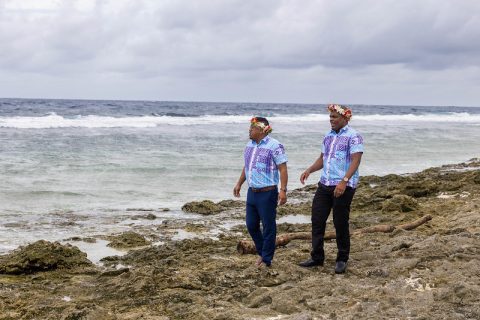
Burdened by rising fuel import costs and an “ocean crisis” of record-breaking heat, Pacific island nations are seeking to build support for a new regional fund ahead of COP31, intended to channel investment into renewable energy, community resilience and ocean protection, experts said.
Leaders from the 18-member Pacific Islands Forum (PIF), including Australia and New Zealand, are expected to issue a call for global pledges to the Pacific Resilience Facility (PRF) at a high-level meeting this coming week in Palau, seeking to build a new model for financing climate action.
The new regional fund was formally launched in May this year and is meant to “serve communities at a community level”, swiftly channelling investments for their projects on the ground, according to Fiji’s assistant minister for foreign affairs, Lenora Qereqeretabua.
“We are expecting pledges for the PRF, and these funds will go to communities that apply,” she told journalists at an online briefing. “We have organised it in such a way that it makes our application processes much, much easier than applying for global funding.”
Qereqeretabua added that she expects that PRF funds will be “utilised by communities to protect themselves from climate change and the effects of climate change.”
The Pacific Islands Forum meeting is expected to shape the region’s priorities ahead of this year’s pre-COP, hosted by Fiji and Tuvalu, and COP31, which will be co-led by Australia and Türkiye.
At COP31, a dedicated session on the climate finance needs of small island states will seek to drive pledges into the PRF. The fund has so far received about $172 million in capital – with about $67 million coming from Australia – and aims to close the year with $500 million.
-
Battle over cleaning up shipping set to resume at London talks
The US and Saudi Arabia want to scrap shipping’s Net-Zero Framework and have swung behind a far less ambitious alternative -
As marine heat breaks records, countries seek ocean roadmap at COP31
Africa and the EU are leading a push for COP31 to deliver a roadmap that lays out measures to protect fast-warming oceans -
Indonesia’s nickel production cuts are not enough to create a sustainable industry
The government is restricting nickel production to push up prices but producing more sustainable nickel for a premium requires addressing the industry’s coal issue


Ocean heat and fossil fuel shocks
Leaders from the Pacific will meet in Palau from Sunday amid an “ocean crisis” of record-breaking ocean heat caused by this year’s “super El Niño”, according to Kevin Chand, Pacific ocean policy director at National Geographic’s Pristine Seas conservation project.
Leaders at the PIF are expected to put forward commitments towards new marine protected areas, which will be key for shielding ecosystems from future climate extremes, Chand said. The forum is expected to issue a statement on the need for ocean action at COP31, and announce commitments towards reaching the global goal of protecting 30% of the planet’s land and sea ecosystems by 2030.
Rising ocean heat could lead to food insecurity and lost government earnings in the region, as key fish stocks like tuna start migrating away from their coastline in search of colder waters, said Coral Pasisi, director of climate change and sustainability at the Pacific Community (SPC).
Climate shocks are deepening existing economic pressures, as Pacific nations have spent up to a quarter of their GDP on fossil fuel imports due to the war in Iran, according to a recent report by the University of New South Wales (UNSW) in Australia.
Wesley Morgan, one of the study’s authors, told journalists that partner nations “ought to be putting their money where their mouth is”, and should support the energy transition in the Pacific by covering the upfront costs of switching from polluting diesel to solar power, batteries and electricity grid upgrades.
China keeps Indonesia’s battery dream afloat but future less certain
Given the increase in climate-related shocks and sea-level rise, the PIF should also mention the need to phase out fossil fuel extraction and consumption, said Sindra Sharma, international policy lead at the Pacific Islands Climate Action Network (PICAN).
Last year’s COP30 failed to deliver a global roadmap on transitioning away from fossil fuels, which led to a group of countries – including several Pacific island nations – pursuing their own fossil fuel phase-out summit in Santa Marta, Colombia. Next year’s conference will be hosted by Tuvalu and co-chaired by Ireland, which should also receive backing from the PIF, Sharma said.
Both the chairs of the Santa Marta coalition and the Australian COP31 co-presidency have vowed to continue a push for this topic to be discussed at COP31.

New fund to test allies
As local communities in the Pacific struggle to access global climate funds, the PRF’s planned model for quick, direct disbursements has “very solid and good” intentions, Sharma said, but it will need political and financial backing from donor countries.
“The proof is going to be when the fund actually starts operating and delivering to communities,” she added. “If there is too much bureaucracy in being able to access the funds, for example. These things will have to be scrutinised.”
The facility aims to deliver funds in two categories: one for climate adaptation and “disaster resilience”, and another for social and community resilience that includes areas like community capacity-building, education, data analytics and financial management, among others. It will launch its first call for proposals at the PIF.
Morgan added that Australia will need to “leverage global interests” so that funding is directed to the Pacific Resilience Facility “or else the Pacific won’t be able to trust Australia as a partner”. The country ratified the PRF treaty in May, triggering its entry into force.
“The perception [of Australia] in the region is genuinely divided, and it’s worth being honest about it,” Sharma said, adding that the pre-COP31 in Fiji, which is usually limited to a technical space for negotiations, will determine how meaningful Australia’s advocacy for the Pacific can be.
This time, Pacific nations want to use the pre-COP in early October as an opportunity to demonstrate the challenges their largely low-lying islands face and to advocate for their political priorities, including a renewed global effort to limit global warming to 1.5C by cutting emissions faster and deeper. World leaders are due to visit Tuvalu to experience the frontline of rising sea levels, although Australia and Fiji have yet to confirm who will attend.
“In Bonn, Australia was largely missing on the negotiated outcomes that we so urgently need to see. It’s not enough to get Pacific priorities on the agenda. Agenda placement is not delivery,” Sharma added.
The post Pacific islands seek backing for new regional fund ahead of COP31 appeared first on Climate Home News.
Pacific islands seek backing for new regional fund ahead of COP31

A beacon of love
On an outer island of Fiji, two thousand nautical miles from Sydney, is a shining light of hope and resilience for our troubled world.
The island of Kioa is home to a Tuvaluan community who migrated from their atoll of Vaitupu in the late 1940s. It is a land of warm hearts, big smiles, and deep cultural roots; a place where the sound of a conch still summons the island together, where islanders paddle out to fish in carved outrigger canoes, and healthy happy children walk barefoot to school.
Here, culture is life. Kioans live sustainably through their traditional knowledge and practices. The island is alive with song, dance and the rhythms of a life tied to the tides, the winds, and the seasons.

Facing the future
Greenpeace has been lucky to have a relationship with Kioa for a number of years now, and we are continually learning from this remarkable community.
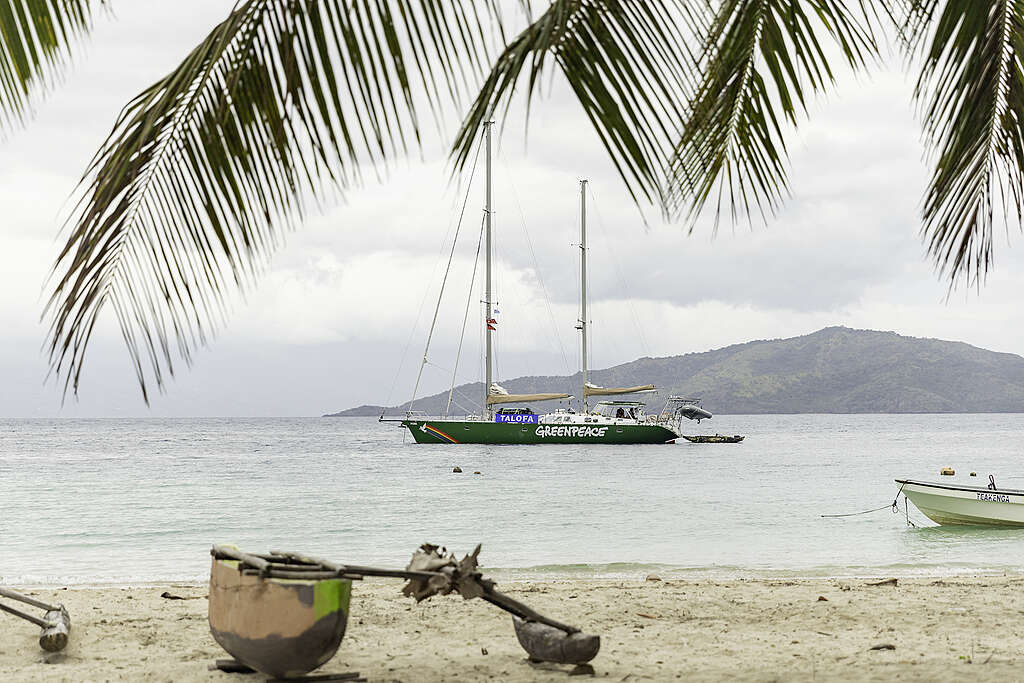
Last week, as part of our Voyaging Oceania project, we returned to the island. Our purpose was twofold —- to carry messages from the island to leaders gathering in Nadi this week for the Pacific Pre-COP, and to support the Kioa community in their efforts to improve water security for the island.
Unlike Tuvalu itself, with its eight atolls, Kioa is a mountainous, forested and richly fertile island. It will remain habitable far into the future. Kioans did not initially migrate from Vaitupu due to climate change, but the move was prophetic. They now have a lifeboat.
However, even Kioa faces challenges on our rapidly warming planet, in particular when it comes to water. Climate change is shifting once reliable rainfall patterns. On top of this, the island is already feeling the effect of this year’s intensifying El Niño event, which for Fiji means reduced rainfall and prolonged dry spells.
Right now, fresh water has to be carefully rationed, and is only available for a few hours a day. During last week’s visit aboard our campaigning ship Oceania, Greenpeace was privileged to work with the Kioa community on a new solar-powered water distribution project for the island.
Designed and led by the island, the project involves using a solar pump to move water from a reliable source to a storage tank and then using gravity to distribute the water around the village.
It was a lesson in how local knowledge and ingenuity can be the backbone of today’s climate solutions. To build a dam around the source, the local community knew the exact spot where they could gather gravel at low tide to mix with the cement. They took only what was needed, knowing that all resources must be carefully conserved. Kioa has no roads and no machinery, and it was an all-of-island effort to carry the materials up to the project site, including many heavy bags of sand and rock.
Such projects truly bring to life the vision of a resilient, locally-led, fossil fuel free Pacific.
Gallery photos taken by Raeed Ali, Pacific Community Mobiliser at Greenpeace Australia Pacific
Voices of wisdom
During our four precious days on Kioa, Greenpeace’s Pacific team sat with the island’s elders as they shared stories and experiences for us to carry with us to the Pre-COP. During a fun filled morning at the island’s school, Kioa’s children shared what they love about their life on Kioa and what they want to see nourished and protected. They wrote these messages on flags which will fly proudly from Oceania in Nadi.

It is hard to describe the warmth and generosity we experienced once again in Kioa. Meals were lovingly prepared for us, each one the product of many hours and many hands needed to fish, to grow, and to prepare. In the evenings we were entertained with traditional songs and dances, each one pulsing with an indescribable energy. For Kioans, these rituals are of course more than entertainment. This is how they have encoded and kept alive countless generations’ worth of traditional knowledge, and the wisdom that has enabled them to flourish sustainably and peacefully.
We are now sailing on to Nadi, inspired by the warmth and wisdom of Kioa, and determined to help take the voice of Pacific climate justice to the world.
A visit to Kioa is a reminder of what life can and should be. It is a reminder of what we are all fighting to protect. It is a reminder of the power of local knowledge and culture, and of listening to those on the climate front line. And it’s a reminder that tackling climate change is above all about building community, and respecting and loving each other.
Piers Forster is Professor of Physical Climate Change and Director of the Priestley Centre for Climate Futures at the University of Leeds. He has previously served as a lead author on several IPCC assessment reports.
Evidence of a rapidly changing climate and our improved scientific understanding is compelling nations to act, but not always in a good way. The science itself is facing well-organised obstruction.
The consequences of politicising the evidence are now more apparent than ever, especially in the run-up to a crucial intergovernmental climate meeting taking place in Addis Ababa this week.
On the agenda is a proposal that would prevent all governments from being able to use the most up-to-date analysis of options for combatting climate change at a critical stage in UN negotiations.
The meeting is the 65th session of the Intergovernmental Panel on Climate Change (IPCC), the body charged with providing gold-standard scientific and economic evidence on climate change to the world.
-
Pre-COP draws attention to Pacific’s climate plight and 1.5C goal
After visiting Tuvalu’s shrinking land, COP31 President Murat Kurum said that the global 1.5C warming limit is “a matter of survival” for the Pacific