

- What timeline options were delegates debating?
- How did the timeline discussions unfold?
- What were the main points of disagreement?
- Why is the IPCC in a ‘serious funding crisis’?
- How have scientists reacted?
- What other issues remain unresolved?
- How are the IPCC AR7 reports progressing?
- How might the IPCC use AI and enhance gender inclusivity?

The UK is considering a new law which would invite applications for new oil and gas production licenses in the North Sea every year.
This Offshore Petroleum Licensing Bill will not help with the UK’s energy security, reduce bills or serve anything but fossil fuel giants’ short-term profits.
On top of this, if it passes into law, the UK faces the grave risk of economy-wrecking lawsuits.
This is because the UK is a member of the Energy Charter Treaty (ECT) – a multilateral investment pact which allows investors in energy to sue governments over policies that affect their investments in over 50 countries across Europe and Asia.
Investors weapon
The ECT is the most litigated investment agreement in the world. It contains Investor-State Dispute Settlement (ISDS) provisions which are used by fossil fuel companies to deter, delay or raise the cost of climate policies.
ISDS enables them to sue governments for billion-dollar payouts over their climate policies, in secretive tribunals outside of national legal systems.
Weak attempts at reforming the Energy Charter Treaty have failed numerous times over the years, and thus many European countries including Germany, France and the Netherlands have decided to exit over the risks to their climate action.
The UK government launched a review of its membership last year and is overdue announcing its outcome.
Recent research by CommonWealth found that at least 40% of the UK’s North Sea oil and gas licenses are owned by foreign investors, many headquartered in ECT member countries like France or Spain.
If the UK government fails to leave the ECT, foreign investment into North Sea oil and gas means not only a headlong sprint in the wrong energy policy direction, but invites a huge bill even if a future government changes course.
The Labour Party, which is far ahead in the polls, says it will stop new oil production. An election will be held this year.
Coming clash
Carbon Tracker recently showed that North Sea oil and gas companies are financially planning for far slower energy transition scenarios than governments are working to.
Switzerland proposes first UN expert group on solar geoengineering
As a result, they are setting up a clash between climate policies and their financial expectations, raising the risk of ISDS claims.
Producing the first oil and gas from a field can take more than 18 years. By then, the climate policy landscape will be vastly different.
The 1.5 C warming limit is likely to be passed within the next decade or two, so the imperative to reduce fossil fuel use will be even greater.
The dearth of long-term thinking in Westminster means policymakers are ignoring the risk of leaving the fossil fuel industry with such a powerful weapon.
An investor using ISDS can claim not only for costs sunk by a government policy but for any future lost profit it expected to earn over a project’s lifetime.
These companies can decry far bigger losses than is reasonable given the fast-moving renewables revolution, and ISDS tribunals are rigged to back them up.
Problems mount for Sahara gas pipeline, leaving Nigerian taxpayers at risk
Facing an ECT claim, any reasonable argument the UK may have developed about the environmental, social – even economic – imperative to phase out fossil fuels will have to be left at the door: it signed up to the fossil fuel giants’ charter, failed to leave it when it had the chance, and breached it.
So much for the polluter pays: the UK taxpayer will have to bail them out.
Failed reforms
There’s no reforming the deadly oil and gas bill, in or out of the ECT. But remaining a member of the treaty adds an incredulous new dimension of fiscal irresponsibility.
The European Commission is proposing a mass withdrawal to neutralise the Energy Charter Treaty’s sunset clause – which extends the right to ISDS claims for 20 years even after countries leave – among exiting parties.
If the countries leaving together agree to cancel the sunset clause between themselves, then the benefits of exit are magnified.
Given how many ECT-covered investors in 1.5C-incompatible projects on British soil are European, the UK joining this coordinated withdrawal would eliminate 99% of the ISDS risk – leaving little logical argument to remain bedfellows with climate laggards in a collapsing treaty.
It’s time to rip up the get-out-of-jail-free card that dirty North Sea projects, fast becoming obsolete, have up their sleeve.
At stake is a chill on policies to address the biggest crisis facing humanity, and an unjust transition that would be billed to the UK public.
Cleodie Rickard is trade campaign manager at Global Justice Now.
The post Oil drilling while in the Energy Charter Treaty is economically reckless appeared first on Climate Home News.
Oil drilling while in the Energy Charter Treaty is economically reckless
Continue Reading
Countries have failed – for the sixth time running – to agree on the timeline for publishing the Intergovernmental Panel on Climate Change’s (IPCC) next set of influential reports.
The IPCC’s 65th session (IPCC-65) was seen by many to be the final opportunity for countries to agree on a schedule where its seventh assessment report (AR7) would be published in time for the UN’s second “global stocktake” of climate action.
Before last week’s meeting in Addis Ababa, Ethiopia, IPCC chair Prof Sir Jim Skea had warned that releasing the reports in time for the stocktake in 2028 would depend on a timelines being agreed by the end of 2026.
But the week-long meeting descended into fraught disagreements between governments, resulting in Skea “suspending” the talks on Friday evening with no decision made.
Countries were also unable to agree on the IPCC’s budget for the rest of the AR7 cycle, leaving the body with a “serious funding crisis”.
The IPCC has pledged to reconvene the meeting at the “earliest opportunity”; however, it has not yet given an indication of when this will be.
In his concluding remarks, Skea described the Addis Ababa summit as a “profound disappointment” and “among the most difficult IPCC meetings”, according to reporting from the Earth Negotiations Bulletin (ENB).
Some countries have reacted with dismay to the breakdown of negotiations, warning that a failure to have the IPCC’s latest assessments on climate adaptation and mitigation ready for the UN stocktaking exercise would undermine global climate action.
A climate envoy from a Pacific island state said it was a “travesty that a handful of countries continue to delay the IPCC’s reports – the science we need back home to help us save lives and livelihoods”.
Below, Carbon Brief explores the key developments, debates and disagreements at the IPCC meeting.
- What timeline options were delegates debating?
- How did the timeline discussions unfold?
- What were the main points of disagreement?
- Why is the IPCC in a ‘serious funding crisis’?
- How have scientists reacted?
- What other issues remain unresolved?
- How are the IPCC AR7 reports progressing?
- How might the IPCC use AI and enhance gender inclusivity?
What timeline options were delegates debating?
Top of the agenda during the Addis Ababa meeting was a decision on the timeline of the publication of AR7’s three working group reports – also known as the “work plan”. The three reports cover climate science (WG1), impacts and adaptation (WG2) and mitigation (WG3).
Countries failed to reach a resolution on the scheduling of the influential reports at five consecutive IPCC meetings since 2024 – despite drafting being well underway.
(For more, see Carbon Brief’s write-up of discussions in Istanbul, Sofia, Hangzhou, Lima and Bangkok.)
Reporting from the ENB from inside these meetings has highlighted that countries are split, broadly, into two groups – those that want all three reports to be published in time for the UN’s second “global stocktake” in 2028, and those that one, or more, to be published afterwards.
A key pillar of the Paris Agreement, the global stocktake is a formal assessment of the world’s collective progress on tackling climate change. The exercise is designed to guide future global climate action, including decisions on national emissions targets and climate finance.
The second global stocktake is due to culminate in late 2028 at the COP33 climate summit.
The Addis Ababa meeting was the final IPCC plenary where countries would be able to agree on a stocktake-aligned timeline. In April, Skea told Carbon Brief that publishing reports by the end of 2028 would only be possible if a decision was taken before the end of 2026.
India, Kenya, Russia and Saudi Arabia have emerged as among the loudest voices calling for a timeline where the IPCC’s latest assessment of climate impacts and mitigation are published after the stocktake. They have argued that developing countries need more time to prepare, review and approve working group reports.
A coalition of developed nations and small-island developing states, meanwhile, have argued in favour of all three reports being published in time for the stocktake, so that the latest climate science can inform future climate action.
(For more on the standoff around the reports and why it matters for climate action, read Carbon Brief’s explainer.)
Ahead of the Addis Ababa meeting, the IPCC’s secretariat, on behalf of Skea, published a document setting out three options for a timeline for the working group reports. These are summarised below.
| Option 1 | Option 2 | Option 3 | ||||
| Proposal set out by working group co-chairs at IPCC-61 in Sofia. | Revisited proposal presented by working-group co-chairs at IPCC-63 in Lima. | Submissions by India and Saudi Arabia to a survey sent out by IPCC in 2026. | ||||
| Report approval | Plenary | Proposed month of approval | Plenary | Proposed month of approval | Plenary | Proposed month of approval |
| Working Group 1 | IPCC-69 | May 2028 | IPCC-69 | May 2028 | IPCC-69 | May 2028 |
| Working Group 2 | IPCC-70 | June 2028 | IPCC-70 | July 2028 | IPCC-71 | April 2029 |
| Working Group 3 | IPCC-71 | July 2028 | IPCC-71 | Sept 2028 | IPCC-72 | July 2029 |
Source: Table 1 and Appendix A in “Work plan of the IPCC seventh assessment report”, IPCC.
Over several days of fraught talks in Addis Ababa, the number of timeline options in contention ballooned to seven – before being reduced down to four.
How did the timeline discussions unfold?
On Monday, Skea established a “contact group”, chaired by Brazil and Ireland, to focus on the timeline issue.
By Friday morning, the group reported back to the plenary that they were still a “long way from consensus”, according to the ENB.
By that afternoon, four options still remained – the three set out by the IPCC ahead of the meeting and a fourth, proposed by Haiti, which would see WG1 approval in April 2028, WG2 in July 2028 and WG3 in October 2028.
The IPCC’s secretariat subsequently presented a “draft decision” for the timeline issue to plenary, informed by the contact group’s work. The text did not establish a formal decision on the timeline, but presented a number of options for how the IPCC could move forward on the issue, as well as proposals for addressing inclusivity concerns.
Two out of three options suggested that IPCC co-chairs to continue work on reports in 2027 “without prejudging the panel’s agreement on the timing of the respective approval sessions” and for timeline discussions to be continued at a future session.
Another suggestion was that the IPCC fund a second delegate for developing countries and “economies in transition” for future approval sessions.
After one delegation said they were uncertain how to engage with the draft text, Skea clarified the text had three elements – a preamble, the timeline and a section on inclusivity and avenues for providing input.
He said that “it was clear the panel would not be able to take a decision on the timeline at IPCC-65” and explained the idea was to include the four timeline options that emerged from the contact group in an annex “in order to capture progress made during IPCC-65”.
After countries were not able to agree on the draft decision, Skea suspended the meeting at 8:29pm on Friday.
He noted that it would no longer be inclusive for the meeting to continue, given that a number of delegations from developing countries had left.
Earlier in the plenary, Antigua and Barbuda’s delegation had emphasised that 6pm was its deadline and noted that representatives of other small-island developing states had departed. Nepal’s negotiating team had also stated it was leaving.
What were the main points of disagreement?
The ENB’s report details how the five-day meet was beset by disagreements between country delegations on the timeline issue.
As proceedings kicked off on Monday, a significant number of countries set out their position on whether publication of the reports should occur before, or after, the global stocktake.
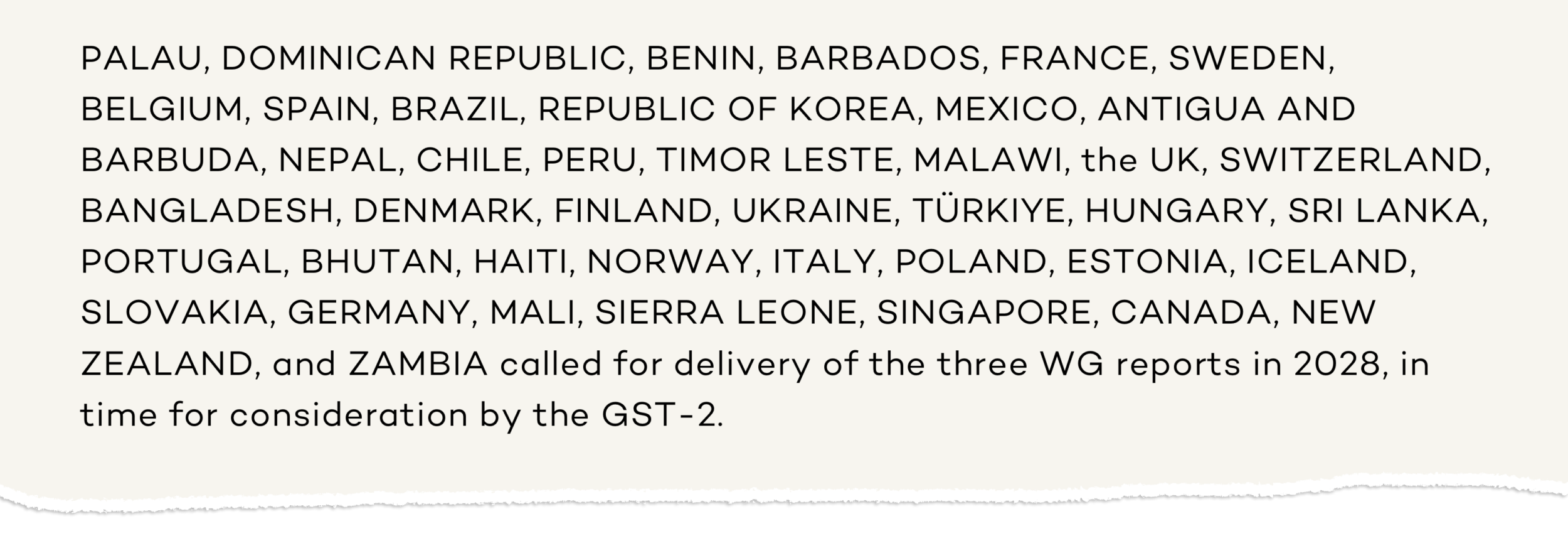
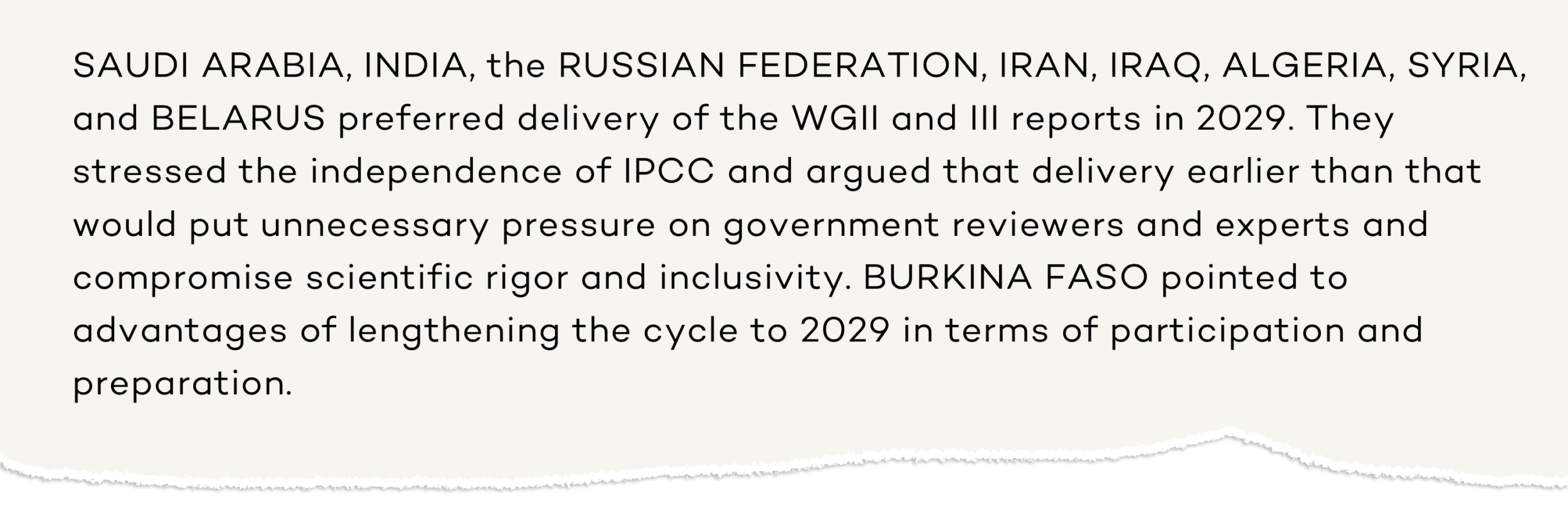
Both camps cited inclusivity concerns. Those in favour of a stocktake-aligned timeline said that “inclusivity is a priority and should be addressed, but said delaying delivery of the report would further disadvantage the countries most vulnerable to climate change”, according to the ENB.
In discussions on Monday, the Pacific island nation of Vanuatu underscored that “every year of delay is a year in which communities on the frontlines bear losses that cannot be measured or claimed”, the ENB says. The delegation pointed