

My grandma is my north star and my mentor in nature. She is a beacon of hope for those committed to protecting and appreciating nature and all that the outdoors has to offer. She thrives in nature and she works, with relentless determination, to get those she loves outside to explore the wondrous beauty of the natural world.

When I was young, many weekends were spent packing up the car and driving hours away from the busy day-to-day of our lives, filling our weekends with outdoor adventures. Adventures varied from hut-to-hut hikes meeting inspiring thru-hikers who chatted with us about their times on the trail, cross-country skiing in the early mornings in search of grazing moose, ice skating across broad lakes, learning to kayak properly whilst fishing, playing games identifying small critters plants and flowers, to trekking through snowy woods to secluded huts warmed only by small fires. While these adventures were intended as fun weekends away from our routine, they were also lessons in how to engage with and respect the natural world as we enjoyed the playgrounds it offered.

While my grandma served as our leader in engaging with the environment, she let nature be our teacher. She knew that she too would always find new things to wonder about. So, through her eyes, we got to see it and appreciate its beauty. Today, at 83, she still regularly goes camping, hiking, and xc skiing, but with a more adamant demeanor, because she knows that she has only a limited time to have these adventures. Although this is true, and she has slowed down. She has watched my siblings and I grow older and as we continue to engage with nature, to respect it, and to learn from it. Although she has watched her natural playground be threatened and shrink because of climate change caused by human powers, she has also seen a growth in those willing to fight for it; those like you and me who cherish this natural playground and who want to protect it for our future generations. In her day she was the anomaly, today those convictions to cherish and protect our planet are felt by so many of us so that we can take on that beacon of hope for our planet.

What I grasped from these naive childhood explorations of nature is that our world is colorful and magnificent, that everything is connected.
That it is enduring, and I am lucky to have been able to see nature and all its connections in the ways that I have. As I have grown older, have lived across continents, and have seen and learned more about the complexities of humans, ecosystems, and our changing climate, those childhood lessons have transformed into a deeper recognition that we must respect and embrace the natural harmonies of our world, just as my grandma has always done.

My climate story is fortunate; I’ve never faced the climate disasters that are displacing communities or forcing evacuations from homes due to extreme weather occurrences.
Still, I have seen the lake that I used to skate on as a child stop freezing over during the winter, and I’ve stopped swimming in certain lakes and rivers due to dangerous levels of toxins from algal blooms and bacteria. And I no longer see moose wandering through forests and grasslands in more southern parts of New England. These changes are not themselves the story but are little, tiny pieces to a much larger story of climate change.
While those childhood experiences may, very well, only ever again be a childhood memory, I know that I must help protect those natural ecosystems and climate so that they continue to endure and work in harmony with each other and so that future generations get to see and experience the colorful magnificent nature in the same way that I got to.

I want my climate story to be one of hope. So, I hope to inspire our current generations to do as my grandma did – to guide others into nature so they, too, can learn to embrace and respect those natural systems that are integral to the climate and our world. Those childhood lessons, combined with the knowledge we have today in our current climate crisis, can and must be used to empower and motivate communities, societies, and humanity to protect the harmonious systems of nature so that they endure for us and for the wonderous ecosystems that depend on it.

Alyssa is a graduate Public Health Student at Lund University in Sweden. Originally from New England, USA, she grew up in the mountains and is passionate about making sustainable systems in public health.
The post My North Star to Nature appeared first on Climate Generation.

Governments at the COP17 nature summit in Armenia agreed on Saturday to scale up their policies to protect the planet’s shrinking biodiversity, and for the first time invited large emerging economies like China and Gulf states to take on donor responsibilities to help fund those efforts.
For the past two weeks, countries held talks in Yerevan under the UN Convention on Biological Diversity to outline a plan to ramp up currently “insufficient” policies to conserve land and marine ecosystems. A recent UN progress report found the world is off track to meet 22 out of 23 global targets aimed at reversing species loss and protecting 30% of land and seas by 2030.
While a response plan, called the “Global Review of Collective Progress”, was expected to be the main outcome of COP17, negotiations struggled to advance amid a deadlock over the controversial subject of how to finance the boost in conservation measures needed.
After an all-night session on Friday, delegates agreed to invite developing countries to voluntarily signal their interest in assuming donor funding obligations alongside developed nations. Negotiators repeatedly warned that any stronger provisions on expanding the donor base would collapse the deal.
COP president: Results beat expectations
An exhausted COP17 president Hambardzum Matevosyan, Armenia’s environment minister, told journalists in the early hours of Saturday that “we’ve achieved more than we could’ve expected” given the “importance” of the decisions being taken.
“It was 100% possible that those items did not made it through. 100% possible,” he said, adding that the conference had made progress on “all the most important items”.
Speaking at the closing plenary, the group of Pacific Islands said that, while the summit had achieved “great outcomes”, delegates are also departing Yerevan “with realities not reflected in the official text”, such as the low replenishment of the Global Environment Facility (GEF), a key funder of nature projects.
-
Lula’s election win in Brazil raises hopes for zero deforestation drive
Lula’s re-election makes it more likely Brazil can meet a key goal to end forest loss in the Amazon and builds confidence in a new fund to protect the world’s rainforests, experts say

Some observers also said the deal did not go far enough. Steven Guilbeault, a former Canadian environment minister who helped broker the Global Biodiversity Framework (GBF), said the Yerevan package of action is “an important step forward”, but still “falls short of what is needed to meet our 2030 commitments”.
An Lambrechts, biodiversity politics expert at Greenpeace International, said COP17 had kept things moving forward and set well-intentioned promises, but added that these “won’t remove major roadblocks to implementation” such as insufficient finance and debt constraints in developing countries.
WWF chief conservation officer Daudi Sumba noted that financial issues were not fully resolved. Despite the deal in Yerevan, “I fear finance will remain the key issue that continues to haunt the UN biodiversity summits,” he said in a statement.
‘Yerevan Pathway’ tackles nature plans and subsidies
In the lead-up to the summit, the UN assessment report showed countries are falling short on virtually all targets in the GBF, the 2022 global deal often referred to as the ‘Paris Agreement for nature’.
They include a landmark target to protect at least 30% of the planet’s land and sea by 2030. If countries all stick to their current national goals, about 26% of land would be protected and only about 12% of marine ecosystems would be under conservation measures.
The main COP17 decision – named the Yerevan Pathway by the presidency – calls for countries to revise their biodiversity plans, subject to available funding, with a particular focus on addressing the gap in coverage of “marine, coastal and inland water ecosystems”.
It also urges the over 60 countries who have not submitted a biodiversity plan yet to finalise them “as soon as possible” and taking into account the gaps identified by the UN progress report.
Countries also agreed to tackle the drivers of biodiversity loss by “accelerating” the reduction of subsidies for activities that damage nature. Subsidy reform, covered by Target 18 of the GBF, is where countries have made the least progress so far, according to the assessment report.
Jill Hepp, director of nature and marine policy and incentives at green group Conservation International, said singling out subsidies in the Yerevan Pathway “gives a strong signal” that closing the gap for biodiversity action requires “more urgent efforts to reform harmful incentives and scale up positive incentives”.
“Timid” steps to expand base of donors
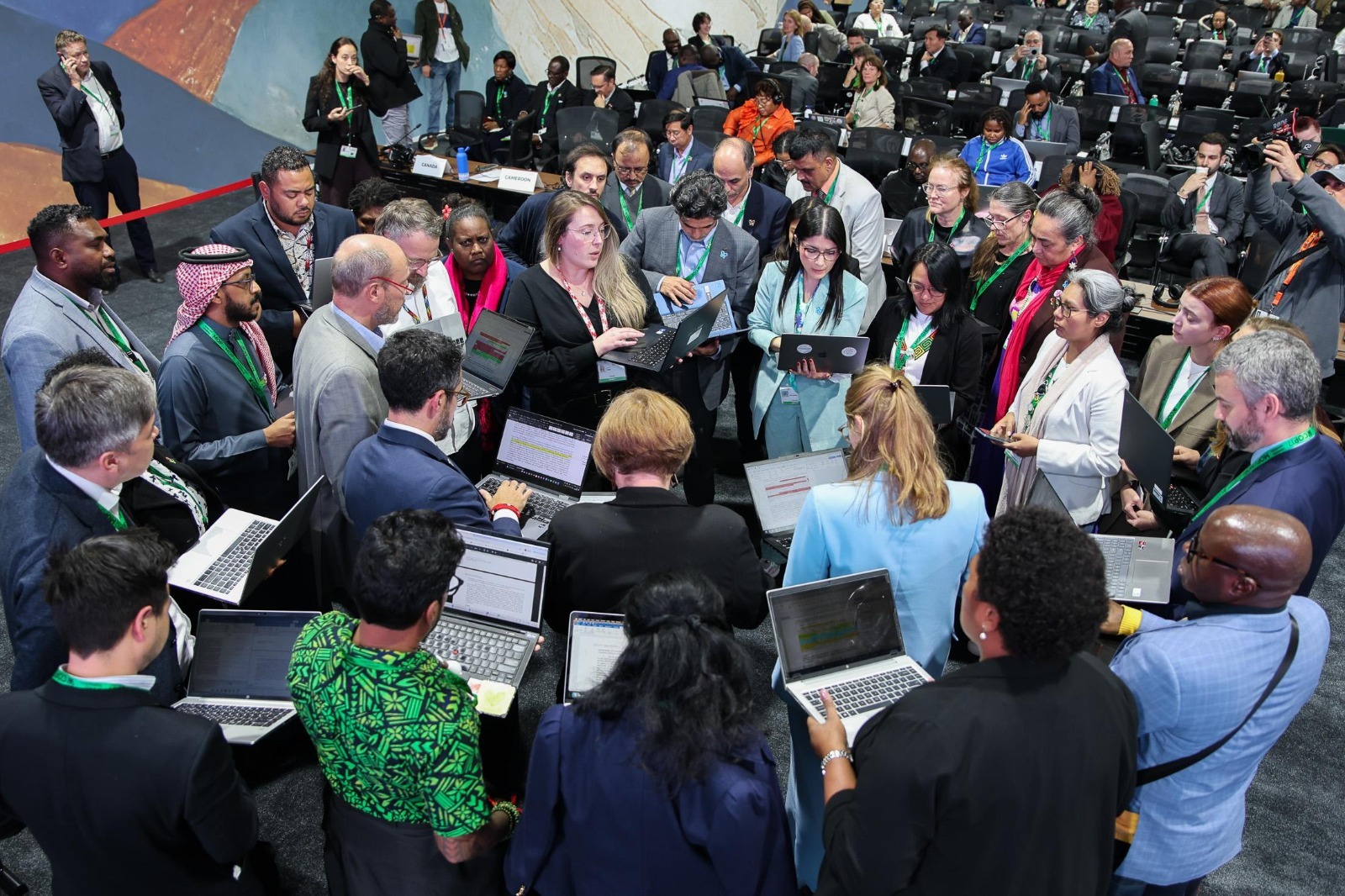
Having failed to meet a target to channel $20 billion for biodiversity conservation by 2025 and faced with shrinking aid budgets, the EU pushed a proposal to expand the list of which countries count as donors, so that wealthy emerging economies like China and Saudi Arabia could also voluntarily contribute. The group of Arab nations strongly opposed this.
During the talks, Irish minister of state for nature, Christopher O’Sullivan, whose country holds the EU presidency, said the bloc wanted the world’s “new realities” to be reflected in the donor list.
Negotiations remained gridlocked for most of the two-week talks, until a last-day compromise was struck to invite developing countries that may want donor status “to indicate to the [Convention on Biological Diversity] secretariat their interest in being included in the corresponding list”.
Countries also asked the secretariat to send an invitation to emerging economies wanting donor status at each subsequent COP, and requested a technical report on “the implications of inclusion in the list” for emerging economies.
Swiss lead negotiator Gabriela Blatter said during one of the sessions that her country had expected greater steps towards expanding the base of contributing countries, but added that “if we’re mutually unhappy, it’s probably the closest we can get on these very delicate political compromises”. Saudi Arabia, on the other hand, also noted their dissatisfaction but said it had expected “a lot less”.
The fragile deal was approved in a package of decisions together with the Global Review, after some delegations including Brazil and China appealed to the plenary not to make further changes to the text at the risk of collapsing the whole agreement.
In a statement delivered to the closing plenary, the EU said the finance outcome had delivered “timid” progress towards fully broadening the base of donors.
Cali Fund still not operational
Adopted two years ago at COP16, the Cali Fund was seen by some observers as a way to channel private-sector finance into biodiversity conservation, as governments struggle to find public funds. But it is still struggling to get up on its feet.
The fund allows big corporations to access certificates for the use of genetic material found in biodiversity in return for a financial contribution, which experts estimate has the potential to raise up to $6.9bn for biodiversity. While voluntary, companies are encouraged to pay 1% of their profits or 0.1% of revenue into the fund.
But since its creation, the fund has received little more than $10,000, which Guilbeault argued is because the rules for disbursements to local communities and the operation of the fund had yet to be fleshed out. This was due to happen at COP17.
Yet, while the final decision on the fund laid out some of the rules – including how companies can earn “Cali Fund certificates” – some key technical details were left to the next COP in 2028 in Ecuador. This includes the issue of whether companies can pay a lower rate if they use genetic data for only a small portion of their products.
“By punting essential decisions to two years from now, parties have all but ensured the fund remains empty until then,” said Pakhi Das, a public policy advisor at NGO Plant-for-the-Planet.
The post COP17 delivers fragile deal to boost conservation and funding for nature appeared first on Climate Home News.
COP17 delivers fragile deal to boost conservation and funding for nature
SYDNEY, Thursday 30 October 2026 — In response to reports that the Albanese government is set to introduce draft legislation this year that would seek to ban data centres in Australia’s suburbs, Joe Rafalowicz, Head of Climate and Energy at Greenpeace Australia Pacific, said:
“These reports are a testament to the growing community opposition to these completely inappropriate AI factories that have sprung up across our suburbs, and Big Tech corporations should take heed — the data centre build-out must not happen without the endorsement of the Australian people.
“But the government can’t simply ship this problem out to regional Australia without addressing the fundamental issues with this extractive new industry.
“We’re already seeing a trend of AI data centre proposals moving to the regions, in areas that are more water-scarce, more environmentally sensitive, and next to sources of fracked and coal seam gas to support their massive BYO gas-fired power plans — a pattern we’ve seen play out in the United States.
“From the Beetaloo Basin in the NT to the Western Downs in Qld, we’re seeing a wave of AI data centre proposals that would see new gas fast-tracked to support their massive energy demand, and threaten to completely derail Australia’s energy transition.
“Just as suburban Australians are asking, “what for?”, regional communities like Berry Springs and Dalby do not want dirty data centres setting up shop with absolutely no benefit to their communities. Greenpeace is calling for a moratorium on AI data centre developments until strict and enforceable safeguards are in place to protect our climate and our communities.”
-ENDS-
Media contact
Kate O’Callaghan on +61 406 231 892 or kate.ocallaghan@greenpeace.org
AI data centre ban in suburbs would not address fundamental issues: Greenpeace
In the thick of the COP29 climate summit in Azerbaijan in 2024, the UN climate talks were rattled by what can only be described as a major PR disaster. The BBC, Reuters and The Guardian all carried headlines, attributed to leading climate policy experts, that the COPs were “no longer fit for purpose”.
The articles outlined a series of reforms called for in an open letter signed by 22 eminent scientists and politicians, including a former UN secretary-general and previous UN climate chief, with a further 150 lending their support. The headlines shook confidence in the COP process, just as governments were wrestling over a new climate finance goal.
The Club of Rome – which handled the media relations for the letter – hurried to say that its “constructive, supportive ideas” had been “misinterpreted”. Negotiators kept calm(ish) and carried on, in the end landing the finance goal after some high-stakes drama on the final day.
-
Early speakers’ list suggests few powerful leaders will attend COP31
Just 77 heads of state or government are scheduled to address the COP31 climate summit in Antalya, a third less than the COP28 peak -
Africa wants adaptation finance on COP31 agenda, raising risk of a fight
The African Group wants dedicated space on tripling adaptation finance, the Green Climate Fund and trade, setting up a possible clash

To my surprise, when I went back this week to read the letter again, I could not find the offending line about the COPs not being fit for purpose. The Club of Rome has yet to respond to my query about its disappearance.
Whatever happened to the wording, that sentiment has been widely shared. COPs have ballooned in size while the importance of their outcomes seems to have diminished since the 2015 Paris Agreement (with the exception of the 2023 COP in Dubai where countries agreed to transition away from fossil fuels in energy systems).
The same on the surface
Two years on from those painful headlines in Baku, has anything changed for the better? You might be forgiven for thinking not. Official decisions are still made by consensus rather than the majority voting some have called for to stop blockers.
Tens of thousands of officials, activists and business execs still scurry around the halls to an ever-growing list of side events, roundtables and dialogues, while deals still come down to rows, all-nighters and jargon-filled texts adopted to rounds of applause.
But it would not be true to say that COPs have completely failed to respond to the very real need to translate the words of the Paris Agreement into action in the outside world.
Global warming is projected to be around 1.3C lower this century than it would have been if the world had not committed to tackle the climate crisis under that accord. Developing countries have a valued space at COPs in which their voices have equal weight in decision-making, unlike in many other international fora. And most importantly, perhaps, there has been a subtle shift, tipping the balance away from negotiating towards doing.
Brazil branded last year’s summit in Belém as the “COP of Implementation”, corralling the sprawling Action Agenda into six axes. This was a bid to impose some structure on the mushrooming efforts between governments, UN agencies, cities, businesses and civil society to set targets and spur faster results on their pet issues, from methane emissions to health and adaptation in conflict zones. COP30 alone saw the launch of 120 “plans to accelerate solutions”.
COP30 roadmaps off the cuff
Meanwhile, as the formal negotiations drew to a close, it was clear that consensus decision-making was evolving into something a little more improvised.
With only around half of all countries on board with the idea of a roadmap to transition away from fossil fuels, COP30 President André Corrêa do Lago announced his team would put one together over the coming year, along with another on how to meet a global goal to halt deforestation by 2030. Those roadmaps will be launched next week, presented and discussed at COP31, though it’s still unclear whether or how they’ll be incorporated into the formal negotiating agenda.

Some leading policy-makers don’t think that matters too much. Speaking to journalists before the Antalya summit, COP30 CEO Ana Toni and Dutch climate minister Stientje van Veldhoven said “coalitions of the willing” can move ahead without needing consensus from the COPs. This, they said, was evident this year at the first global conference on TAFF, co-chaired by van Veldhoven and attended by 60 countries.
“Consensus or no-consensus in the general COP doesn’t make a difference for the choices I have to make in my country to get my country to phase out fossil fuels,” said the Dutch minister. The Netherlands recently became one of the first to publish a national TAFF plan.
COP31 banks on flagship voluntary initiatives
This thinking has permeated the management and expected outcomes of this year’s COP too. Earlier this year, Türkiye, supported by international energy agencies, floated the idea of a voluntary goal to boost electrification to 35% of the world’s final energy consumption by 2035 – and this is now being touted as one of the main results to be expected from Antalya.
Türkiye is also championing a pledge on AI and climate, while co-host Australia is pushing to ease access to climate finance for least developed countries and small island states.
COP31 presidency announces AI pledge as UN climate chief says Big Tech ‘on thin ice’
None of these needs consensus. But with a political cover decision already in the works, as trailed by the COP presidents, they – and perhaps the fossil fuel roadmap – may find a home in the official text if language acceptable to most can be found, giving them them additional weight.
UNFCCC reform process in the shadows
Formal reform is underway too, if quietly. UN climate chief Simon Stiell is leading a review informed by ongoing consultations with a group of 15 well-respected climate policy experts, three of whom signed the open letter in 2024.
Among them is leading Swedish climate and sustainability scientist Johan Rockström who has strong ideas about how to make COPs function better, including a switch to majority voting. He told the same press briefing nothing stands in the way of this, because the rules of procedure for making decisions at COPs have never been formally agreed.
Still, to get away from the default setting of consensus would require agreement on a new system that may be impossible to achieve given the rise in bullying tactics by fossil fuel heavyweights.