

Governments are starkly divided over plans for a loss and damage fund, with two months to go until it is due to be established.
While rich and poor countries have agreed to set up a fund to address loss and damage caused by climate change, they are miles apart on who pays and who benefits.
At a ministerial meeting on the sidelines of the UN general assembly on Friday, there was little sign of bridging the gap. The event complemented ongoing technical discussions ahead of Cop28 climate talks in Dubai this December, where decisions are due on how to get the fund up and running.
Ana Mulio Alvarez, an analyst at E3G, said the meeting “did not advance negotiations but it served as a political moment to put the cards on the table more publicly”.
A transitional committee has been working since March to draw up the rules for the fund.
Who gets the money?
One of the major sticking points is the question of who should be eligible for help.
The decision adopted at last year’s Cop27 summit in Sharm el-Sheikh, Egypt, says it should assist “developing countries that are particularly vulnerable” to climate change impacts. That is open to interpretation.
For the vast majority of rich countries, the pool of beneficiaries should be limited.
Developing countries call for $100 billion loss and damage target
The EU’s interim climate chief Maroš Šefčovič told the meeting that the resources should “explicitly target countries and its communities that are particularly vulnerable to the adverse effects of climate change, such as least developed countries (LDCs) and small island developing states (SIDs)”.
His views were echoed by the representatives of the US, UK and Australian governments, among others.
‘No discrimination’
Developing countries disagree with the position, arguing that all of them should be able to tap into the fund’s coffers.
Speaking on behalf of the G77 group of developing countries, a representative from Cuba said “the fund should operate without discrimination”.
Among the most vocal campaigners for a fund open to all is Pakistan, where devastating floods killed more than 1,700 people and caused damage totaling more than $30 billion last year. Classed as middle income by the World Bank, it would not automatically qualify for support based on a tight definition of vulnerability.
“All vulnerable developing countries, irrespective of their level of development and geographical grouping, must be eligible,” said Pakistan’s foreign minister Jalil Abbas Jilani. “We would not be able to lend our support to any such select, divisive and exclusionary approach.”
Speaking on behalf of the Alliance of Small Island States, Samoa said all developing countries should be eligible, but the fund’s resources should be “allocated equitably” so that the small island states are “not left behind and forgotten”.
Who pays?
The question of who pays into the fund is equally contentious.
When the European Union opened the door to a fund at the Cop27 climate talks last year, its then climate chief Frans Timmermans said large economies like China should also pay. The agreement was eventually struck without that condition, but the same debate has now reemerged.
EU’s Šefčovič said the fund should attract contributions from “all well-resourced governments”, in addition to innovative sources of financing, philanthropies, and the private sector. Spain and France floated the idea of introducing new taxes and levies as a way to bolster resources.
The UK’s energy minister Graham Stuart said governments “must break out” of “outdated categories from decades ago”, to deliver the volume of support needed. His statement was likely referencing the UN classification of developed countries established in 1992. The fund “must be financed by all, all of those capable of doing so,” Stuart added.
Similarly, the US disagreed with the notion that only developed countries would be invited to pay into the fund. “There is no existing donor base for loss and damage funding, it is a new idea,” a government official said.
The counterargument is that history matters. Developed countries got that way by being early adopters of coal, oil and gas. Emissions dating back to the industrial revolution are still in the air causing suffering today.
“Developed countries should effectively fulfill their funding obligations,” said China’s representative. “Developed countries who shoulder historical responsibilities for climate change should provide new additional finance for the funding arrangement of the fund in the form of grants supplemented by concessional loans.”
Debt trap fears
Developed and developing countries also disagree on what the money should be spent on, how the fund should be governed and whether it should be delivered as grants or loans
Avinash Persaud, special finance envoy to Prime Minister Mia Mottley of Barbados, is on the transitional committee. He told Climate Home he feared some developed countries see the loss and damage mechanism more as a way to coordinate existing funding that is primarily loan-based.
“Countries that are particularly vulnerable are already highly indebted,” he said. “We are going to be drowning in debt if we need to get loans every time get hit by a climate event.”
Time running out
With the clock ticking to the climate summit, the time to strike a compromise is limited.
The transitional committee is holding another round of talks next month, before preparing its recommendations for governments to consider in Dubai.
Persaud said he remained “cautiously optimistic” that countries will reach an agreement.
E3G’s Mulio Alvarez said the disagreements put the negotiations in a “tough position”.
“Real steps need to be taken towards a transformation of the financial architecture in order to meet needs, rebuild trust and increase understanding between parties,” she added. “There is a real risk that the fund could be set up but not adequately funded or truly operational.”
The post Ministerial shows fault lines on climate loss and damage fund appeared first on Climate Home News.
https://www.climatechangenews.com/2023/09/25/ministerial-shows-fault-lines-on-climate-loss-and-damage-fund/

The conference is one of the largest aimed at preparing for hurricane season, which begins June 1. A task force report on potential reforms to the agency also remains on hold.
ORLANDO, Fla.—A major conference to help communities prepare for hurricane season kicked off Monday without the agency that coordinates federal disaster response.
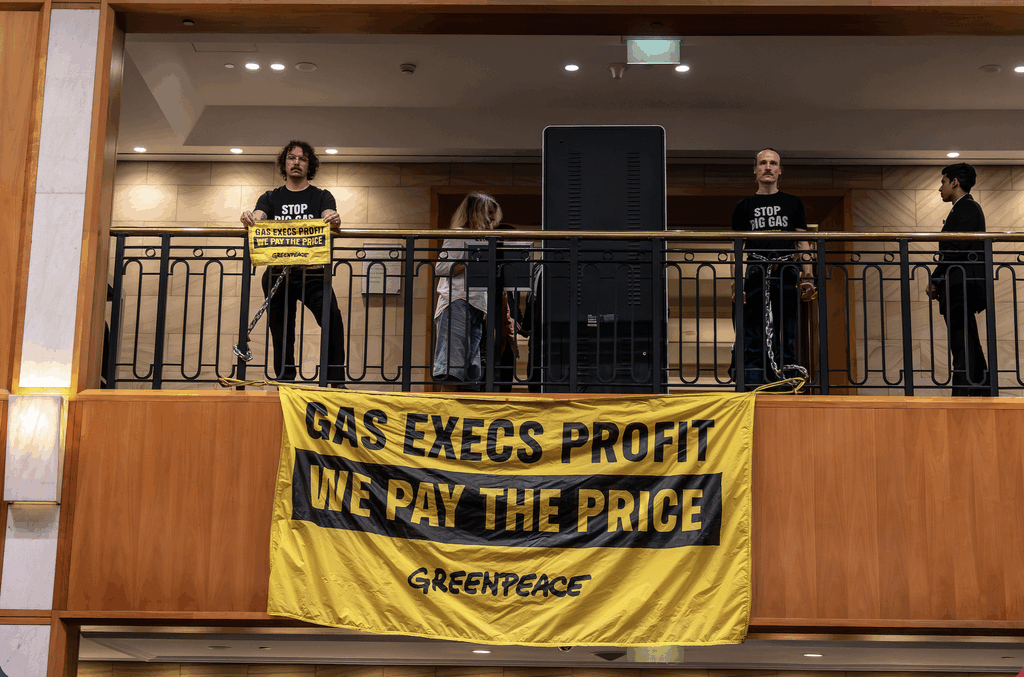
Right now, Greenpeace activists are standing up to Big Gas at a major gas conference in Sydney.
Inside the Sheraton Grand Hotel, executives from fossil fuel companies have gathered alongside lobbyists, investors and political allies to plan the future of gas in Australia – and how to maximise their profits.
So Greenpeace has stepped in to call it out. Activists have dropped a banner inside the venue with a clear message: Gas Execs Profit. We Pay The Price.
We need your help to spread the message that we won’t stand by and let this happen.
What’s really going on
Gas corporations are making billions in windfall profits from global conflicts – from Ukraine to Iran – while Australians pay the price with higher energy bills and climate damage.
And they want more.
More drilling. More exports. More profit.
Why Greenpeace took action today
This conference is where it all comes together. Behind closed doors, gas executives, lobbyists, investors and political allies are meeting to push for more gas expansion, no doubt using global instability as their justification.
That’s why Greenpeace couldn’t let this gathering go uninterrupted.
Big Gas is counting on people not paying attention. Let’s prove them wrong.
Share the video to call out Big Gas.
What needs to happen now
Gas is expensive. It’s volatile. And it ties our energy system to global instability.
But there is a better way. Renewable energy is already cheaper, more reliable, and made right here in Australia. It’s the fastest path to lower bills, real energy security and a safer climate.
To get there, we need to:
- properly tax the gas industry and its exports
- stop expanding gas
- and speed up the transition to homegrown renewable energy.
Share this video far and wide to show just how much support there is to tax Big Gas properly and speed up the transition to renewable energy.
This is just the beginning
This action is part of a growing movement to stand up to Big Gas and challenge the power it holds over our government and society. The Federal Government has a role to play – starting by taxing gas corporations properly and then accelerating the transition to homegrown renewable energy.
Together, we can show just how much support there is for change and make it impossible for decision-makers to ignore.
What you can do
- Follow along on our social channels.
- Share the video far and wide to show how much support there is.
- Sign the petition to tell Albo to stand up to Big Gas – because if we can, he can.
BREAKING: Greenpeace activists disrupt major gas conference in Sydney
SYDNEY, Tuesday 31 March 2026 — Two Greenpeace Australia Pacific activists have been arrested following a peaceful protest at the Australian Domestic Gas Outlook conference in Sydney, where they dropped a banner that said — “Gas Execs Profit. We Pay The Price” and held banners saying “Tax Gas Profits”.
Photos and B Roll video of the protest and arrests are available here
Live updates on Greenpeace Instagram
The two activists were arrested by police around 9:00am AEDT and taken to Day Street Police Station. Information on this morning’s gas conference disruption can be found here.
Solaye Snider, Campaigner at Greenpeace Australia Pacific, said: “Greenpeace activists have taken a strong stand today against profit hungry gas corporations and lobbyists, who see horrific global wars as an opportunity to price gouge and profiteer, while everyday people pay the price.
“Australians have had enough of gas corporations like Santos and ConocoPhillips ripping us off, leaving us with nothing but empty pockets and climate damage. The gas industry is aggressively lobbying against being fairly taxed and pushing to drill for more gas. Change requires showing up and speaking out, and that’s what these activists have done today.
“Greenpeace Australia Pacific stands by our activists, and stands with all communities who are peacefully fighting for a safe and clean energy future. The right to peaceful protest is a fundamental pillar of a healthy democracy and a basic right of all Australians.”
-ENDS-
Media contacts:
Lucy Keller: +61 491 135 308 or lkeller@greenpeace.org or Kate O’Callaghan: +61 406 231 892 or kate.ocallaghan@greenpeace.org
Greenpeace activists arrested after disrupting major gas conference in Sydney



-
Climate Change8 months ago
Guest post: Why China is still building new coal – and when it might stop
-
Greenhouse Gases8 months ago
Guest post: Why China is still building new coal – and when it might stop
-

 Greenhouse Gases2 years ago
嘉宾来稿:满足中国增长的用电需求 光伏加储能“比新建煤电更实惠”
-
Climate Change2 years ago
Bill Discounting Climate Change in Florida’s Energy Policy Awaits DeSantis’ Approval
-

 Climate Change2 years ago
嘉宾来稿:满足中国增长的用电需求 光伏加储能“比新建煤电更实惠”
-
Climate Change Videos2 years ago
The toxic gas flares fuelling Nigeria’s climate change – BBC News
-

 Renewable Energy5 months ago
Sending Progressive Philanthropist George Soros to Prison?
-

 Carbon Footprint2 years ago
US SEC’s Climate Disclosure Rules Spur Renewed Interest in Carbon Credits