Connect with us

Published

on

Microsoft’s Mega Move: 18M Carbon Credit Deal with Rubicon Carbon

Microsoft has made a significant move for its climate goals. It signed a deal with Rubicon Carbon to buy 18 million tonnes of carbon removal credits. This will happen over the next 15 to 20 years. These carbon credits will come from Afforestation, Reforestation, and Revegetation (ARR) projects around the world.

The agreement is one of the largest of its kind by a single company and shows how big corporations can help scale climate solutions. Microsoft has entered into many similar carbon removal deals starting early this year. 

Rubicon Carbon, a leading carbon credit management firm backed by TPG Rise Climate, will manage the projects and ensure they meet high scientific standards. With this deal, Microsoft is funding climate efforts that may not have received investment otherwise.

Tom Montag, CEO of Rubicon Carbon, emphasized the importance of the deal, saying:

“Addressing climate change requires more than good intentions—it requires capital deployment at scale. This collaboration serves as a blueprint for how the financial sector can meet the urgency of the moment while also generating strong financial returns.”

Why Carbon Removal Matters

Carbon removal is the process of taking carbon dioxide (CO₂) out of the atmosphere and storing it in natural or engineered ways. Reducing emissions is important, but scientists say we also need carbon removal to reach global climate goals.

Nature-based solutions like planting trees are some of the most affordable and scalable options available today.

According to Microsoft, carbon removal plays a key role in their goal to be carbon negative by 2030. That means removing more CO₂ than the company emits. To reach this goal, Microsoft has committed to using a blend of natural and technological solutions.
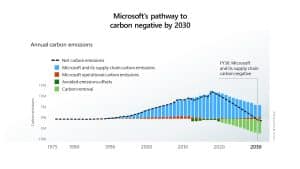
Microsoft 2030 carbon negative goal

This deal focuses on ARR projects—planting trees and restoring vegetation to capture carbon from the air. These projects often get ignored because of low funding. However, Microsoft’s long-term purchase helps make sure they are built and cared for.

The tech giant has been the top buyer of carbon removal credits, purchasing 5 million tonnes in 2024 as seen below.

top carbon removal buyer 2024

Setting a New Standard for Carbon Markets

Each transaction under the agreement is a long-term “offtake.” That means Microsoft promises to buy credits in the future, giving developers financial certainty now. These types of deals are common in energy markets but are still new in the carbon market.

Microsoft and Rubicon also worked together to create a new evaluation framework for carbon credit quality. It includes Microsoft’s science-based standards and Rubicon’s existing due diligence tools. The credits must meet strict rules for impact, durability, and transparency.

Rubicon’s science team will use satellite data and remote sensing tools to track and verify carbon removal over time. This approach builds confidence in a market that has faced criticism for low-quality or unverifiable carbon credits in the past.

Brian Marrs, Senior Director of Energy & Carbon Removal at Microsoft, noted:

“We believe that project finance needs to be central to the voluntary carbon market. This deal signals the long-term demand for carbon removal necessary to mobilize infrastructure-grade investment and world-class execution.”

Fueling a Maturing Carbon Market

The voluntary carbon market—where companies buy carbon credits to meet sustainability goals—is growing fast. According to McKinsey & Company, global carbon credit demand could reach 1.5 to 2 billion tonnes per year by 2030, up from under 500 million in 2023. Yet, concerns about credit quality have held back investment.

Deals like Microsoft’s help build trust in the market by sending clear signals: there is real, long-term demand for high-quality removal. This helps project developers get loans, attract private funds, and plan bigger projects.

Nature-based credits are also more affordable than high-tech options like direct air capture (DAC), which can cost over $100 per tonne. In contrast, ARR credits often cost between $5 and $15 per tonne. You can find carbon prices for different types of credits on our page here.

Microsoft’s commitment to long-duration contracts gives these projects a better chance to succeed. It helps diversify removal technologies in the market. This is key for increasing global carbon removal capacity. The market has seen significant growth since 2020, as shown below. 

Durable carbon removal credits CDR purchases 2024

A Growing List of Corporate Climate Leaders

Microsoft is not alone in investing in carbon removal. Other major companies like Shopify, Stripe, and Alphabet (Google) have made similar commitments. They are working together to create the early market for permanent carbon removal. This can happen through nature or new technologies.

But Microsoft stands out for the scale and structure of its deals. Besides the 18-million-tonne deal with Rubicon, Microsoft has invested in carbon removal projects. These include DAC facilities and bioenergy with carbon capture and storage (BECCS).

The company’s 2023 sustainability report showed it contracted 1.4 million tonnes of carbon removal. About 40% of this comes from engineered sources. These investments are part of a bigger climate plan. This plan aims to cut Scope 1, 2, and 3 emissions in operations, the supply chain, and products.

The Road Ahead: Scaling Climate Solutions Through Partnership

Rubicon Carbon launched in 2022 with the goal of scaling high-quality carbon credit projects. Supported by TPG Rise Climate, it blends finance and climate science to help companies track their carbon footprints. The Microsoft partnership is its largest and most ambitious deal to date.

Jim Coulter, Founding Partner of TPG and Managing Partner at TPG Rise Climate, noted that this deal is not just about selling the credits, but also about reshaping how they fund climate action. 

The new evaluation framework aims to show how carbon markets can grow into reliable and scalable systems. Both parties hope to lead by example. This includes transparency, long-term planning, and science-driven impact assessments.

Looking forward, the success of this deal could encourage more companies to enter similar agreements. It might also create better financing tools for carbon project developers. This could strengthen standards in the voluntary carbon market.

Microsoft’s carbon credit agreement with Rubicon Carbon shows how corporate climate commitments can translate into meaningful global impact. By locking in 15- to 20-year purchases, the tech giant is helping fund carbon removal projects that can last decades.

The blend of business innovation, environmental science, and financial strategy sets a new path forward. As other companies watch this space, one thing is clear: carbon removal is becoming a core part of the climate solution, and Microsoft is helping to lead the way.

The post Microsoft’s Mega Move: 18 Million Carbon Credit Deal with Rubicon Carbon appeared first on Carbon Credits.

Continue Reading

Carbon Footprint

Nickel Prices Hit $18,000 in 2026 Amid Global Oversupply, US Boosts Domestic Supply Chain

Published

on

Nickel Prices - Alaska Energy Metals - AEMC

Disseminated on behalf of Alaska Energy Metals Corporation.

nickel Price Analysis Today

Nickel futures rallied as markets priced in Indonesia’s tightened 2026 ore quotas, sparking supply concerns that overshadowed earlier geopolitical jitters. Robust purchasing activity from China’s electric vehicle battery sector and stainless steel mills provided fundamental support, triggering a technical rebound from recent lows. The move reflects a swift shift in sentiment as investors prioritize looming supply deficits over broader macroeconomic headwinds.

The global nickel market enters 2026 after a bruising and uneven year. In 2025, macroeconomic stress, trade disruptions, and deep supply imbalances reshaped pricing and sentiment. Although short-term rallies have returned, the underlying structure of the market remains fragile. As a result, 2026 is shaping up to be a year defined by volatility rather than a sustained recovery.

A Challenging Backdrop from 2025

To understand where nickel is headed, it helps to revisit the environment it emerged from. In 2025, global trade flows came under pressure after the US implemented new tariff policies. These measures disrupted supply chains and dampened confidence across industrial commodities. At the same time, global manufacturing growth slowed, weighing heavily on the broader nonferrous metals complex.

SMM reported highlighted some significant points. Adding to the uncertainty, the US Federal Reserve sent mixed signals throughout the year. Expectations around interest rate cuts shifted repeatedly. Each change altered risk appetite and triggered sharp moves across commodity markets. Nickel, already vulnerable due to oversupply, struggled to attract sustained buying interest.

China attempted to offset some of these pressures. Policymakers rolled out proactive fiscal measures and maintained a moderately accommodative monetary policy. They also focused on boosting domestic demand and diversifying export routes to reduce exposure to trade frictions. In July, China introduced its “anti-involution” policy, aimed at curbing destructive price competition across industries.

Even so, nickel underperformed. While other nonferrous metals showed mixed results, nickel remained constrained by a clear mismatch between supply and demand. Prices trended lower for most of the year. LME nickel opened near $15,365 per tonne and slid to lows around $13,865 per tonne, marking a sharp reset in the price center.

2026 Nickel Price Outlook: A Volatile Start to the New Cycle

Momentum shifted suddenly toward the end of the year. From mid-December, nickel prices began climbing rapidly.

  • By early January, LME prices had surged past $18,000 per tonne, the first time in more than a year. In just 12 trading sessions, prices jumped nearly 20%, catching many traders off guard.

nickel prices

Several factors fueled this rebound. Demand signals from China improved modestly, particularly from stainless steel mills and EV battery producers. At the same time, speculative positioning adjusted as supply risks from Indonesia returned to the spotlight.

Trading Economics analysis stated that Indonesia, the world’s largest nickel producer, hinted at a potential 34% reduction in output for this year. Meanwhile, Vale temporarily halted operations at its Pomalaa and Bahodopi mines while waiting for regulatory approvals. Although its flagship Sorowako mine continued operating, these pauses added to market caution.

Still, the rally faced clear limits. Inventory levels remained elevated. Combined LME registered and off-warrant stocks jumped nearly 58% last year, reaching more than 367,000 tonnes. In addition, large shadow inventories in Singapore and Kaohsiung continued to hang over the market. As a result, every price spike met resistance.

Price Expectations Remain Capped

Most analysts expect nickel prices to settle into a narrow band rather than trend sharply higher. Forecasts largely cluster between $15,000 and $16,000 per tonne. Several major institutions attribute the restrained outlook to ongoing surpluses.

Analysts consider that the differences in price forecasts primarily reflect contrasting views on how strictly Indonesia will enforce production limits and how quickly global manufacturing activity is expected to recover.

Nickel Demand Drivers Show Modest Growth

  • Stainless steel: remains the dominant driver, accounting for about 70% of total demand. Consumption may rise to roughly 2.45 to 2.5 million tonnes. China’s production recovery offers support, while infrastructure projects in emerging markets add incremental demand. Still, no major surge is expected.
  • Battery and EV application: They make up roughly 13% to 15% of demand. Nickel use in this segment could reach up to 500,000 tonnes. High-nickel cathodes continue to support premium EV models.

According to Benchmark Mineral Intelligence, demand for battery-grade nickel is expected to surge, tripling by 2030. This growth will largely be due to mid- and high-performance EVs in Western markets.GLOBAL nickel supply nickel demand

Other uses, including alloying, plating, aerospace, and electronics, provide steady but smaller contributions. A broader manufacturing recovery and net-zero investments could lift demand slightly, while faster EV adoption remains the main upside risk.

Supply-Demand Balance Stays Uneven

According to SMM, the nickel market will remain oversupplied through the year, remaining between 120,000 and 275,000 tonnes. While short-term rallies may continue, oversupply will remain the dominant force.

On the supply side, Indonesia’s refined nickel output stays high, supported by sunk investments and low operating costs. On the demand side, growth remains steady but unspectacular.

indonesia nickel
Source: AEMC

Ewa Manthey, a commodities strategist at London-Based ING Group, explained that the global nickel market is still set to remain oversupplied, with a projected surplus of about 261,000 metric tonnes. As a result, any production cuts would need to be deep and sustained to meaningfully shift market fundamentals.

Global nickel market

China’s real estate support policies may provide limited relief for stainless steel consumption. However, a strong housing rebound appears unlikely, and any improvement is expected to be gradual. Similarly, demand from ternary batteries faces structural headwinds. Solid-state batteries remain years away from large-scale commercial use, and near-term battery chemistry trends do not favor a sharp jump in nickel intensity.

As a result, the average price level may drift lower over time. Tightening ore supply could briefly push prices above $16,000 per tonne. However, high inventories and excess capacity will take longer to absorb.

Why Nickel Matters for US Critical Mineral Independence?

Nickel plays a critical role in military-grade alloys, advanced weapons systems, electric vehicle batteries, grid-scale energy storage, and broader clean energy infrastructure. Despite its importance, the United States remains almost entirely dependent on imports for nickel, while China controls much of the global processing and supply chain. This reliance has become a clear strategic risk, one that domestic resources need more exploration.

And this is the reason America’s push to secure its critical mineral supply is gaining real momentum.

Spotlight: Alaska Energy Metals – America’s Nickel Backbone

At the center of this shift is Alaska Energy Metals Corporation (TSX-V: AEMC, OTCQB: AKEMF) and its Eureka deposit, the largest documented nickel resource in the United States. As Washington intensifies efforts to reshore critical supply chains for national security and clean energy goals, AEMC’s Nikolai Project in Alaska is steadily gaining recognition as a strategic domestic asset.

At the same time, the project aligns closely with the Trump administration’s executive orders focused on critical minerals and Alaska resource development. Those directives sought to speed up domestic production, curb reliance on foreign suppliers, and reinforce US security interests.

Against this backdrop, Nikolai stands out as a fully US-based “Sulphide nickel and battery metal project” to meet the country’s metal needs for the energy transition. Significantly, it has two claim blocks: Eureka and Canwell.

Nikolai nickel aemc
Source: AEMC

Eureka: The Largest Known Nickel Resource in the US

The Eureka deposit is not just large—it is nationally strategic. It hosts nickel alongside copper, cobalt, chromium, iron, and platinum group metals, including platinum and palladium. This metal mix makes Eureka highly relevant for both defense systems and the expanding clean energy economy.

According to the 2025 Mineral Resource Estimate, Eureka contains:

  • Indicated Resource of 814 million tonnes grading 0.42% nickel equivalent, representing 5.62 billion pounds of nickel in situ.
  • Inferred Resource of 896 million tonnes grading 0.39% nickel equivalent, totaling 9.38 billion pounds of nickel in situ.

Combined, the deposit contains more than 15 billion pounds of nickel, enough to support American demand for decades.

FAST-41 Listing Accelerates the Nikolai Project

A major step forward came when the Nikolai Project was accepted onto the FAST-41 Transparency Dashboard by the Federal Permitting Improvement Steering Council.

  • The initial phase focuses on infrastructure upgrades, including rehabilitation and extension of the Rainy Creek Mining Trail, installation of temporary bridges, and development of an on-site camp.

These improvements will lower exploration costs, improve safety, enable better site access, and speed up the transition to advanced exploration and development at Eureka. Just as important, FAST-41 provides transparency, inter-agency coordination, and defined permitting milestones.

aemc nikolai eureka
Source: AEMC

Key catalysts ahead

AEMC is entering a phase with several near- and mid-term value drivers. These include a first-pass metallurgical study to assess metal recovery, the potential for a major US Department of Defense grant, completion of a Preliminary Economic Assessment, and continued drilling at the Angliers target. Each step strengthens the investment and strategic case for Eureka.

Nickel Oversupply Overseas, Opportunity in the US

In summary, the nickel market faces another complex year. Structural oversupply, elevated inventories, and cautious demand growth define the landscape. Although policy shifts in Indonesia and short-term demand improvements can trigger sharp rallies, fundamentals continue to cap sustained upside. For now, nickel remains a market driven more by volatility than by balance.

As the US rebuilds its domestic critical mineral supply chain, assets like Eureka are becoming indispensable. With its scale, multi-metal profile, federal permitting support, and alignment with national policy priorities, Alaska Energy Metals Corporation is positioning itself as a key player in America’s push for resource security. In a world increasingly defined by competition for critical metals, Eureka has the potential to become the backbone of the US nickel supply for generations.

READ MORE: Nickel Demand to Triple by 2030: Can the Market Keep Up?

The post Nickel Prices Hit $18,000 in 2026 Amid Global Oversupply, US Boosts Domestic Supply Chain appeared first on Carbon Credits.

Continue Reading

Carbon Footprint

Microsoft Secures 1.8M Carbon Credits from Africa’s Rainforest Builder

Published

on

Microsoft is doubling down on nature-based carbon removal, and this time in West Africa. The tech giant has signed a long-term offtake agreement with Rainforest Builder, a fully integrated tropical forest restoration company, to support Project Buffalo in Sierra Leone. The deal will deliver up to 1.8 million carbon removal credits over 15 years, making it one of the largest single-project carbon removal agreements announced in Africa to date.

More than just a credit purchase, the partnership signals growing confidence in Africa’s high-integrity carbon markets. It also reinforces Microsoft’s aggressive push to become carbon negative by 2030.

A Landmark Carbon Removal Deal in Africa

Rainforest Builder operates across Sierra Leone, Ghana, and Guinea, employing more than 2,500 people. The company follows a science-led, community-focused model that blends ecosystem restoration with economic development.

Under the Microsoft agreement, Project Buffalo will restore 15,000 hectares of degraded community land in Sierra Leone. The initiative will plant more than 10 million trees, rebuilding native forest ecosystems in the Upper Guinean Forest — one of the most biodiverse yet threatened rainforest regions in the world.

So far, Rainforest Builder’s Sierra Leone team has planted more than 1.8 million trees since 2023. The scale-up now underway will dramatically expand restoration efforts.

Importantly, this is not a short-term offset arrangement. The 15-year offtake structure provides long-term revenue certainty. That stability helps finance restoration, workforce development, and monitoring systems. In turn, it raises the bar for project integrity and permanence.

Restoring the Upper Guinean Forest

The Upper Guinean Forest once stretched across West Africa as a dense tropical ecosystem rich in endemic species. Today, more than 90% of it has been cleared due to logging, agriculture, and land degradation.

In Sierra Leone, old-growth forest now covers less than 1% of the country’s total land area. Many mammal and plant species survive only in isolated fragments. Without intervention, biodiversity loss could accelerate.

Project Buffalo aims to reverse that trend. By restoring native species across 15,000 hectares, the project will rebuild wildlife habitat, strengthen carbon sinks, and restore ecological connectivity. The region contains the highest number of mammal species among the world’s biodiversity hotspots. Many species exist nowhere else.

Forest restoration here delivers dual impact: measurable carbon removal and biodiversity recovery.

Unlike avoided deforestation projects, reforestation physically removes carbon dioxide from the atmosphere and stores it in biomass and soil. When executed with scientific oversight and long-term monitoring, these removals can be accurately measured and verified.

Rainforest Builder operates under the stewardship of a Scientific Advisory Board. The company collaborates with research institutions across West Africa and conducts field trials to optimize species-site matching. These trials improve survival rates and accelerate ecosystem recovery.

Jobs, Infrastructure, and Community Benefits

In 2025 alone, Project Buffalo directly employed 1,200 people. Employment is expected to grow significantly as planting expands toward the 10 million tree target.

Beyond wages, the project includes a broad benefit-sharing structure. This includes:

  • Community land leasing agreements
  • Smallholder agricultural improvement programs
  • Rural road infrastructure upgrades
  • A community development fund

This model ensures local communities remain long-term stakeholders in forest recovery.

Carbon Credits Could Unlock Billions for Africa’s Economy

Africa contributes just 3.9% of global CO₂ emissions. Yet it faces some of the most severe climate impacts, including extreme weather, crop loss, and land degradation. Carbon markets, therefore, represent more than an environmental solution — they present an economic development pathway.

High-integrity African carbon credits could generate up to $6 billion annually by 2030. Longer-term projections suggest the market could scale to $120 billion per year by 2050, supporting as many as 30 million jobs.

  • In 2024, Africa issued approximately 75 million carbon credits, valued at around $15 billion. That represented roughly 14% of the global voluntary carbon market.

Initiatives such as the Africa Carbon Markets Initiative (ACMI) are accelerating this momentum. The ACMI has secured more than $1 billion in commitments, including major purchase agreements from global financial institutions.

Deals like Microsoft’s with Rainforest Builder strengthen both supply credibility and demand confidence.

africa carbon market
Source: ACMI

Microsoft’s Expanding Carbon Removal Portfolio

The agreement also fits perfectly within Microsoft’s climate strategy.

The company has committed to becoming carbon negative by 2030 and to removing all historical emissions by 2050. To reach those goals, Microsoft shifted in 2020 away from avoided emissions credits and toward carbon dioxide removal (CDR).

MICROSOFT CARBIN REMOVAL
Source: Microsoft

In fiscal year 2024, Microsoft signed long-term agreements covering 22 million metric tons of carbon removal — more than all previous years combined. Of that volume, 2.8 million metric tons are expected to contribute directly to its 2030 carbon negativity milestone. Additional tons extend into FY31 and beyond.

Microsoft’s approach has evolved. For example, in 2022, it signed its first long-term CDR agreement, purchasing 10,000 tons over 10 years from Climeworks’ direct air capture facility in Iceland.

Then in 2023, it scaled up to multi-million-ton agreements with developers capable of designing large projects from inception.

  • And most importantly, the company refined commercial offtake structures and strengthened due diligence standards with its Criteria for High-Quality Carbon Dioxide Removal.

One of its significant milestones includes innovative climate finance structures. For example, it worked alongside Brazilian reforestation company Mombak and the World Bank to help unlock a $225 million outcome bond supporting Amazon restoration. That model blends natural capital investment with performance-based finance.

And the Rainforest Builder agreement follows a similar logic: long-term contracts create investment certainty, which enables scale.

Why This Matters for Africa’s Carbon Future

Africa’s carbon market remains primarily voluntary today. However, future integration with compliance systems, including mechanisms under Article 6 of the Paris Agreement, could dramatically increase demand.

To capture that opportunity, projects must demonstrate integrity, permanence, biodiversity co-benefits, and strong community engagement.

It restores degraded land rather than displacing communities. It plants native species rather than monocultures. It incorporates scientific oversight. And it delivers measurable socioeconomic benefits.

Ultimately, the Microsoft–Rainforest Builder partnership represents more than a bilateral agreement. It reflects a shift in how global corporations approach climate responsibility. Instead of short-term offsets, buyers are increasingly committing to long-duration, high-integrity carbon removal backed by science and community impact.

The post Microsoft Secures 1.8M Carbon Credits from Africa’s Rainforest Builder appeared first on Carbon Credits.

Continue Reading

Carbon Footprint

Meta Strikes 80 MW Solar Deal to Power Data Centers and Cut Carbon Impact

Published

on

Meta Strikes 80 MW Solar Deal to Power Data Centers and Cut Carbon Impact

Meta Platforms Inc., the owner of Facebook, Instagram, and WhatsApp, has signed a long-term power purchase agreement (PPA) with renewable energy developer MN8 Energy LLC. Under the deal, the tech giant will buy 100% of the electricity generated by MN8’s 80 megawatt (MW) Walker Solar Project in Juniata County, Pennsylvania. The agreement marks the first direct clean-energy contract between the two companies.

Meta will use solar power to help supply electricity to its data centers in the United States. The project is scheduled to begin operations by the end of 2026.

The Walker Solar project will supply power to the PJM Interconnection grid. This grid is the biggest wholesale electricity market in the U.S. It serves over 65 million people in 13 states and Washington, D.C.

Urvi Parekh, Director of Global Energy at Meta, said:

“We are thrilled to partner with MN8 ​Energy​ to bring new renewable energy to Pennsylvania and help support our operations with 100% clean energy.”

Inside the 80 MW Walker Solar Deal

The solar facility will generate about 80 MW of clean electricity when complete. Under the PPA, Meta will acquire all of the project’s output.

The agreement is a long-term contract. Meta will buy renewable power from MN8 Energy for years. This will help meet part of its data center electricity demand with clean energy.

MN8 Energy, a New York-based renewable energy and battery storage company, will develop and build the solar plant. It has about 4 GW of operational and under-construction solar projects nationwide. The company also operates 1.1 gigawatt-hours (GWh) of battery capacity and over 40 high-power EV charging stations in the U.S.

The Walker Solar project will supply energy to the regional grid and create local jobs during construction. It will also generate tax revenue for Juniata County and strengthen local energy infrastructure.

Powering AI Growth With Long-Term Solar

Meta has set a clear long-term climate goal. The company aims to reach net-zero emissions across its full value chain by 2030. This includes direct operations and supply chain emissions.

The tech giant has matched 100% of its global electricity use with clean and renewable energy since 2020. This covers its offices and data centers. To support this goal, Meta has helped add nearly 29 gigawatts (GW) of new clean energy capacity to power grids worldwide.

Meta renewable energy projects map
Source: Meta

Since 2021, Meta reports that its renewable energy procurement has helped reduce emissions by 23.8 million metric tons of CO₂ equivalent (CO₂e). These reductions come from large-scale wind and solar projects tied to long-term power purchase agreements.

However, electricity demand continues to grow. Meta’s data centers are expanding to support artificial intelligence and digital services. The company notes that rising data center demand makes decarbonization more complex, even as renewable energy use increases.

Meta aims to go further. It wants to reach net zero across its full value chain by 2030. This means not only its own operations (Scope 1 and Scope 2 emissions) but also the emissions tied to its suppliers, hardware, and products (Scope 3). Scope 3 emissions, which are about 8.15 million metric tons of CO2e, account for 99% of its total carbon footprint.

Meta 2024 carbon footprint
Source: Meta

As of its latest report, 48% of its suppliers — based on emissions contribution — have set science-aligned emissions reduction targets. These supplier commitments are critical because Scope 3 emissions make up a large share of Meta’s total carbon footprint.

  • The company has also set a goal to reduce Scope 1 and Scope 2 emissions by 42% by 2031, using 2021 as a baseline year.

Meta’s sustainability reports also show that electricity use remains central to its climate strategy. Since using 100% renewable energy in operations, Meta has helped avoid millions of tons of CO₂ emissions.

Beyond Carbon Emissions: Biggest Clean Energy Buyer

Beyond carbon reductions, Meta includes water and biodiversity in its ESG strategy. Since 2017, Meta has supported more than 40 water restoration projects.

In 2024 alone, these projects helped restore over 1.6 billion gallons of water in regions facing high or medium water stress. The company has committed to becoming water positive by 2030, meaning it plans to restore more water than it consumes.

The Facebook owner also supports biodiversity near its facilities. It has allocated more than 4,000 acres of land, over half of its owned data center campus footprint, for habitat protection and restoration using native species.

carbon removal projects backed by Meta
Source: Meta

In addition, Meta invests in voluntary carbon removal. The company funds projects designed to remove carbon dioxide from the atmosphere to address emissions that are difficult to eliminate. It also works with industry groups and government initiatives to help scale high-quality carbon removal markets.

A recent BloombergNEF report highlights Meta’s role in large-scale corporate clean energy procurement. The tech company was the biggest corporate clean energy buyer in 2025. They signed over 10 GW in power purchase agreements (PPAs).

corporate clean energy purchases BNEF 2025
Source: BNEF

It also found that Meta and its peers, Amazon, Google, and Microsoft, accounted for nearly half of all corporate clean energy deals last year. This demonstrates Meta’s influence in driving new renewable capacity online.

These efforts show Meta is combining financial power with sustainability action. The Walker Solar PPA helps the tech giant meet the fast-growing electricity needs from its data centers and AI workloads. Data centers use a lot of power. Using renewables can help meet this demand and reduce carbon emissions from grid electricity.

New Solar Capacity Strengthens the PJM Grid

The solar project will deliver clean power into the PJM Interconnection market. PJM coordinates electricity flow across a broad region of the U.S. and manages one of the most complex power systems in North America.

Adding new generation capacity like Walker Solar contributes to grid resilience and supports broader decarbonization goals. Solar generation helps offset older fossil-fuel plants as they retire or reduce output.

Experts say utility-scale solar is key. As more sectors electrify, the demand for electricity keeps rising. More solar capacity means steady, low-carbon energy when the sun is out, which helps reduce overall system emissions.

The Walker Solar project is part of a larger trend in U.S. solar growth. The U.S. Energy Information Administration (EIA) says 2026 will bring a record increase in utility-scale solar capacity. Over 40 GW is set to be added, marking a big jump from previous years.

US electricity generation 2026 by source solar EIA
Source: EIA

Big Tech’s Expanding PPA Playbook

Meta’s solar PPA with MN8 reflects a broader trend in corporate renewable procurement. Many large technology companies have signed long-term deals to secure clean electricity for their operations.

Beyond Meta, firms like Google, Amazon, and Microsoft also regularly enter into PPAs for new solar and wind projects. These companies made up almost half of all corporate clean energy deals in 2025, based on market analysis.

Long-term solar PPAs give companies a way to lock in clean power at predictable costs. They also help developers secure financing for new projects, since a contracted buyer reduces risk for lenders and investors.

These corporate procurement strategies go beyond purchasing renewable energy certificates (RECs). They involve direct contracts tied to specific solar or wind projects. This practice supports actual builds of new clean capacity rather than shifting existing output on paper.

The Next Wave of Data Center Decarbonization

The Meta–MN8 Energy solar agreement highlights a shift in how major tech companies meet their clean energy goals. Long-term PPAs like this one are becoming a key tool for corporate decarbonization.

Analysts believe major data center operators will keep growing their PPA portfolios. This is due to increased electricity demand and investor expectations for ESG. This trend could help accelerate the broader deployment of solar and wind generation across the U.S. power system.

As the landscape changes, data center operators and renewable developers may look into hybrid solutions, which could mix solar power with battery storage, microgrids, and demand response systems. This approach aims to provide reliable, low-carbon power all day long.

The post Meta Strikes 80 MW Solar Deal to Power Data Centers and Cut Carbon Impact appeared first on Carbon Credits.

Continue Reading

Trending

Copyright © 2022 BreakingClimateChange.com

