

Europe has been hit by a searing heatwave, which has shattered temperature records across France, Spain and the UK.
In London, for example, the mercury hit a record high for May of 35.1C at Kew Gardens on Tuesday 26 May, breaking the former record-high May temperature by more than 2C.
Multiple people have died as a result of the high temperatures, including 14 people across the UK and France who drowned.
The heatwave was driven by a “heat dome”, in which warm air moving up from northern Africa has become trapped under a high-pressure system over western Europe.
Experts have been quick to point out the link between extreme heat and global warming, with one saying it was “beyond a shadow of a doubt” that climate change was making such events “more likely and more severe”.
In this article, Carbon Brief examines the impacts of the heatwave and the role of climate change.
- What is happening with the May heatwave in Europe?
- What is driving the record-shattering heat?
- What are the impacts of the extreme heat?
- How has the media responded?
What is happening with the May heatwave in Europe?
Europe has been hit by “mind-bogglingly crazy” temperature records in May, according to the Financial Times, quoting Peter Thorne, director of the ICARUS Climate Research Centre at Maynooth University in Ireland.
In London, on Tuesday 26 May, temperatures hit a record high for May of 35.1C at Kew Gardens – breaking the previous record of 34.8C, set just the day before.
This was more than 2C above the previous May temperature high of 32.8C recorded in 1922 and again in 1944, reported the Times.
The Associated Press added that the UK capital also recorded a rare “tropical night”, when temperatures did not fall below 20C overnight.
The Daily Telegraph reported that Wales and Northern Ireland also saw record-high temperatures, of 27.4C in Cardiff and 23.4C in Armagh, on Sunday.
As with the UK record, these were quickly surpassed. BBC News reported that temperatures hit 32.9C in Bute Park, Cardiff and 24.5C in Thomastown, County Fermanagh, on Tuesday.
BBC News quoted a spokesperson from the Met Office, who said:
“This heat would be exceptional in the UK even in mid-summer, let alone in May.”
The broadcaster added that the average temperature in the UK at the end of May is usually 14-20C.
The Associated Press reported that temperature records have also fallen across Europe.
This includes in France, where temperatures reached 36C on Monday in the country’s south-west and remained above 20C at night across much of the country. The newspaper Libération declared that “it has never been so hot, so early, in France”.
The Guardian reported that the weather agency Météo France said the heatwave could last through the week and bring temperatures as high as 39C in some areas in the country.
As well as the UK and France, other nations have been seeing temperatures soar. France24 reported that temperatures in Spain were expected to reach 38C, with Italy also facing high temperatures.
The Irish Times reported that the May high-temperature record was broken twice in Ireland on the same day, with 29.7C recorded in Carlow and then 30.5C at Shannon Airport on Tuesday.
Le Monde explained that a “heat dome” of warm air from northern Africa is behind the high temperatures across Europe. (See: What is driving the record-breaking heat?)
The Financial Times quoted ICARUS’s Thorne saying that the records being set in Europe, “particularly in the UK and France, are mind-bogglingly crazy”. He added:
“We have more than 100 years of observational records. To break the all-time May record by more than 2C…is hard to comprehend.”
What is driving the record-shattering heat?
The immediate driver of the extreme heat seen over Europe this week is a “heat dome”, according to Politico.
The outlet explained that the phenomenon is driven by “warm air moving up from northern Africa [that] has become trapped under a high-pressure system over western Europe”. It added:
“The effect is similar to that of a lid on a pot, with warm air forced downward and baking affected regions with prolonged, blistering heat.”
Spain’s El Correo explained that the phenomenon is “not a simple heatwave”, adding that such “high-pressure systems trapped over Europe are not usually seen before summer”.
However, many publications have linked the severity of the extreme heat to climate change. The Associated Press quoted ICARUS’s Thorne, who said:
“We know beyond a shadow of a doubt that heatwave events such as this have been made more likely and more severe due to climate change arising from our emissions of heat-trapping greenhouse gases.”
The Guardian quoted Dr Chloe Brimicombe, a researcher at the University of Oxford, who said:
“The record-breaking heat is a reminder of how climate change is impacting our lives in the UK. It highlights the urgency of recent calls for heat adaptation.”
France’s Le Figaro described the event as an “unequivocal sign of global warming”.
The Independent reported that the heatwave “has the fingerprints of climate change all over it”. Other outlets, including Inside Climate News and Scientific American, also covered the links between extreme heat and climate change.
BBC News noted that over the last 30 years, Europe has been warming by 0.56C per decade – more than twice the global average.
The outlet quoted Prof Erich Fischer, professor at the Institute for Atmospheric and Climate Science at ETH Zurich in Switzerland, who compared the record-breaking temperatures to setting a new record in sports.
He explained that “if someone beats a world record in high jump, you would expect them to beat it by one centimetre and not suddenly by 20, 30 centimetres”. Similarly, he said that in the case of temperature, you would expect new records to be broken by a fraction of a degree, rather than 2 or 3C.
However, the broadcaster explained that “when a relatively rare weather system, such as this week’s heat dome, comes around in a warming climate, the margin of record can be huge”.
Simon Stiell, the executive secretary of UN Climate Change, called the heatwave a “brutal reminder of the cost of global warming”, according to Politico.
The Guardian also quotes Stiell, who said:
“The science is clear that human-induced climate change is making these heatwaves more frequent and extreme”.
What are the impacts of the extreme heat?
The heatwave has already been linked to multiple deaths.
This included seven people in France, five of whom died by drowning and two who suffered heat-related deaths while competing in sporting events, said the Guardian.
Separately, the Guardian reported that at least nine people have died in the UK from “water-related incidents” during the heatwave.
France24 reported that “restrictions on outdoor work were imposed in parts of Italy” and that “farmers reported accelerated harvests as temperatures went beyond 30C across [south-west France]”.
The Guardian reported that tennis players at the French Open were “forced to adjust their games while trying to find their best level through obvious discomfort”, amid 33C temperatures in Boulogne-Billancourt, Paris, on Monday.
CNN added that, in the UK, “a wildfire broke out near Arthur’s Seat, a hill in Edinburgh, Scotland, and hundreds of properties in south-east England were left without water as demand spiked”.

BBC News reported on a warning from a chief nurse that hospitals in the south-west of England were busier than usual amid the heatwave.
BBC News reported that the UK saw a surge in emergency calls on Tuesday. The Daily Telegraph added that “Britain’s roads started melting and rail commuters were left stranded for hours”.
Meanwhile, the Guardian reported on a warning from climate campaigners that the government “urgently” needs to start installing air conditioning units in schools and care homes.
The extreme heat has also affected Europe’s renewable energy generation. Bloomberg said that “the heat dome has blocked clouds and fueled booming solar generation”, but added that “by clearing clouds and calming the atmosphere, the heat dome has had the opposite effect on wind speeds”.
How has the media responded?
The unseasonably high temperatures have caught the attention of news outlets in the UK, France and other affected nations.
Often, news stories were accompanied by photos of people relaxing at the beach, eating ice cream and swimming in the sea.
Such images of “fun in the sun” have often drawn criticism from climate researchers for “misrepresenting” the risks of heatwaves.
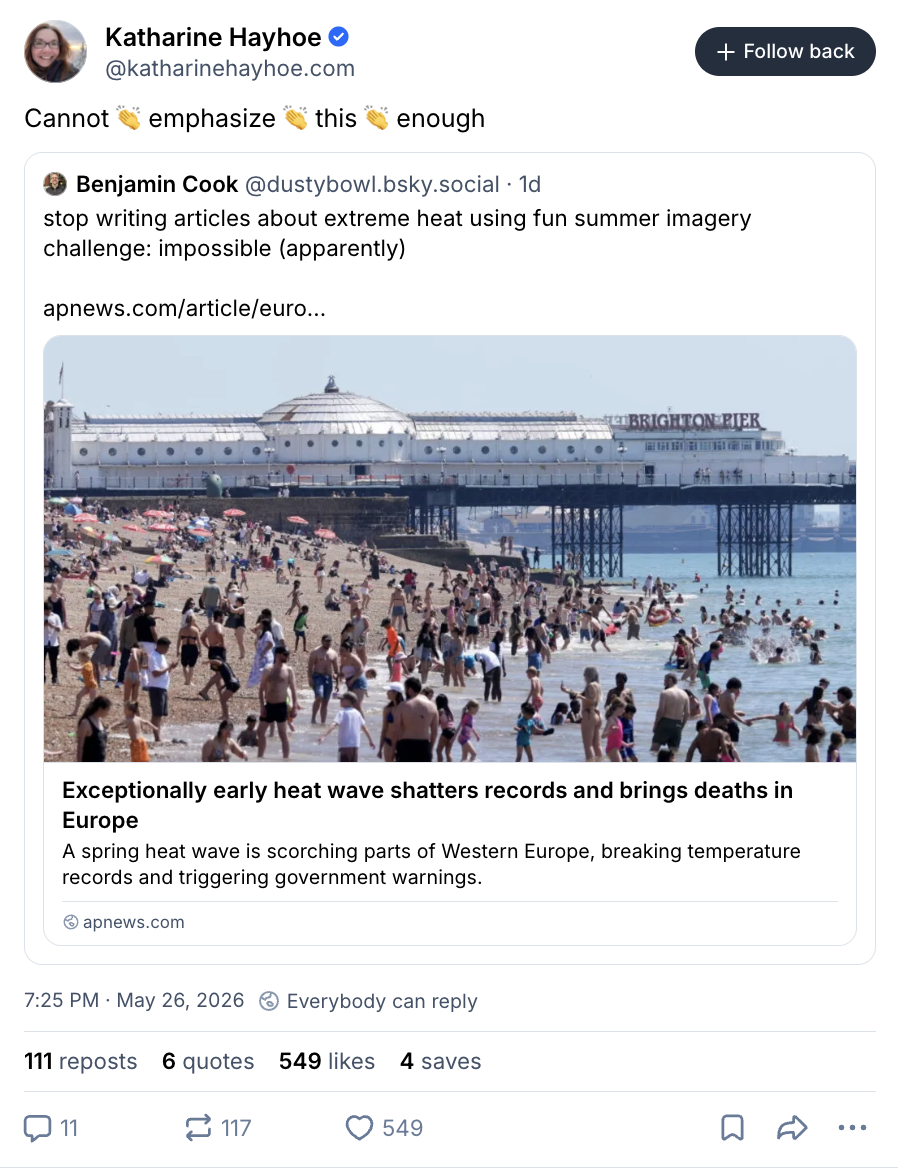
This choice of imagery – and the way right-leaning newspapers in the UK tend to focus on the positive aspects of hot weather – was highlighted by journalist and media critic Mic Wright in a Substack post. He wrote:
“Most British newspapers write about extremely hot weather with the tone of a frog in a boiling pot pretending it’s a jacuzzi.”
Despite blanket news coverage of the record heat in media outlets across western Europe, there has been relatively little commentary from their opinion pages.
No major UK newspapers have published editorials about the heat and there has been no space dedicated to it in the comment sections of the largest French and Spanish newspapers.
One exception in UK media was the Daily Mail’s climate-sceptic columnist Richard Littlejohn writing an article mocking heat-safety measures and warnings issued by the Met Office and the UK Health Security Agency (UKHSA).
In contrast, the Guardian published an article by Bill McGuire, professor emeritus of geophysical and climate hazards at University College London, warning of the dangers facing the UK as extreme heat becomes “the norm”. He wrote:
“We need, then, to face the fact that life in the 2050s is going to be very different from today, and act now. The sooner we recognise this and begin – as a nation – to prepare and adapt accordingly, the better we will be able to meet these enormous challenges to our everyday lives.”
Oliver Duff, editor-in-chief of the i newspaper, wrote that the UK is “emotionally underprepared”, as a nation, for the heat:
“Worries about climate change are forgotten in the giddy determination to enjoy our brief, unreliable summers, whichever month of the year they deign to visit.”
Writing in the Independent, journalist Kat Brown reflected on the Climate Change Committee’s recent advice to the UK government on adapting to climate change. She stressed the need to “take heatwaves seriously”.
James Wallace, chief executive of the charity River Action, was given a guest column in the Daily Express in which he wrote: “As the nation swelters in record-breaking temperatures, England is sleepwalking into a water crisis.”
In reference to water shortages and increasingly extreme weather, Wallace also emphasised that “this is climate breakdown in real time”.



The post Media reaction: UK and Europe’s ‘mind-boggling’ May heat and climate change appeared first on Carbon Brief.
Media reaction: UK and Europe’s ‘mind-boggling’ May heat and climate change

Climate Change
Commencement of NSW Forestry assessment a ‘chance to fix a broken system’ and deliver urgent forest protection
SYDNEY, Friday 18 September 2026 — In response to the Federal and NSW government’s announcement to commence an assessment of NSW forestry under the new national nature laws, Adele Chasson, Nature Policy Lead at Greenpeace Australia Pacific said:
“This is the Federal Government’s chance to fix a broken system that has enabled the destruction of NSW’s precious forests for far too long.
“Native forest logging continues to smash threatened species habitat. In NSW, it is pushing unique wildlife like koalas, greater gliders and glossy black cockatoos towards extinction. The state-owned logging agency has a disastrous record of environmental damage and breaches.
“The Regional Forest Agreement (RFA) system has failed, allowing the industrial logging of special forests for decades across Australia with no oversight. Thankfully, the Federal Government has started the process to finally remove the logging industry’s exemption from national nature laws.
“It’s time for the Federal Government to deliver the protection that forests urgently need, and that Australians overwhelmingly want. The Government must ensure a thorough assessment of the devastating impacts of native forest logging in NSW, and establish strong environmental rules that states must follow.
“These forests have been cared for by First Nations people for tens of thousands of years. They are some of the most biodiverse on the planet, store carbon, clean our air and water. It’s critical we protect them.”
ENDS
Media contact:
Kate O’Callaghan on 0406 231 892 or kate.ocallaghan@greenpeace.org
What happens when a love of marine life meets a playful imagination?
Sydney artist, illustrator and children’s author Sha’an d’Anthes, better known as Furry Little Peach, has teamed up with Greenpeace to create Happy Ocean Happy Planet: a joyful celebration of the extraordinary creatures that call our oceans home.
Sha’an felt inspired to create an illustration celebrating the beauty and resilience of marine life. Its hopeful message, A Happy Ocean is a Happy Planet, sparked a special collaboration with Greenpeace and a limited-edition t-shirt designed to help protect the oceans that inspired it.
The exclusive Furry Little Peach tee is available as a gift to new regular Greenpeace donors who give $30 or more and make at least three donations. By becoming a regular giver, you’ll help Greenpeace campaign for ocean protection.

ARTIST INTERVIEW: Sha’an d’Anthes (Furry Little Peach)
Sha’an shares the story behind the artwork, the local marine creatures featured in the design and why hope can be such a powerful force for action.
Hi Sha’an! Can you tell us a little about yourself and what you do?
My name is Sha’an d’Anthes, I also go by the pseudonym Furry Little Peach and I’m an illustrator, artist and children’s author based in Sydney, Australia. I love creating joyful, vibrant and nostalgic art that looks at the world through the lens of childlike wonder.

What do you love about drawing animals and nature?
I love all of the different shapes, colour and narrative you get to explore when drawing animals and nature. I’m also a city-slicker these days, and so I think that my work is a sort of escapism (for myself and hopefully for my audience).
How did the Greenpeace collaboration come about?
I went to the premiere of David Attenborough’s documentary Ocean, and felt compelled to create something to share the message of the film. This t-shirt is actually based off of that illustration including the tagline in I included when I shared it “A Happy Ocean is a Happy Planet”. I’m so grateful Greenpeace approached me for the project – it was a blast.
Where did you start when creating the Happy Ocean Happy Planet design?
The Happy Ocean tee starts the same as all of my work – with a brainstorm/braindump and really loose concept sketches.
How did you choose the animals for the illustration?
I actually asked Greenpeace to help me with the research of local marine life and they were so accommodating. They very quickly delivered me a huge list of local species of fish, mammals and coral and I just went through and looked up each creature and curated a little group of sea life that I thought would look sweet together – a mix of sizes, types, colours, textures and shapes.
What did you use to create the artwork?
So much of my work is traditional, but when it comes to things like t-shirts I always use digital drawing programs because I like to draw each colour in a separate layer which requires me to jump in and out of layers because it allows me to control colour and printing. When working digitally I always sketch in Procreate (an Australian digital art app), and then with this project I created final art in Adobe Fresco because it called for a vector graphic (an image that can be blown up to any size).
Do you have a favourite creature in the design?
I love painting Humpback Whales and always have, but I also have a soft spot for the sweet little Jelly Blubber jellyfish.
What did you want people to feel when they saw the artwork?
I specifically wanted to focus on the outcome that all of us want to see – a happy, thriving ocean where creatures are given the time and space to balance themselves. I feel that even when tackling tough subjects, leaning into hope is my natural inclination. As long as we have hope that things can be better, we will continue to take action.
What was the most fun part of creating it?
I actually documented the entire process of this project in a studio vlog on YouTube – and you can see how much fun I’m having doing final art jumping between layers and building the image. I had just come off completing final art for two books which are multi-year long projects, so being able to do a project that from start to finish in just a few days was really freeing at the time.
What does a “happy ocean” mean to you?
An ocean that given the time and space to repair and balance itself. Something I really took away from David Attenborough’s Ocean is that ocean ecosystems are actually really good at repairing themselves if we just let them do their thing.
How can people get their hands on the t-shirt?
The shirt is a reward for regular givers to Greenpeace – those who commit to at least 3 months of donations will receive the tee as a gift. Read about how at http://act.gp/flp-tee
How is Greenpeace helping to make our oceans happier places?
They have a deep focus on the health and happiness of our oceans through advocating for the set up of marine sanctuaries, holding big ocean polluters to account and calling for a ban on deep sea mining.
What are you working on next?
I will be jumping headfirst into Peachtober – an annual daily art challenge I run each year in October, if there are any artists reading this it’s a great time so please come join! In terms of publications my next picture book The Late Bird will be out in February 2027 (published by Harper Collins US) and then I have an creative activity book for adults coming out next August with Chronicle US and Penguin Australia. Otherwise you can always check out what I’m tinkering away with in my studio on Instagram and YouTube.

Climate Change
AI giant Anthropic’s first Australian data centre deal an “egregious” example of Big Tech double talk
SYDNEY, Thursday 17 September 2026 — Greenpeace Australia Pacific has slammed AI giant Anthropic’s deal for its first Australian site in Queensland’s Western Downs, the heart of coal seam gas country, saying the project will entrench gas and turbocharge climate pollution.
The expected electricity demand from the data centre site, situated in the middle of the Western Downs coal seam gas fields, is comparable to 1.5 million Australian households. Greenpeace’s report Energy Vampires: The AI data centres draining Australia called for a moratorium on frenzied data centre development until appropriate guardrails are in place.
Joe Rafalowicz, Head of Climate and Energy at Greenpeace Australia Pacific, said: “This is an egregious example of Big Tech giants being given carte blanche to drain energy and water, and use polluting gas to fuel their hyperscale data centres.
“AI and Big Tech corporations claim to bring new renewable energy to the grid, while blatantly planning to power their operations with polluting fossil fuels.
“Planning documents show the first stage of this behemoth project could be powered by ‘behind the metre’ gas — the same playbook AI companies have used in the US, leading to a 20% increase in climate pollution from electricity. Now these companies want to bring their cowboy plans to Australia and the Federal Government is allowing it.
“If they plugged into the local grid, the power required would increase Queensland’s electricity grid emissions by around 6.6 million tonnes — an 18% rise. If they build their own gas-fired power plants, this will drive up Queensland’s emissions even more.
“Billions of dollars are now pouring into a massive pipeline of proposed new data centres, of unprecedented size, being built at incredible speed across the country. Australians should be worried about the extreme lack of scrutiny being applied to these projects, and the corporations leading the data centre charge.
“The data centre build-out is happening without the endorsement of the Australian people, yet we are the ones who will pay the price. We can not allow unchecked data centre expansion to derail our renewable energy transition, entrench gas and turbocharge climate pollution — that’s why Greenpeace has called for an urgent moratorium until appropriate guardrails are in place.”
ENDS
Media contact: Kate O’Callaghan on 0406 231 892 or kate.ocallaghan@greenpeace.org



-

 Greenhouse Gases2 years ago
嘉宾来稿:满足中国增长的用电需求 光伏加储能“比新建煤电更实惠”
-
Climate Change1 year ago
Guest post: Why China is still building new coal – and when it might stop
-
Greenhouse Gases1 year ago
Guest post: Why China is still building new coal – and when it might stop
-

 Climate Change2 years ago
嘉宾来稿:满足中国增长的用电需求 光伏加储能“比新建煤电更实惠”
-

 Renewable Energy11 months ago
Sending Progressive Philanthropist George Soros to Prison?
-
Climate Change2 years ago
Bill Discounting Climate Change in Florida’s Energy Policy Awaits DeSantis’ Approval
-
Greenhouse Gases1 year ago
嘉宾来稿:探究火山喷发如何影响气候预测
-

 Carbon Footprint2 years ago
US SEC’s Climate Disclosure Rules Spur Renewed Interest in Carbon Credits